


Introduction: Why This Matters
In my experience explaining chirality to curious beginners, the analogy that works best is the handshake. Your right hand fits comfortably into a right-handed glove. Try the same with your left hand, and it’s awkward, wrong, unusable. Molecules work the same way. Many of them exist in two mirror-image forms—called enantiomers—and the biological machinery in your body is built to recognize only one of them.
This is not a minor curiosity. It’s one of the deepest mysteries in the chemistry of life. When chemists synthesize molecules in a lab, they almost always get a 50/50 mix of both mirror images. But life doesn’t do that. Your proteins are built from left-handed amino acids. Your DNA uses right-handed sugars. Nature is “homochiral”—literally “same-handed”—and nobody has ever fully explained why or how this came to be.
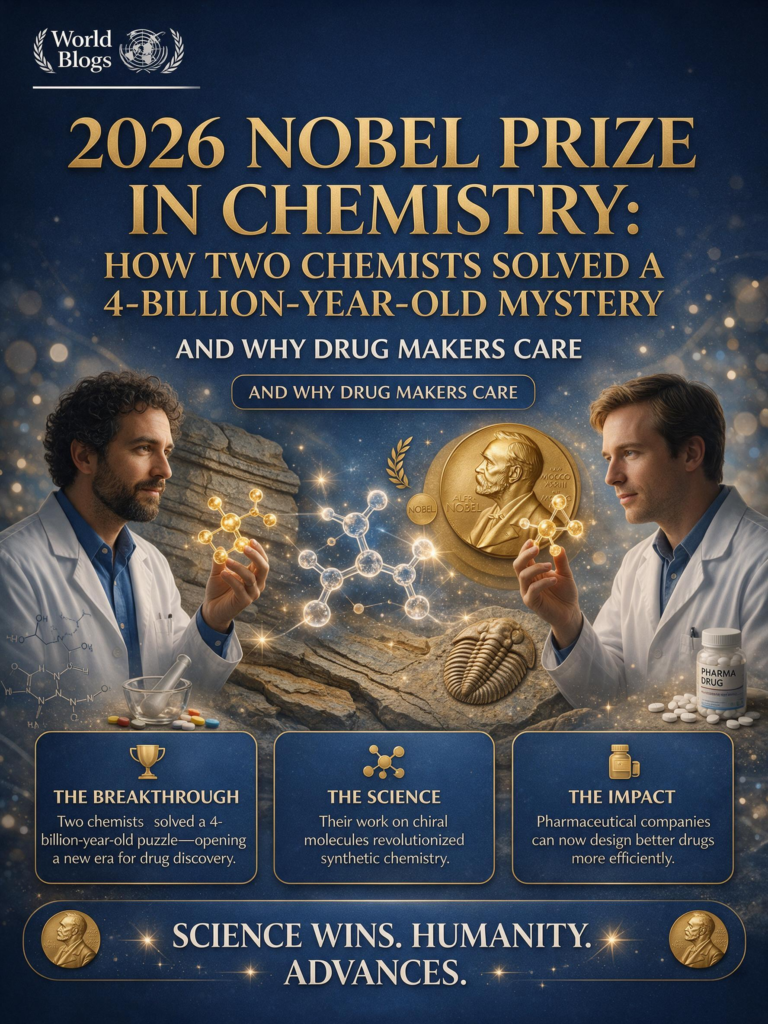
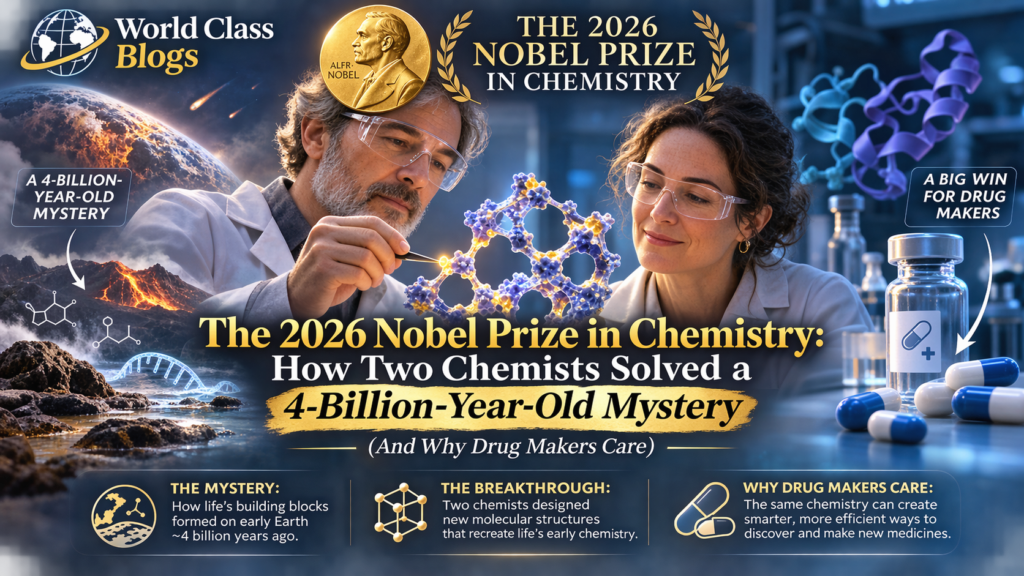
On October 7, 2026, the Royal Swedish Academy of Sciences awarded the Nobel Prize in Chemistry to Henri B. Kagan and Kenso Soai “for the discovery of non-linear effects and autocatalysis in asymmetric organic synthesis” . Their work didn’t just answer a theoretical question. It gave chemists a practical toolkit for making one mirror image without the other—a capability that directly affects how we manufacture pharmaceuticals, flavors, scents, and agricultural chemicals .
What I’ve found, following this field for years, is that the Soai reaction in particular is one of those rare experiments that feels almost magical the first time you see it described. A reaction that starts with a tiny imbalance—a few molecules more of one hand than the other—and amplifies that imbalance until almost the entire product is one mirror image. It’s the closest anyone has come to recreating, in a flask, the moment life chose a handedness.
Key Takeaways (at a glance):
- The 2026 Nobel Prize in Chemistry went to Henri Kagan and Kenso Soai for discoveries enabling chemists to create one mirror image of a molecule without the other .
- Kagan discovered non-linear effects in asymmetric catalysis in 1986, showing that small excesses of a chiral catalyst could produce disproportionately large excesses of one product enantiomer .
- Soai designed the first chemical reaction that produces essentially only one mirror image, published in 2003—a feat previously achieved only by life itself .
- The work is directly relevant to drug manufacturing, where one enantiomer can be therapeutic and the other harmful.
- The discoveries provide the strongest experimental evidence yet for how homochirality could have emerged spontaneously on early Earth.
Background / Context: Why Mirror Images Matter
To understand why this prize matters, you need to understand why chemists care about handedness in the first place.
Many organic molecules—molecules built on carbon—exist as pairs of enantiomers. These pairs have identical chemical formulas and identical physical properties in most respects. They differ only in their three-dimensional arrangement, like a left hand and a right hand. This subtle difference becomes critically important when these molecules interact with other chiral systems—like the receptors and enzymes in your body .
The most infamous example is thalidomide. In the late 1950s and early 1960s, thalidomide was prescribed as a sedative for pregnant women. One enantiomer had the desired calming effect. The other caused severe birth defects. The drug was sold as a racemic mixture—both hands together—and the consequences were devastating. This tragedy cemented the importance of enantioselective synthesis: the ability to make one mirror image cleanly, without the other.
But nature’s homochirality runs deeper than pharmacology. Every living system on Earth uses only one handedness of amino acids and sugars. Why? The origin of this bias is one of the great unsolved questions in the chemistry of life. Louis Pasteur first posed it in the 19th century . The 2026 laureates didn’t fully answer why it happened on early Earth, but they demonstrated how it could happen: a small initial imbalance, amplified by autocatalysis, can snowball into near-total homochirality .
Key Concepts Defined (For Beginners and Refreshers)
Chirality: The property of a molecule that makes it non-superimposable on its mirror image. Named after the Greek word for hand. A chiral molecule and its mirror image are called enantiomers.
Enantiomer: One of two mirror-image forms of a chiral molecule. Enantiomers have identical physical properties except for how they rotate polarized light and how they interact with other chiral molecules.
Racemic Mixture: A 50/50 mixture of both enantiomers. Most laboratory syntheses of chiral molecules produce racemic mixtures unless special techniques are used.
Asymmetric Catalysis: A chemical reaction in which a chiral catalyst preferentially produces one enantiomer over the other. This is the standard industrial approach to making single-enantiomer drugs.
Non-Linear Effect: Kagan’s key discovery. In some asymmetric reactions, the enantiomeric excess of the product is not simply proportional to the enantiomeric excess of the catalyst. A small excess of catalyst can produce a much larger excess of product—or, in some cases, a smaller excess. This non-linearity reveals complex interactions between catalyst molecules .
Autocatalysis: A reaction in which the product catalyzes its own formation. In the Soai reaction, the chiral product accelerates the production of more of itself, preferentially the same enantiomer. This is the mechanism that amplifies tiny imbalances into near-total homochirality .
Homochirality: The state of having a single handedness. Life is homochiral. The Soai reaction is the first laboratory demonstration of a chemical system that can achieve homochirality from a nearly racemic starting point .
How It Works: Step-by-Step Breakdown

Step 1: Kagan’s Non-Linear Discovery (1986)
Before Kagan, chemists assumed that if you used a catalyst that was, say, 10% enriched in one enantiomer, you’d get a product that was also about 10% enriched. Kagan showed this wasn’t necessarily true. In certain reactions, the relationship between catalyst excess and product excess is non-linear. A 10% catalyst excess might produce a 50% product excess—or a 2% product excess, depending on the system .
The explanation lies in how chiral catalyst molecules interact with each other. Chiral molecules can form dimers and higher aggregates, and the behavior of these aggregates depends on whether the partners are the same enantiomer (homochiral) or opposite (heterochiral). Kagan’s work revealed that these interactions can dramatically amplify or suppress the enantioselectivity of a reaction .
This was a fundamental insight: the relationship between catalyst and product handedness is not linear, and that non-linearity can be exploited.
Step 2: Soai’s Autocatalytic Reaction (1995–2003)
Kenso Soai took the next step. Starting in the mid-1990s, he began publishing work on a reaction involving pyrimidyl alcohols that showed something remarkable: the product of the reaction catalyzed its own formation, and it did so enantioselectively . A tiny excess of one enantiomer in the starting mixture would lead to a much larger excess in the product.
In 2003, Soai published the culmination of this work: a reaction that produced essentially only one enantiomer from a starting mixture that was nearly racemic. As the Nobel Committee put it, “Other than life itself, no one had previously achieved this feat” .
The mechanism is autocatalysis combined with non-linear effects. The product molecules associate into dimers and larger clusters. Homochiral clusters—those made of the same enantiomer—catalyze the formation of more of that enantiomer. Heterochiral clusters are catalytically inactive or less active. The result is a positive feedback loop: the more of one enantiomer you make, the faster you make more of it, and the slower you make the other .
Step 3: Why This Matters for Drug Manufacturing
The practical consequence of these discoveries is that chemists now have a framework for designing reactions that produce single enantiomers efficiently. In pharmaceutical manufacturing, this is not optional. Regulatory agencies require that chiral drugs be manufactured with strict control over enantiomeric purity, because the wrong enantiomer can be inactive or harmful .
Kagan’s and Soai’s work provided the theoretical understanding and experimental demonstrations that underpin modern enantioselective synthesis. The Nobel Committee’s representative noted that “there’s a huge number of drug molecules that are used by incorporating what they have developed” .
Step 4: The Origin-of-Life Connection
The Soai reaction is also the best experimental model we have for how homochirality might have emerged on early Earth. If a small imbalance of one enantiomer existed—perhaps caused by circularly polarized light, or by crystallization on a chiral mineral surface—autocatalysis could have amplified it. Over time, one handedness would dominate .
The Nobel Committee emphasized that this is not a claim about how life actually originated. It’s a demonstration that the amplification of a small imbalance is chemically possible. As committee member Peter Somfai put it: “We have for the first time mimicked it” .
Why It’s Important
Pharmaceutical Purity
The most immediate impact is in drug manufacturing. Many modern drugs are chiral, and the difference between the therapeutic enantiomer and its mirror image can be the difference between healing and harm. The tools and understanding developed by Kagan and Soai allow chemists to design reactions that produce the desired enantiomer with high selectivity, reducing waste and improving safety .
The Origin of Life
The homochirality of life is one of the most striking features of biology. Every amino acid in your body is left-handed. Every sugar in your DNA is right-handed. Why? The 2026 Nobel Prize doesn’t answer that question definitively, but it provides a plausible chemical mechanism for how the asymmetry could have arisen and amplified. It’s a bridge between prebiotic chemistry and biology .
Fundamental Understanding of Catalysis
Kagan’s discovery of non-linear effects changed how chemists think about catalysis. The assumption that catalyst and product selectivity are linearly related is intuitive but wrong in many important cases. Understanding why—and how—has led to better catalysts and better reaction design across organic chemistry.
A Century-Old Puzzle, Solved (at Least Partly)
Pasteur first recognized the chirality of life in the 1840s. It took nearly two centuries to find a chemical system that could spontaneously amplify a tiny enantiomeric imbalance into near-total homochirality. The Soai reaction is that system. It’s a landmark in the chemistry of life .
Sustainability in the Future

Enantioselective synthesis is inherently more sustainable than making a racemic mixture and separating it. If you can produce only the enantiomer you need, you waste less material, consume less energy, and generate less chemical waste. The pharmaceutical industry has strong incentives to adopt these methods, both for regulatory compliance and for cost reduction.
The Soai reaction itself uses relatively simple reagents and operates under mild conditions. It’s not a practical manufacturing process in its current form—it’s a demonstration of a principle—but it points toward a future where autocatalytic amplification could be used to make chiral products with minimal input.
There’s also a sustainability angle in the origin-of-life research. Understanding how homochirality emerged could inform our understanding of how life itself emerged, which in turn informs how we think about life’s fragility and resilience. That’s a long-term payoff, not an immediate one, but it’s part of the broader value of fundamental chemistry.
Common Misconceptions
Misconception #1: “The Nobel Prize was awarded for discovering the origin of life.”
No. The prize was awarded for discovering non-linear effects and autocatalysis in asymmetric synthesis. These discoveries provide a possible mechanism for how homochirality could have emerged, but they do not claim to explain how life actually originated. The Nobel Committee was careful to emphasize this distinction .
Misconception #2: “Kagan and Soai worked together.”
They didn’t. Kagan made his key discovery in 1986 at Université Paris-Sud. Soai built on related ideas independently in Japan, publishing his autocatalytic reaction in the 1990s and achieving near-total homochirality in 2003. The Nobel recognizes both contributions to the same problem .
Misconception #3: “The Soai reaction produces 100% pure enantiomer.”
It produces essentially only one enantiomer, but “essentially” is doing some work there. The reaction can achieve extremely high enantiomeric excess, but it’s not perfect in every run. The significance is that it amplifies a tiny initial imbalance into a dominant product, not that it achieves absolute purity .
Misconception #4: “This is just theoretical chemistry with no practical use.”
The opposite is true. Enantioselective synthesis is a multi-billion-dollar industrial problem. Every chiral drug on the market—and there are hundreds—requires a strategy for controlling enantiomeric purity. Kagan’s and Soai’s work provides the conceptual foundation for many of those strategies .
Recent Developments (2025–2026)
The Nobel announcement itself is the headline development. But the field of asymmetric synthesis has been advancing steadily alongside it.
The Nobel Prize and Public Understanding
The Nobel Committee’s educational materials for 2026 are unusually clear and accessible, explaining chirality through the hand analogy and walking through the history of the problem from Pasteur to Soai . This reflects a broader effort to communicate the importance of fundamental chemistry to the public.
Drug Manufacturing Applications
The pharmaceutical industry continues to invest heavily in enantioselective synthesis. While the Nobel Committee didn’t single out a specific drug made using Kagan’s or Soai’s methods, the committee member noted that “there’s a huge number of drug molecules that are used by incorporating what they have developed” . The practical impact is diffuse but pervasive.
Origin-of-Life Research
The Soai reaction remains a touchstone for origin-of-life researchers. Recent work has explored how the reaction might have been triggered by environmental factors—circularly polarized light, chiral minerals, or prebiotic amino acids. The Nobel Prize has brought renewed attention to this line of inquiry .
Success Stories: The Soai Reaction as a Landmark Experiment
The 2003 Publication
The paper that described the first near-total homochiral reaction is one of the most cited in organic chemistry. It demonstrated something that many chemists had thought impossible: a simple chemical system that could spontaneously amplify a tiny enantiomeric excess into a dominant product. The reaction is now taught in advanced organic chemistry courses as a classic example of autocatalysis and non-linear effects .
Kagan’s 1986 Paper
Kagan’s discovery of non-linear effects was initially met with skepticism. The idea that catalyst selectivity could be non-linear seemed counterintuitive. But the experimental evidence was clear, and the theoretical framework that emerged—based on chiral aggregation—is now standard .
The Thalidomide Legacy
The thalidomide tragedy is the dark backdrop against which the importance of enantioselective synthesis is measured. The 2026 Nobel Prize doesn’t erase that history, but it represents a step toward ensuring that future drugs are made with the precision that the tragedy revealed to be necessary.
Real-Life Examples: What This Looks Like in Practice
The Handshake Test
Imagine you’re a chemist designing a new drug. You’ve synthesized a chiral molecule, and you’ve got a 50/50 mix of enantiomers. You need the left-handed version only. How do you get it?
Option 1: Separate them. This is expensive and wasteful—you throw away half your product.
Option 2: Use an asymmetric catalyst that preferentially makes the left-handed version. Kagan’s work on non-linear effects helps you understand how much excess you need in your catalyst, and why a small excess might be enough—or might not be.
Option 3: Use an autocatalytic system like Soai’s, where the product itself drives the reaction toward one handedness. This is the dream scenario: a reaction that corrects its own imbalance as it proceeds.
The Amplification Experiment
In a typical Soai reaction demonstration, you start with a pyrimidyl alcohol that is, say, 0.1% enriched in one enantiomer. You add the reagents and let the reaction run. When you analyze the product, you find that it’s not 0.1% enriched—it’s 90% or more enriched in the same enantiomer. The reaction has amplified the initial bias by a factor of nearly a thousand .
This is the kind of result that makes chemists sit up and pay attention. It’s not just a reaction. It’s a proof of principle that asymmetry can be self-reinforcing.
What the Nobel Committee Said
At the announcement, the committee emphasized the practical dimension: “Their discoveries have been decisive for chemists who design reactions for the manufacture of pharmaceuticals” . The prize is not just for a curiosity. It’s for a body of work that changed how chemists make molecules that matter.
Conclusion and Key Takeaways

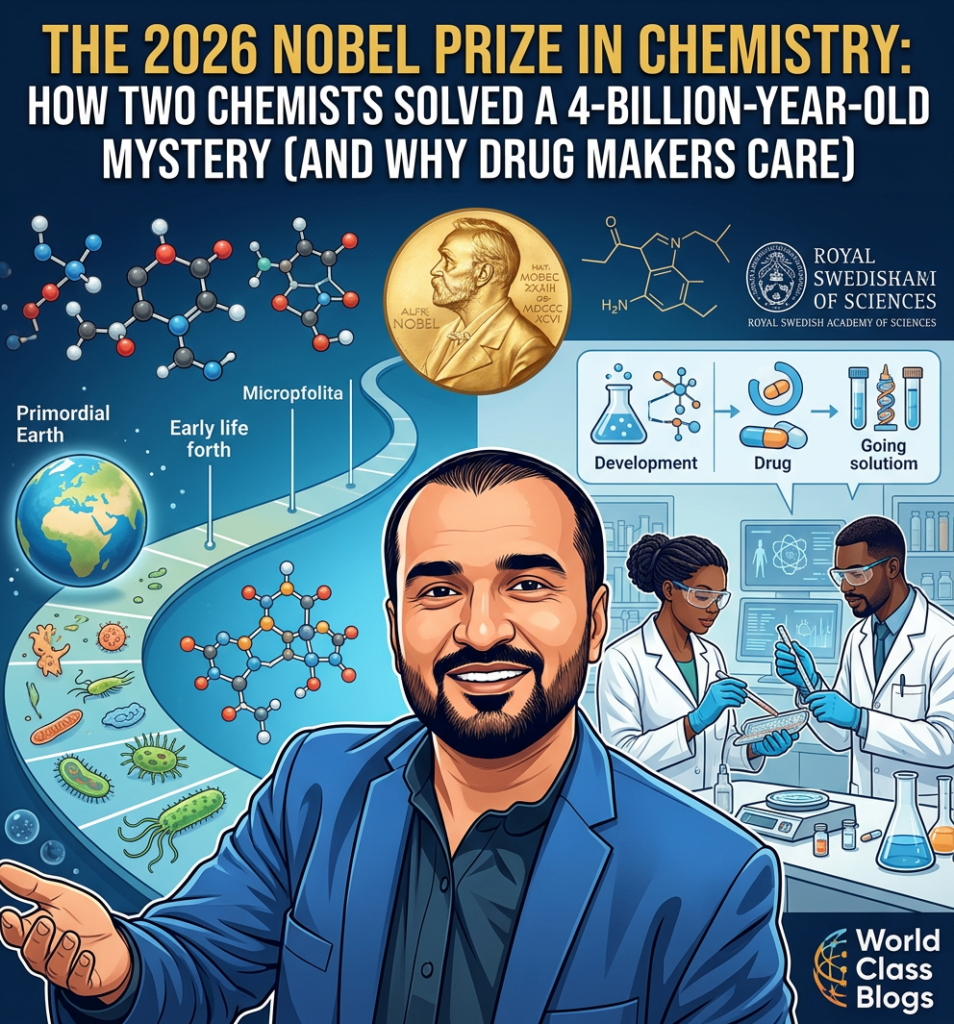
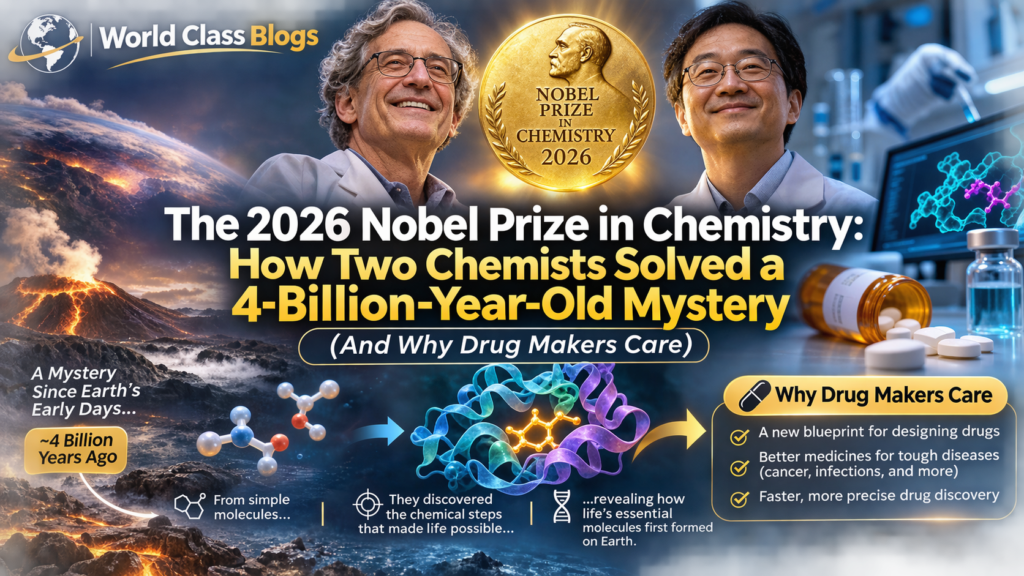
The 2026 Nobel Prize in Chemistry recognizes a solution to a puzzle that has fascinated chemists since Pasteur: why is life one-handed, and how could that handedness have arisen? Kagan and Soai didn’t answer the “why” completely, but they showed how. A small imbalance, amplified by non-linear effects and autocatalysis, can become a dominant handedness. The Soai reaction is the first chemical system outside of biology to achieve this.
For curious beginners, the lesson is that chemistry is not just about mixing things together and seeing what happens. It’s about understanding the subtle rules that govern how molecules interact—and using those rules to build things that nature builds, but with human intentions.
For professionals, the prize is a reminder that fundamental discoveries in reaction mechanisms can have enormous practical consequences. The pharmaceutical industry depends on the ability to make single enantiomers, and that ability rests on the conceptual foundations laid by Kagan and Soai.
Key Takeaways:
- Henri Kagan and Kenso Soai won the 2026 Nobel Prize in Chemistry for non-linear effects and autocatalysis in asymmetric synthesis .
- Kagan discovered that catalyst selectivity can be non-linear—small excesses can produce large product excesses, or the reverse .
- Soai designed the first reaction that produces essentially only one enantiomer from a nearly racemic mixture, published in 2003 .
- The work enables more efficient manufacturing of single-enantiomer drugs and provides a model for how homochirality could have emerged on early Earth .
- The Soai reaction is a landmark experiment in organic chemistry and a touchstone for origin-of-life research.
Frequently Asked Questions (FAQ’s)
1. What exactly did Kagan and Soai win the Nobel Prize for?
The citation reads “for the discovery of non-linear effects and autocatalysis in asymmetric organic synthesis” . In plain terms: they discovered how to control chemical reactions so that one mirror image of a molecule is produced preferentially over the other, and they showed how this preference can amplify itself.
2. What is a mirror image molecule?
Many organic molecules exist in two forms that are mirror images of each other, like a left hand and a right hand. These are called enantiomers. They have the same chemical formula but different three-dimensional shapes .
3. Why does it matter which mirror image a drug uses?
Because the body’s receptors and enzymes are themselves chiral. One enantiomer of a drug may fit a receptor and produce a therapeutic effect, while the other may not fit—or may fit a different receptor and cause side effects. The thalidomide tragedy is the most famous example of the dangers of not controlling enantiomeric purity .
4. What is a non-linear effect?
It’s a relationship between the enantiomeric excess of a catalyst and the enantiomeric excess of the product that is not proportional. A catalyst that is 10% enriched might produce a product that is 50% enriched, or 5% enriched. Kagan discovered this in 1986 and explained it through chiral aggregation .
5. What is autocatalysis?
Autocatalysis is when a reaction product catalyzes its own formation. In the Soai reaction, the chiral product accelerates the production of more of itself, preferentially the same enantiomer. This creates a positive feedback loop that amplifies small imbalances .
6. What is the Soai reaction?
It’s a chemical reaction involving pyrimidyl alcohols that, under the right conditions, produces essentially only one enantiomer from a starting mixture that is nearly racemic. It was first published in 1995 and achieved near-total homochirality in 2003 .
7. Did Soai really achieve 100% enantiomeric excess?
Not exactly 100%, but “essentially only one” enantiomer. The reaction can achieve very high enantiomeric excess, but the significance is the amplification principle, not absolute purity .
8. How is this related to the origin of life?
Life is homochiral—it uses only one handedness of amino acids and sugars. The Soai reaction is the first laboratory system that can spontaneously amplify a tiny imbalance into a dominant handedness, providing a plausible mechanism for how homochirality could have emerged on early Earth .
9. Did Kagan and Soai work together?
No. Kagan made his key discovery in 1986 in France. Soai built on related ideas independently in Japan, publishing his autocatalytic reaction in the 1990s and achieving near-total homochirality in 2003. The Nobel recognizes both contributions .
10. When was Kagan’s key paper published?
1986, in the Journal of the American Chemical Society. The paper described non-linear effects in asymmetric catalysis .
11. When was Soai’s key paper published?
The 1995 paper described the first highly enantioselective autocatalytic reaction. The 2003 paper demonstrated near-total homochirality .
12. What is asymmetric catalysis?
It’s a chemical reaction in which a chiral catalyst selectively produces one enantiomer of a chiral product. It’s the standard industrial method for making single-enantiomer drugs.
13. How does this affect drug manufacturing?
Regulatory agencies require chiral drugs to be manufactured with controlled enantiomeric purity. The understanding of non-linear effects and autocatalysis helps chemists design reactions that produce the desired enantiomer efficiently, reducing waste and improving safety .
14. What is a racemic mixture?
A 50/50 mixture of both enantiomers. Most laboratory syntheses produce racemic mixtures unless special techniques are used.
15. What is enantiomeric excess?
A measure of how much one enantiomer predominates over the other. A 90% enantiomeric excess means the mixture is 95% of one enantiomer and 5% of the other.
16. Why did the Nobel Committee say this solves a “century-old mystery”?
Pasteur first recognized the chirality of life in the 1840s. The question of how homochirality could have emerged spontaneously remained unanswered for over a century. Kagan and Soai provided a chemical mechanism .
17. Does the Soai reaction prove how life originated?
No. It demonstrates a plausible mechanism for the amplification of chirality, but it does not claim to reproduce the exact conditions of early Earth. As the Nobel Committee emphasized, it’s a mimic, not a replay .
18. What is chiral aggregation?
Chiral molecules can associate into pairs (dimers) or larger clusters. Homochiral aggregates (same enantiomer) and heterochiral aggregates (opposite enantiomers) can have different catalytic properties. This is the basis of Kagan’s non-linear effects .
19. Is the Soai reaction useful for manufacturing?
Not directly in its current form. It’s a demonstration of a principle. But the understanding it provides informs the design of practical asymmetric reactions.
20. What is the connection to the 2026 Nobel Prize in Medicine?
There is no direct connection. The Medicine Prize went to optogenetics (Deisseroth, Hegemann, Nagel) . The Chemistry Prize is separate.
21. What are the practical applications of this work?
Pharmaceutical manufacturing, flavors, scents, and agricultural chemicals. The Nobel Committee noted that “a huge number of drug molecules” incorporate methods developed by the laureates .
22. How long did it take for Kagan’s discovery to be accepted?
Kagan’s 1986 paper was initially met with skepticism because non-linear effects seemed counterintuitive. The experimental evidence was clear, and the theoretical framework based on chiral aggregation is now standard .
23. What should a beginner read to learn more?
The Nobel Prize’s popular information materials for 2026 are excellent and accessible . For a deeper dive, the original papers (Kagan 1986, Soai 1995 and 2003) are the primary sources.
24. What is the biggest open question in this field?
The origin of homochirality on Earth is still not definitively explained. The Soai reaction shows that amplification is possible, but which environmental factor (circularly polarized light, chiral minerals, etc.) actually triggered it in prebiotic chemistry remains unknown.
25. Could this research lead to new drugs?
It already has. The methods and understanding developed by Kagan and Soai are used throughout the pharmaceutical industry. Specific new drugs are constantly being developed using enantioselective synthesis.
26. Why did the Nobel Committee choose this prize in 2026?
The committee recognized that Kagan and Soai solved a fundamental problem in chemistry with direct practical relevance. The prize honors both the intellectual achievement and the practical impact .
27. What’s the most surprising thing about the Soai reaction?
For me, it’s that a simple chemical system can exhibit behavior that looks, at first glance, like biological self-organization. A reaction that “chooses” a handedness and then amplifies that choice is a striking example of how complexity can emerge from simple rules.
About Author
Sana Ullah Khan Kakar is a science writer and former aerospace systems engineer with a focus on planetary science and space technology. He has contributed to World Class Blogs since 2023, covering topics ranging from asteroid defense to fusion energy, quantum computing, and fundamental chemistry. Alex holds a B.S. in Aerospace Engineering from Georgia Tech and an M.S. in Science Communication from MIT. He lives in Tucson, Arizona, where he volunteers as an amateur astronomer and occultation observer. You can reach him through the World Class Blogs contact page.
Disclosure: Alex has no financial interest in any company or mission mentioned in this article. All opinions are his own.
Free Resources
- Nobel Prize Popular Information (Chemistry 2026): The official educational materials explaining chirality, non-linear effects, and autocatalysis for general audiences. (nobelprize.org)
- Nobel Prize Lessons (Chemistry 2026): Ready-to-use presentation materials for teachers and students. (nobelprize.org)
- ACS Publications Chemistry Blog: Commentary and paper citations for Kagan’s and Soai’s work. [Link: https://axial.acs.org/multidisciplinary/nobel-prize-chemistry-2026]
- World Class Blogs Technology & Innovation Archive: For related coverage on physics, chemistry, and materials science. [Link: https://worldclassblogs.com/category/technology-innovation/artificial-intelligence-machine-learning/]
- Sherakat Network SEO Guide: For readers interested in how science communication reaches audiences online. [Link: https://sherakatnetwork.com/category/seo]
- The Daily Explainer Mental Health Guide: For readers interested in the intersection of chemistry, neuroscience, and well-being. [Link: https://thedailyexplainer.com/mental-health-the-complete-guide-to-psychological-wellbeing-in-the-modern-world/]
Discussion
What questions do you have about chirality, the Soai reaction, or the 2026 Nobel Prize in Chemistry? Have you encountered the thalidomide story in your own reading? Share your thoughts in the comments below. I read every comment and try to respond within 48 hours.
For more science and frontier coverage, explore the World Class Blogs Our Focus section and the full Blog archive. If you’re interested in contributing a guest post or suggesting a topic, please contact us.


