


Introduction: Why This Matters
In my experience explaining neutrino astronomy to curious beginners, the hardest part isn’t the physics—it’s the scale. People can picture a telescope on a mountain. They can picture a satellite in orbit. But a telescope made of a cubic kilometer of Antarctic ice, buried a mile deep, designed to catch particles that pass through the entire Earth without noticing? That strains the imagination in a way that few scientific instruments do.
On October 6, 2026, the Royal Swedish Academy of Sciences awarded the Nobel Prize in Physics to Francis Halzen “for decisive contributions to the IceCube Neutrino Observatory and the discovery of high-energy neutrinos of astrophysical origin” . The prize recognized something that began as a risky idea in 1988—that the clear, stable ice at the South Pole could be transformed into a detector for the most elusive particles in the universe .
What I’ve found, covering physics breakthroughs for general audiences, is that the real significance of this Nobel isn’t just the hardware. It’s the proof of a concept: that neutrinos can be used as astronomical messengers, carrying information from cosmic accelerators so violent and so distant that no light can escape them. For professionals needing a refresher, the award validates decades of instrument development and data analysis. For curious beginners, it opens a window into a kind of astronomy that doesn’t look at light at all.
Key Takeaways (at a glance):
- The 2026 Nobel Prize in Physics went to Francis Halzen for conceiving, building, and leading the IceCube Neutrino Observatory.
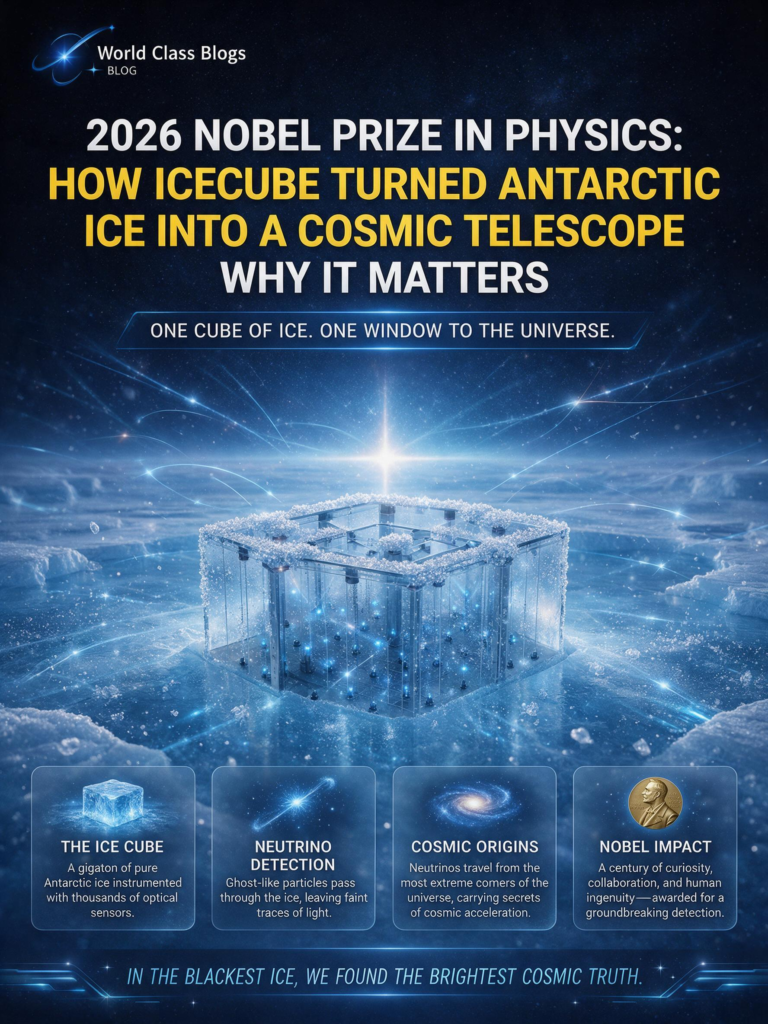
- IceCube uses 5,160 light sensors on 86 strings, frozen into a cubic kilometer of Antarctic ice between 1,450 and 2,450 meters deep .
- In 2013, IceCube made the first detection of high-energy astrophysical neutrinos—particles from outside our solar system .
- The observatory has since detected neutrinos from the Milky Way and identified candidate sources, opening a new field of “neutrino astronomy.”
- An upgrade, IceCube-Gen2, is planned for 2033 and will cover eight cubic kilometers, detecting ten times as many neutrinos .
Background / Context: Why Build a Telescope Out of Ice?
The idea sounds absurd until you understand the problem. Cosmic rays—high-energy protons and atomic nuclei—bombard Earth constantly. Some carry energies millions of times greater than anything the Large Hadron Collider can produce. But cosmic rays are electrically charged, which means their paths through space are bent by magnetic fields. By the time they reach us, we have no idea where they came from. They’ve lost their address .
Neutrinos solve this problem. They’re electrically neutral, nearly massless, and interact so weakly with matter that they can travel across the universe in a straight line, passing through gas, dust, stars, and planets without being deflected or absorbed. If a cosmic ray collides with matter or radiation near its source, it can produce neutrinos. Those neutrinos escape and travel to Earth, carrying directional information that no other messenger can provide .
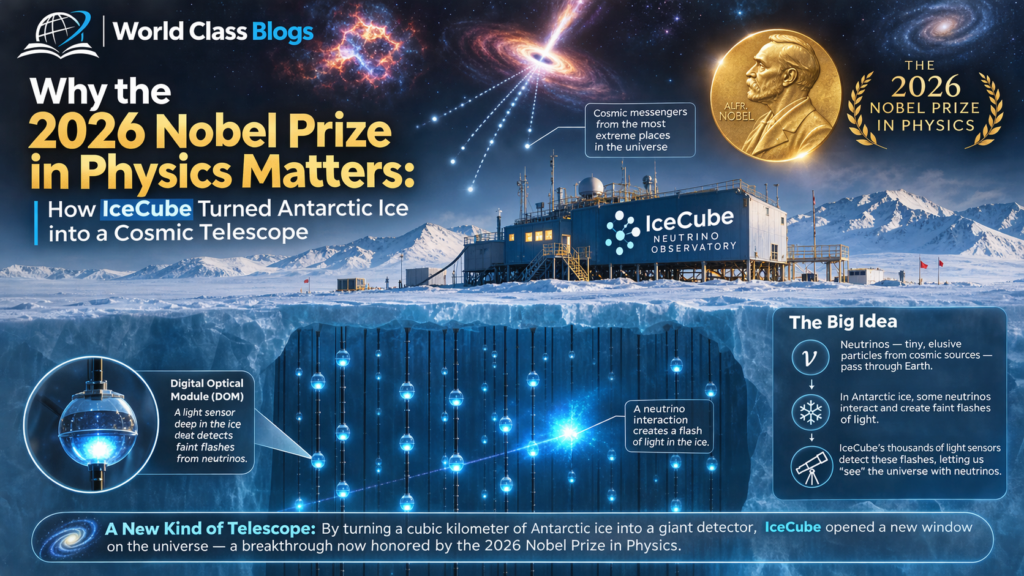
The catch is that neutrinos are so weakly interacting that you need an enormous detector to catch even a few. Halzen’s insight, first presented in 1988, was that Antarctic ice could serve as both the target and the detection medium . When a neutrino happens to collide with a nucleus in the ice, it produces charged particles that emit Cherenkov radiation—a faint blue glow. If you instrument enough ice with light sensors, you can reconstruct the direction and energy of the original neutrino .
The predecessor to IceCube, a project called AMANDA, proved the concept in the 1990s and early 2000s. But AMANDA was too small to detect the high-energy cosmic neutrinos everyone wanted to find. IceCube was the scale-up: a full cubic kilometer, completed in 2011 .
Key Concepts Defined (For Beginners and Refreshers)
Neutrino: A fundamental particle with no electric charge and an almost negligible mass. Neutrinos are produced in radioactive decay, nuclear fusion, and high-energy cosmic processes. Trillions pass through your body every second without interacting .
Cherenkov Radiation: When a charged particle travels through a medium faster than light travels in that medium, it emits a cone of blue light. This is the optical signature IceCube detects. The ice at the South Pole is exceptionally transparent below about 1,400 meters, allowing Cherenkov light to travel hundreds of meters before being absorbed .
Digital Optical Module (DOM): The basic sensor unit of IceCube. Each DOM is a glass sphere containing a 10-inch photomultiplier tube and electronics that digitize the signal with nanosecond timing precision. There are 5,160 DOMs in total .
String: A cable holding 60 DOMs, deployed into a hole melted in the ice with hot water. IceCube has 86 strings .
Track vs. Cascade: IceCube sees two main event patterns. A track is a long trail of light produced when a muon neutrino interacts and creates a muon that travels through the ice. Tracks point back to their sources with better than one-degree resolution. A cascade is a more spherical flash produced by electron or tau neutrino interactions. Cascades give better energy measurements but poorer directional information .
Astrophysical Neutrino: A neutrino produced by a cosmic source (a black hole, a supernova, a galaxy) rather than by cosmic-ray interactions in Earth’s atmosphere. Distinguishing astrophysical neutrinos from atmospheric background is the central challenge of neutrino astronomy .
How It Works: Step-by-Step Breakdown

Let’s walk through the entire chain—from construction to discovery—so you can see how a cubic kilometer of ice becomes a working telescope.
Step 1: Drilling and Deployment
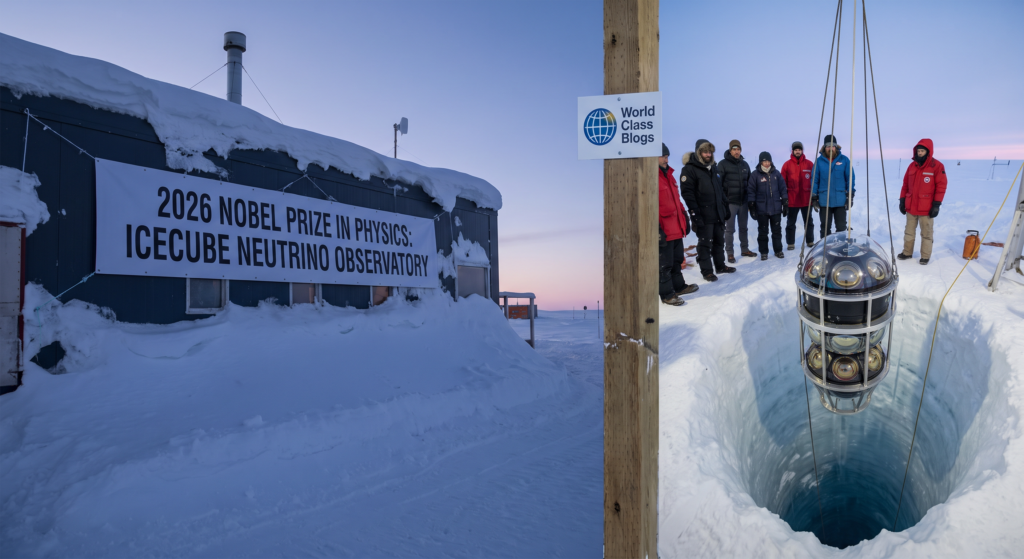
The Antarctic summer is short. Construction crews have roughly two months per year to drill holes and deploy strings. The drill is a hot-water system: a nozzle sprays water at nearly 7 megapascals and high temperature to melt a hole 61 centimeters in diameter down to 2,450 meters. The water at the edges refreezes almost immediately, but the hole stays open long enough—about 30 hours—to lower a string of 60 DOMs into position . The DOMs freeze into place, and the ice becomes permanently instrumented.
Step 2: Waiting for a Neutrino
Most neutrinos pass straight through the detector without a trace. IceCube records over a hundred million downward-going muons from atmospheric cosmic-ray showers every day—background that must be filtered out . The neutrinos scientists want are the rare ones that interact inside or near the detector, producing a flash of Cherenkov light that multiple DOMs record.
Step 3: Reconstructing the Event
When enough DOMs light up within a tiny time window, IceCube’s computers reconstruct the event. For muon tracks, the arrival times of photons at different DOMs allow the system to point back along the muon’s path. The angular resolution for high-energy tracks is better than 0.3 degrees . The amount of light gives the energy deposited in the ice, which in turn estimates the neutrino’s energy.
Step 4: Separating Signal from Background
The vast majority of detected events are atmospheric—produced by cosmic rays hitting the atmosphere above Antarctica. These form a background that must be statistically separated from astrophysical neutrinos. One key trick: astrophysical neutrinos arrive from all directions, including upward through the Earth. Atmospheric muons can’t do that—they’re absorbed by the planet. By looking for upward-going events, IceCube can isolate a cleaner neutrino sample .
Step 5: The 2013 Discovery
In 2013, IceCube announced the first detection of high-energy neutrinos of astrophysical origin. The analysis found events with energies far above what atmospheric neutrinos could produce, and with a directional distribution consistent with a cosmic origin . It was the first time anyone had observed neutrinos from outside the solar system at these energies.
Step 6: From Discovery to Astronomy
Since 2013, IceCube has moved from “we see astrophysical neutrinos” to “we are beginning to identify where they come from.” In 2023, the collaboration reported evidence for neutrinos from the Milky Way galaxy itself—the first observation of our galaxy in neutrinos rather than light . Candidate source associations with individual blazars and active galaxies have also been reported, though the field is still working toward definitive identifications.
Why It’s Important
The 2026 Nobel recognizes three distinct achievements, each important in its own right.
A New Window on the Universe
Every time astronomy has opened a new wavelength or messenger, it has found something unexpected. Radio astronomy found quasars. X-ray astronomy found black holes. Neutrino astronomy is the newest window, and it’s uniquely suited to probing the most violent environments in the cosmos—places where protons are accelerated to extreme energies and collide with surrounding matter or radiation, producing neutrinos as a byproduct . Unlike photons, neutrinos escape from these environments without being absorbed. Unlike cosmic rays, they point back to their sources. They are, in a literal sense, the only messenger that can tell us where the highest-energy processes in the universe are happening.
Proof That a Risky Idea Can Work
Halzen has said that when the project began, “very few thought it would work, including myself” . IceCube was a massive engineering gamble: a kilometer-scale detector in one of the most hostile environments on Earth, built on the premise that natural ice would be transparent enough and stable enough to serve as a precision instrument. The Nobel is a validation not just of the physics, but of the kind of long-term, high-risk instrumentation project that funding agencies increasingly struggle to support.
A Legacy of Technical Innovation
The hot-water drilling system developed for IceCube, the digital optical modules, and the data-handling architecture that processes a terabyte per day from the South Pole have all had ripple effects. The drilling technology has been adapted for other ice-based projects. The DOM design has influenced subsequent neutrino detectors like KM3NeT in the Mediterranean. And the data pipeline—sending 10% of the data via satellite, processing the rest on-site—is a model for remote scientific facilities .
Sustainability in the Future
Planetary-scale physics experiments raise legitimate questions about sustainability, both environmental and financial. IceCube’s footprint at the South Pole is carefully managed under the Antarctic Treaty system. Power comes from the Amundsen-Scott Station’s generators, and waste is packed out. The detector itself has no moving parts and requires no maintenance once deployed—the strings are designed to operate for decades without intervention. In that sense, it’s an unusually low-impact megaproject.
The bigger sustainability question is financial. IceCube cost roughly $270 million to build, funded primarily by the National Science Foundation with contributions from international partners. The planned upgrade, IceCube-Gen2, will be larger and more expensive . The Nobel Prize strengthens the case for continued investment, but it also raises expectations: if neutrino astronomy is now a proven field, what should the next generation of detectors deliver?
There’s also a scientific sustainability angle. IceCube’s data is archived and publicly released for analysis by the broader community. The collaboration has committed to open data policies that allow researchers outside the main team to mine the archive for new physics—non-standard neutrino interactions, Lorentz invariance tests, and other searches that the original designers didn’t anticipate. This extends the scientific value of the instrument well beyond its construction cost.
Common Misconceptions
Misconception #1: “IceCube is a telescope that looks at the sky.”
IceCube doesn’t look at anything in the traditional sense. It doesn’t collect light from distant objects. It waits for neutrinos to interact in the ice beneath it and reconstructs their direction from the Cherenkov light produced in the collision. It’s more like a giant particle detector that happens to be pointed at the entire sky at once.
Misconception #2: “Neutrinos are dangerous.”
Neutrinos pass through you constantly with no effect. Even the high-energy astrophysical neutrinos that IceCube detects interact so rarely that the probability of one interacting in your body in your lifetime is vanishingly small. They’re the least dangerous form of radiation imaginable.
Misconception #3: “The Nobel was awarded for a single discovery.”
The prize citation recognizes both the instrument and the discovery: “decisive contributions to the IceCube Neutrino Observatory and the discovery of high-energy neutrinos of astrophysical origin” . The Nobel committee is honoring the decades of engineering and leadership that made the discovery possible, not just the 2013 paper.
Misconception #4: “IceCube has solved the mystery of cosmic rays.”
Not yet. IceCube has detected astrophysical neutrinos, which must come from cosmic accelerators, but identifying the specific sources is still an active area of research. The 2013 discovery was a proof of concept; the astronomy is still developing. As Halzen himself said after the Nobel announcement, “The real excitement is that I cannot answer that question yet. This is just an introduction to the science, the astronomy is still to come” .
Recent Developments (2025–2026)
The Nobel announcement is the headline, but the field has been moving quickly.
The Milky Way in Neutrinos
In 2023, IceCube reported the first observation of high-energy neutrinos from the Milky Way galaxy. This was a significant milestone: it meant that our own galaxy, long studied in every electromagnetic wavelength, had finally been seen in a completely different messenger. The result was cited by the Nobel committee as part of the scientific case for the award .
IceCube-Gen2 Planning
The next-generation detector, IceCube-Gen2, is in the planning and early construction phase. It will instrument eight cubic kilometers of ice—eight times the volume of the current detector—with a mix of densely and sparsely spaced sensors. The goal is to detect ten times as many neutrinos and push to higher energies, where the most extreme cosmic accelerators operate. Operational date is targeted for around 2033 .
Real-Time Alerts
IceCube now issues real-time alerts to the astronomical community when it detects candidate astrophysical neutrinos. These alerts allow telescopes on Earth and in space to quickly follow up on the neutrino direction, looking for counterparts in other wavelengths. In October 2026, for example, IceCube issued an alert for a track-like event with a moderate probability of astrophysical origin, triggering follow-up observations across observatories . This multi-messenger approach—combining neutrinos with photons and gravitational waves—is the future of the field.
Success Stories: Beyond the Nobel
The IceCube collaboration’s success isn’t limited to the headline discoveries.
AMANDA’s Proof of Concept
Before IceCube, there was AMANDA—a smaller array that proved Antarctic ice could be used as a Cherenkov detector. AMANDA’s first string was deployed in 1996, and by 2000 it had demonstrated that the ice below 1,400 meters was transparent enough for neutrino detection . Without AMANDA’s data, IceCube would never have been funded.
The 2013 Discovery Paper
The 2013 paper announcing high-energy astrophysical neutrinos was a turning point. It took data from the partially completed detector and found events that could not be explained by atmospheric backgrounds. The collaboration was careful—the result was conservative, with a significance that grew with more data—but it was unmistakably real. It validated the entire premise of the project.
International Collaboration
IceCube involves participants from 14 countries, including researchers from institutions across Europe, Asia, and North America . The collaboration’s ability to coordinate construction, data analysis, and publication across time zones and funding systems is itself a success story—one that the Nobel committee explicitly recognized by honoring Halzen’s leadership.
Real-Life Examples: What This Looks Like in Practice
The Christmas Eve Deployment (1993)
Halzen has described sitting at the dinner table on Christmas Eve in 1993, with a computer on his lap, waiting for a message confirming that the first cable of optical modules had been successfully installed in the ice . It was the moment the idea became real. The upper ice was full of bubbles that scattered light and made the first data disappointing. But below 1,400 meters, the ice was exceptionally clear—better than anyone had expected. That discovery, made almost by accident, is what made IceCube possible.
The 2013 Analysis
Imagine being a graduate student in 2013, working on an analysis of IceCube data that had been collected while the detector was still being built. You’re looking for events that are too energetic to be atmospheric. Most of the data looks like background. Then you find a handful of events—high-energy, upward-going, with no plausible atmospheric explanation. You check the reconstruction. You check the calibration. You run the analysis again. The events are still there. That’s how the discovery happened: not with a single dramatic flash, but with a statistical excess that refused to go away.
The Daily Data Flow
Every day, IceCube’s DOMs record about a terabyte of data. Most of it is filtered on-site at the IceCube Lab, a building on the surface that houses roughly 200 computers. About 10% of the data is sent via satellite for further analysis; the rest is stored or processed locally . The system is designed to operate autonomously through the Antarctic winter, when no one can reach the station. If something breaks between February and November, it stays broken until the next summer. That constraint shaped every design decision.
Conclusion and Key Takeaways

The 2026 Nobel Prize in Physics is a recognition of patience as much as genius. Halzen’s idea was proposed in 1988. The first string went into the ice in the 1990s. IceCube was completed in 2011. The discovery came in 2013. The full implications are still unfolding. That’s a thirty-five-year arc from idea to Nobel, and it required sustained funding, international collaboration, and a willingness to build something that might not work.
For curious beginners, the lesson is that physics isn’t just about equations on a blackboard. It’s about building instruments that let us see what was previously invisible. IceCube is a telescope that doesn’t look at light, a detector that waits for ghost particles, a cubic kilometer of ancient ice turned into a precision machine. That’s engineering and physics at their most ambitious.
For professionals, the Nobel validates the multi-messenger approach. Neutrino astronomy is now a real field, with real results and a clear path forward. IceCube-Gen2 will push the sensitivity further. The next decade should bring the first definitive identification of a high-energy neutrino source, and with it, a new understanding of how the universe accelerates particles to extreme energies.
Key Takeaways:
- Francis Halzen received the 2026 Nobel Prize in Physics for conceiving and leading IceCube, and for the discovery of astrophysical neutrinos.
- IceCube instruments a cubic kilometer of Antarctic ice with 5,160 sensors to detect Cherenkov light from neutrino interactions.
- The 2013 discovery of high-energy astrophysical neutrinos opened a new field of astronomy using particles rather than light.
- IceCube has since detected neutrinos from the Milky Way and issued real-time alerts for multi-messenger follow-up.
- The planned IceCube-Gen2 upgrade will cover eight cubic kilometers and detect ten times as many neutrinos, with operations targeted for the 2030s.
Frequently Asked Questions (FAQ’s)
1. What exactly did Francis Halzen win the Nobel Prize for?
The citation reads “for decisive contributions to the IceCube Neutrino Observatory and the discovery of high-energy neutrinos of astrophysical origin” . In plain terms: he proposed the idea of using Antarctic ice as a neutrino detector, led the effort to build it, and the instrument he built made the first detection of high-energy neutrinos from space.
2. Why is it called IceCube?
Because the detector instruments approximately one cubic kilometer of ice. The name is literal.
3. How big is IceCube, exactly?
The instrumented volume is about one cubic kilometer, with sensors deployed between 1,450 and 2,450 meters below the surface. There are 86 strings, each with 60 DOMs, for a total of 5,160 sensors .
4. How does IceCube detect something that passes through everything?
Neutrinos mostly pass through the ice without interacting. But occasionally—very occasionally—a neutrino collides with an atomic nucleus in the ice. That collision produces charged particles that travel faster than light in ice, emitting Cherenkov radiation. The DOMs detect that light and reconstruct the event .
5. What’s the difference between a track and a cascade?
A track is produced by a muon neutrino, which creates a muon that travels a long distance through the ice, leaving a line of Cherenkov light. Tracks point back to their sources very precisely. A cascade is produced by an electron or tau neutrino, creating a more spherical shower of particles. Cascades give better energy measurements but worse directional information .
6. How do scientists know a neutrino came from space and not from the atmosphere?
Atmospheric neutrinos are produced by cosmic rays hitting the atmosphere. They have a characteristic energy spectrum and mostly come from above. Astrophysical neutrinos have higher energies on average and arrive from all directions, including upward through the Earth. By selecting upward-going events and looking for energies above the atmospheric background, IceCube can isolate a cosmic signal .
7. What was the 2013 discovery?
IceCube found a handful of high-energy neutrino events that could not be explained by atmospheric production. The energies were too high, and the directional distribution was consistent with a cosmic origin. This was the first detection of high-energy astrophysical neutrinos .
8. Has IceCube identified any specific sources?
Not definitively. There have been candidate associations with blazars and other active galaxies, but none has reached the gold standard of statistical significance. The Milky Way itself has been detected as a diffuse neutrino source, which is a major result . Identifying individual point sources is the next goal.
9. What is IceCube-Gen2?
A planned upgrade that will instrument eight cubic kilometers of ice—eight times the current volume—with a combination of dense and sparse sensor arrays. It’s designed to detect ten times as many neutrinos and push to higher energies. Operations are targeted for around 2033 .
10. How much did IceCube cost?
Approximately $270 million for construction, funded primarily by the U.S. National Science Foundation with international contributions. Operating costs are ongoing but modest compared to the construction cost.
11. Why the South Pole? Why not somewhere else?
The South Pole offers several advantages: the ice is exceptionally clear below 1,400 meters, the environment is stable (no earthquakes, no living organisms to interfere with sensors), and the station provides infrastructure and power. The main disadvantage is the difficulty of access—construction is limited to the Antarctic summer .
12. How is the data transmitted from the South Pole?
About 10% of the data is sent via satellite. The rest is processed or stored on-site. The satellite bandwidth is limited, so the collaboration designed the system to filter and compress data before transmission .
13. What happens if something breaks during the Antarctic winter?
It stays broken until the next summer. No one can reach the station between February and November. This constraint drove the design toward reliability and redundancy. The DOMs are designed to operate for decades without maintenance.
14. How cold is it at the South Pole?
Summer temperatures range from about -15°C to -45°C. Winter is colder. The altitude is 2,800 meters, which adds physiological stress for the crews working there .
15. How many people work on IceCube?
The collaboration includes hundreds of scientists, engineers, and students from institutions in 14 countries . The on-site crew during construction seasons was much smaller—dozens of people drilling, deploying, and commissioning.
16. Did Halzen build the detector himself?
No. He was the scientific leader and principal investigator—the person who conceived the idea, secured funding, assembled the collaboration, and sustained the project through decades of development. The actual construction was done by engineering teams, drillers, and technicians working in Antarctica.
17. What’s the connection between IceCube and machine learning?
IceCube uses machine learning extensively for event reconstruction and background rejection. The 2024 Nobel Prize in Physics, which recognized machine learning, cited IceCube’s use of neural networks as one of the applications of the technology .
18. Are neutrinos dangerous?
No. They interact so weakly that they pass through matter without effect. Even the high-energy astrophysical neutrinos detected by IceCube pose no threat to humans.
19. Can IceCube detect neutrinos from the Sun?
The Sun produces lower-energy neutrinos through nuclear fusion. IceCube is optimized for high-energy neutrinos and is not designed to study solar neutrinos. Other experiments (like Super-Kamiokande and Borexino) handle that.
20. What about neutrinos from supernovae?
IceCube can detect neutrinos from a nearby supernova, and it’s part of the Supernova Early Warning System (SNEWS). If a supernova occurs in or near our galaxy, IceCube would see a burst of events and could alert astronomers within minutes.
21. What’s the biggest challenge in neutrino astronomy right now?
Source identification. IceCube sees astrophysical neutrinos, but pinpointing exactly which objects produce them is difficult because the angular resolution is limited and the background is high. Multi-messenger follow-up—combining neutrino alerts with observations in light, radio, and gravitational waves—is the main strategy.
22. How does IceCube compare to KM3NeT?
KM3NeT is a Mediterranean neutrino telescope using seawater instead of ice. It’s complementary: it can see different parts of the sky and uses a different detection medium. Having both ice-based and water-based detectors provides valuable cross-checks and all-sky coverage.
23. What did Halzen say when he heard about the Nobel?
He said he was “delighted” and “surprised,” and that he was attending a conference in Italy when the call came. He also emphasized how lucky he felt, given that “very few thought it would work, including myself” .
24. Is there any controversy about the Nobel?
A Zenodo preprint circulated shortly after the announcement arguing that IceCube only observes “half” the neutrino spectrum and criticizing the award . This is a non-peer-reviewed opinion piece and does not reflect the consensus of the physics community. The Nobel committee’s citation is based on the peer-reviewed discovery of astrophysical neutrinos, which is well established.
25. What should a beginner read to learn more about neutrino astronomy?
The Nobel Prize’s popular science background document is an excellent, accessible overview . The IceCube collaboration website has educational materials and animations. For a deeper dive, “The Telescope in the Ice” by Mark Bowen is a book-length history of the project.
26. What’s next for Francis Halzen?
At 82, Halzen remains active in the field and continues to be involved with IceCube and its upgrades. He has said that the main fruits of the work are yet to come and that “the astronomy is still to come” .
27. Why should a non-scientist care about this?
Because it’s a reminder that curiosity-driven research can lead to entirely new ways of seeing the universe. Neutrino astronomy didn’t exist when Halzen proposed it. Now it’s a field with a Nobel Prize, a next-generation detector on the drawing board, and the potential to answer questions about the most extreme objects in the cosmos. That’s a good return on a risky idea.
About Author
Sana Ullah Khan Kakar is a science writer and former aerospace systems engineer with a focus on planetary science and space technology. He has contributed to World Class Blogs since 2023, covering topics ranging from asteroid defense to fusion energy and quantum computing. Alex holds a B.S. in Aerospace Engineering from Georgia Tech and an M.S. in Science Communication from MIT. He lives in Tucson, Arizona, where he volunteers as an amateur astronomer and occultation observer. You can reach him through the World Class Blogs contact page.
Disclosure: Alex has no financial interest in any company or mission mentioned in this article. All opinions are his own.
Free Resources
- Nobel Prize Popular Information (Physics 2026): The official background document, written for general audiences. (nobelprize.org)
- IceCube Neutrino Observatory: Official collaboration website with educational materials, animations, and data releases. (icecube.wisc.edu)
- IceCube-Gen2: Planning documents and science case for the next-generation detector. (icecube-gen2.wisc.edu)
- World Class Blogs Technology & Innovation Archive: For related coverage on physics, AI, and space technology. [Link: https://worldclassblogs.com/category/technology-innovation/artificial-intelligence-machine-learning/]
- The Daily Explainer Science Communication: For accessible explanations of complex topics and public understanding of science. [Link: https://thedailyexplainer.com/mental-health-the-complete-guide-to-psychological-wellbeing-in-the-modern-world/]
- Sherakat Network SEO Guide: For readers interested in how science communication reaches audiences online. [Link: https://sherakatnetwork.com/category/seo]
Discussion
What questions do you have about IceCube, neutrino astronomy, or the 2026 Nobel Prize? Have you followed the development of multi-messenger astronomy? Share your thoughts in the comments below. I read every comment and try to respond within 48 hours.
For more science and frontier coverage, explore the World Class Blogs Our Focus section and the full Blog archive. If you’re interested in contributing a guest post or suggesting a topic, please contact us.


