



Introduction: The Digital Arms Race in Financial Security
Every 2 seconds, somewhere in the world, a financial fraud attempt is blocked by an artificial intelligence system. This silent war between cybercriminals and financial institutions has escalated into one of the most sophisticated technological battles of our time, with billions of dollars—and consumer trust—hanging in the balance. As financial services have digitized, so too has financial crime evolved from simple stolen card usage to elaborate, AI-assisted schemes that can bypass traditional security measures in milliseconds.
Enter AI-powered fraud detection—the financial industry’s intelligent shield. This isn’t just incremental improvement; it’s a paradigm shift from rules-based systems that could only recognize yesterday’s attacks to adaptive learning systems that anticipate tomorrow’s threats. For fintechs and traditional banks alike, implementing effective AI fraud detection has moved from competitive advantage to existential necessity. The stakes couldn’t be higher: Juniper Research estimates that merchant losses to online payment fraud will exceed $343 billion globally between 2023 and 2027. Yet amidst this alarming trend lies an equally impressive story of innovation, where machine learning algorithms now process thousands of data points per transaction, making risk assessments in under 100 milliseconds with accuracy rates that would have been unimaginable just five years ago.
Background/Context: From Manual Reviews to Machine Intelligence
The evolution of fraud detection mirrors the broader digital transformation of finance, progressing through distinct technological eras:
The Manual Era (Pre-1990s)
Fraud detection was human-centric: bank tellers recognizing suspicious behavior, signature verification, manual review of paper statements. Detection rates were low, response times slow, and scalability impossible in our modern transaction volumes.
Rules-Based Systems (1990s-2010s)
The first wave of automation arrived with simple “if-then” rules:
- “If transaction > $5,000, flag for review”
- “If international transaction from new location, require verification”
- “If multiple rapid transactions, freeze account”
While an improvement, these systems suffered from fundamental flaws:
- High False Positives: Up to 90% of flagged transactions were legitimate
- Reactive Nature: Only caught patterns seen before
- Easy to Game: Criminals quickly learned the rules
- Poor Customer Experience: Legitimate transactions frequently blocked
Statistical Models (2000s-2015)
Regression models and basic machine learning brought modest improvements:
- Score-based risk assessments
- Historical pattern analysis
- Reduced false positives to 70-80%
However, these systems still struggled with new attack vectors and required constant manual tuning by data scientists.
The AI Revolution (2015-Present)
Three technological breakthroughs converged to enable modern AI fraud detection:
- Big Data Infrastructure: Cloud computing and distributed processing could handle the volume, velocity, and variety of transaction data
- Advanced ML Algorithms: Deep learning, ensemble methods, and neural networks could identify complex, non-linear patterns
- Real-time Processing: Streaming data platforms enabled millisecond-level decisioning
The results have been transformative. According to a 2023 NICE Actimize survey, financial institutions using AI/ML fraud detection reduced false positives by 50-70%, increased fraud detection rates by 30-50%, and decreased operational costs by 20-40% compared to rules-based systems.
Key Concepts Defined: The AI Fraud Detection Lexicon
- Supervised Learning: ML models trained on labeled historical data (known fraud vs. legitimate transactions) to predict outcomes on new data. Most common for fraud detection.
- Unsupervised Learning: Algorithms that identify anomalies or clusters in data without pre-existing labels. Crucial for detecting novel fraud patterns.
- Behavioral Biometrics: Analysis of unique user behavior patterns—typing rhythm, mouse movements, device handling—to continuously verify identity.
- Synthetic Identity Fraud: Creation of fake identities using combinations of real and fabricated information, now the fastest-growing financial crime in the US.
- Feature Engineering: The process of selecting and transforming raw transaction data into meaningful inputs for ML models (e.g., “transaction frequency last 24 hours,” “velocity of spending increase”).
- Model Drift: The degradation of ML model performance over time as fraud patterns evolve, requiring continuous retraining.
- False Positive Rate: Percentage of legitimate transactions incorrectly flagged as fraudulent. Critical for customer experience.
- False Negative Rate: Percentage of fraudulent transactions incorrectly approved. Critical for loss prevention.
- Ensemble Methods: Combining predictions from multiple ML models to improve accuracy and stability.
- Federated Learning: Training ML models across decentralized devices or servers without exchanging raw data, enhancing privacy.
How Modern AI Fraud Detection Systems Work: A Technical Deep Dive

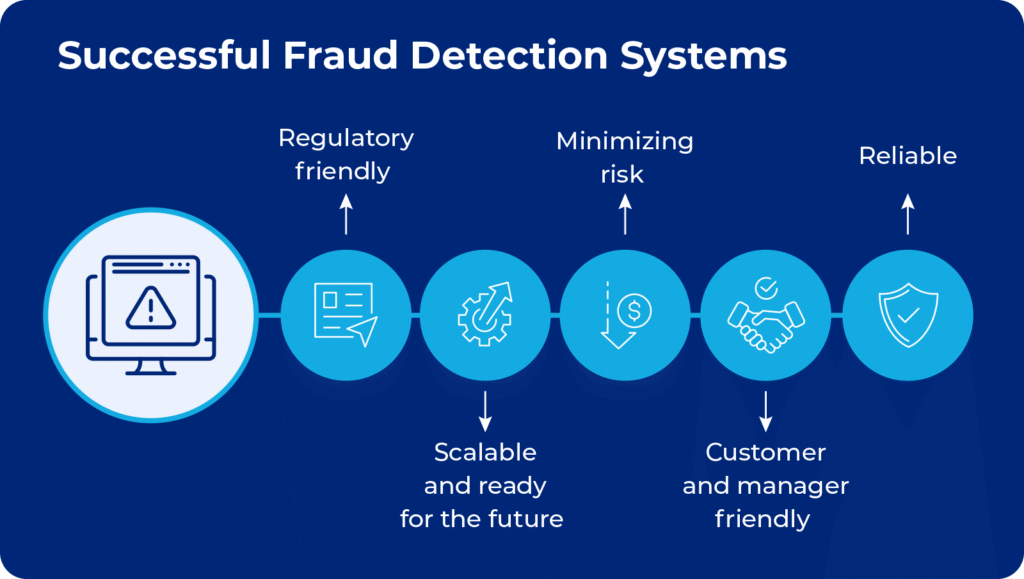
Stage 1: Data Collection and Enrichment (0-20ms)
Multi-dimensional Data Capture
Modern systems analyze far more than just transaction amount and location:
- Transactional Data: Amount, merchant, location, time, currency
- Device Intelligence: Device fingerprint, IP address, geolocation, VPN detection
- Behavioral Data: Typing patterns, mouse movements, navigation paths
- Network Data: Relationship graphs showing connections between entities
- Historical Patterns: User’s typical behavior, spending categories, timing
Real-time Data Enrichment
Third-party services enhance the raw data:
- IP Geolocation: Verify location consistency
- Device Reputation: Check if device has been associated with fraud
- Email/Phone Intelligence: Validate contact information
- Public Records: Cross-reference identity information
Stage 2: Feature Engineering and Processing (20-50ms)
Derived Features Creation
Raw data transforms into predictive features:
- Velocity Features: “Number of transactions in last hour” vs. user average
- Time-based Features: “Transaction at 3 AM” when user typically shops 9 AM-6 PM
- Amount Anomalies: “Transaction 10x larger than typical”
- Geographic Impossibility: “Transaction in NY 1 hour after one in London”
- Merchant Risk Scoring: Based on historical fraud rates at that merchant
Graph Feature Extraction
For sophisticated fraud rings detection:
- Social Network Analysis: Connections between accounts, devices, IPs
- Common Point Analysis: Identifying shared attributes across fraudulent accounts
- Community Detection: Finding clusters of suspicious activity
Stage 3: Multi-Model Scoring and Decisioning (50-80ms)
The Model Ensemble Approach
No single model catches all fraud. Modern systems use layered approaches:
- Supervised Models (Random Forest, XGBoost, Neural Networks)
- Trained on millions of labeled transactions
- Excel at catching known fraud patterns
- Provide probability scores (0-100% fraud likelihood)
- Unsupervised Models (Isolation Forest, Autoencoders, Clustering)
- Detect novel attack patterns
- Identify outliers in high-dimensional space
- Crucial for “zero-day” fraud attacks
- Deep Learning Models (Recurrent Neural Networks, Transformers)
- Analyze sequential patterns in transaction histories
- Understand context and temporal relationships
- Particularly effective for behavioral analysis
- Graph Neural Networks
- Analyze relationships between entities
- Detect organized fraud rings
- Identify mule accounts and money laundering patterns
Real-time Decision Engine
Models produce scores that feed into a rules engine that considers:
- Business risk appetite
- Customer value and history
- Regulatory requirements
- Available authentication methods
Stage 4: Adaptive Response and Feedback Loop (80-100ms+)
Dynamic Authentication
Based on risk score, systems trigger appropriate responses:
- Low Risk (<30): Approve instantly
- Medium Risk (30-70): Step-up authentication (OTP, biometrics)
- High Risk (>70): Block and alert security team
Continuous Learning Loop
Every decision feeds back to improve models:
- Confirmed Fraud: Reinforces detection patterns
- False Positives: Teaches models what’s legitimate
- Evolving Patterns: Models retrained regularly (hourly/daily)
- Concept Drift Detection: Automatic alerts when patterns change
Why AI-Powered Detection Is Revolutionary: The Quantitative Impact
Dramatically Improved Detection Rates
- Traditional Rules: 40-60% detection rate for new fraud patterns
- AI Systems: 85-95% detection rate, even for novel attacks
- Reduced Time to Detection: From days/weeks to milliseconds
- Synthetic Identity Detection: AI identifies 3-5x more synthetic identities than human analysts
Massive Reduction in False Positives
- Rules-Based: 70-90% of alerts were false positives
- AI Systems: Reduced to 10-30%, freeing investigators for real threats
- Customer Experience Impact: Fewer legitimate transactions blocked
- Operational Efficiency: Investigation time reduced by 60-80%
Economic Impact and ROI
- Fraud Loss Reduction: 40-70% decrease in annual fraud losses
- Investigation Cost Savings: $15-25 per alert in reduced manual review
- Customer Retention: 20-30% lower attrition due to fewer false declines
- Competitive Advantage: Trust as a differentiator in crowded markets
Regulatory and Compliance Benefits
- Anti-Money Laundering: AI detects suspicious patterns humans miss
- Real-time Reporting: Automated SAR (Suspicious Activity Report) generation
- Audit Trails: Complete documentation of decision logic
- Adaptive Compliance: Systems update as regulations change
Common Misconceptions and Implementation Challenges
Misconception 1: “AI fraud detection is only for large banks”
Reality: Cloud-based AI fraud platforms have democratized access. Fintechs and even medium-sized businesses can now deploy sophisticated detection at affordable costs. Many providers offer pay-as-you-go models that scale with transaction volume.
Misconception 2: “AI eliminates the need for human analysts”
Reality: AI augments human intelligence, doesn’t replace it. Investigators shift from manual review to:
- Analyzing complex cases AI flags as uncertain
- Monitoring model performance and drift
- Investigating sophisticated fraud rings
- Providing feedback to improve models
Misconception 3: “Once implemented, AI systems run themselves”
Reality: Effective AI fraud detection requires continuous:
- Model monitoring and retraining
- Feature engineering updates
- Performance metric tracking
- Integration with new data sources
- Adaptation to evolving attack vectors
Misconception 4: “More data always means better detection”
Reality: Quality trumps quantity. Relevant, clean, timely data matters more than volume. Many systems suffer from “garbage in, garbage out” when fed poor-quality or irrelevant data.
Misconception 5: “AI fraud systems are too expensive”
Reality: The cost of fraud typically far exceeds detection costs. A mid-sized fintech losing $500,000 annually to fraud could implement AI detection for $50,000-100,000 annually with 60-80% fraud reduction—clear ROI in year one.
Industry-Specific Applications and Success Stories
Case Study 1: PayPal’s Adaptive AI Defense System
The Challenge:
As one of the world’s largest payment platforms, PayPal processes over $1.3 trillion annually across 4.5 billion transactions. They face constant, sophisticated attacks across multiple vectors: account takeover, merchant fraud, money laundering, and synthetic identities.
The AI Solution:
PayPal developed Deep Fraud Insight, a proprietary AI system featuring:
- Reinforcement Learning: Models that learn optimal decisions through trial and error
- Graph Neural Networks: Mapping relationships between billions of entities
- Real-time Adaptation: Models that update based on attack patterns within hours
- Multi-layered Defense: Different models for different fraud types
Implementation Results:
- Fraud Rate Reduction: From 0.32% to 0.08% of revenue (75% reduction)
- False Positive Reduction: From 50% to under 10% of alerts
- Investigative Efficiency: 80% reduction in manual review time
- Adaptive Speed: New fraud patterns detected within 2-4 hours vs. days
Key Innovation: PayPal’s “champion-challenger” approach constantly tests new models against production systems, ensuring continuous improvement without risking performance.
Case Study 2: Revolut’s Real-time Behavioral Biometrics
The Unique Approach:
While most focus on transaction patterns, Revolut pioneered behavioral biometrics at scale:
- Typing Dynamics: How users type passwords and information
- Device Handling: How they hold and interact with their phones
- Navigation Patterns: How they move through the app
- Timing Analysis: Speed and rhythm of interactions
Technical Implementation:
- Continuous Authentication: Monitoring throughout session, not just login
- Contextual Analysis: Behavioral norms vary by activity (checking balance vs. transferring large amounts)
- Privacy-Preserving: Behavioral data stored as mathematical representations, not raw recordings
- Federated Learning: Model improvements without centralizing sensitive data
Business Impact:
- Account Takeover Prevention: 94% reduction in successful attacks
- Customer Experience: No additional friction for legitimate users
- Competitive Differentiation: Security as a feature, not just a cost
- Regulatory Compliance: Stronger authentication meets PSD2/SCA requirements
Strategic Insight: By focusing on “how” users interact rather than just “what” they do, Revolut created a fraud barrier that’s invisible to customers but formidable to attackers.
Case Study 3: Square’s Small Business Fraud Protection
The Problem Space:
Small businesses face unique fraud challenges:
- Limited fraud expertise and resources
- High impact of even small fraud losses
- Diverse business types with different risk profiles
- Need for simplicity and automation
AI Solution Design:
Square built a system specifically for SMBs:
- Industry-Specific Models: Different risk profiles for retailers, restaurants, service businesses
- Automated Dispute Resolution: AI handles chargeback evidence gathering
- Educational Nudges: Simple explanations of risks and protections
- Gradual Trust Building: Limits that increase with demonstrated good behavior
Results and Adoption:
- Fraud Reduction: 65% decrease in chargebacks for protected businesses
- Adoption Rate: 85% of eligible businesses enable the protection
- Loss Recovery: 40% of disputed transactions recovered through automated evidence
- Small Business Loyalty: 92% satisfaction with fraud protection features
Lesson Learned: Effective fraud prevention must be accessible and understandable to non-experts. The best AI systems simplify complexity rather than exposing it.
Implementation Framework: Building Your AI Fraud Defense
Phase 1: Assessment and Foundation (Weeks 1-4)
Step 1: Fraud Risk Assessment
- Historical Analysis: Review 12-24 months of fraud data
- Loss Analysis: Quantify direct losses, operational costs, customer impact
- Attack Vector Mapping: Identify your specific fraud types
- Benchmarking: Compare to industry peers and best practices
Step 2: Data Readiness Evaluation
- Data Inventory: What fraud-relevant data do you collect?
- Data Quality: Accuracy, completeness, timeliness assessment
- Gap Analysis: What additional data would improve detection?
- Privacy Compliance: Ensure GDPR, CCPA, and other regulations addressed
Step 3: Technology Stack Assessment
- Current Systems: Capabilities and limitations
- Integration Complexity: How new systems would connect
- Team Skills: Data science, engineering, fraud operations expertise
- Budget Realities: Total cost of ownership considerations
Phase 2: Solution Design and Partner Selection (Weeks 5-12)
Step 4: Build vs. Buy Decision
Build If: You have unique requirements, massive scale, and specialized team
Buy If: You need speed to market, lack specialized expertise, or have moderate scale
Hybrid Approach: Buy platform, customize models for your specific needs
Step 5: Vendor Evaluation Criteria
- Detection Performance: Historical accuracy rates, reduction metrics
- False Positive Management: Approaches and typical rates
- Implementation Support: Onboarding, integration assistance
- Continuous Improvement: How models adapt and improve
- Total Cost: Implementation, licensing, operational costs
Step 6: Phased Implementation Plan
- Phase 1: Transaction monitoring (3-4 months)
- Phase 2: Account takeover protection (months 4-6)
- Phase 3: Synthetic identity detection (months 6-9)
- Phase 4: Advanced analytics and reporting (months 9-12)
Phase 3: Implementation and Optimization (Months 4-12)
Step 7: Model Development and Training
- Data Preparation: Cleaning, labeling, feature engineering
- Model Selection: Choosing appropriate algorithms for your data
- Training and Validation: Using historical data with known outcomes
- Performance Testing: Against held-out test datasets
Step 8: Integration and Deployment
- API Integration: Connecting to transaction systems
- Real-time Processing: Ensuring <100ms decisioning
- Fallback Systems: Rules-based backup during AI system issues
- Monitoring Dashboards: Real-time performance visibility
Step 9: Tuning and Optimization
- Threshold Calibration: Balancing detection vs. false positives
- Feedback Loop Implementation: Learning from investigator decisions
- Performance Monitoring: Tracking key metrics daily
- Regular Retraining: Scheduled model updates
The Future of AI Fraud Detection: Emerging Trends and Technologies


Explainable AI (XAI) for Regulatory Compliance
- Model Interpretability: Understanding why AI flagged a transaction
- Regulator Acceptance: Meeting regulatory requirements for transparency
- Customer Communication: Clear explanations for declined transactions
- Bias Detection: Identifying and correcting discriminatory patterns
Quantum Machine Learning
- Pattern Recognition: Quantum algorithms for complex fraud pattern detection
- Encryption Breaking: Preparing for quantum attacks on current encryption
- Optimization Problems: Solving complex fraud network analysis faster
- Timeline: 5-10 years for practical implementation
Federated Learning Advancements
- Privacy-Preserving AI: Training across institutions without sharing sensitive data
- Industry Consortia: Banks collaboratively improving models without competitive risk
- Regulatory Support: Encouraged by data protection authorities
- Technical Challenges: Communication efficiency, model aggregation methods
AI-Powered Social Engineering Defense
- Phishing Detection: Analyzing communication patterns for social engineering
- Voice Synthesis Detection: Identifying AI-generated voice fraud
- Deepfake Detection: Spotting synthetic media in verification processes
- Behavioral Analysis: Detecting manipulation patterns in customer interactions
Integration with Blockchain and Web3
- On-chain Analysis: Tracking cryptocurrency transaction patterns
- Smart Contract Auditing: Automated vulnerability detection
- DeFi Protocol Security: Monitoring for exploit patterns
- Cross-chain Fraud Detection: Following funds across multiple blockchains
Ethical Considerations and Responsible AI Implementation
Algorithmic Bias and Fairness
- Disparate Impact Testing: Regular audits for demographic bias
- Fairness Constraints: Building equity into model objectives
- Diverse Training Data: Ensuring representative data across customer segments
- Transparent Criteria: Clear, consistent decision standards
Privacy-Preserving Techniques
- Differential Privacy: Adding statistical noise to protect individuals
- Homomorphic Encryption: Processing encrypted data without decryption
- Data Minimization: Collecting only what’s necessary for fraud prevention
- User Control: Options for data sharing preferences
Transparency and Accountability
- Right to Explanation: Customers can understand why actions were taken
- Appeal Processes: Clear paths to challenge AI decisions
- Human Oversight: Final decision authority for high-stakes cases
- Audit Trails: Complete records of AI decision processes
Psychological Impact Considerations
The constant security measures can create anxiety. As noted in research on psychological wellbeing, balancing security with user experience is crucial for maintaining trust and reducing digital stress.
Conclusion and Key Takeaways
The battle against financial fraud has evolved from human intuition to algorithmic intelligence, but the fundamental goal remains unchanged: protecting value and maintaining trust in an increasingly digital financial ecosystem. AI-powered fraud detection represents not just a technological upgrade but a fundamental rethinking of how we secure financial transactions.
Key Takeaways:
- Adaptability is the New Imperative: Static rules cannot keep pace with evolving fraud. Continuous learning systems are essential for modern financial security.
- Data Quality Trumps Quantity: Sophisticated algorithms cannot compensate for poor data. Invest in clean, comprehensive, timely data collection and management.
- Balance Detection with Experience: The most secure system fails if it frustrates legitimate customers. Optimize for both low false negatives (catching fraud) and low false positives (not blocking good customers).
- Human-AI Collaboration Maximizes Value: AI excels at pattern recognition at scale; humans excel at context, judgment, and complex investigation. The most effective systems leverage both.
- Privacy and Ethics Are Competitive Advantages: Transparent, fair, privacy-preserving AI systems build customer trust and regulatory confidence.
- Start Simple, Scale Intelligently: Begin with transaction monitoring, then expand to account protection, identity verification, and advanced analytics as capabilities mature.
- Continuous Improvement is Non-Negotiable: Fraud patterns evolve, and so must your defenses. Regular model retraining, feature updates, and system evaluations are essential.
- Ecosystem Collaboration Multiplies Defense: Sharing threat intelligence (with appropriate privacy protections) creates network effects that benefit all participants.
As financial services continue their digital transformation, the role of AI in security will only grow more critical. The institutions that thrive will be those that view AI fraud detection not as a cost center but as a strategic capability that enables innovation, builds trust, and creates competitive advantage in an increasingly perilous digital landscape.
Frequently Asked Questions (FAQ)
Technical Implementation Questions (Q1-Q8)
Q1: How much historical data is needed to train effective fraud detection models?
A: Minimum 6-12 months of labeled data (known fraud vs. legitimate transactions). Ideally 2-3 years for seasonal pattern recognition. For new businesses without historical data, consider starting with rules and industry benchmark models, then transitioning to custom models as data accumulates.
Q2: What’s the typical accuracy rate for AI fraud detection systems?
A: Top systems achieve 85-95% detection rates with 5-15% false positive rates. However, these vary by fraud type: card-not-present fraud detection typically 90-95%, synthetic identity detection 70-85%, first-party fraud (friendly fraud) 60-75%. The key is continuous improvement from your baseline.
Q3: How often should fraud detection models be retrained?
A: It depends on transaction volume and fraud pattern volatility. High-volume systems (millions of transactions daily): retrain weekly or even daily. Medium volume: weekly or bi-weekly. All systems should monitor for concept drift and retrain when performance degrades beyond thresholds.
Q4: What computing resources are needed for real-time AI fraud detection?
A: For moderate volume (10K-100K transactions daily): cloud instances with 8-16 vCPUs, 16-32GB RAM. High volume (1M+ daily): distributed computing with auto-scaling. Many providers offer fully managed services that handle infrastructure automatically.
Q5: How do we handle model explainability for regulatory requirements?
A: Implement Explainable AI (XAI) techniques: SHAP values, LIME, decision trees for interpretability. Maintain detailed model cards documenting training data, performance, limitations. Develop business-friendly explanations for flagged transactions.
Q6: Can AI systems detect completely novel fraud patterns?
A: Yes, through unsupervised learning techniques that identify anomalies without prior examples. However, completely novel patterns with low anomaly scores may be missed initially. Layered approaches combining supervised, unsupervised, and rules provide best coverage.
Q7: How do we integrate AI fraud detection with legacy systems?
A: Common approaches: API gateways that intercept transactions, database triggers that call fraud services, message queue systems that process asynchronously. Many providers offer connectors for common legacy systems. Expect 2-6 months for complex integrations.
Q8: What’s the latency impact of adding AI fraud detection?
A: Well-architected systems add 50-150 milliseconds. Critical to test in staging environment with production-like load. Consider asynchronous processing for non-critical decisions where slight delay is acceptable.
Business and Operational Questions (Q9-Q16)
Q9: What’s the ROI timeline for AI fraud detection implementation?
A: Typically 6-18 months. Factors: fraud losses, implementation costs, false positive reduction, operational efficiency gains. Many see positive ROI in first year. Case study: $100M transaction fintech reduced fraud losses from $800K to $200K annually with $150K system cost—ROI in 4 months.
Q10: How do we measure success beyond fraud reduction?
A: Key metrics: False positive rate (customer experience), investigator efficiency (cases/hour), time to detection (minutes from fraud to alert), customer satisfaction scores (NPS/CSAT), reduction in manual review costs.
Q11: What team structure is needed to manage AI fraud systems?
A: Core team: Fraud analysts (investigation), data scientists (model development), ML engineers (deployment), DevOps (infrastructure). Start small: 1-2 analysts + technical lead, expand as system scales. Many organizations use managed services to reduce team requirements.
Q12: How do we handle disputes and chargebacks with AI systems?
A: Integrate AI evidence gathering: automated collection of transaction context, device fingerprints, behavioral data. Use AI to predict dispute outcomes and suggest resolution strategies. Automate evidence submission to card networks where possible.
Q13: What compliance requirements apply to AI fraud systems?
A: Varied by jurisdiction: GDPR/CCPA (data privacy), PSD2/SCA (authentication), Reg E/Z (dispute rights), BSA/AML (suspicious activity reporting). Document model decisions, maintain audit trails, implement explainability, conduct regular bias testing.
Q14: How do we communicate fraud prevention to customers without causing anxiety?
A: Proactive education (“How we protect you”), transparent notifications (“Unusual activity detected”), simple resolution paths (“Click to verify”), and emphasizing security as a benefit, not just a barrier. Balance security with user experience thoughtfully.
Q15: Can small fintechs really implement effective AI fraud detection?
A: Absolutely. Cloud-based services offer: Pay-per-transaction pricing, pre-built models for common fraud types, managed infrastructure, and implementation support. Many providers specialize in SMB/SME markets with solutions starting under $1,000/month.
Q16: How does AI fraud detection integrate with customer onboarding/KYC?
A: Increasingly integrated: AI analyzes document authenticity, facial recognition liveness detection, cross-references identity databases, assesses risk from digital footprint. Creates continuous risk assessment from onboarding through ongoing transactions.
Strategic and Future Questions (Q17-Q22)
Q17: How will quantum computing affect AI fraud detection?
A: Both threat and opportunity: Threat—breaking current encryption. Opportunity—quantum ML for complex pattern detection. Timeline: 5-10 years for practical impact. Action now: implement quantum-resistant cryptography, monitor developments, plan for migration.
Q18: What role will blockchain play in fraud detection?
A: Currently: transaction tracing for crypto fraud. Future: decentralized identity verification, immutable audit trails, smart contract-based rules execution. Most implementations will be hybrid—blockchain for specific use cases within traditional systems.
Q19: How can we prepare for AI-powered fraud attacks?
A: Adversarial testing (attempting to fool your own systems), monitoring for anomalous model inputs, implementing robust input validation, staying current on attack research, participating in industry threat intelligence sharing.
Q20: What’s the future of fraud investigator roles with AI?
A: Evolution from transaction review to: Complex case analysis, model monitoring and improvement, strategic fraud pattern analysis, customer communication for sensitive cases, and regulatory compliance oversight. Higher-value, more analytical work.
Q21: How do global regulations impact AI fraud system design?
A: Requires flexible, configurable systems: Different rules by country/region, varying data privacy requirements, localized model training, jurisdiction-specific reporting. Many providers offer region-specific configurations and compliance expertise.
Q22: Can AI help prevent fraud in emerging payment methods?
A: Critical for: Real-time payments (faster fraud opportunities), BNPL (first-party fraud risk), cryptocurrency (irreversible transactions), embedded finance (new attack surfaces). AI adaptability makes it ideal for emerging payment security.
Industry Collaboration and Standards (Q23-Q26)
Q23: Are there industry standards for AI fraud detection systems?
A: Emerging standards: NIST AI Risk Management Framework, ISO/IEC standards for AI system evaluation, regulatory guidelines from FFIEC, EBA, etc. Industry groups like APWG, FINTRAIL, and MLFTC are developing best practices.
Q24: How can financial institutions collaborate on fraud without sharing sensitive data?
A: Federated learning (train models collaboratively without data sharing), synthetic data generation, privacy-preserving analytics, threat intelligence sharing with anonymization, industry consortiums with legal frameworks for cooperation.
Q25: What certifications should we look for in AI fraud solution providers?
A: SOC 2 Type II (security controls), ISO 27001 (information security), PCI DSS (payment security), regional financial certifications. Also evaluate: model validation processes, bias testing protocols, transparency documentation.
Q26: Where can we learn more about specific implementations for our fintech segment?
A: Industry conferences (Money20/20, Finovate), regulatory guidance publications, provider case studies, and professional associations. For broader technology context, explore our technology innovation resources and consider how fraud prevention integrates with overall digital transformation strategy.


