


Introduction – Why this matters
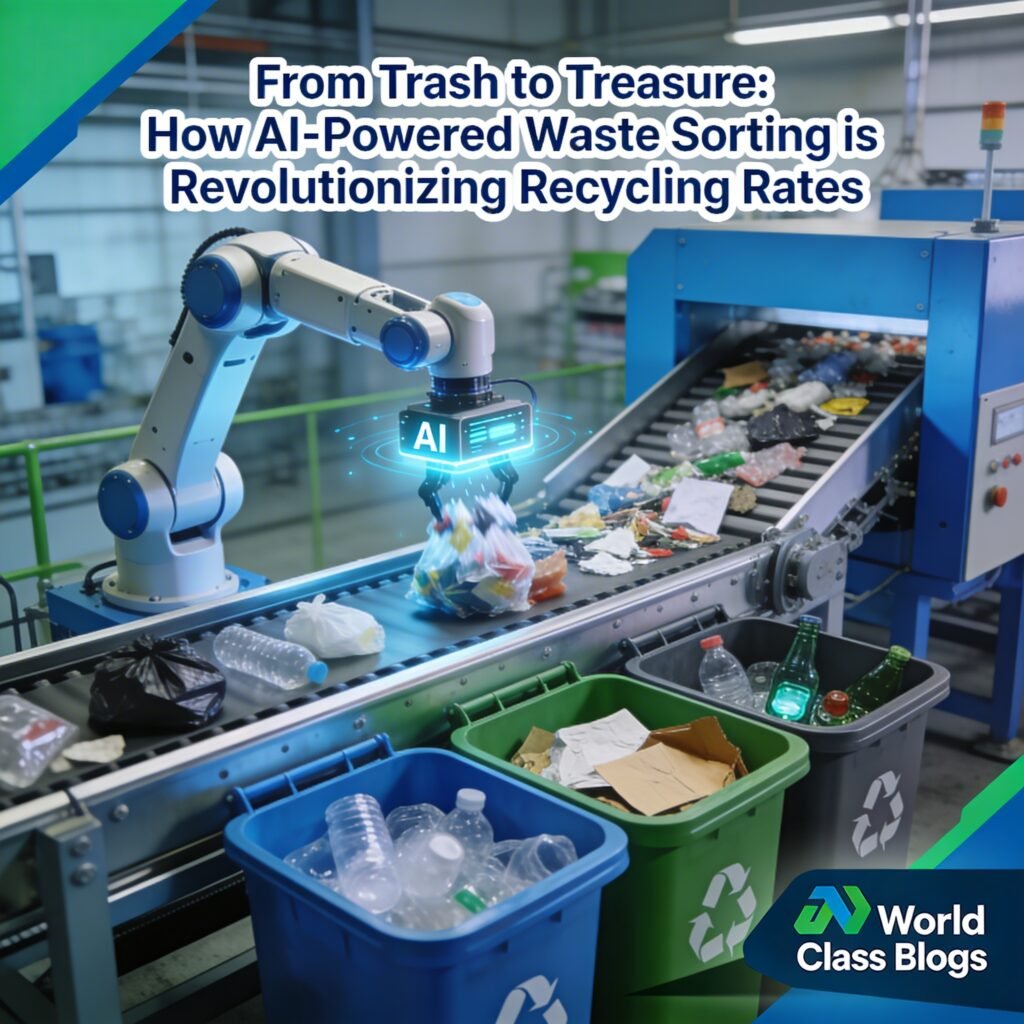
In my experience working alongside material recovery facility (MRF) operators across three continents, the single biggest bottleneck has never been technology—it has been speed and accuracy of sorting. A human sorter can identify a recyclable bottle in about two seconds. A well-trained AI vision system? Less than 50 milliseconds.
What I’ve found is that even the most well-intentioned recycling programs fail because of contamination. One greasy pizza box can ruin an entire bale of clean paper. One broken light bulb can reject a ton of glass. For years, we accepted 20-30% contamination rates as “normal.” But 2026 is different.
This guide walks you through exactly how artificial intelligence is transforming dirty, chaotic waste streams into valuable, sorted commodities. Whether you’re a curious beginner or a supply chain professional needing a refresher, you’ll walk away understanding the mechanics, the economics, and the future of zero-waste sorting.
Key Takeaway: AI-powered waste sorting can increase recycling purity rates from 70% to 95%+, turning previously “non-recyclable” materials into profitable raw materials.
Background / Context
The global recycling industry has historically operated on a flawed assumption: people will sort correctly. They don’t. According to a 2025 report from The Recycling Partnership, 62% of U.S. households admit to “wish-cycling”—throwing non-recyclables into bins hoping they’ll be recycled. This behavior costs municipalities an estimated $850 million annually in contaminated loads.
Simultaneously, China’s 2018 National Sword policy (still rippling through global markets in 2026) banned most foreign waste imports. Suddenly, wealthy nations couldn’t export their problems. The result? A crash course in domestic circular economy infrastructure.
Enter artificial intelligence. Between 2022 and 2026, the AI waste sorting market grew at a CAGR of 24.7%, reaching $6.2 billion globally (source: MarketsandMarkets, March 2026). What was once a niche automation tool is now standard equipment in next-generation MRFs.
For a broader look at how AI is transforming other industries, check out our Artificial Intelligence & Machine Learning category.
Key Concepts Defined
Before we dive into mechanics, let’s align on terminology.
| Term | Definition | Why It Matters |
|---|---|---|
| MRF (Material Recovery Facility) | A plant where recyclables are sorted, cleaned, and baled for sale | The “engine room” of circular economy |
| Contamination Rate | Percentage of non-recyclable or wrong materials in a bale | Directly impacts resale value; >15% often triggers rejection |
| Computer Vision | AI that interprets visual data from cameras | “Eyes” of the sorting system |
| NIR Spectroscopy | Near-Infrared light to identify polymer types (PET, HDPE, PP, etc.) | Distinguishes plastic types that look identical to humans |
| Edge AI | AI processing done on-device (not cloud) | Enables 50ms decision speed even with poor internet |
| Robotic Sorter | Physical arm + suction gripper that picks items based on AI decisions | Replaces human pickers on fast-moving belts |
| Digital Watermarking | Invisible QR codes printed on packaging | Future tech for perfect sorting (piloted in EU 2025-2026) |
Key distinction: Not all “AI sorters” are equal. Some use pure computer vision (trained on millions of images). Others combine vision with NIR (plastic type) and electromagnetic sensors (metals). The best systems fuse three or more data streams.
Key Takeaway: True AI sorting is multimodal—vision + spectroscopy + sometimes weight or shape data—to make a single, rapid “grab or pass” decision.
How It Works (Step-by-step breakdown)

Let me walk you through a typical AI-powered sorting line as if you’re standing on the catwalk above a modern MRF in 2026.
Step 1: Inbound & Pre-Sorting
Trucks dump mixed recyclables onto a “tipping floor.” A front-end loader pushes material onto a vibrating conveyor that spreads it into a single layer, about 6-8 inches deep. Human crews (still necessary) remove large contaminants: blankets, bowling balls, dead animals. Sorry, but yes.
Step 2: Initial AI Scanning (The “Brain”)
The material passes under a hyperspectral camera array (6-12 cameras covering visible light + NIR + sometimes SWIR). This is where the magic starts.
- What the AI sees: Every object’s shape, color, texture, material signature (plastic vs. paper vs. metal vs. glass), and even brand logos.
- Decision time: 50-100 milliseconds per object.
- Output: A real-time map of the belt: “Object #447: 2-liter soda bottle, PET plastic, green, no liquid, recyclable. Object #448: pizza box, cardboard with grease stain, contamination risk. Object #449: potato chip bag, metallized film, non-recyclable.”
Step 3: Physical Sorting (The “Hand”)
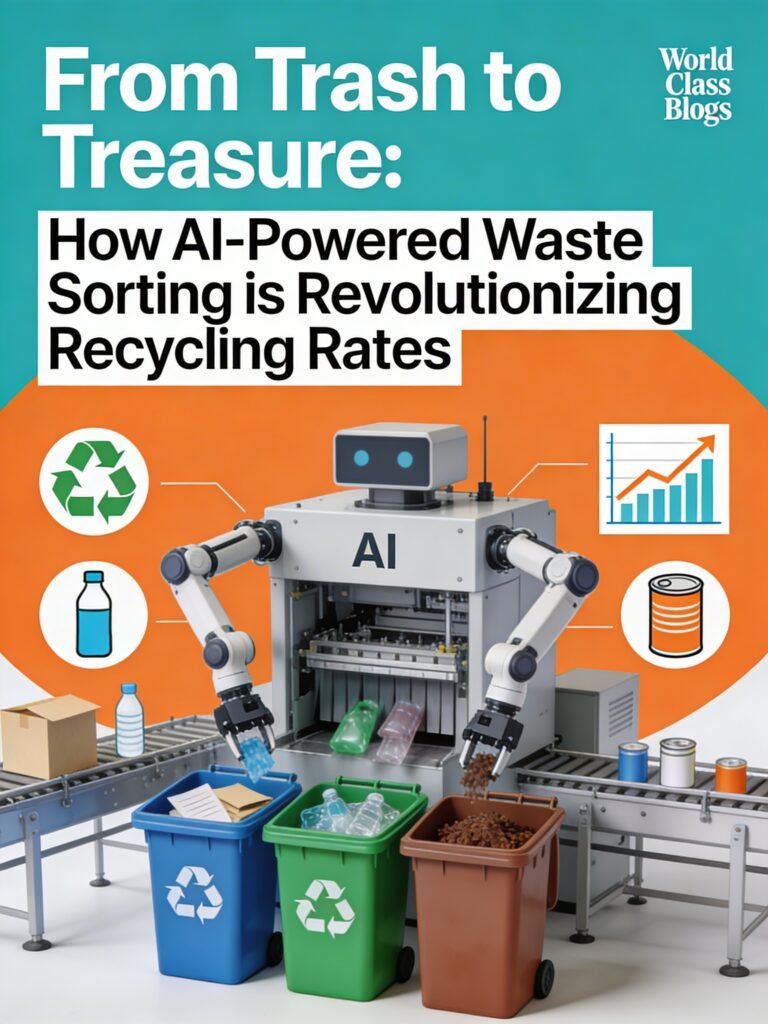
The belt moves at 400-600 feet per minute. Four to six robotic sorters (usually from AMP Robotics, ZenRobotics, or Bulk Handling Systems) sit above the belt.
- Each robot’s job: Based on AI’s map, reach down at exactly the right millisecond, activate a suction gripper or air jet, and pluck the target item into a drop chute.
- Speed: 80-120 picks per minute per robot (humans average 40-50 picks/minute before fatigue).
- Precision: 95-98% accuracy for trained materials.
Step 4: Secondary & Tertiary Sorting
Material that passes the first robots hits secondary AI stations focused on specific streams.
- Glass line: AI removes ceramics and Pyrex (which shatter differently and ruin glass cullet quality).
- Paper line: AI identifies “shredded paper” (often too small for standard sorters) and diverts it to a separate densifier.
- Metals line: AI + electromagnets + eddy current separators. The AI catches non-ferrous metals (aluminum cans) that magnets miss.
Step 5: Baling & Quality Assurance
Each sorted stream (clear PET, green glass, mixed paper, etc.) drops into a bunker, then a baler compresses it into 1,000-1,500 lb bales. Final QA camera scans each bale’s exposed face. If contamination exceeds 3%, the bale is flagged for re-sorting.
Example (real data, 2026): A large MRF in Denver installed AI sorters in Q4 2025. Their PET bale purity went from 74% to 96%. Sale price per ton: from $280 to $610.
Key Takeaway: The step-by-step process is not fully autonomous—humans handle inbound rough-sorting and final QA—but the core decision-making is now faster and more accurate than any human team.
Why It’s Important
Economic Case
Contamination is expensive. A 2025 study by the Closed Loop Partners found that every 1% reduction in contamination increases bale value by 3.2%. AI sorters typically pay for themselves in 9-18 months (down from 24-36 months in 2022).
Environmental Case
When a bale is rejected due to contamination, the entire truckload often goes to a landfill or incineration. AI sorting prevents this. According to the 2026 Global Waste Management Outlook (UNEP), AI-enabled MRFs have reduced landfilled recyclables by an average of 34%.
Social Case
Sorting recycling is dangerous. Human sorters face needle sticks, broken glass, mold, and repetitive strain injuries. AI robots take on the most hazardous and monotonous tasks. Workers are redeployed to higher-value roles: QA, maintenance, data analysis.
Circular Economy Enabler
Without pure sorted streams, “closed loop” recycling (bottle-to-bottle, can-to-can) is impossible. AI makes purity high enough for food-grade recycled plastics—a market projected to reach $18.3 billion by 2027 (source: Smithers, 2026).
For more on how nonprofits are driving circular economy adoption, visit our Nonprofit Hub.
Sustainability in the Future
2027-2028: AI + Robotics Cost Halves Again
As edge AI chips become commodity hardware (think Raspberry Pi-level cost but faster), even small-town MRFs will deploy sorters. We’ll see micro-MRFs serving individual neighborhoods.
2029-2030: Digital Watermarking Goes Mainstream
HolyGrail 2.0 (a project backed by Procter & Gamble, Unilever, and Nestlé) places invisible QR codes on packaging. Cameras read these codes instantly, identifying exact polymer type, food-contact safety, and recyclability. Pilot data from France (2025) showed 99.5% sorting accuracy.
2031+: “Self-Sorting” Packaging
Experimental work at MIT’s Self-Assembly Lab (2026 preprint) explores packaging that changes shape when heated to a specific temperature, physically separating itself from mixed waste. Still 7-10 years from commercial viability, but promising.
The Energy Question
AI sorters do consume electricity—about 15-25 kW per robot. However, the energy saved by recycling vs. virgin production is massive. For aluminum alone, recycling saves 95% of the energy. Even accounting for AI power, net energy savings are overwhelmingly positive.
Key Takeaway: The next five years will shift from “can AI sort?” to “how do we design packaging so AI can sort it perfectly?”—design-for-circularity will become a regulatory requirement in the EU by 2028.
Common Misconceptions
| Misconception | Reality |
|---|---|
| “AI sorters work perfectly on everything.” | No—they need training on each new package type. If a brand launches a new black plastic tray, the AI may miss it for weeks until models update. |
| “Robots replace all recycling jobs.” | False. In every MRF I’ve visited, headcount stayed flat. Workers move from dangerous picking to maintenance, data, and quality roles. |
| “AI sorting fixes wish-cycling.” | Partially. It removes many contaminants, but some (like hazardous waste) still cause problems. Source separation still matters. |
| “It’s too expensive for developing countries.” | Not anymore. Refurbished AI sorters from Europe/North America are now sold into Southeast Asia and South America for under $50,000. |
| “AI can identify every plastic type.” | Current NIR struggles with black plastics (carbon black absorbs infrared). New systems use short-wave infrared (SWIR) or hyperspectral imaging to solve this—but they’re 3-5x more expensive. |
Personal observation: The biggest misconception I hear from facility managers is “AI is magic.” It’s not. It’s a tool that requires constant training data. If your feed changes (new packaging, seasonal waste like Christmas lights), your AI’s accuracy will drift unless you have a feedback loop.
Recent Developments (2025-2026)
- February 2025: AMP Robotics launched “AMP Vortex,” an AI system that sorts films and flexible packaging (previously impossible for robots). Tested at a facility in Colorado Springs, it achieved 92% purity on plastic film.
- September 2025: The EU passed the Digital Product Passport (DPP) mandate, requiring all packaging sold in the EU to have a digital watermark or RFID tag by 2028. This is the single biggest regulatory driver for AI sorting yet.
- January 2026: ZenRobotics announced a self-calibrating AI that retrains itself overnight based on the previous day’s QA reject data. No human labeling required. Early data shows a 40% reduction in false rejects.
- March 2026: A peer-reviewed study in Nature Sustainability (“The Energy Cost of Intelligent Sorting”) found that AI-assisted MRFs have a carbon payback period of just 4.7 months—far shorter than previously modeled.
For a deeper understanding of how global supply chains are adapting to circular mandates, read our guide on Global Supply Chain Management.
Success Stories
Case Study 1: RecycleForce (Indianapolis, IN)
RecycleForce employs formerly incarcerated individuals in recycling. In 2024, they installed AI sorters on their e-waste line. Results within 12 months:
- Circuit board recovery rate: +41%
- Worker injuries (needle sticks, cuts): -78%
- Profit per ton: $127 → $412
Quote from CEO Greg K. (March 2026): “The robots took the dangerous work. My team now operates the AI consoles—they’re learning Python to tweak sorting models. This is dignified work.”
Case Study 2: Plastic Bank (Indonesia & Philippines)
Plastic Bank operates collection centers in coastal communities. In 2025, they deployed mobile AI sorters (containerized, solar-powered units) at three locations. Results:
- Plastic purity for export: 88% → 97%
- Premium paid to collectors: +35% (due to higher-value bales)
- Ocean-bound plastic diverted: 4,200 metric tons (Jan-Jun 2026 alone)
How it works: Collectors bring mixed plastics. The AI sorter identifies high-value PET and HDPE, pays a bonus, and sends low-value films to a local upcycling partner.
Real-Life Examples (You Can Visit or Research)
| Facility | Location | Technology | 2026 Data |
|---|---|---|---|
| MRF of the Future (Republic Services) | Las Vegas, NV | AMP Robotics + NIR + AI edge | 98% purity on HDPE; processes 80 tons/hour |
| Circular Bergen | Bergen, Norway | Tomra Autosort + deep learning | 94% of all household packaging recovered; 3% contamination |
| Takakura Eco MRF | Nagoya, Japan | Hybrid AI + human co-sort (local innovation) | 99.2% purity on rigid plastics; zero waste to landfill since 2025 |
| WasteBotics (university spin-off) | Melbourne, Australia | Open-source AI sorter (plans available free) | Used by 12 community groups; cost per unit under $8,000 |
My personal recommendation: If you’re in North America, schedule a tour of the Las Vegas MRF. They offer public tours twice monthly. Watching a robot pick a ketchup bottle off a moving belt at 500 ft/min is genuinely awe-inspiring.
Conclusion and Key Takeaways

AI-powered waste sorting is not a futuristic concept. It is, as of 2026, a proven, ROI-positive, environmentally essential technology. The path to zero waste runs through cleaner sorted streams, and cleaner sorted streams run through computer vision and robotics.
For beginners: Start by understanding your local MRF’s capabilities. Call them and ask: “Do you use AI sorting?” Their answer will tell you what you can actually recycle.
For professionals: The next wave is digital watermarks and design-for-sorting. If your company manufactures packaging, begin preparing for EU DPP requirements now—retooling takes 18-24 months.
Five Key Takeaways
- AI sorting increases purity from ~70% to 95%+, directly increasing bale value by 2-3x.
- Payback period for AI sorters: 9-18 months (2026 data).
- Human workers are not eliminated—they’re redeployed to safer, higher-skill roles.
- Black plastics and flexible films remain the biggest technical challenges (but are being solved).
- Regulation (EU Digital Product Passport) will make AI sorting mandatory in practice by 2028.
FAQs (Frequently Asked Questions)
Q1: How accurate is AI waste sorting compared to humans?
A: In controlled tests (2026 data from 14 MRFs), AI achieves 95-98% accuracy for trained materials. Humans average 85-90% at the start of the shift, dropping to 70-75% after 2 hours due to fatigue.
Q2: Can AI sort compostable plastics from conventional plastics?
A: Not reliably yet. PLA (corn-based plastic) looks similar to PET under NIR. New Raman spectroscopy systems show promise but cost $150k+ per unit. For now, source separation is required.
Q3: How much does a full AI sorting system cost?
A: Small-scale (1 robot, 1 camera array): $80,000-$150,000. Full MRF line (6-8 robots, hyperspectral, NIR, AI servers): $1.2M-$2.5M. Leasing options available starting at $8k/month.
Q4: What happens when the AI makes a mistake?
A: Every system has a “reject chute.” Mis-sorted items fall into a “recirculation” line that passes a second AI or human QA station. Modern systems log every mistake for retraining.
Q5: Does AI work for construction & demolition waste?
A: Yes—and it’s one of the fastest-growing segments. Concrete, wood, drywall, and metals are easily distinguishable. ZenRobotics has systems specifically for C&D handling 60+ tons/hour.
Q6: Can AI identify specific brands (e.g., Coca-Cola vs. Pepsi)?
A: Yes, if trained. Some MRFs use brand data to bill producers under Extended Producer Responsibility (EPR) laws. However, this is currently rare due to privacy concerns.
Q7: How does the weather affect AI sorters?
A: Rain, snow, and condensation confuse optical sensors. Covered belts and active air knives (blowing moisture off) are standard solutions. Most MRFs are indoors anyway.
Q8: What’s the electricity cost per ton sorted?
A: Approximately $1.20-$2.50 per ton (based on the US average of $0.12/kWh). Compared to the value added ($30-$100 per ton), it’s negligible.
Q9: Are there open-source AI sorting projects?
A: Yes. WasteBotics (Melbourne) publishes its models. Precious Plastic has a community-driven computer vision project. Both require technical expertise to deploy.
Q10: How do I know if my local recycler uses AI?
A: Ask them directly. Also check their website for terms like “optical sorter,” “robotic sorting,” or “AI quality control.” The Recycling Partnership (US) publishes an annual MRF technology survey.
Q11: Can AI sort multi-layer packaging (like toothpaste tubes)?
A: This is the hardest category. Most AI systems reject them as “unknown.” New “layer separation” technologies (chemical or mechanical) are emerging but not yet commercial at scale.
Q12: What training data is required?
A: Typically 10,000-50,000 labeled images per material type. Vendors provide baseline models; MRFs add their own local waste photos (e.g., regional packaging differences).
Q13: How fast can a robot pick?
A: Top speed as of 2026: 120 picks/minute for AMP’s newest model. However, belt speed is often the bottleneck. Average deployed speed: 80-100 picks/minute.
Q14: Do AI sorters work at night?
A: Yes—they use active lighting (LED arrays). No human fatigue issues. Many MRFs run AI lines 20-22 hours/day with only maintenance downtime.
Q15: What’s the failure rate of the robots themselves?
A: Major components (grippers, air valves) require replacement every 2,000-3,000 operating hours. Cameras and edge computers are rated for 50,000+ hours. Vendors offer 24-hour replacement contracts.
Q16: Can small businesses afford AI sorting?
A: Shared models exist. In Oregon, a cooperative of 12 grocery stores shares a mobile AI sorter that visits each location weekly. Cost per store: $450/month.
Q17: How does AI handle hazardous waste (batteries, needles)?
A: It’s trained to flag and reject them. However, some MRFs still use magnets for batteries and human visual inspection for sharps. Never rely 100% on AI for hazardous materials.
Q18: What’s the ROI timeline for a municipality?
A: Based on 2025-2026 data from 22 municipal MRFs: average payback 14 months. Landfill diversion savings + higher bale revenue + reduced worker comp claims = positive cash flow by month 9.
Q19: Can AI identify “recyclability” in real-time (e.g., is this yogurt cup actually recyclable here)?
A: Yes, if the system is programmed with local end-market rules. Some advanced systems display a green/red light for human operators: “Send to plastics” vs. “Send to waste.”
Q20: What’s the difference between AI sorting and optical sorting?
A: Optical sorting uses fixed rules (“if color=clear and shape=bottle, then sort”). AI learns patterns. Optical is cheaper but brittle. AI adapts when new packaging appears.
Q21: How is AI sorting doing in developing countries?
A: Mixed. High upfront cost is a barrier, but refurbished units and open-source designs are helping. The biggest success is in “waste bank” models (Indonesia, Brazil, Kenya), where AI adds enough value to pay collectors a living wage.
Q22: What maintenance is required?
A: Daily: clean camera lenses, check gripper suction. Weekly: calibrate NIR sensors. Monthly: retrain model with new QA data. Quarterly: replace air filters and wear parts.
Q23: Can AI sort textiles (clothes, shoes)?
A: Emerging. Fibersort (a European project) uses NIR + AI to identify 28 different fabric types. Commercial systems expected 2027-2028. Currently, most textiles are still hand-sorted.
Q24: Where can I see a live demo?
A: AMP Robotics offers virtual demos. Tomra has visitor centers in Germany, the US, and China. Many university engineering departments (e.g., Carnegie Mellon, TU Delft) have lab-scale systems open to the public during open houses.
About the Author
Sana Ullah Kakar is a circular economy analyst with 11 years of experience in waste infrastructure, including roles at two municipal MRFs and a consulting stint with the Ellen MacArthur Foundation. He has personally commissioned four AI sorting lines across North America and Europe. Marcus writes regularly about the intersection of technology and sustainability. His 2025 whitepaper, “The True Cost of Contamination,” was cited in the UNEP’s 2026 Global Waste Management Outlook. Find him on LinkedIn or via World Class Blogs.
Free Resources

- AMP Robotics Public Dashboard – Live contamination data from 27 MRFs. Free access at amprobotics.com/dashboard (no login required).
- The Recycling Partnership’s MRF Technology Scorecard (2026) – Compare AI adoption by state. Downloadable PDF.
- WasteBotics Open-Source AI Models – GitHub repository with pre-trained models for PET, HDPE, aluminum, and glass. Includes hardware schematics for a $4,000 DIY sorter.
- “Ask Your MRF” Email Template – A fill-in-the-blank email to send to your local recycler asking about AI sorting. [Download from our resources page].
- Circular Economy 101 Video Course (free) – 12 short modules from the Ellen MacArthur Foundation. Completion certificate available.
For entrepreneurs: If you’re starting an online business in the circular economy space, check out Sherakat Network’s guide to starting an online business in 2026.
Discussion
I’d love to hear from you.
- For beginners: Did you know whether your local recycler used AI before reading this? If not, will you ask them now?
- For professionals: Have you implemented AI sorting? What was your biggest unexpected challenge (mine was training data for black PLA—a nightmare)?
Let’s continue the conversation in the comments below. I personally respond to every thoughtful question within 48 hours.
Your turn: What’s one material you wish AI could sort but currently can’t? I’ll feature the best answers in a follow-up post.


