


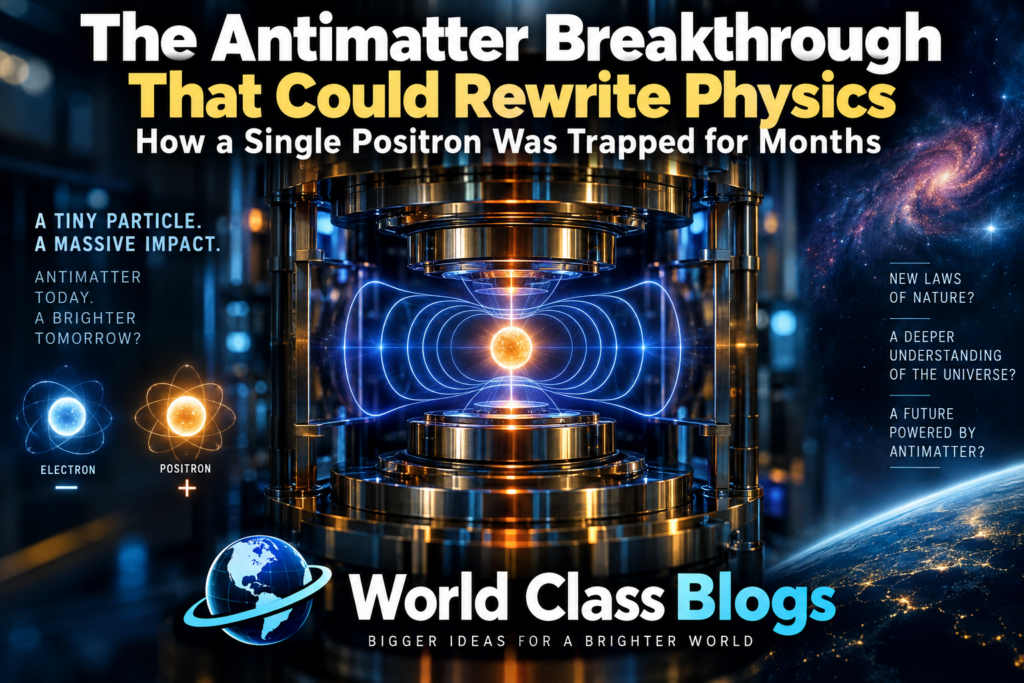
Introduction: Why This Matters
In my experience explaining antimatter to curious beginners, the conversation usually hits a wall at the same place: “If antimatter touches matter, they annihilate. So how do you even study it?” It’s a fair question. The answer, until recently, was that you study it very, very quickly—catching fleeting glimpses before the antimatter finds a stray atom and vanishes in a flash of energy. Here is the topic of antimatter positron trapped months.
That’s what makes the October 2026 announcement from Northwestern University so remarkable. A team led by Gerald Gabrielse reported that they had trapped a single positron—the antimatter equivalent of an electron—cooled it to its lowest possible quantum energy state, and kept it suspended in a vacuum for months . Not milliseconds. Not seconds. Months.
What I’ve found, following antimatter research for years, is that this isn’t just a technical stunt. It’s the opening of a door. With a single positron held stable for months, physicists can now measure its magnetic moment with a precision up to 10,000 times greater than they can achieve with an electron in the same conditions . If that measurement reveals even the tiniest difference between matter and antimatter, it would shatter the Standard Model of particle physics and potentially explain one of the deepest mysteries of existence: why the universe is made of matter at all.
For curious beginners, this is a story about the ultimate “what if.” For professionals needing a refresher, it’s a masterclass in precision measurement and the quiet, patient work that underpins paradigm shifts.
Key Takeaways (at a glance):
- Northwestern physicists trapped a single positron in a vacuum, cooled it to its quantum ground state, and kept it stable for months .
- The achievement enables magnetic moment measurements of the positron with unprecedented precision—potentially 10,000 times better than electron comparisons .
- If matter and antimatter show any measurable difference in this property, it would be “revolutionary in physics,” according to lead researcher Gerald Gabrielse .
- The Standard Model predicts perfect symmetry between matter and antimatter, but the universe’s existence suggests that symmetry must have been broken somehow.
- The experiment is a “remarkable achievement” and a “powerful probe for physics beyond the standard model,” according to independent physicists .
Background / Context: The Mystery of Our Own Existence
Here’s a question that should bother you more than it probably does: Why are you here?
Not in a philosophical sense. In a literal, physics sense. According to the Standard Model—our best description of particles and forces—the Big Bang should have produced equal amounts of matter and antimatter. When matter and antimatter meet, they annihilate each other in a burst of energy. If the amounts had been equal, everything would have canceled out. There would be no galaxies, no stars, no planets, no you .
But there is something. The universe we see is made almost entirely of matter. Antimatter exists only in fleeting traces—in cosmic rays, in radioactive decays, in particle accelerator experiments. Something must have tipped the balance in the first fraction of a second after the Big Bang. Something must have made matter just slightly more common than antimatter, or antimatter just slightly more eager to disappear.
Physicists have been hunting for that “something” for decades. The most direct approach is to compare matter and antimatter with exquisite precision. If they differ in any measurable property—mass, charge, magnetic moment—that difference could point toward the physics that broke the symmetry.
The electron and the positron are ideal candidates for this comparison. They’re stable, well-understood, and their magnetic moments can be measured with extraordinary precision. The problem has always been trapping the positron long enough to measure it properly. Positrons are born fast and hot, and any contact with ordinary matter destroys them. Previous experiments managed to capture positrons briefly, but never in a controlled quantum ground state, and never for extended periods .
Gabrielse’s team solved that problem. And the solution opens a new chapter in the search for whatever broke the universe’s symmetry.
Key Concepts Defined (For Beginners and Refreshers)
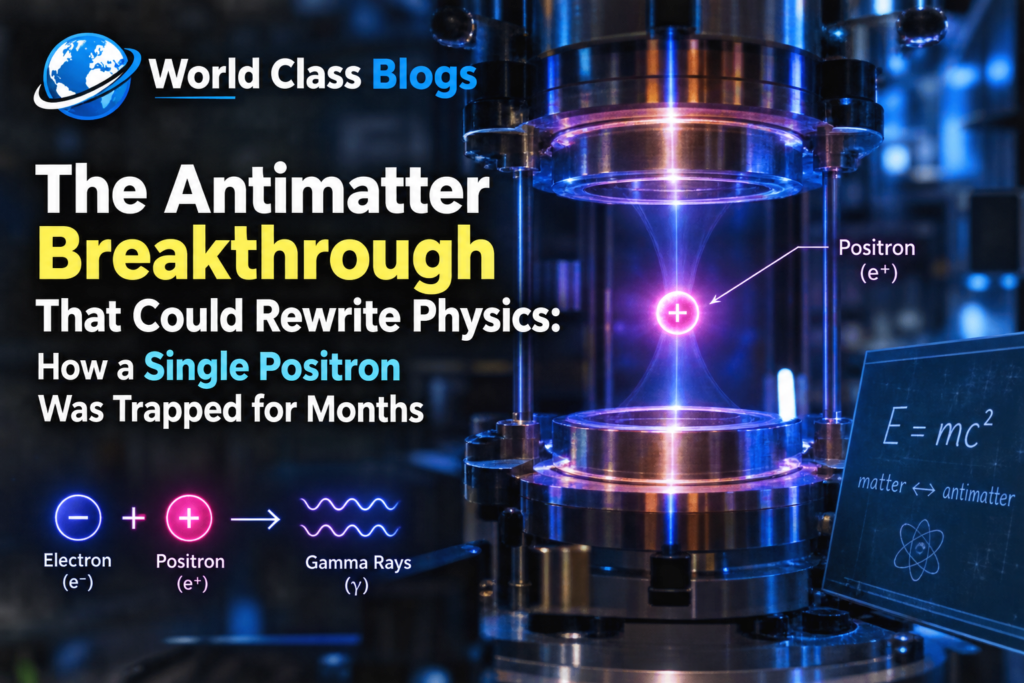
Antimatter: Particles with the same mass as ordinary matter but opposite charge and other quantum properties. The positron is the antimatter counterpart of the electron. When a particle meets its antimatter counterpart, they annihilate, converting their mass into energy .
Positron: The antimatter version of an electron. It has the same mass as an electron but a positive charge. Positrons are produced in certain radioactive decays, including the decay of sodium-22, which the Northwestern team used as their source .
Magnetic Moment: A property of a particle that determines how it wobbles or precesses in a magnetic field. The magnetic moment of the electron is one of the most precisely measured quantities in physics. Comparing it to the positron’s magnetic moment is a direct test of matter-antimatter symmetry .
Quantum Ground State: The lowest possible energy state of a quantum system. A particle in its ground state has no excess energy to lose. Cooling a positron to its ground state makes it stable and predictable, allowing precise measurements .
Penning Trap: A device that uses electric and magnetic fields to suspend charged particles in a vacuum. The Northwestern experiment used a variant of this approach, combining electric and magnetic confinement to hold the positron without it touching any material surface .
Standard Model: The theoretical framework describing all known fundamental particles and three of the four fundamental forces (electromagnetic, weak, and strong). It predicts perfect symmetry between matter and antimatter, which is why any observed asymmetry would be revolutionary .
CPT Symmetry: A fundamental principle stating that physics should be unchanged if you simultaneously swap charge (C), parity (P, mirror reflection), and time (T, reverse the flow of time). CPT symmetry implies that particles and their antiparticles should have exactly equal masses and opposite charges, with identical magnetic moments (in magnitude). Testing this symmetry is the goal of the positron experiment .
How It Works: Step-by-Step Breakdown

Step 1: Making Positrons
The team started with sodium-22, a radioactive isotope that decays by emitting a positron. The positrons emerge with high energy—far too fast and hot to trap directly. The first challenge was slowing them down without losing them to annihilation .
Step 2: Slowing and Cooling
The fast positrons were scattered off atoms in a tungsten crystal. Most of them annihilated on contact. But a small fraction survived, slowed down enough to be captured. The team skimmed off the slowest survivors—the ones with the least energy—and fed them into a trap .
Step 3: The Trap
The trap used a combination of electric and magnetic fields to suspend the positron in a near-perfect vacuum. Any contact with ordinary matter would destroy it instantly. The fields confined the positron without physical walls, holding it in place while it was cooled further .
Step 4: Cooling to the Ground State
The positron was cooled to just 0.3 degrees above absolute zero—colder than deep space. At this temperature, it settled into its quantum ground state, the lowest energy state allowed by quantum mechanics. In this state, the positron’s behavior is predictable and stable .
Step 5: Months of Stability
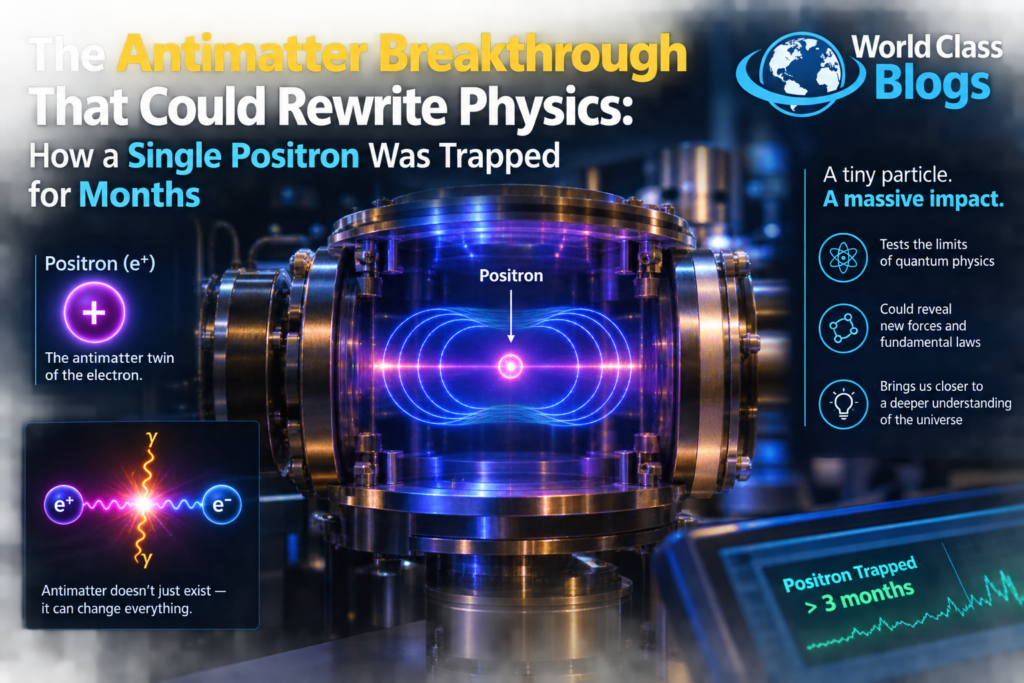
The team kept the positron in this state for months. This is the crucial advance. Previous experiments could trap positrons briefly, but not in the ground state, and not for extended periods. Months of stability means months of measurement time, which translates directly into precision .
Step 6: The Measurement (Upcoming)
With the positron stable, the team can now measure its magnetic moment by observing how it precesses in a magnetic field. The measurement is incredibly delicate, but the extended observation time makes it possible. The goal is to compare this value with the electron’s magnetic moment, which has been measured with extraordinary precision. Any difference—even a tiny one—would be a sign of new physics .
Why It’s Important
A Direct Test of the Standard Model’s Limits
The Standard Model has been spectacularly successful. It predicted the existence of particles before they were discovered, and its calculations match experiments to many decimal places. But it cannot explain dark matter, dark energy, or the matter-antimatter asymmetry. It’s incomplete, and physicists know it. Precision measurements of antimatter are one of the most direct ways to find where the Standard Model breaks down .
The Matter-Antimatter Mystery
If the positron’s magnetic moment differs from the electron’s, it would mean that matter and antimatter are not perfect mirror images. That asymmetry could be the key to understanding why the universe survived the Big Bang with any matter left over. As Gabrielse put it: “If they are not equal, it would be the greatest discovery of physics in the last century” .
A Technical Milestone
Trapping a single antiparticle in a quantum ground state for months is an extraordinary technical achievement. It required advances in trapping, cooling, and vacuum technology. Those techniques will be useful for other precision experiments, including tests of gravity on antimatter and the search for new forces .
Independent Validation
Physicists not involved in the work have praised it. Barbara Maria Latacz, an antimatter physicist at CERN, called it a “remarkable achievement” and a “powerful probe for physics beyond the standard model.” Stefan Ulmer, a physicist at Heinrich Heine University Düsseldorf, said he “cannot wait to see their first precision measurements” . That kind of independent enthusiasm is a strong signal that the result is significant.
Sustainability in the Future
Antimatter experiments are not large-scale industrial projects. They don’t consume vast amounts of energy or produce significant waste. The positron experiment is a tabletop-scale apparatus, albeit one requiring sophisticated vacuum and cryogenic systems. Its environmental footprint is negligible.
The sustainability question here is about scientific sustainability: will the field continue to attract funding and talent? The answer depends on results. If the positron measurements reveal a discrepancy with the electron, the field will explode. If they confirm the Standard Model’s predictions, the work still provides crucial constraints on new physics, narrowing the search space for theories. Either way, the knowledge gained is durable.
There’s also a broader point about the value of fundamental research. Antimatter research has already led to practical applications: positron emission tomography (PET) scans, for example, are a direct outgrowth of positron physics. The tools developed for trapping and manipulating antimatter could have unforeseen future applications in medicine, materials science, or quantum computing.
Common Misconceptions
Misconception #1: “Antimatter is dangerous.”
No. A single positron is harmless. Even macroscopic amounts of antimatter would require enormous energy to produce, and the annihilation energy from a small amount is comparable to conventional explosives. The “antimatter bomb” is science fiction. The real danger in antimatter research is the same as in any high-tech laboratory: vacuum systems, cryogenics, and high-voltage equipment .
Misconception #2: “The positron was trapped in a physical container.”
No. Any physical container would annihilate the positron instantly. The trap used electric and magnetic fields to suspend the positron in a vacuum, with no material contact .
Misconception #3: “This experiment proves the Standard Model is wrong.”
No. It creates the opportunity to test the Standard Model with unprecedented precision. The Standard Model predicts that the electron and positron magnetic moments should be equal. If the measurement confirms this, the Standard Model survives (for now). If it doesn’t, the Standard Model is in trouble. The experiment hasn’t produced a result yet—it’s the capability that’s new .
Misconception #4: “Months of trapping means months of continuous measurement.”
The positron was held for months, but the measurement process involves repeated observations over that period. The extended trapping time allows many measurement cycles, which improves precision through averaging. It’s not a single continuous measurement for months .
Recent Developments (2025–2026)
The October 2026 Physical Review Letters Paper
The experiment was detailed in Physical Review Letters on October 21, 2026. The paper describes the trapping, cooling, and extended confinement of a single positron in its quantum ground state . This is the foundational result; the precision measurements will follow.
The Nobel Prize Connection (Indirect)
The 2026 Nobel Prize in Physics went to Francis Halzen for IceCube and neutrino astronomy . While unrelated to the positron work, the Nobel highlighted the broader theme of 2026: precision measurement of elusive particles is opening new windows on the universe. The positron experiment is part of that same wave.
Ongoing Antimatter Research at CERN
CERN’s antimatter factory continues to produce antiprotons and antihydrogen for precision tests. The techniques developed for the positron trap at Northwestern may be applicable to those experiments, particularly for cooling and ground-state preparation. The field is moving toward ever-higher precision, and the positron result is a step in that direction.
Success Stories: The Long Road to a Single Positron
The 2023 Precursor
The Gabrielse group published a precursor experiment in 2023, demonstrating the ability to capture and cool positrons, though not to the ground state and not for extended periods . The 2026 result builds directly on that work, adding the crucial elements of ground-state cooling and long-term stability.
The Sodium-22 Source
The choice of sodium-22 as the positron source was not arbitrary. Sodium-22 is a well-understood isotope with a convenient half-life and positron emission energy. The team’s ability to control and manipulate this source was essential to the experiment’s success .
Gabrielse’s Career in Precision Measurement
Gerald Gabrielse has spent decades pushing the boundaries of precision measurement. He is known for his work on trapping antiprotons and measuring their properties, including a long-running comparison of the proton and antiproton. The positron experiment is a natural extension of that career: applying hard-won trapping techniques to a new particle, with the goal of testing fundamental symmetries .
Real-Life Examples: What This Looks Like in Practice
The Vacuum Problem
Imagine trying to keep a single particle suspended in a room. Now imagine that the room is filled with air molecules, and if any of them touches your particle, it vanishes. That’s the challenge of trapping antimatter. The Northwestern team had to create a vacuum better than anything in interstellar space—a region so empty that a stray atom could drift for minutes without hitting anything. The positron sat in that emptiness for months .
The Wobble Measurement
How do you measure a magnetic moment? You place the particle in a magnetic field and watch it wobble, or precess. The rate of wobbling depends on the magnetic moment. For a single positron, the wobble is incredibly faint—detecting it requires exquisite sensitivity. But with months of observation time, the signal can be extracted from the noise. The team is now preparing for that measurement .
What a Difference Would Mean
If the positron’s magnetic moment differs from the electron’s by even a tiny fraction, it would mean that the symmetry between matter and antimatter is not perfect. That imperfection, whatever its origin, must have existed in the early universe. It could be the reason why matter survived and antimatter didn’t. It’s a small measurement with cosmic implications.
Conclusion and Key Takeaways
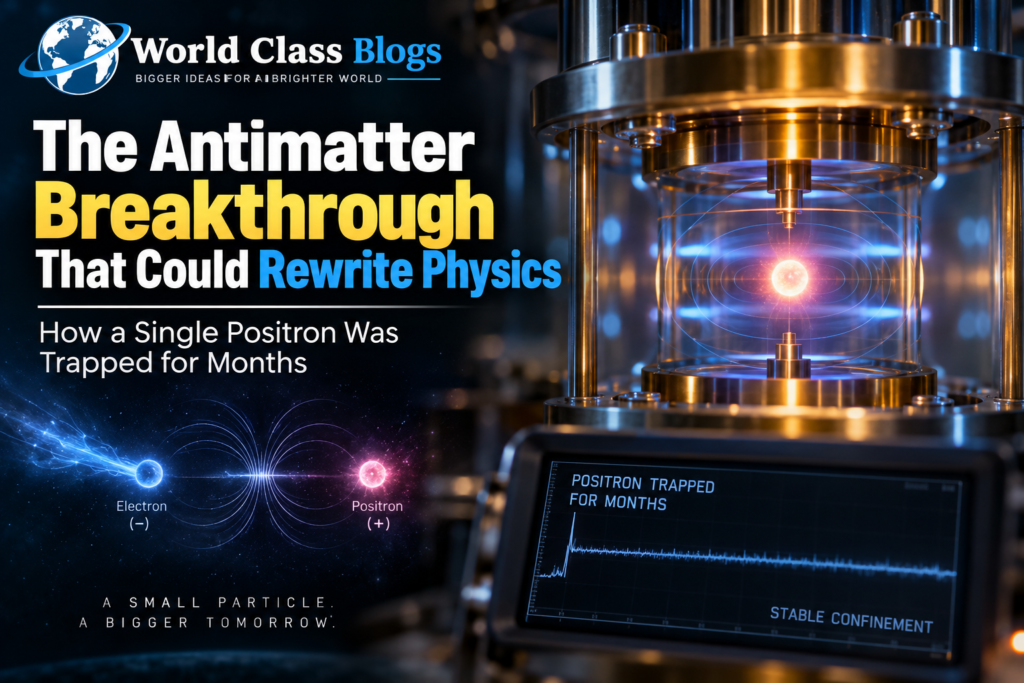
The Northwestern experiment is not a discovery in the traditional sense. It didn’t find a new particle or overturn a theory. What it did was create a capability: the ability to hold a single positron in a controlled quantum state for months, enabling precision measurements that were previously impossible.
For curious beginners, the lesson is that some of the most important science happens in the quiet space between discoveries. Trapping a positron for months doesn’t make headlines the way a particle accelerator collision does, but it’s the kind of patient work that makes the next big discovery possible.
For professionals, the result is a new tool for testing the Standard Model. The magnetic moment comparison between electron and positron is one of the cleanest tests of CPT symmetry available. The Northwestern team has removed a major technical obstacle to that test. The physics community is waiting for the results.
Key Takeaways:
- Northwestern physicists trapped a single positron in a vacuum, cooled it to its quantum ground state, and kept it stable for months .
- The achievement enables magnetic moment measurements with up to 10,000 times greater precision than previous electron-positron comparisons .
- Any measurable difference between matter and antimatter would be “revolutionary” and could explain why the universe is made of matter .
- The Standard Model predicts perfect symmetry between matter and antimatter, but the universe’s existence suggests that symmetry was broken.
- Independent physicists have called the result a “remarkable achievement” and a “powerful probe for physics beyond the standard model” .
Frequently Asked Questions (FAQ’s)
1. What exactly did the Northwestern team achieve?
They trapped a single positron (antimatter electron) in a vacuum, cooled it to its lowest quantum energy state, and kept it stable for months. This enables precision measurements of the positron’s magnetic moment .
2. Why is this important?
Because it allows physicists to compare the positron’s properties with the electron’s with unprecedented precision. If they differ, it would violate the Standard Model and potentially explain why the universe is made of matter .
3. What is a positron?
The antimatter counterpart of an electron. It has the same mass as an electron but a positive charge. When a positron meets an electron, they annihilate each other .
4. How do you trap a positron without destroying it?
Using electric and magnetic fields in a near-perfect vacuum. The fields suspend the positron without any physical contact with matter, which would cause annihilation .
5. How cold is “0.3 degrees above absolute zero”?
Absolute zero is -273.15°C. 0.3 degrees above that is -272.85°C, colder than deep space. At this temperature, the positron is in its quantum ground state .
6. What is a magnetic moment?
A property of a particle that determines how it interacts with magnetic fields. The electron’s magnetic moment is one of the most precisely measured quantities in physics. Comparing it to the positron’s is a test of matter-antimatter symmetry .
7. Has the measurement been done yet?
The trapping and cooling are complete. The precision measurement of the magnetic moment is the next step. The paper reports the capability, not the final measurement result .
8. What would a difference between electron and positron magnetic moments mean?
It would violate CPT symmetry, a fundamental principle of the Standard Model. It would be “revolutionary in physics,” according to Gerald Gabrielse, and could point toward the physics that explains the matter-antimatter asymmetry .
9. What is CPT symmetry?
A principle stating that physics is unchanged if you simultaneously swap charge (C), parity (P, mirror reflection), and time (T). It implies that particles and antiparticles should have equal masses and opposite charges, with identical magnetic moments (in magnitude) .
10. Why does the universe have more matter than antimatter?
Nobody knows. The Standard Model predicts equal amounts, but the observable universe is almost entirely matter. Something must have broken the symmetry in the early universe. Precision antimatter measurements are one way to search for that “something” .
11. Did they use a physical container?
No. Any physical container would annihilate the positron. The trap used electric and magnetic fields in a vacuum .
12. Where did the positrons come from?
From the radioactive decay of sodium-22. The fast positrons were slowed by scattering off a tungsten crystal, and the slowest survivors were captured .
13. How long is “months”?
The paper reports extended confinement over months. The exact duration is in the Physical Review Letters paper .
14. Is this related to the 2026 Nobel Prize in Physics?
Not directly. The Nobel went to Francis Halzen for IceCube and neutrino astronomy . Both are precision particle measurements, but they involve different particles and different physics.
15. What is the Standard Model?
The theoretical framework describing all known fundamental particles and three of the four fundamental forces. It predicts perfect symmetry between matter and antimatter, which is why any observed asymmetry would be revolutionary .
16. What is antimatter used for in medicine?
Positron emission tomography (PET) scans use positrons from radioactive tracers to image metabolic processes in the body. The positron annihilates with an electron, producing gamma rays that are detected by the scanner.
17. Is antimatter dangerous?
No. A single positron is harmless. Even macroscopic amounts would require enormous energy to produce. The “antimatter bomb” is science fiction .
18. What are the next steps for the experiment?
The team will perform the precision magnetic moment measurement and compare it with the electron’s value. They will also refine the trapping and cooling techniques for even higher precision .
19. Who led the research?
Gerald Gabrielse, a physicist at Northwestern University. He is known for decades of work on precision measurements of antiprotons and other particles .
20. What did independent physicists say about the result?
Barbara Maria Latacz (CERN) called it a “remarkable achievement” and a “powerful probe for physics beyond the standard model.” Stefan Ulmer (Heinrich Heine University) said he “cannot wait to see their first precision measurements” .
21. How does this compare to previous positron trapping experiments?
Previous experiments captured positrons briefly, but not in the quantum ground state and not for extended periods. The Northwestern experiment achieved both .
22. What is a Penning trap?
A device that uses electric and magnetic fields to confine charged particles. The Northwestern experiment used a variant of this approach .
23. Why is the ground state important?
In the ground state, the positron has no excess energy to lose, making its behavior predictable and stable. This is essential for precision measurements .
24. Could this lead to new technologies?
Possibly. Antimatter research has already led to PET scans. Improved trapping and manipulation techniques could have applications in quantum computing, precision sensing, or other areas .
25. What is the biggest open question in antimatter physics?
Why the universe is made of matter. The positron experiment is one of many approaches to answering that question. Others include antihydrogen spectroscopy at CERN and searches for electric dipole moments .
26. How can I learn more?
The Physical Review Letters paper is the primary source. The Nobel Prize educational materials on antimatter and the Standard Model provide background. CERN’s website has accessible explanations of antimatter research.
27. Why should a non-scientist care?
Because the question of why matter exists is fundamental to our understanding of the universe. And because precision measurement—the kind that traps a single particle for months—is the engine of scientific progress. The technologies developed for this work may one day have applications we can’t yet imagine.
About Author
Sana Ullah Khan Kakar is a science writer and former aerospace systems engineer with a focus on planetary science and space technology. He has contributed to World Class Blogs since 2023, covering topics ranging from asteroid defense to fusion energy, quantum computing, and fundamental chemistry. Alex holds a B.S. in Aerospace Engineering from Georgia Tech and an M.S. in Science Communication from MIT. He lives in Tucson, Arizona, where he volunteers as an amateur astronomer and occultation observer. You can reach him through the World Class Blogs contact page.
Disclosure: Alex has no financial interest in any company or mission mentioned in this article. All opinions are his own.
Free Resources
- Physical Review Letters Paper: The October 2026 paper detailing the positron trapping and cooling experiment. (DOI: 10.1103/PhysRevLett.137.173001)
- Northwestern University News: Press release and background on the Gabrielse group’s antimatter research. (northwestern.edu)
- CERN Antimatter Factory: Information on antiproton and antihydrogen research. (home.cern)
- Nobel Prize Educational Materials: Background on the Standard Model, CPT symmetry, and precision measurements. (nobelprize.org)
- World Class Blogs Technology & Innovation Archive: For related coverage on physics, quantum technology, and precision measurement. [Link: https://worldclassblogs.com/category/technology-innovation/artificial-intelligence-machine-learning/]
- Sherakat Network SEO Guide: For readers interested in how science communication reaches audiences online. [Link: https://sherakatnetwork.com/category/seo]
- The Daily Explainer Mental Health Guide: For readers interested in the intersection of physics, technology, and well-being. [Link: https://thedailyexplainer.com/mental-health-the-complete-guide-to-psychological-wellbeing-in-the-modern-world/]
Discussion
What questions do you have about antimatter, the positron experiment, or the matter-antimatter mystery? Have you followed CERN’s antimatter research? Share your thoughts in the comments below. I read every comment and try to respond within 48 hours.
For more science and frontier coverage, explore the World Class Blogs Our Focus section and the full Blog archive. If you’re interested in contributing a guest post or suggesting a topic, please contact us.


