


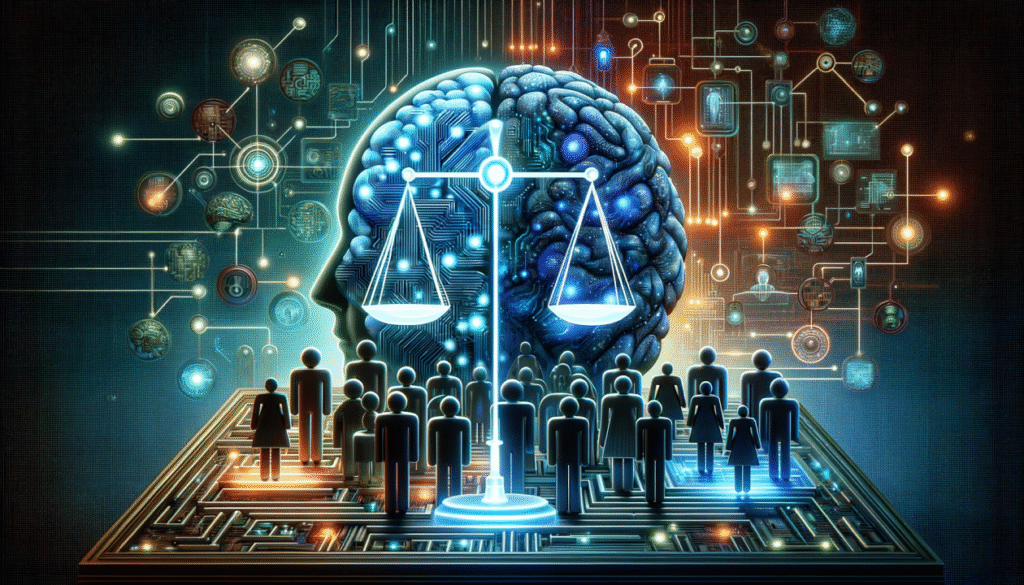
Introduction: The Unseen Consequences of Intelligent Systems
As artificial intelligence systems become increasingly embedded in our daily lives—from determining creditworthiness to screening job applications to assisting in medical diagnoses—a crucial conversation has emerged from research labs and tech boardrooms into the public sphere: the ethics of AI. While the potential benefits of AI are tremendous, we are simultaneously discovering that these systems can perpetuate and even amplify societal biases, threaten personal privacy, and operate as “black boxes” that make inexplicable decisions affecting human lives. Understanding Ethical AI is no longer an academic exercise; it’s an urgent imperative for developers, businesses, and policymakers alike.
This article delves into the critical ethical challenges at the heart of modern AI development. We will move beyond the hype to confront the real risks and responsibilities associated with creating intelligent systems. The goal is not to stifle innovation but to guide it toward outcomes that are fair, transparent, and beneficial for all of humanity, not just a privileged few. For context on how these systems work, refer to our previous article on Demystifying AI.
Background/Context: From Technical Challenge to Social Crisis
The field of AI ethics has exploded into prominence following several high-profile failures and scandals. In 2018, Amazon scrapped an internal AI recruiting tool after discovering it was penalizing applications that included the word “women’s” (like “women’s chess club captain”) and showed bias against graduates of all-women’s colleges. Similarly, studies of facial recognition technologies have revealed significantly higher error rates for women and people with darker skin tones.
These incidents highlighted a fundamental truth: AI systems are not inherently objective. They learn from data generated by humans, and if that data reflects historical or social inequalities, the AI will learn those too. The rapid deployment of these systems across critical sectors like criminal justice, healthcare, and finance, as explored in our piece on Machine Learning in Industries, has turned what was once a technical concern into a potential social crisis. This has sparked a global movement toward developing frameworks for responsible AI, involving not just technologists but also ethicists, sociologists, and lawmakers.
Key Concepts Defined
- Algorithmic Bias: Systematic and repeatable errors in a computer system that create unfair outcomes, such as privileging one arbitrary group of users over others.
- Explainable AI (XAI): Methods and techniques that make the results and decisions of AI models understandable to human experts, moving away from “black box” models.
- AI Governance: The legal frameworks, standards, and practices that ensure AI technologies are developed and deployed responsibly and in alignment with human values.
- Fairness in ML: The concept that an ML model’s predictions should not be disproportionately unfavorable to individuals based on their sensitive attributes (e.g., race, gender).
- Data Privacy: The right of individuals to control how their personal information is collected, used, and shared, a major concern in AI systems that often require vast amounts of data.
- Model Transparency: The degree to which the inner workings of an AI model can be understood and audited by people.
How It Works: Identifying and Mitigating Ethical Risks (A Step-by-Step Framework)


Building ethical AI requires a proactive, systematic approach integrated throughout the development lifecycle.
Step 1: Diverse Team Assembly
The first line of defense against bias is diversity. Homogeneous teams are more likely to overlook potential harms to groups they are not part of.
- Action: Ensure your development team includes people of different genders, ethnicities, cultural backgrounds, and disciplines (not just engineers).
Step 2: Problem Formulation and Impact Assessment
Before writing a single line of code, critically assess the problem you’re solving.
- Action: Ask: “Who could be adversely affected by this system? What are the potential misuse cases? Could this system create or reinforce unfair bias?” Document these risks.
Step 3: Bias-Aware Data Collection and Auditing
Since bias often stems from data, this stage is critical.
- Action:
- Audit Your Datasets: Check for representation gaps. Does your training data adequately represent all groups the model will serve?
- Identify Proxies: Be aware that certain neutral-sounding variables (like zip code) can act as proxies for sensitive attributes (like race), potentially leading to discriminatory outcomes.
Step 4: Model Selection and Fairness Testing
Choose models that allow for a degree of interpretability and rigorously test for fairness.
- Action:
- Use fairness metrics (e.g., demographic parity, equalized odds) to evaluate your model’s performance across different subgroups.
- Consider techniques like adversarial de-biasing, where a second model is used to punish the main model for making predictions based on sensitive attributes.
Step 5: Ensuring Transparency and Explainability
Build systems that can explain their reasoning.
- Action:
- For high-stakes applications (like loan approvals or medical diagnoses), prioritize inherently interpretable models or use Explainable AI (XAI) tools like LIME or SHAP to generate post-hoc explanations.
- A rejection for a loan application should be explainable, e.g., “Application denied due to high debt-to-income ratio,” not just “AI said no.”
Step 6: Human-in-the-Loop (HITL) Design
For critical decisions, maintain meaningful human oversight.
- Action: Design the system so that a human expert reviews the AI’s recommendations, especially in high-risk domains like healthcare or criminal justice. This balances automation with human judgment.
Step 7: Continuous Monitoring and Feedback Loops
An ethical AI system is not a “set it and forget it” product.
- Action:
- Monitor the model’s performance in the real world to detect “model drift” or emerging biases.
- Create clear channels for users to appeal or report problematic outcomes, turning them into a feedback mechanism for improvement.
Why It’s Important: The Stakes of Getting It Wrong
The consequences of ignoring AI ethics are severe and far-reaching:
- Perpetuation of Discrimination: Biased algorithms in hiring, lending, or policing can systematically disadvantage marginalized groups, cementing existing inequalities.
- Erosion of Trust: When people feel that AI systems are unfair or inexplicable, they lose trust not only in the technology but in the institutions that deploy it. This can be devastating for businesses and governments alike.
- Legal and Reputational Risk: Companies face increasing regulatory scrutiny under laws like the EU’s AI Act and potential lawsuits for discriminatory outcomes. The reputational damage from an ethical AI failure can be irreversible.
- Safety and Security Threats: Unethical use of AI in autonomous weapons or mass surveillance systems poses existential threats to global security and individual freedoms.
- Stifled Innovation: A public backlash against unethical AI could lead to overly restrictive regulations that hinder beneficial innovation.
Common Misconceptions About Ethical AI
- Misconception 1: Ethical AI is just about removing bias. Reality: While bias is a major component, Ethical AI also encompasses privacy, transparency, accountability, safety, and the broader societal and environmental impact.
- Misconception 2: Making AI fair means making it less accurate. Reality: Often, a model that appears highly accurate is performing well only for the majority group. Improving fairness can mean improving accuracy for underrepresented groups, leading to a more robust and truly accurate system overall.
- Misconception 3: If we use “neutral” data, the AI will be neutral. Reality: Data is a reflection of our world, which is full of historical and social biases. Neutrality is not the default; it must be actively engineered through careful design and testing.
- Misconception 4: Ethics are too subjective to be built into technology. Reality: While some ethical questions are philosophical, many aspects—like non-discrimination, privacy, and safety—are supported by clear laws and societal norms that can be operationalized into technical requirements.
Recent Developments: The Global Push for Governance


The field of AI ethics is rapidly evolving from principles to practice:
- The EU AI Act: The world’s first comprehensive AI law, which takes a risk-based approach, banning certain AI applications (like social scoring) and imposing strict requirements on high-risk systems.
- The U.S. AI Bill of Rights: A blueprint for building and deploying automated systems that protect the American public.
- Corporate AI Principles: Major tech companies have published their own AI principles and established internal ethics boards, though their effectiveness is often debated.
- Algorithmic Auditing: A growing industry of third-party firms that audit AI systems for bias, fairness, and compliance, similar to financial audits.
Case Study: The COMPAS Recidivism Algorithm
The Problem: The Correctional Offender Management Profiling for Alternative Sanctions (COMPAS) algorithm was used by U.S. courts to predict the likelihood of a defendant re-offending. This score influenced decisions about bail, sentencing, and parole.
The Ethical Failure: A 2016 investigation by ProPublica found that the algorithm was biased against Black defendants. They were twice as likely as white defendants to be misclassified as higher risk, while white defendants were more often misclassified as lower risk.
The Lesson: This case became a landmark example of how a poorly designed AI system can perpetuate real-world injustice. It highlighted the critical need for algorithmic fairness audits, transparency, and accountability in high-stakes applications. It also underscored that the goal of a system must be clearly defined and aligned with human values—predicting “recidivism” based on arrest data is not the same as predicting actual criminal behavior.
Real-Life Examples of Ethical AI in Action
- IBM’s AI Fairness 360 Toolkit: An open-source library containing metrics to check for unwanted bias in datasets and models, and algorithms to mitigate that bias.
- Google’s “What-If” Tool: Allows users to visually probe the behavior of trained ML models, performing fairness analysis and counterfactual investigations with minimal code.
- The City of Helsinki’s AI Register: A public, online register that explains how the city uses AI algorithms to provide services, a leading example of AI transparency in government.
Conclusion & Key Takeaways
Building Ethical AI is a complex, multi-faceted challenge, but it is not an insurmountable one. It requires a shift in mindset—from viewing ethics as a constraint to seeing it as a core component of quality, safety, and long-term viability.
Key Takeaways:
- Proactivity is Paramount: Ethical considerations must be integrated from the very beginning of the AI development lifecycle, not bolted on at the end.
- Bias is a Bug, Not a Feature: Actively test for and mitigate bias as you would any other critical software bug.
- Transparency Builds Trust: Strive for explainability, especially for decisions that significantly impact people’s lives, opportunities, or access to services like personal finance.
- Diversity is a Technical Requirement: Diverse teams are essential for identifying blind spots and building systems that work well for everyone.
- Ethics is a Continuous Process: Ongoing monitoring, auditing, and feedback are necessary to maintain ethical standards as the AI operates in a changing world.
The future of AI should be shaped by a commitment to human dignity and fairness. By embracing this responsibility, we can harness the incredible power of AI to create a more just and equitable world. For more insights into the responsible implementation of technology, explore our Our Focus section.
Frequently Asked Questions (FAQs)
1. What is the most common type of bias in AI?
Historical bias, where the training data reflects existing societal prejudices and inequalities, is the most common and challenging type to address.
2. Can an AI be 100% unbiased?
Perfect, absolute fairness is a theoretical ideal that is difficult to achieve in practice. The goal is to proactively identify and minimize bias to levels that are acceptable and non-harmful.
3. Who is legally responsible when an AI makes a harmful decision?
This is a rapidly evolving area of law. Generally, the company or organization that deploys the AI system is held liable for its actions and outcomes.
4. How does AI threaten data privacy?
AI systems, particularly large machine learning models, often require massive datasets for training, which can include personal information. There’s a risk of this data being misused, breached, or used to make intrusive inferences about individuals.
5. What is “ethics washing” in AI?
When a company promotes high-level ethical principles for PR purposes but fails to implement meaningful changes in its practices or governance structures.
6. How can I check if an AI system is biased?
Look for disparities in performance or outcomes across different demographic groups. Independent audits and demanding transparency from vendors are key steps.
7. What are the key principles of Ethical AI?
Common principles include: Fairness, Accountability, Transparency, Privacy, Safety, and Inclusivity.
8. How does AI ethics relate to mental health?
Unethical AI, such as social media algorithms that promote harmful content or create unrealistic beauty standards, can negatively impact mental health, especially among young people.
9. What is the Trolley Problem in AI ethics?
A thought experiment about an autonomous vehicle that must choose between two bad outcomes (e.g., hit one person or five). It highlights the difficulty of programming moral reasoning into machines.
10. Are there jobs in AI ethics?
Yes, roles like AI Ethicist, Responsible AI Lead, and AI Governance Manager are growing rapidly in both industry and academia.
11. How can governments promote Ethical AI?
By creating clear regulatory frameworks (like the EU AI Act), funding research into AI safety and fairness, and using their procurement power to demand ethical practices from vendors.
12. What is “model cards” or “datasheets for datasets”?
A practice of documenting the intended use, limitations, and performance characteristics of models and datasets to improve transparency and responsible use.
13. Can open-source AI be more ethical?
Open-source can promote transparency and broader scrutiny, but it also allows potentially unethical uses by bad actors. The relationship is complex.
14. How does AI bias affect ecommerce?
Biased recommendation engines might steer certain demographic groups toward lower-quality products or different price points, a practice known as “price discrimination.”
15. What is the role of consent in AI ethics?
Individuals should have agency over how their data is used to train AI systems. Informed consent is a cornerstone of ethical data practices.
16. How can small businesses implement Ethical AI?
Start by using validated, audited third-party AI tools instead of building from scratch, and conduct basic impact assessments for any new AI deployment.
17. What is “AI for Social Good”?
A movement focused on applying AI to address pressing societal challenges, such as poverty, climate change, and inequality, aligning with the missions of many organizations in our Nonprofit Hub.
18. How is AI used in unethical surveillance?
Facial recognition and predictive policing algorithms can be used for mass surveillance, infringing on civil liberties and targeting marginalized communities.
19. What is the difference between fairness and equality in AI?
Equality means treating everyone the same. Fairness might require giving more resources or different treatment to disadvantaged groups to achieve equitable outcomes.
20. Can AI have moral agency?
No, current AI lacks consciousness and intentionality. The moral and legal responsibility always lies with the humans who design, deploy, and use it.
21. How does AI impact global supply chain ethics?
AI can optimize for both efficiency and ethical sourcing by tracking labor practices and environmental impact, but it can also be used to exploit workers through excessive monitoring.
22. What is an “ethics committee” for AI?
A multi-disciplinary group within an organization that reviews high-risk AI projects, provides guidance on ethical dilemmas, and oversees the implementation of AI principles.
23. How do cultural differences affect AI ethics?
Concepts of privacy, fairness, and appropriate use can vary significantly across cultures, making global AI deployment a complex ethical challenge.
24. Where can I learn more about AI ethics on your site?
Continue exploring these critical topics through our dedicated Technology & Innovation section and our main Blogs page.
25. How can I provide feedback on this topic?
We value diverse perspectives on this critical issue. Please share your thoughts with us via our Contact Us page.


