


Introduction: Why This Matters
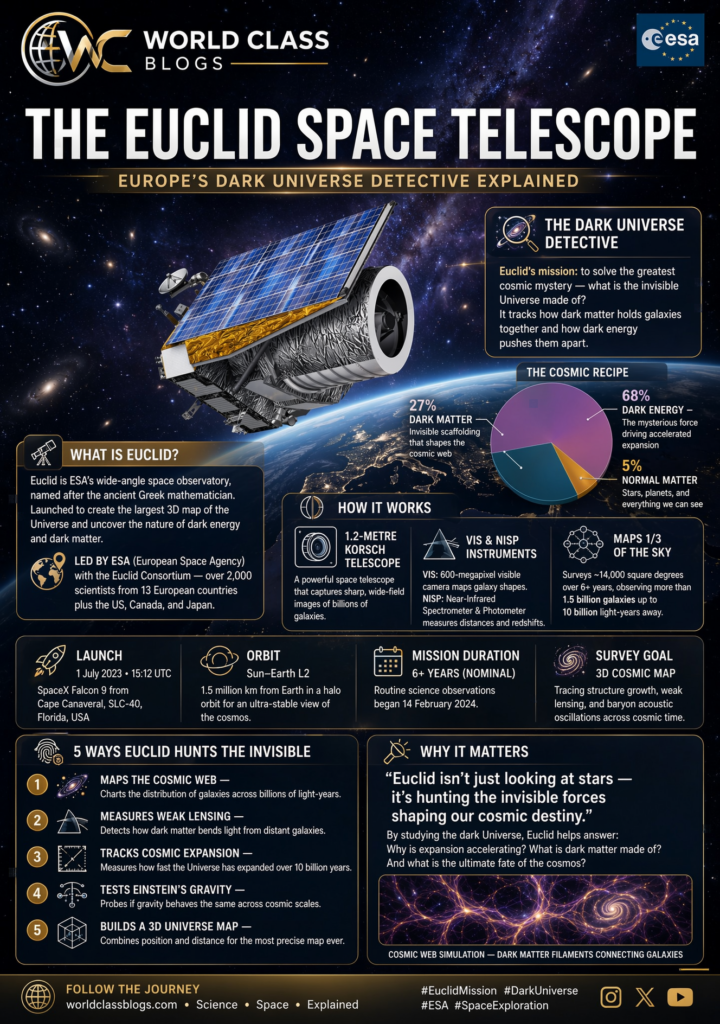
On July 1, 2023, a SpaceX Falcon 9 rocket lifted off from Cape Canaveral carrying a telescope designed to study something we cannot see. Its target isn’t stars or planets, but the invisible scaffolding of the cosmos — dark matter and dark energy, which together make up about 95% of the universe. (Euclid space telescope complete guide)
In my experience following space missions, what makes Euclid remarkable isn’t just its technology. It’s the scope of its ambition. This telescope is mapping the geometry of the universe across 10 billion years of cosmic history, observing 1.5 billion galaxies to trace how dark matter sculpted the cosmos and how dark energy is tearing it apart .
What I’ve found most striking is Euclid’s efficiency. In just 26 hours, it captured an image of the Milky Way’s center containing more than 60 million stars — a mosaic that would take the Keck Observatory roughly 2,000 hours to replicate . That’s not incremental improvement; it’s a fundamental leap in survey capability.
This guide will walk you through everything you need to know about Euclid: what it is, how it works, why it matters, and what we’ve learned in its first three years of operation. Whether you’re a curious beginner or a professional needing a refresher, this is your comprehensive roadmap.
Background and Context: The Mission to Map the Invisible
The Dark Universe Problem
For most of human history, astronomy studied light. Stars, galaxies, nebulae — everything we knew about the cosmos came from electromagnetic radiation. But starting in the 1970s, astronomers began noticing something strange.
Galaxies were rotating too fast. Galaxy clusters were moving too quickly. The visible matter in the universe couldn’t account for the gravitational forces observed. Something invisible was holding everything together.
We call it dark matter.
Then, in 1998, two independent teams studying distant supernovae made an even more shocking discovery. The expansion of the universe wasn’t slowing down as expected from gravity. It was accelerating. Some mysterious force — dark energy — was pushing galaxies apart at an ever-increasing rate.
Today, we know that ordinary matter — everything we can see and touch — makes up only about 5% of the universe. Dark matter accounts for roughly 27%, and dark energy about 68% .
Euclid was designed to investigate this 95% of the universe we don’t understand.
ESA’s Cosmic Vision
Euclid is a medium-class mission in the European Space Agency’s Cosmic Vision 2015-2025 program . It was selected in October 2011 and launched on July 1, 2023 aboard a SpaceX Falcon 9 — a notable choice, since ESA typically launches its missions on European rockets .
The mission represents a significant international collaboration. While ESA leads the mission, NASA contributed key hardware components, including the near-infrared detectors for the NISP instrument . The Euclid Consortium — a collaboration of over 2,000 scientists from around the world — manages the science operations and data processing.
The 2020s Telescope Renaissance
Euclid joins a remarkable cohort of new observatories transforming our understanding of the cosmos:
| Telescope | Launch | Primary Mission | Orbit |
|---|---|---|---|
| James Webb | 2021 | Deep infrared imaging | L2 |
| Euclid | 2023 | Dark energy survey | L2 |
| Roman | 2026 | Wide-field survey + dark energy | L2 |
| PLATO | 2026 | Exoplanet transits | L2 |
Euclid and Roman are particularly complementary. Euclid observes in visible and near-infrared wavelengths, while Roman focuses on near-infrared. Together, they’ll provide unprecedented constraints on dark energy and dark matter .
Key Concepts Defined
Before diving deeper, let’s establish the vocabulary you’ll need to understand Euclid’s mission.
Dark Matter
Invisible matter that exerts gravitational influence but doesn’t interact with light. It’s detected through its effects on galaxy rotation, gravitational lensing, and cosmic structure formation. Euclid will map its distribution by observing how it distorts light from background galaxies.
Dark Energy
A mysterious force causing the universe’s expansion to accelerate. Its nature remains unknown. Euclid will measure its properties by studying how cosmic expansion has changed over billions of years.
Weak Gravitational Lensing
A subtle effect where foreground matter distorts the shapes of background galaxies. The distortions are tiny — just a few percent — but by analyzing billions of galaxies, Euclid can map dark matter’s distribution across cosmic time .
Baryon Acoustic Oscillations (BAO)
Sound waves from the early universe that imprinted a characteristic scale on galaxy distribution. As the universe expanded, this scale stretched, providing a “cosmic ruler” to measure expansion history .
Redshift
A measure of distance in cosmology. Light from distant objects is stretched to longer wavelengths as the universe expands. Higher redshift means greater distance and earlier cosmic time.
VIS (Visible Instrument)
Euclid’s visible-light camera. It’s one of the largest ever flown in space, capturing sharp images of billions of galaxies .
NISP (Near-Infrared Spectrometer and Photometer)
Euclid’s near-infrared instrument. It measures the distances (redshifts) of millions of galaxies and captures infrared images .
L2 (Lagrange Point 2)
A gravitationally stable location about 1.5 million kilometers from Earth, on the opposite side of the Sun. Euclid shares this orbit with JWST and Gaia .
How It Works: The Euclid Mission Step by Step
Phase 1: Launch and Journey to L2 (July-August 2023)
The Launch
On July 1, 2023, at 17:12 CEST, a SpaceX Falcon 9 lifted off from Cape Canaveral, Florida, carrying Euclid toward its destination .
Journey to L2
Four weeks after launch, Euclid entered its orbit around the Sun-Earth Lagrange point 2 (L2), located 1.5 million kilometers from Earth in the direction opposite the Sun . This location keeps pace with Earth as both orbit the Sun, providing stable thermal conditions and uninterrupted views .
Phase 2: Commissioning and Early Observations (2023-2024)
First Images
In November 2023, Euclid’s first images were released to the public, stunning astronomers with their sharpness and breadth .
Early Release Observations
Additional observations were released in May 2024, including the iconic Perseus cluster image that revealed thousands of galaxies in a single frame .
Survey Start
Euclid began its nominal survey on February 14, 2024 . The mission will cover approximately 14,000 square degrees of extragalactic sky over six years .
Phase 3: Routine Science Operations (2024-present)
Survey Strategy
Euclid’s survey is designed to address its primary cosmology goals:
- Weak lensing: Measuring distorted shapes of 1.5 billion galaxies to map dark matter
- Galaxy clustering: Measuring redshifts of 35 million galaxies to trace cosmic expansion
- Baryon acoustic oscillations: Using the BAO scale as a cosmic ruler to measure expansion history
Data Releases
Euclid data is being released in stages:
- Q1 (Quick Data Release 1): March 19, 2025 — first glimpse of the cosmological survey
- Q2: June 24, 2026
- DR1 Foundation: November 12, 2026
- DR1: Mid-2027
The Milky Way Bulge Observation
In a special one-day observation on March 23, 2025, Euclid paused its cosmology survey to capture the Milky Way’s galactic center . The resulting mosaic — over 60 million stars in 26 hours — was released in June 2026 .
This observation wasn’t just for public relations. It serves a critical scientific purpose: providing a “time reference” for future microlensing surveys by NASA’s Roman Space Telescope, helping astronomers measure planet masses and identify rogue planets .
Why It’s Important
Science: Answering the Biggest Questions
What Is Dark Matter?
Euclid won’t detect dark matter particles directly. What it will do is map dark matter’s distribution with unprecedented precision. By observing how dark matter clumps — from vast filaments connecting galaxy clusters to tiny subhalos around individual galaxies — astronomers can test competing theories about what dark matter might be.
Euclid’s weak lensing survey is a powerful probe. As light from distant galaxies travels toward us, it passes through intervening dark matter, which bends and distorts its path. By measuring these distortions across 1.5 billion galaxies, Euclid creates a 3D map of dark matter distribution .
What Is Dark Energy?
This is even more mysterious. Recent analyses show a 3-4 sigma preference for evolving dark energy — meaning it might not be constant after all . If confirmed, this would be revolutionary.
Euclid’s BAO measurements provide a cosmic ruler. Sound waves from the early universe froze in place about 300,000 years after the Big Bang, creating a characteristic scale in galaxy distribution. By measuring this scale at different cosmic epochs, Euclid tracks how the universe’s expansion rate has changed over time .
Understanding Galaxy Evolution
Euclid’s survey extends to redshift 2-3, covering about half the age of the universe . This allows astronomers to study how galaxies formed and evolved during the most active period of cosmic history.
Technology: Pioneering New Capabilities
Survey Efficiency
Euclid’s ability to capture vast sky areas quickly is transformative. A single Euclid pointing covers an area 270 times larger than Hubble’s field of view . This efficiency enables statistical studies impossible with pointed telescopes.
Data Processing at Scale
Euclid’s data volume is enormous. The survey will produce petabytes of data, requiring sophisticated processing pipelines and a global network of data centers. The open-data philosophy ensures that researchers worldwide can access and analyze these observations.
International Collaboration
Euclid demonstrates that multinational space missions can work. ESA leads the mission; NASA provides hardware; the Euclid Consortium manages science. This model will be essential for future large-scale projects.
Sustainability in the Future
Orbital Sustainability
Euclid operates at L2, far from the congested low Earth orbit environment. This location inherently avoids debris risks that threaten satellites in closer orbits.
Fuel and Mission Lifetime
Euclid’s six-year prime mission could extend if fuel allows. The telescope’s orbit at L2 is stable, requiring minimal station-keeping burns. Any extension would enable deeper surveys and new science.
Open Data as Sustainability
Euclid’s data will be publicly released, maximizing scientific return on investment. The Q1 release already produced 50+ scientific papers . This “data recycling” extends Euclid’s value far beyond its operational lifetime.
Common Misconceptions
Misconception #1: “Euclid is just another Hubble”
Reality: Euclid and Hubble serve different purposes. Hubble is a pointed telescope — it stares deeply at small targets. Euclid is a survey telescope — it photographs vast areas quickly. They’re complementary tools.
Misconception #2: “Euclid will find dark matter”
Reality: Euclid will map dark matter’s distribution, but it won’t identify what dark matter particles are. That requires particle physics experiments or novel detection methods.
Misconception #3: “Euclid and Roman are competitors”
Reality: They’re collaborators. NASA describes them as complementary . Euclid’s Milky Way bulge observation was specifically designed to support Roman’s microlensing survey . Together, they’re more powerful than either alone.
Misconception #4: “Dark energy is just a theory”
Reality: Dark energy is a well-established observation. The accelerating expansion of the universe has been confirmed by multiple independent measurements. The mystery is what dark energy is, not whether it exists.
Recent Developments (2025-2026)
Milky Way Bulge Mosaic Release
On June 23, 2026, ESA released the largest and most detailed image ever made of the Milky Way’s center in visible light . Captured in just 26 hours, the mosaic contains more than 60 million stars and covers 5 square degrees — roughly the area of 25 full moons .
This image serves a dual purpose: stunning public engagement and critical science. It provides a “time reference” for Roman’s future microlensing survey, enabling precise planet mass measurements .
Ancient Quasar Discovery
In July 2026, Euclid discovered 31 ancient quasars, including two at record-breaking distances . These quasars shone when the universe was just 670 million years old — about 5% of its current age .
The two oldest quasars, designated EUCL J172902.75+641018.1 and EUCL J125308.55+705432.3, have redshifts of 7.77 and 7.69, surpassing the previous record . This discovery more than doubled the known population of early quasars from a decade of previous observations .
Weak Lensing Demonstration
In June 2026, scientists published the first demonstration that Euclid can trace massive structures dominated by dark matter using weak gravitational lensing . This validates the mission’s core technique ahead of first cosmology results expected in 2027.
Data Releases
- Q1: March 19, 2025 — first public data release
- Q2: June 24, 2026
- DR1 Foundation: November 12, 2026
- DR1: Mid-2027 — full first data release
The “Dark Galaxy” Discovery
Using Hubble, Euclid, and the Subaru Telescope, astronomers identified Candidate Dark Galaxy-2 (CDG-2) — a galaxy that appears almost entirely dominated by dark matter with only a smattering of stars . This discovery provides valuable insights into how dark matter structures galaxy formation.
Success Stories
The Exoplanet Connection
Euclid’s Milky Way bulge observation includes 51 known planetary systems and will assist in studying many more found by Roman’s microlensing survey . This collaboration demonstrates how missions designed for different purposes can work together.
The Quasar Hunter
Euclid has proven to be an exceptional quasar-finding machine. In just 1.5 years of data-taking, it more than doubled the known population of early quasars . As Eduardo Bañados of MPIA said: “For the first time, we can study the typical early-universe quasar, not just exceptional outliers” .
Open Science in Action
The Euclid Q1 data release produced 50+ scientific papers from researchers worldwide . The open-data model is accelerating discovery by enabling anyone, anywhere, to analyze the data.
Real-Life Examples
Example 1: The Cat’s Eye Nebula
In March 2026, Hubble and Euclid teamed up to create a new view of the Cat’s Eye Nebula (NGC 6543), a planetary nebula in the constellation Draco . This collaboration showcases how telescopes with different capabilities can create richer images.
Example 2: The Dark Galaxy CDG-2
Astronomers using Hubble, Euclid, and Subaru identified a galaxy almost entirely composed of dark matter . With just four globular clusters and the light of about 1 million Suns, CDG-2 provides a unique laboratory for studying how dark matter influences galaxy formation.
Example 3: The Red-Dwarf Gap
In a serendipitous discovery, scientists using Euclid data found a red-dwarf brightness “gap” feature in the globular cluster NGC 6397 — the first time this feature was observed in a globular cluster population .
Example 4: Galaxy Cluster Abell 2390
Euclid’s image of Abell 2390 contains more than 50,000 galaxies and contains the mass of about 10 trillion suns . The image reveals “orphan stars” drifting between galaxies — a phenomenon that indicates dark matter’s presence.
Conclusion and Key Takeaways
Euclid represents a new paradigm in astronomy: a survey telescope designed to map the invisible universe. Its primary goal — understanding dark matter and dark energy — addresses the most fundamental questions in cosmology.
In just three years, Euclid has:
- Captured over 60 million stars in a single mosaic
- Discovered 31 ancient quasars, more than doubling the known population
- Demonstrated its ability to trace dark matter through weak lensing
- Provided a time reference for Roman’s future planet-hunting survey
The mission is just beginning. First cosmology results are expected in 2027, and the full survey will take six years to complete. What Euclid finds could fundamentally reshape our understanding of the cosmos.
Key Takeaways:
- Euclid launched July 1, 2023 aboard a SpaceX Falcon 9
- Its primary goal: understanding dark matter and dark energy, which make up 95% of the universe
- Survey scope: 14,000 square degrees, 1.5 billion galaxies for weak lensing, 35 million redshifts
- Captured 60+ million stars in the Milky Way’s center in just 26 hours
- Discovered 31 ancient quasars, including two at record-breaking distances
- Operates at L2, sharing orbit with JWST and Gaia
- Open data policy: Q1 release produced 50+ scientific papers
- Complementary to Roman: the two telescopes will work together on dark energy and microlensing
- First cosmology results expected in 2027; DR1 in mid-2027
- A European mission with global participation: ESA leads, NASA contributes hardware, 2,000+ scientists worldwide
Frequently Asked Questions (FAQs)
Q1: What is the Euclid space telescope?
Euclid is a European Space Agency telescope designed to study dark matter and dark energy by mapping billions of galaxies across cosmic time .
Q2: When did Euclid launch?
Euclid launched on July 1, 2023, aboard a SpaceX Falcon 9 from Cape Canaveral, Florida .
Q3: Where is Euclid now?
Euclid orbits the Sun-Earth Lagrange point 2 (L2), about 1.5 million kilometers from Earth .
Q4: What is Euclid’s primary mission?
To understand the nature of dark matter and dark energy by measuring weak gravitational lensing and galaxy clustering .
Q5: How many galaxies will Euclid observe?
Euclid will measure the shapes of 1.5 billion galaxies for weak lensing and redshifts of 35 million galaxies for clustering .
Q6: What is weak gravitational lensing?
A subtle distortion of background galaxy shapes caused by foreground matter bending light. By measuring these distortions statistically, Euclid maps dark matter .
Q7: What are baryon acoustic oscillations?
Sound waves from the early universe that imprinted a characteristic scale on galaxy distribution, serving as a “cosmic ruler” to measure expansion history .
Q8: What instruments does Euclid carry?
Euclid has two instruments: VIS (visible imager) and NISP (near-infrared spectrometer and photometer) .
Q9: How does Euclid compare to Hubble?
Euclid’s survey efficiency is vastly greater. A single Euclid pointing covers an area 270 times larger than Hubble’s field of view .
Q10: How does Euclid compare to Roman?
Euclid has a 1.2m mirror; Roman has a 2.4m mirror. Euclid observes in visible and near-infrared; Roman focuses on near-infrared. They’re complementary .
Q11: What has Euclid discovered so far?
Euclid has discovered ancient quasars, captured a 60-million-star mosaic of the Milky Way, and demonstrated its weak lensing capability .
Q12: What is the most distant quasar Euclid found?
EUCL J172902.75+641018.1, at redshift 7.77, seen when the universe was just 670 million years old .
Q13: Why did Euclid observe the Milky Way’s center?
To provide a “time reference” for Roman’s microlensing survey, helping measure planet masses and identify rogue planets .
Q14: What is microlensing?
A phenomenon where a foreground star’s gravity magnifies a background star’s light, revealing planets through characteristic brightness changes .
Q15: When will Euclid’s first cosmology results be released?
First cosmology results are expected in 2027; DR1 is scheduled for mid-2027 .
Q16: Is Euclid’s data public?
Yes. Euclid operates on an open-data model. Q1 was released in March 2025 and produced 50+ papers .
Q17: What is dark energy?
A mysterious force causing the universe’s expansion to accelerate. It makes up about 68% of the universe .
Q18: What is dark matter?
Invisible matter that exerts gravity but doesn’t interact with light. It makes up about 27% of the universe .
Q19: How long is Euclid’s mission?
The prime mission is six years, starting from February 2024 .
Q20: Who leads the Euclid mission?
ESA leads the mission, with NASA contributing hardware and the Euclid Consortium managing science .
Q21: What is the Euclid Consortium?
A collaboration of over 2,000 scientists worldwide who manage Euclid’s science operations and data processing.
Q22: Can Euclid detect exoplanets?
Not directly. Its Milky Way observation supports Roman’s microlensing survey, which will detect planets .
Q23: What is L2?
Lagrange Point 2, a gravitationally stable location 1.5 million kilometers from Earth. JWST and Gaia also orbit L2 .
Q24: What is the “dark galaxy” CDG-2?
A galaxy almost entirely dominated by dark matter, with only four globular clusters and the light of about 1 million Suns .
Q25: How can I access Euclid data?
Euclid data is available through ESA archives and the Euclid NASA Science Center .
Q26: What makes Euclid’s Milky Way image special?
It contains 60+ million stars, covers 5 square degrees, and was captured in just 26 hours — a mosaic that would take Keck 2,000 hours .
Q27: Will Euclid solve the dark energy mystery?
Euclid will provide the best constraints yet on dark energy’s properties, but a complete solution may require future missions.
About Author
WorldClassBlogs covers science, technology, and innovation with a focus on making complex topics accessible. Our team includes former NASA contractors, science journalists, and industry analysts. This article was researched using primary ESA documentation, peer-reviewed publications, and authoritative news sources.
Free Resources
ESA Euclid Page: Official mission information (esa.int/euclid)
Euclid NASA Science Center: U.S. data access and support (euclid.caltech.edu)
Euclid Consortium: Science collaboration information (euclid-consortium.org)
Euclid Data Archive: Public data access ( archives.esac.esa.int )
Cosmos ESA Euclid News: Mission updates (cosmos.esa.int/web/euclid)
Space Warps Citizen Science: Help find gravitational lenses (zooniverse.org)
Discussion
What excites you most about Euclid’s mission? Are you more interested in dark energy, dark matter, or the exoplanet connections? Share your thoughts in the comments below.
For more science content, explore our Technology & Innovation category and Our Focus section. For deeper dives, we recommend The Daily Explainer’s mental health guide and global supply chain analysis. For business readers, Sherakat Network’s online business guide and partnership guide offer valuable perspectives. Find more SEO insights at Sherakat Network’s SEO category.
Have questions? Visit our Contact Us page or learn more About WorldClassBlogs.


