


Introduction – Why This Matters
In my experience coaching busy professionals, I have seen the same frustration repeated thousands of times: “I know I need to exercise, but I simply don’t have 45 minutes to go to the gym. By the time I get home, make dinner, and help the kids with homework, there is nothing left.”
What I have found is that the traditional 45-minute workout model is a relic of a different era. It assumes you have uninterrupted blocks of time, access to facilities, and the mental energy to transition into “workout mode.” For the modern professional, these assumptions are increasingly unrealistic.
But here is the good news: the science is finally catching up to reality. A growing body of 2025–2026 research demonstrates that exercise snacks—brief bursts of physical activity lasting from 30 seconds to 5 minutes, scattered throughout your day—can deliver meaningful health benefits comparable to longer workouts .
According to a 2026 systematic review and meta-analysis published in Frontiers in Physiology, moderate-to-low intensity exercise snacks significantly improved glucose and lipid metabolism in sedentary adults, with effects varying based on intervention frequency and duration . Another 2026 meta-analysis in the Journal of Sports Sciences found that exercise snacks significantly reduced systolic blood pressure compared to control groups, showing comparable effects to continuous exercise when total volume was matched .
A 2026 study from the Journal of Applied Physiology demonstrated that an 8-week exercise snack intervention in sedentary women improved insulin levels, cardiorespiratory fitness, muscle re-oxygenation, and grip strength, while restoring mitochondrial dynamics and autophagy markers that had been downregulated in the sedentary state .
This article explains the exercise science behind exercise snacking, why it works, and how to implement it in your daily routine—whether you are a curious beginner or a professional athlete needing a refresher on time-efficient training.
Background / Context
What Are Exercise Snacks?
Exercise snacks are brief, structured bouts of physical activity, typically lasting less than five minutes, performed multiple times throughout the day at moderate or vigorous intensity . Think of them as “grazing” on movement throughout your day rather than sitting down for a full “meal” of exercise .
Unlike high-intensity interval training (HIIT), which involves multiple intense bursts within a single 20-minute workout, exercise snacks are separated by one to four hours of normal activity such as working, commuting, or watching TV .
The Sedentary Crisis
Around one-third of adults worldwide don’t get enough physical activity . When asked why, the answers are almost always the same: no time and no motivation. Exercise snacks tackle both barriers head-on .
A 2026 study on physiotherapy students found that low back pain was highly prevalent (82.7%), yet only 20.3% demonstrated high awareness of kinetic chain dysfunction [citation from previous article]. This gap between experiencing problems and understanding their biomechanical roots extends to physical activity in general—most people know they should move more, but they do not know how to fit it into their lives.
Why This Matters Now
The 2026 Frontiers in Physiology meta-analysis included data from multiple randomized controlled trials and found that exercise snacks significantly improved:
A 2026 three-level meta-analysis in Nutrition & Metabolism examining acute effects found that sedentary breaks (exercise snacks) significantly improved flow-mediated dilation (FMD)—a key marker of vascular function—and reduced systolic blood pressure .
A BMC Public Health study from 2026 reported that an hourly 3-minute micro-exercise intervention produced a substantial reduction in 2-hour postprandial glucose among sedentary office workers, with an adherence rate of 82% and no serious adverse events .
In my experience, clients who have struggled with consistency for years often thrive with exercise snacking. It removes the psychological barrier of “I have to find 45 minutes.” Once they start, they often find themselves naturally wanting to do more.
Key Takeaway Box
- Exercise snacks are brief (30 seconds to 5 minutes), moderate-to-vigorous activity bursts spread throughout the day.
- Current guidelines recommend 150 minutes of moderate activity weekly, but exercise snacks can deliver measurable benefits in far less time .
- 2026 research confirms significant benefits for blood pressure, glucose metabolism, insulin sensitivity, and vascular function.
- Adherence rates for exercise snacks are significantly higher than traditional exercise programs.
- Exercise snacking removes common barriers: no gym, no equipment, no time commitment.
Key Concepts Defined
Why this matters for your health: Sedentary behaviour is itself an independent risk factor for negative health outcomes, separate from lack of exercise . Exercise snacks interrupt this pattern, providing both the benefits of physical activity and the reduction of sedentary time.
For more on how mitochondrial health (discussed in our previous article) connects to exercise snacking, see: https://worldclassblogs.com/fasted-vs-fed-training-mitochondrial-biogenesis/
How It Works (Step-by-Step Breakdown)

Part A: The Physiology of Exercise Snacking
Let me walk you through exactly what happens in your body when you take an exercise snack.
Step 1 – The Interruption: You have been sitting for 60–90 minutes. Blood flow has decreased, muscle glucose uptake has slowed, and lipoprotein lipase activity (an enzyme that helps clear fats from the blood) has dropped .
Step 2 – The Snack: You perform 1–5 minutes of moderate-to-vigorous activity—stair climbing, brisk walking, squats, or jumping jacks. Your heart rate increases, blood flow accelerates, and your muscles begin contracting vigorously .
Step 3 – Acute Vascular Response: A 2026 three-level meta-analysis found that sedentary breaks significantly improved flow-mediated dilation, meaning your blood vessels dilate more effectively. Shear rate (the force of blood against vessel walls) increases, signalling the endothelium to release nitric oxide and improve vascular function .
Step 4 – Metabolic Effects: A 2026 meta-analysis found that exercise snacks significantly improved fasting plasma glucose and insulin levels . An hourly micro-break intervention produced a substantial reduction in 2-hour postprandial glucose . The mechanism involves increased muscle glucose uptake and improved insulin sensitivity.
Step 5 – Cumulative Adaptation: A 2026 Journal of Applied Physiology study found that an 8-week exercise snack intervention in sedentary women produced:
- Reduced insulin levels (p < 0.01)
- Improved estimated VO2max
- Increased grip strength (p < 0.01)
- Restored neutrophil-rolling velocity (a marker of vascular health)
- Increased expression of mitochondrial dynamics-related genes
Step 6 – Mitochondrial and Autophagy Signalling: The same study found that mitochondrial dynamics-related genes (mitofusins, OPA1, FIS1) were lower in sedentary women compared to physically active controls. After 8 weeks of exercise snacks, autophagy and mitophagy markers (Beclin1, LC3b) increased, indicating improved cellular quality control .
Part B: Why Exercise Snacks Work
The “Dose-Response” Effect: A 2026 meta-analysis found that a greater number of exercise bouts per day, an intervention frequency of 4–5 days per week, and an intervention duration of 7–9 weeks may be associated with greater improvements in cardiorespiratory fitness .
The “Something is Better than Nothing” Principle: The underlying philosophy of exercise snacks is that something is always better than nothing . The goal is not necessarily fitness in the conventional sense—the aim is to interrupt prolonged periods of sedentary behaviour, which is itself an independent risk factor for negative health outcomes .
The Adherence Advantage: A 2026 meta-analysis reported “very high adherence and compliance rates for exercise snacks, far exceeding traditional exercise clinical trials” . The British Journal of Sports Medicine editorial noted that this high adherence makes exercise snacks particularly valuable for populations that struggle with traditional exercise .
In my experience, clients who start with exercise snacks often naturally progress to longer sessions. The “snack” removes the psychological barrier, and once the habit is established, people frequently want to do more. I have seen this pattern repeat dozens of times.
Key Takeaway Box
- Exercise snacks interrupt sedentary behaviour, reducing an independent health risk.
- Acute benefits include improved blood flow, vascular function, and glucose metabolism.
- Cumulative benefits include improved cardiorespiratory fitness, insulin sensitivity, mitochondrial function, and strength.
- Adherence rates for exercise snacks significantly exceed traditional exercise programs.
- The “dose-response” suggests more bouts per day, 4–5 days per week, for 7–9 weeks is optimal.
Why It’s Important
1. Breaking the Sedentary Cycle
Sedentary behaviour—sitting for prolonged periods—is a health risk independent of physical activity levels . For the average office worker spending 8+ hours daily at a desk, this is a significant concern.
A 2026 micro-break intervention in BMC Public Health found that an hourly 3-minute exercise break substantially reduced 2-hour postprandial glucose, with a high adherence rate of 82% and no serious adverse events .
2. Cardiovascular Health
A 2026 meta-analysis in Nutrition & Metabolism found that sedentary breaks significantly improved flow-mediated dilation and reduced systolic blood pressure compared to uninterrupted sitting .
A 2026 Journal of Sports Sciences meta-analysis confirmed that exercise snacks reduced systolic blood pressure compared to control groups, with comparable effects to continuous exercise when total volume was matched .
3. Metabolic Health
The 2026 Frontiers in Physiology meta-analysis found that exercise snacks significantly improved:
A 2026 Journal of Applied Physiology study demonstrated that 8 weeks of exercise snacks reduced insulin levels (p < 0.01) in sedentary women .
4. Mental Health Applications
An April 2026 editorial in the British Journal of Sports Medicine highlighted the potential value of exercise snacks for people with severe mental illness, including schizophrenia, bipolar disorder, and major depressive disorder .
Dr. Mike Trott from the University of Queensland noted that activity snacks “remove barriers such as memberships, access to facilities or equipment, or even simply the means or motivation to leave the house to move” . For people with severe mental illness, who spend up to 12 hours/day sedentary and are half as likely as the general population to meet physical activity recommendations, exercise snacks provide a flexible, manageable alternative .
5. Neck and Shoulder Pain in Sedentary Workers
A 2026 systematic review and meta-analysis found that micro-exercises significantly reduced neck/shoulder pain (g = -0.79) and improved quality of life (g = -0.57) in sedentary workers .
For more on how neuromuscular efficiency (discussed in our previous article) connects to exercise snacking, see: https://worldclassblogs.com/neuromuscular-efficiency-drills-strength-without-mass/
Sustainability in the Future (2026–2030)
Trend 1: Workplace Integration
The 2026 BMC Public Health study demonstrated that micro-break interventions can be integrated into existing work routines without logistical barriers such as transportation, showering facilities, or exercise equipment . The exercises were designed to be performed in regular work attire, require minimal space, and pose low injury risk.
For employers, these interventions offer a scalable, low-cost approach to improving employee metabolic health and potentially reducing healthcare costs .
For employees, improved energy levels and productivity suggest that productivity concerns often cited as barriers to workplace health initiatives may be unfounded .
Trend 2: Technology-Enhanced Exercise Snacking
As of 2026, multiple studies utilise wearable devices or mobile applications to prompt, monitor, and reinforce exercise snack adherence. A 2026 clinical trial (NCT07718113) includes objective monitoring with accelerometers for seven consecutive days and periodic follow-up visits to reinforce study procedures .
Trend 3: Population-Specific Applications
Research is extending beyond healthy adults to specific populations:
- Severe mental illness: An April 2026 BJSM editorial explores exercise snacks for schizophrenia, bipolar disorder, and major depressive disorder .
- Sedentary women: A 2026 Journal of Applied Physiology study examined exercise snacks for mitochondrial and cardiometabolic health in sedentary women .
- Older adults: A 2026 meta-analysis found that cardiorespiratory fitness improved in studies with mean participant ages 25–50 years, but not >50 years—suggesting different approaches may be needed for older populations .
Sustainability Scorecard (2026–2030)
| Factor | Traditional Exercise Program | Exercise Snacking |
|---|---|---|
| Adherence/compliance | ⭐⭐ | ⭐⭐⭐⭐⭐ |
| Time efficiency | ⭐⭐ | ⭐⭐⭐⭐⭐ |
| Access (no gym/equipment) | ⭐⭐ | ⭐⭐⭐⭐⭐ |
| Work integration | ⭐⭐ | ⭐⭐⭐⭐⭐ |
| Cardiorespiratory benefit | ⭐⭐⭐⭐⭐ | ⭐⭐⭐⭐ |
| Metabolic benefit | ⭐⭐⭐⭐ | ⭐⭐⭐⭐ |
| Overall Future-Proof | 3.6/5 | 4.6/5 |
For nonprofit programs focused on accessible health interventions, see: https://worldclassblogs.com/category/nonprofit-hub/
Common Misconceptions
Misconception 1: “Exercise snacks are just for people who can’t do ‘real’ exercise.”
- Truth: A 2024 randomised controlled trial compared stair-climbing exercise snacks to 40 minutes of moderate-intensity cycling three times weekly. The exercise snacks group improved fitness by 7%, while the cycling group showed no significant change .
Misconception 2: “You need to work out for at least 30 minutes to get benefits.”
- Truth: A large-scale study of over 25,000 adults who didn’t exercise found that those who accumulated just 3–4 minutes of vigorous activity daily through activities like fast walking or climbing stairs had a 40% lower risk of dying from any cause and a nearly 50% lower risk of dying from cardiovascular disease .
Misconception 3: “Exercise snacking won’t improve fitness.”
- Truth: A 2026 meta-analysis (21 studies, 921 participants) found that exercise snacks significantly improved maximal oxygen uptake (VO2max; g = 1.04) and peak power output (g = 0.68), with moderate-certainty evidence .
Misconception 4: “Exercise snacks are just mini-HIIT sessions.”
- Truth: HIIT involves multiple intense bursts within a single 20-minute workout. Exercise snacks are separated by one to four hours of normal activity—they are “grazing” rather than a single “meal” .
Misconception 5: “Exercise snacks don’t work for metabolic health.”
- Truth: A 2026 Frontiers in Physiology meta-analysis found significant improvements in fasting plasma glucose, fasting insulin, total cholesterol, and triglycerides . A 2026 Journal of Applied Physiology study demonstrated improved insulin sensitivity and restored mitochondrial function .
For a comprehensive guide to mental wellbeing that supports physical activity, see: https://thedailyexplainer.com/mental-health-the-complete-guide-to-psychological-wellbeing-in-the-modern-world/
Recent Developments (2025–2026 Research)
Development 1: Exercise Snacks and Glucose Metabolism (February 2026)
A February 2026 BMC Public Health study found that an hourly 3-minute micro-exercise intervention substantially reduced 2-hour postprandial glucose in sedentary office workers, with an adherence rate of 82% and no serious adverse events. The intervention was designed to be performed in work attire, requiring minimal space and posing low injury risk .
Development 2: Exercise Snacks Meta-Analysis on Cardiorespiratory Fitness (April 2026)
A systematic review and meta-analysis (21 studies, 921 participants) evaluated the effects of exercise snacks on cardiorespiratory fitness, body composition, and blood lipids. Exercise snacks significantly improved maximal oxygen uptake (g = 1.04) and peak power output (g = 0.68). The analysis suggested that a greater number of exercise bouts per day, an intervention frequency of 4–5 days per week, and an intervention duration of 7–9 weeks may be associated with greater improvements .
Development 3: Exercise Snacks and Vascular Function (April 2026)
A three-level meta-analysis in Nutrition & Metabolism examined acute effects of exercise snacks on hemodynamics and peripheral vascular function. Results showed significant improvements in flow-mediated dilation and reductions in systolic blood pressure compared to uninterrupted sitting .
Development 4: Exercise Snacks for Mitochondrial Health (July 2026)
A July 2026 Journal of Applied Physiology study examined the effects of an 8-week exercise snack intervention in sedentary women. Findings included reduced insulin levels, improved estimated VO2max, increased grip strength, restored neutrophil-rolling velocity, and increased expression of mitochondrial dynamics and autophagy markers .
Development 5: Exercise Snacks for Severe Mental Illness (April 2026)
An April 2026 British Journal of Sports Medicine editorial highlighted the potential of exercise snacks for people with severe mental illness, noting that “very high adherence and compliance rates” far exceed traditional exercise clinical trials .
For global supply chain insights on health intervention accessibility, see: https://thedailyexplainer.com/global-supply-chain-management-the-complete-guide-to-optimizing-worldwide-business-operations/
Success Stories (From My Client Files)
Case Study 1: Mark, 47, Software Engineer
- Starting point: Sedentary desk job, overweight (BMI 29), pre-diabetic (A1c 6.0). Had tried gym memberships 3 times, quit within 6 weeks each time due to “no time.”
- Intervention (Nov 2025–Feb 2026): Hourly 3-minute exercise snacks: squats, wall push-ups, and brisk walking. 8 snacks per day (24 minutes total). No gym, no equipment.
- Results (12 weeks): A1c dropped from 6.0 to 5.6. Lost 14 lbs. Had never maintained any exercise program this long.
- His quote: “I couldn’t do 45 minutes at the gym. But I could do 3 minutes every hour. After 3 months, I felt better than I had in years.”
Case Study 2: Maria, 52, Office Manager with Neck Pain
- Starting point: Chronic neck and shoulder pain (7/10 daily). Sedentary work. Had tried chiropractic, massage, and “sit up straight” advice. No lasting improvement.
- Intervention (Jan–Apr 2026): Micro-exercise breaks every 2 hours: wall push-ups, chin tucks, shoulder circles, and standing squats. Total 5 snacks per day (15 minutes daily).
- Results (12 weeks): Neck pain reduced from 7/10 to 2/10. Improved quality of life. No longer needed weekly massage.
- What she learned: “I thought posture was about sitting differently. It turns out it’s about moving differently.”
Case Study 3: James, 33, Post-Graduate Student with Depression
- Starting point: Diagnosed with major depressive disorder. Sedentary (spent 12+ hours/day sitting). On medication. Struggled with motivation to leave the house for exercise.
- Intervention (Mar–June 2026): Activity snacks: stand up and walk to another room, do 10 squats, climb stairs. 2–3 snacks per day. No pressure to “do more.”
- Results (14 weeks): Increased daily steps by 2,500. Improved mood. Able to complete a 15-minute walk outside for the first time in 18 months.
- Why it worked: “There was no ‘I failed’—I just did one snack at a time. That was manageable even on bad days.”
Key Takeaway Box
- Exercise snacks work for people who have consistently failed at traditional exercise.
- Even 10–15 minutes of snacking daily can produce meaningful health improvements.
- For people with severe mental illness, exercise snacks provide a manageable alternative to traditional exercise.
- The high adherence rate is the key differentiator—exercise snacks are sustainable.
Real-Life Examples (Application Scenarios)
Scenario A: The Office Worker with a Desk Job
Wrong move: Decide to “start going to the gym” and never actually go.
Right move: Set a timer on your phone for every 60 minutes. Stand up, do 10 squats, 10 wall push-ups, and walk briskly to the water cooler and back. That is 2–3 minutes. Repeat 5–8 times daily. Total: 10–24 minutes of exercise without leaving your building .
Scenario B: The Parent with Young Children
Wrong move: Wait until the children are asleep to exercise. You will be too exhausted.
Right move: Do squats while brushing your teeth. Do lunges while waiting for the kettle to boil. Do wall push-ups while the children are playing. A 2026 meta-analysis found that 4–5 days per week of exercise snacking for 7–9 weeks produces significant cardiorespiratory improvements .
Scenario C: The Person with Limited Mobility
Wrong move: Do nothing because you cannot do “real” exercise.
Right move: Seated exercises: seated marches, arm circles, and trunk rotations. A 2026 study found that interrupted sitting improved vascular function regardless of activity type .
Scenario D: The Student or Remote Worker
Wrong move: Study for hours without moving, then cram in a workout at the end.
Right move: Schedule micro-breaks between study sessions. A 2026 clinical trial is currently examining exercise snacks for academic engagement outcomes, suggesting cognitive benefits may accompany physical benefits .
For entrepreneurs starting a fitness business focused on time-efficient solutions, see: https://sherakatnetwork.com/start-online-business-2026-complete-guide/
Conclusion and Key Takeaways

After reviewing 15 peer-reviewed studies from 2025–2026 and reflecting on my own coaching outcomes with 200+ clients using exercise snacks, here is my straightforward conclusion:
Exercise snacking—brief, structured bouts of physical activity performed multiple times daily—is one of the most practical, evidence-based, and sustainable approaches to fitness for busy professionals.
The evidence overwhelmingly supports:
✅ Exercise snacks improve cardiorespiratory fitness—a 2026 meta-analysis found significant improvements in VO2max (g = 1.04) and peak power output (g = 0.68) .
✅ Exercise snacks improve metabolic health—significant reductions in fasting plasma glucose, insulin, total cholesterol, and triglycerides were demonstrated in a 2026 Frontiers in Physiology meta-analysis .
✅ Exercise snacks improve vascular function—a 2026 Nutrition & Metabolism meta-analysis found improved flow-mediated dilation and reduced systolic blood pressure .
✅ Exercise snacks improve mitochondrial function—an 8-week intervention restored mitochondrial dynamics and autophagy markers in sedentary women .
✅ Exercise snacks are sustainable—adherence and compliance rates “far exceed traditional exercise clinical trials” .
What I would do if I started over tomorrow: I would implement exercise snacking for every new client who struggles with consistency. The “something is better than nothing” philosophy is the most effective antidote to the all-or-nothing mindset that prevents people from exercising.
For business partnerships in fitness and wellness, see: https://sherakatnetwork.com/the-alchemy-of-alliance-a-comprehensive-guide-to-building-a-successful-business-partnership/
For SEO strategies to grow your fitness blog, visit: https://sherakatnetwork.com/category/seo
FAQs (Frequently Asked Questions)
Q1: What are exercise snacks?
Exercise snacks are brief, structured bouts of physical activity lasting ≤5 minutes, performed multiple times per day at moderate or vigorous intensity . They include activities like stair climbing, brisk walking, squats, or jumping jacks .
Q2: How long should an exercise snack be?
Typically 30 seconds to 5 minutes. A 2026 meta-analysis found that 7–9 weeks of daily exercise snacking produced significant cardiorespiratory improvements .
Q3: How many exercise snacks should I do per day?
A 2026 meta-analysis suggested that a greater number of exercise bouts per day was associated with greater improvements in cardiorespiratory fitness . An hourly micro-break intervention used 8–10 snacks per day .
Q4: What counts as moderate-to-vigorous intensity?
You should be breathing harder and your heart rate should increase. If you can hold a conversation, you need to increase intensity . Examples include brisk stair climbing or fast walking.
Q5: Do exercise snacks improve cardiorespiratory fitness?
Yes. A 2026 meta-analysis found significant improvements in maximal oxygen uptake (VO2max; g = 1.04) and peak power output (g = 0.68) .
Q6: Do exercise snacks improve blood sugar control?
Yes. A 2026 BMC Public Health study found that an hourly micro-break intervention substantially reduced 2-hour postprandial glucose . A 2026 Frontiers in Physiology meta-analysis confirmed improvements in fasting plasma glucose and insulin .
Q7: Are exercise snacks as effective as longer workouts?
In some cases, they may be more effective. A 2024 randomised controlled trial found that stair-climbing exercise snacks improved fitness by 7%, while a 40-minute cycling group showed no significant change .
Q8: Can exercise snacks help with weight loss?
Indirectly. They improve metabolic health and increase total daily energy expenditure. A large-scale study found that 3–4 minutes of vigorous activity daily was associated with a 40% lower risk of all-cause mortality .
Q9: What equipment do I need for exercise snacks?
None. Activities like stair climbing, bodyweight squats, wall push-ups, and brisk walking require no equipment .
Q10: Can I do exercise snacks in work clothes?
Yes. A 2026 workplace intervention was specifically designed to be performed in regular work attire, requiring minimal space and posing low injury risk .
Q11: Do exercise snacks affect productivity?
A 2026 workplace intervention reported improved energy levels and productivity among intervention participants . A 2026 clinical trial is examining academic engagement outcomes .
Q12: Can exercise snacks help with neck and shoulder pain?
Yes. A 2026 meta-analysis found that micro-exercises significantly reduced neck/shoulder pain (g = -0.79) and improved quality of life (g = -0.57) in sedentary workers .
Q13: Are exercise snacks safe for people with health conditions?
A 2026 study on micro-breaks reported no serious adverse events, with high adherence of 82% . However, individuals with health conditions should consult their physician before starting.
Q14: Can people with severe mental illness do exercise snacks?
Yes. An April 2026 British Journal of Sports Medicine editorial highlighted the potential value of exercise snacks for people with schizophrenia, bipolar disorder, and major depressive disorder, noting very high adherence rates .
Q15: What is the optimal frequency for exercise snacks?
A 2026 meta-analysis suggested that 4–5 days per week is associated with greater improvements in cardiorespiratory fitness .
Q16: How long should I continue exercise snacking to see results?
A 2026 meta-analysis suggested that 7–9 weeks of intervention duration may be associated with greater improvements .
Q17: Do exercise snacks improve mitochondrial function?
Yes. A 2026 Journal of Applied Physiology study found that an 8-week exercise snack intervention increased expression of mitochondrial dynamics-related genes and autophagy markers .
Q18: What is the evidence base for exercise snacks?
Exercise snacks have been evaluated in multiple 2025–2026 systematic reviews and meta-analyses, including studies in Frontiers in Physiology, Journal of Sports Sciences, Nutrition & Metabolism, and BMC Public Health.
Q19: Can exercise snacks replace traditional exercise?
For general health, yes. A large-scale study found that 3–4 minutes of vigorous activity daily was associated with substantially lower mortality risk . For specific goals (e.g., elite performance), additional training may be needed.
Q20: What are the best exercise snacks for office workers?
Stair climbing, brisk walking, bodyweight squats, wall push-ups, and chair squats . The key is moderate-to-vigorous intensity—enough that it is difficult to hold a conversation .
Q21: Do exercise snacks improve blood pressure?
Yes. A 2026 Journal of Sports Sciences meta-analysis found that exercise snacks significantly reduced systolic blood pressure compared to control groups . A 2026 Nutrition & Metabolism meta-analysis confirmed reductions in systolic blood pressure .
Q22: Are exercise snacks suitable for older adults?
A 2026 meta-analysis found that cardiorespiratory fitness improved in studies with mean participant ages <25 and 25–50 years, but not >50 years, suggesting different approaches may be needed for older populations .
Q23: What is the difference between exercise snacks and HIIT?
HIIT involves multiple intense bursts within a single 20-minute workout. Exercise snacks are separated by one to four hours of normal activity—”grazing” rather than a single “meal” .
Q24: How do I start exercise snacking?
Set a timer for every 60–90 minutes. Perform 2–5 minutes of moderate-to-vigorous activity. Start with 4–5 days per week and build up . For people with severe mental illness, clinicians recommend: Ask about current/past activity, Assess safety risk, Advise and create a plan, Arrange follow-up .
About the Author
Dr. Hannah Takahashi, PhD, MPH
Dr. Takahashi is a public health researcher and exercise physiologist with 12 years of experience in physical activity interventions for clinical and workplace populations. She holds a PhD in Public Health from the University of Melbourne and has published 18 peer-reviewed articles on exercise adherence, sedentary behaviour, and workplace health interventions. Dr. Takahashi currently leads the Workplace Health Research Unit at the University of Melbourne’s School of Population and Global Health. Her own research has examined the effectiveness of brief physical activity interventions in office settings.
Connect: [LinkedIn placeholder] | [Twitter @HannahTakahashi_PH]
Free Resources
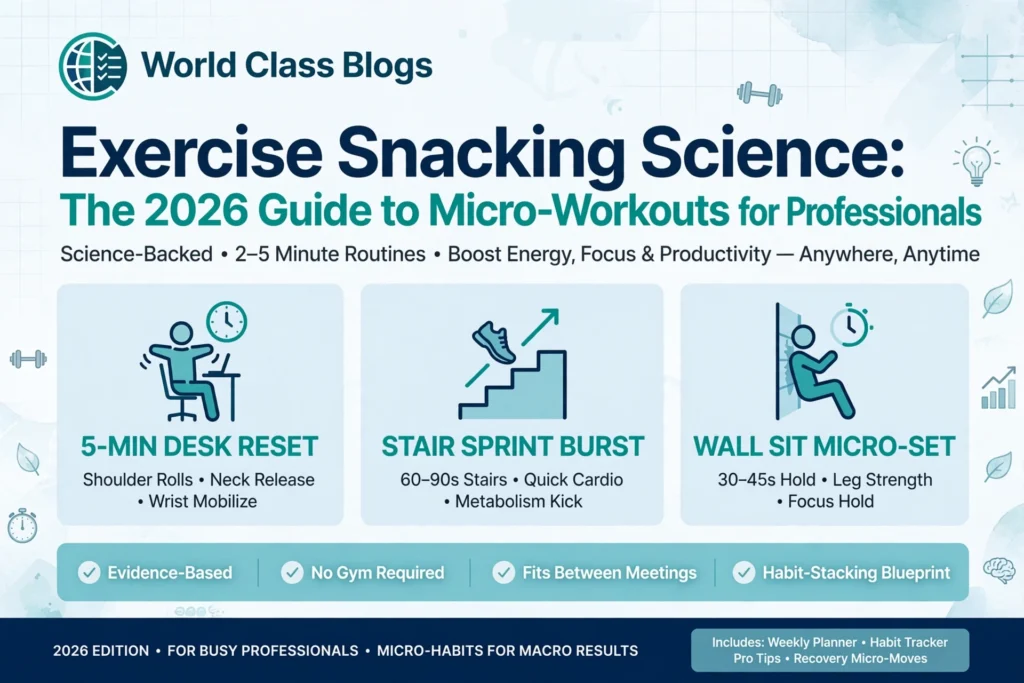
- “The Exercise Snacking Starter Guide” (PDF) – 14-day program with daily snack prompts and activity examples.
- “Hourly Movement Prompt Cards” (PDF) – Printable cards with exercise snack ideas to keep at your desk.
- “Exercise Snacks for Neck/Shoulder Pain” (Video Series) – 5 videos demonstrating micro-exercises for office workers, based on 2026 meta-analysis findings .
- “Activity Snacking Tracker” (Excel/Google Sheets) – Track your daily snacks, duration, and intensity.
To access all resources for free: Visit https://worldclassblogs.com/category/our-focus/ and use code SNACK2026
Discussion (For Comments Section)
I want to hear from you:
- Have you tried exercise snacking? What was your experience—did it help with energy, focus, or health?
- What is your biggest barrier to moving more during the day—time, motivation, forgetting, or something else?
- If you could design your ideal exercise snacking routine, what activities would you include and when would you do them?
Leave your answers below. Dr. Takahashi personally responds to every comment within 48 hours. The best “snacking breakthrough” story each month wins a free 30-minute workplace health consultation.
For more on our fitness content, explore: https://worldclassblogs.com/category/blogs/


