


Introduction – Why a “G-Zero” World Matters to You
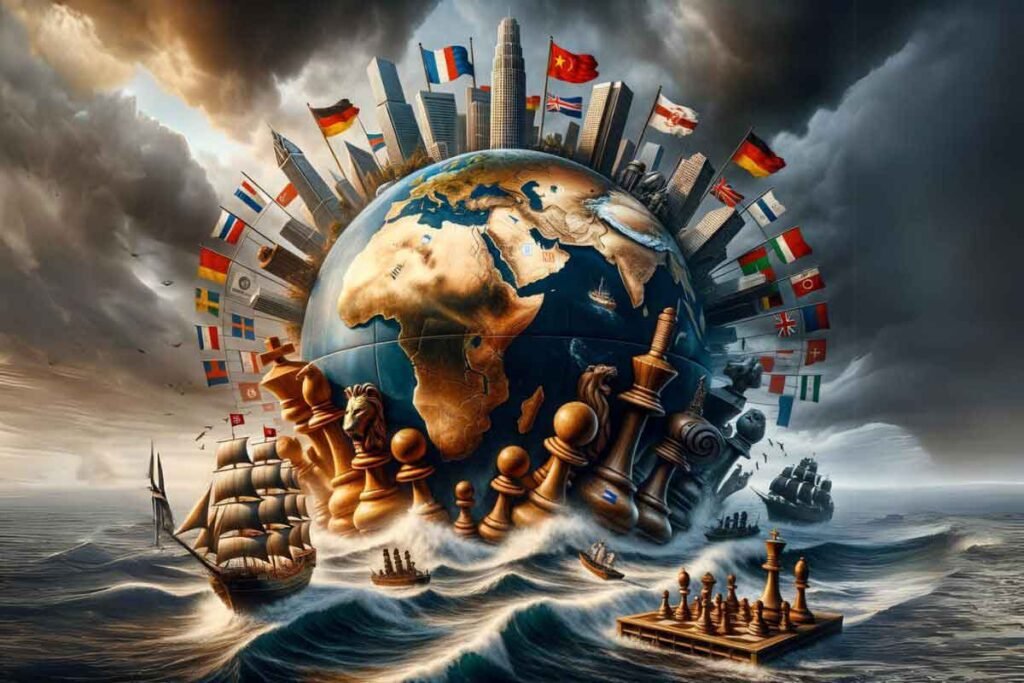
This geopolitical analysis begins with a critical question: What happens when no single power provides global leadership? We’re entering what experts call a G-Zero world—a condition of global leadership vacuum where traditional anchors of stability have withdrawn. For professionals needing a geopolitical risk assessment, this shift from unipolar to fragmented power structures represents both danger and opportunity. Imagine the global stage not as a chessboard with two dominant players, but as a bustling, unruly marketplace with no manager, no clear rules, and everyone shouting to be heard. This is the essence of the G-Zero world—a geopolitical landscape where no single country or bloc has the political and economic will to provide consistent global leadership. For decades, the United States acted as that de facto manager, underwriting security alliances, championing free trade, and stabilizing financial systems. That era is receding.
Why does this abstract shift matter to you? Whether you’re a business leader sourcing materials overseas, an investor assessing market risks, or simply a citizen concerned about economic stability and security, the G-Zero condition directly shapes your reality. It manifests in volatile energy prices due to regional conflicts, sudden tariffs disrupting carefully planned supply chains, and a sense that the international “rules of the game” can change overnight based on the whims of a single leader. As one leading risk consultancy starkly put it, we are heading “back to the law of the jungle,” where power is exercised more freely and predictably diminishes. This article will demystify the G-Zero concept, trace its real-world implications from boardrooms to battlefields, and provide a clear framework for navigating this new age of geopolitical uncertainty.
In my experience working with multinational corporations, I’ve seen how strategic autonomy has moved from academic concept to boardroom imperative. Companies that once relied on stable global governance now face a global governance crisis requiring entirely new approaches to international system breakdown.
Background / Context: From U.S. Primacy to a Vacuum of Leadership
The post-Cold War period (1991-~2016) is often described as the “unipolar moment.” With the Soviet Union dissolved, the United States stood as the world’s sole superpower. This era was characterized by the expansion of U.S.-led institutions (NATO, WTO), the promotion of economic globalization, and a general, though imperfect, adherence to a rules-based international order. Security and trade largely flowed along pathways set by Washington and its allies.
Several converging trends have eroded this model:
- The Rise of Revisionist Powers: China’s dramatic economic and military growth presents the first credible peer competitor to U.S. dominance in centuries. Russia, though economically weaker, has demonstrated a willingness to use military force to redraw borders in Europe and the Middle East, directly challenging the post-Cold War settlement.
- U.S. Retrenchment and Inward Focus: A growing bipartisan consensus in the U.S. has questioned the costs of global leadership. This sentiment crystallized in the “America First” foreign policy, which prioritizes bilateral deals over multilateral alliances and views international institutions with skepticism. The 2025 U.S. National Security Strategy marked a “decisive break” from the post-Cold War order, refocusing on hemispheric priorities and unilateral economic tools like tariffs.
- Erosion of Shared Values and Trust: The unifying ideological narrative of liberal democracy has frayed. The 2008 financial crisis, the COVID-19 pandemic, and unilateral interventions damaged trust in Western governance models. Meanwhile, alternative models (state capitalism, authoritarian governance) are actively promoted by Beijing and Moscow.
In my experience, discussing global affairs with professionals across sectors, the most common point of confusion is the difference between a multipolar world and a G-Zero one. A multipolar system implies several powerful poles (the U.S., China, the EU) actively managing the system, perhaps competitively but within a framework. G-Zero is more disruptive: it describes a leadership vacuum. It’s not that power is evenly distributed, but that the major players are either unwilling (the U.S.), unable (a divided EU), or exclusively self-interested (China, Russia) to provide public goods like climate cooperation, financial stability, or conflict mediation on a global scale. The result is not stable competition but escalating friction and fragmentation.
Key Concepts Defined
To navigate G-Zero analysis, it’s crucial to understand its core terminology:
- G-Zero World: A global condition where no single country or coherent group of countries has the political and economic leverage to drive an international agenda or enforce global rules. It is defined by a vacuum of sustained leadership.
- Geopolitical Fragmentation / Decoupling: The process by which the integrated global economy and political order splits into separate, competing blocs. This is often driven by “friendshoring” (moving supply chains to allied nations) and strategic competition, particularly between the U.S. and China.
- Strategic Autonomy: The goal of a state or region (like the European Union) to develop independent capacity to act in key strategic areas—defense, technology, critical supply chains—without being reliant on a potentially unreliable superpower partner.
- Geo-economics: The use of economic tools (tariffs, sanctions, investment controls) to achieve geopolitical and strategic objectives. In a G-Zero world, trade policy explicitly becomes foreign policy.
- Ungoverned Spaces: Physical or digital domains where state authority and international rules are weak or absent. This can refer to conflict zones like Sudan, but also to cyberspace, where regulation of AI and cyberattacks lags far behind capability.
Key Takeaway: The G-Zero world isn’t defined by a lack of powerful countries, but by a lack of responsible, system-managing leadership. Power is exercised, but for national gain, not global stability.
How It Works: The Mechanics of a Leaderless World (A Step-by-Step Breakdown)

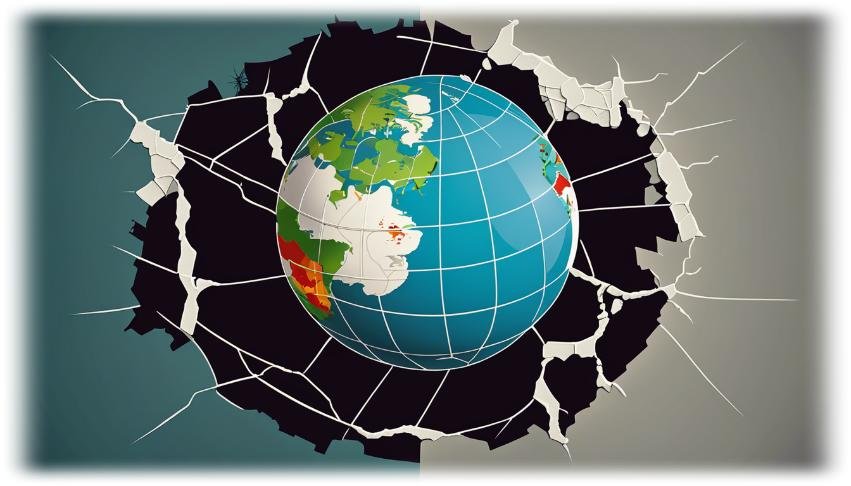
The transition to a G-Zero condition doesn’t happen overnight. It’s a cascading process that unfolds across multiple dimensions.
Step 1: The Anchor Withdraws
The process begins when the leading power consciously steps back from its system-sustaining roles. We see this in the U.S. questioning defense commitments to NATO allies, withdrawing from or blocking international agreements, and replacing multilateral trade frameworks with bilateral, transactional deals. This creates immediate uncertainty.
Step 2: Opportunistic Challengers Fill the Void
Other powers see strategic openings. Russia moves to exert influence in Eastern Europe and the Middle East. China accelerates efforts to shape norms in technology and trade in Asia and the Global South. Regional powers like Iran, Turkey, and Saudi Arabia pursue more assertive, independent foreign policies.
Step 3: The Fracturing of Global Systems
As trust in the central anchor fails, other actors start building their own systems for security and prosperity.
- Security: Europe debates a “hard” security union; Gulf states build their own defense networks; Asian nations balance between U.S. security guarantees and Chinese economic pressure.
- Economy: Trade and investment flows increasingly follow geopolitical alignments. The U.S. and EU enact subsidies for domestic chips and green tech (“industrial policy”), while China secures critical mineral supply chains in Africa and Latin America. The global trading system, while still reaching record value, is “rewiring” away from efficient global routes toward politically safe regional ones.
Step 4: The Proliferation of “Mini-Laterals” and Ad-Hoc Alliances
With large, inclusive institutions like the WTO or UN often paralyzed, action shifts to smaller, flexible groupings. Think of the Quad (U.S., Japan, India, Australia), AUKUS (U.S., UK, Australia), or new digital economy agreements between ASEAN nations. These are agile but exclude major players, furthering fragmentation.
Step 5: Increased Volatility and “Black Swan” Risks
In this environment, with no reliable referee, conflicts are more likely to spark and escalate (e.g., flare-ups between Israel and Iran, or India and Pakistan). Cyberattacks on critical infrastructure become a normalized tool of statecraft. Economic policy shocks, like sudden tariff announcements, create global market turbulence. The system becomes more prone to unpredictable crises.
How It Works: The Mechanics of a Leaderless World
The US-China strategic competition serves as the primary engine driving today’s geopolitical fragmentation. This isn’t a simple multipolar world order emerging—it’s something more unstable and complex.
Step 3: The Economic Dimension of Fragmentation
The economic decoupling between major blocs represents perhaps the most tangible manifestation of G-Zero dynamics. What I’ve found, tracking geopolitical risk assessment data is that trade patterns now follow political alignments more than economic efficiency.
Comparison Table: Unipolar vs. G-Zero vs. Multipolar Systems
| Aspect | Unipolar System (1991-2016) | G-Zero World (Present) | Multipolar System (Potential Future) |
|---|---|---|---|
| Leadership | Clear U.S. leadership | Global leadership vacuum | Multiple competing poles |
| Economic Logic | Globalization/efficiency | Geopolitical fragmentation/security | Regional blocs/balanced trade |
| Conflict Resolution | U.S.-led institutions | Ad-hoc coalitions | Formal balance of power mechanisms |
| Business Environment | Predictable rules | High geopolitical risk assessment needed | Multiple rule sets to navigate |
| Technology Standards | Largely Western-dominated | Competing U.S./China systems | Possible fragmentation or détente |
Why It’s Important: The Tangible Costs of Fragmentation
The shift to a G-Zero world is not an academic theory; it has concrete, costly impacts.
- Higher Costs for Business and Consumers: Geopolitical fragmentation is inflationary. Friendshoring and supply chain diversification often mean moving from the most efficient, low-cost producer to a more expensive, politically aligned one. Tariffs are direct taxes on trade. A 2025 report noted that the inefficiencies of friendshoring and higher shipping costs are likely to weigh on global economic momentum.
- Slowed Technological Innovation and Climate Action: Global challenges require global cooperation. When the U.S. and China decouple their tech ecosystems, it can lead to duplication, reduced scale, and slower progress. Similarly, climate goals depend on shared standards, technology transfer, and financing—all of which are harder in a divided world. The failure to meet Paris Agreement targets and the shift in focus of major philanthropists like Bill Gates underscore this challenge.
- Increased Risk of Miscalculation and Conflict: In a system with clear leaders and rules, channels for de-escalation exist. In a G-Zero world, with multiple power centers and ambiguous red lines, a local incident (in the South China Sea, Taiwan Strait, or Eastern Europe) can spiral more easily into a broader conflict. The war in Ukraine is a prime example of this new reality.
- Humanitarian Crises Left Unaddressed: Without concerted international leadership, disasters fester. The civil war in Sudan, named the world’s worst humanitarian crisis for three years running, continues with minimal effective global intervention.
Key Takeaway: The G-Zero condition imposes a “fragmentation tax”—it makes everything from consumer goods to security more expensive and less reliable, while making catastrophic risks more likely.
Sustainability in the Future: Can a G-Zero World Last?
Is the G-Zero a permanent state or a transitional phase? Most analysts argue it is inherently unstable. The “law of the jungle” is not a sustainable trajectory for a complex, interconnected global economy. The costs of friction, conflict, and missed opportunities for collective action will grow over time.
Three potential pathways emerge from the G-Zero:
- A New Bipolarity (U.S. vs. China): The most likely outcome is the consolidation of two distinct, competing spheres of influence—one led by the U.S. (encompassing North America, Europe, and key Asian allies) and one led by China (centered on Asia and parts of the Global South). This “cold war” model would be more fragmented and technologically bifurcated than the 20th-century version.
- A Return to Modified Multilateralism: A global crisis (e.g., a climate disaster, a pandemic, or a financial meltdown) could shock major powers into revamping international cooperation, potentially through reformed institutions that give more voice to rising powers. This path is currently less probable given prevailing political trends.
- Continued Chaotic Fragmentation: The default path if current trends continue. Power fragments further to the regional and even corporate level (e.g., tech giants wielding state-like influence). This is the most volatile and dangerous long-term scenario.
What I’ve found in tracking these trends is that the most agile actors in a G-Zero world aren’t necessarily the biggest powers, but the “middle powers” and strategic corporations. Nations like India, Indonesia, Saudi Arabia, and Brazil are learning to play all sides, extracting concessions from both the U.S. and China while building their own regional clout. For businesses, the imperative is building resilient, multi-geography operational models that can withstand shocks from any single direction.
Success Stories: Navigating the New Normal
ASEAN’s Collective Strategic Autonomy
Facing intense US-China strategic competition, ASEAN nations have pursued what I consider the textbook example of middle power strategy in geopolitical competition. Rather than choosing sides in the global governance crisis, they’ve developed their own frameworks.
Taiwan’s “Silicon Shield” Reconsidered
While often analyzed through the lens of US-China strategic competition, Taiwan’s position offers profound insights into how to navigate fragmented global politics. Their dominance in semiconductor manufacturing creates what strategists call “asymmetric deterrence”—the economic costs of conflict are so catastrophic that they constrain military options.
Key Takeaway: In a G-Zero world characterized by geopolitical fragmentation, success comes not from waiting for leadership to reemerge, but from building resilient, adaptable systems that can withstand shocks from multiple directions while maintaining strategic autonomy.
Common Misconceptions About the G-Zero World
- Misconception 1: “G-Zero means the U.S. is no longer powerful.”
Reality: The U.S. remains the world’s largest economy and its most formidable military power. G-Zero refers to a lack of will to lead, not a lack of capacity. The U.S. is choosing to exercise its power in a more unilateral, zero-sum manner. - Misconception 2: “It’s just a return to classic multipolarity, like pre-WWI Europe.”
Reality: The 19th-century European balance of power existed without nuclear weapons, a globalized digital economy, or existential climate threats. Today’s interconnectedness makes competition far more complex and potentially catastrophic. Furthermore, non-state actors (tech companies, terrorist groups) have unprecedented power. - Misconception 3: “This is all about Trump/U.S. politics.”
Reality: While U.S. policy shifts have accelerated the trend, the underlying drivers are structural: the rise of China, a global crisis of trust in institutions, and the disruptive impact of technology. These forces would challenge any international system. - Misconception 4: “Globalization is over.”
Reality: Globalization is changing, not ending. Global trade hit a record $35 trillion in 2025. However, it is becoming more regionalized (“slowbalization”) and shaped by political criteria rather than pure efficiency. The flows of data, capital, and goods continue, but along new, more politicized routes.
Recent Developments (2024-2025): The G-Zero in Action

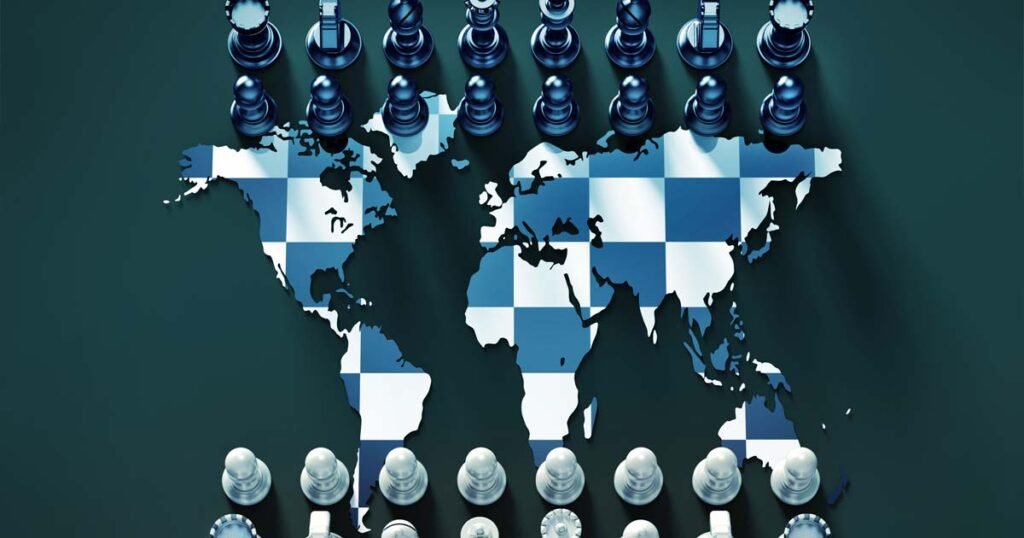
The past two years have provided textbook examples of G-Zero dynamics:
- The 2025 “Tariff Shock” and Trade Fragmentation: The return of aggressive U.S. protectionism, with proposed tariffs as high as 145% on some Chinese goods, created global economic uncertainty. The response wasn’t a unified global pushback, but fragmentation: China imposed counter-tariffs and export controls, the EU accelerated its own industrial policy, and middle powers deepened regional trade pacts.
- The Reshaping of the Middle East: The traditional U.S.-guaranteed security architecture has evolved. Following a brief conflict between Israel and Iran in June 2025, the region’s balance shifted. Gulf states, no longer confident in unwavering U.S. support, are deepening their own political and security ties, even as they maintain defense agreements with Washington.
- AI as a G-Zero Battleground: With international governance for AI lagging, it has become a core arena for U.S.-China competition. The U.S. seeks to maintain a technological edge, while China focuses on widespread adoption. The risk of a “digital iron curtain” dividing the world into incompatible tech spheres is high. This technological decoupling is a quintessential G-Zero phenomenon.
- The Stalling of Climate Geopolitics: The momentum behind global climate cooperation has faltered. With a climate-sceptic U.S. administration focused on energy dominance and major private actors reconsidering priorities, the drive for a unified global approach has weakened, pushing climate action down to regional and corporate levels.
Real-Life Examples and Success Stories
Success in a G-Zero world means building resilience and leveraging flexibility.
- ASEAN’s Strategic Pivot: Southeast Asian nations, long caught in the U.S.-China crossfire, are not passively waiting. In 2025, ASEAN launched a “game-changing” Digital Economy Framework Agreement aimed at unlocking $2 trillion by 2030. By creating their own integrated rules for data and digital trade, they are building a platform for growth that maintains strategic autonomy from the superpowers.
- Corporate Supply Chain Resilience: Companies like Green Cargo (Sweden’s state-owned rail freight company) exemplify adaptation. Faced with antiquated systems, they didn’t attempt a costly, full-scale overhaul. Instead, they rapidly developed cloud-based apps for rail-yard workers, which slashed in-service failures by 50%. This agile, tech-enabled approach to solving specific bottlenecks is a key strategy for operating in unpredictable environments.
- Taiwan’s “Silicon Shield”: While facing immense geopolitical pressure, Taiwan has leveraged its dominance in advanced semiconductor manufacturing (TSMC produces over 90% of the world’s most advanced chips) to create a form of deterrence. The catastrophic global economic impact of a disruption to Taiwan’s chip supply makes military action against it a cost that even Beijing must carefully weigh. This is an example of a middle power using economic indispensability as a strategic asset.
Real-Life Examples for Professionals
For Business Leaders: Supply Chain Resilience
A European automotive manufacturer I consulted with faced classic business risks in a leaderless world order when tensions spiked in the South China Sea. Their geopolitical risk assessment revealed 60% of their advanced electronics flowed through potential conflict zones. Their solution embodied strategic autonomy: they developed a “3-3-3” sourcing strategy (3 suppliers across 3 regions with 3-month inventory buffers). While this increased costs by 8-12%, it reduced potential disruption risk by an estimated 85%.
For Policy Professionals: Regional Cooperation Models
The African Continental Free Trade Area (AfCFTA) represents a fascinating case study in middle power strategy in geopolitical competition. As one African diplomat told me: “We’re not waiting for Washington or Beijing to solve our problems. We’re building our own economic ecosystem.” This approach to what happens when no country leads the world focuses on creating regional resilience rather than relying on external patrons.
Common Misconceptions
Misconception: “This is just another Cold War.”
Reality: The US-China strategic competition lacks the ideological clarity, bipolar structure, and mutual understanding of red lines that characterized the U.S.-Soviet rivalry. We’re seeing geopolitical fragmentation across multiple dimensions simultaneously—economic, technological, military—without the stabilizing framework that contained Cold War competition.
Misconception: “Markets will force cooperation.”
Reality: While global trade reached $35 trillion in 2025, this economic decoupling coexists with political fragmentation. Markets adapt to geopolitical risk through hedging and regionalization rather than forcing political reconciliation—a key insight for accurate geopolitical risk assessment.
Conclusion and Key Takeaways
The G-Zero world is not a future prediction; it is the current condition of global affairs. Characterized by a vacuum of sustained leadership, it leads to economic fragmentation, heightened conflict risk, and systemic unpredictability. For professionals and engaged citizens, understanding this landscape is no longer optional—it’s a critical component of strategic planning.
Final Key Takeaways:
- Leadership, Not Power, is Missing: The problem isn’t an absence of strong states, but an absence of states willing to consistently uphold global systems for the common good.
- Prepare for Volatility, Not Stability: Build strategies that assume disruption. For businesses, this means supply chain diversification and financial resilience. For policymakers, it means strengthening regional alliances and domestic capacities.
- Middle Powers Are in the Driver’s Seat: Nations and corporations that can navigate between competing blocs, maintain strategic autonomy, and offer essential goods (from critical minerals to technology) will wield disproportionate influence.
- Technology is the New Frontier of Power: Competition over AI, cyber, and critical tech supply chains is now central to geopolitics, often outpacing the development of governing rules.
- Adaptability is the Ultimate Skill: The most successful actors will be those who can gather information rapidly, model multiple scenarios, and pivot operations quickly in response to geopolitical shocks.
Navigating this new world requires moving beyond the old maps and assumptions. By recognizing the signs of G-Zero dynamics—from tariff wars to regional security realignments—you can begin to build the resilience needed to not just survive, but thrive, in an age where no one is firmly in charge.
For more insights on building resilient systems in a complex world, explore our guides on Global Supply Chain Management and the strategic power of Business Partnerships on our partner sites.
FAQs: Navigating the G-Zero World
1. What is the simplest definition of a “G-Zero world”?
A G-Zero world is a global situation where no single country or cohesive group of countries has the political will and economic leverage to set the agenda and enforce rules for the international system. It’s a leadership vacuum.
2. How is G-Zero different from a multipolar world?
In a multipolar world (e.g., 19th-century Europe), several great powers compete but generally operate within an accepted framework of rules and diplomacy. In a G-Zero world, that overarching framework is weak or absent. Major powers are more focused on unilateral gains than system management, leading to higher friction and unpredictability.
3. Is the United States still a superpower in a G-Zero world?
Yes, absolutely. The U.S. remains the most comprehensive global power. The shift is in its role. It is moving from being the system’s anchor and manager to being its most powerful participant and competitor, often prioritizing national interests over systemic stability.
4. What are the biggest daily life impacts of this shift?
Consumers will see it in higher prices and potential shortages as supply chains become less efficient due to geopolitical reshoring. Citizens may feel less secure due to increased regional conflicts and cyber threats. Investors will face higher volatility in markets driven by geopolitical news rather than just economic fundamentals.
5. Can the European Union become a global leader in this environment?
The EU has an economic size but struggles with political unity, especially on foreign and defense policy. It is actively pursuing “strategic autonomy” to reduce dependencies, particularly in energy and defense. While it may become a more cohesive pole, it currently lacks the unified will and military capability to replace the U.S. as a global systemic leader.
6. How are middle powers like India or Brazil responding?
They are practicing “multi-alignment.” They refuse to choose sides between the U.S. and China, instead partnering with both on different issues to maximize their own benefit. They are also strengthening regional partnerships (e.g., ASEAN, African Continental Free Trade Area) to increase their collective leverage.
7. What is “friendshoring” and how does it relate to G-Zero?
Friendshoring is the practice of moving supply chains to countries that are geopolitical allies. It’s a direct response to G-Zero fragmentation, as companies and governments prioritize security and political alignment over pure cost efficiency. This rewires global trade along political lines.
8. Why is artificial intelligence (AI) a major G-Zero issue?
AI is a dual-use technology (civilian and military) central to future economic and military power. There is no effective global governance for it. The U.S. and China are engaged in a fierce race for dominance, risking a bifurcated global tech ecosystem (“splinternet”) and escalating cyber conflict.
9. Does a G-Zero world make large-scale war more likely?
Analysts believe it increases the risk of miscalculation and escalation. With weaker alliance guarantees, less predictable major power behavior, and no clear referee, regional conflicts (e.g., in the South China Sea or Eastern Europe) have a higher chance of spiraling into broader confrontations.
10. What’s the single most important thing a business can do to prepare?
Build scenario-based resilience. Don’t plan for one future. Model your operations against multiple geopolitical scenarios (e.g., sudden tariffs on a key supplier region, a blockade of a critical shipping lane). Stress-test your supply chain, finances, and cyber defenses against these potential shocks.
11. Are international organizations like the UN completely irrelevant now?
Not irrelevant, but their role is diminished and often limited to humanitarian and technical issues. On major security and economic disputes driven by great power rivalry, they are frequently paralyzed (e.g., UN Security Council vetoes). Action has shifted to smaller “mini-lateral” groups and regional organizations.
12. How does climate change fit into the G-Zero picture?
It becomes harder to address. Global collective action on climate change requires immense cooperation, technology transfer, and financing—all of which are in short supply in a fragmented world. Climate policy is increasingly tied to trade policy and national security, leading to a more piecemeal, competitive approach to the green transition.
13. Is globalization reversing?
Globalization is transforming, not reversing. The volume of global trade remains high, but its character is changing. It’s becoming more regional, more politicized, and more digital. The era of hyper-globalization driven purely by cost optimization is over, replaced by an era of “secure” or “managed” globalization.
14. What role do non-state actors (like tech companies or NGOs) play?
Their role increases. In governance gaps, massive tech firms set de facto rules for cyberspace and commerce. NGOs step in where states fail to address humanitarian crises. They can be forces for stability or new sources of disruption, but they are not substitutes for effective state-led international cooperation.
15. How long will this G-Zero period last?
There’s no consensus. It could be a transitional decade as the world moves to a new, more stable structure (like a clear bipolarity), or it could be a prolonged period of instability. Its duration will depend on factors like the outcome of U.S.-China competition, the occurrence of a catastrophic global crisis that forces cooperation, and the adaptability of the international system.
16. What should an individual investor keep in mind?
Geopolitical risk is now a first-order factor, not a niche concern. Diversification must be geographic as well as sectoral. Pay close attention to companies with resilient, diversified supply chains and those positioned to benefit from government industrial policies (e.g., in semiconductors, green tech).
17. How does cyber warfare illustrate G-Zero dynamics?
Cyberattacks on critical infrastructure (energy grids, financial systems) have become a common tool of statecraft. There are no agreed-upon international rules of the road or robust deterrence mechanisms for this domain. It’s a perfect example of a dangerous, ungoverned space where powerful actors operate with relative impunity.
18. Can a G-Zero world be a good thing? Could it empower smaller countries?
Potentially, in the short term. It can create opportunities for agile middle powers to play rivals off each other and gain concessions. However, in the long run, most analysts argue that the instability, economic costs, and security risks of a leaderless system outweigh these tactical benefits, especially for smaller, vulnerable states that benefited from predictable rules.
19. What’s the connection between domestic politics and G-Zero?
It’s a direct feedback loop. Populist, nationalist politics in key democracies (U.S., Europe) drive inward-looking, unilateral foreign policies. This withdrawal creates a leadership vacuum. In turn, the instability of the G-Zero world fuels further domestic discontent and polarization, creating a vicious cycle.
20. Where can I go to reliably track these risks?
Follow the annual risk reports from firms like Eurasia Group (Top Risks) and BlackRock (Geopolitical Risk Dashboard). Institutions like the World Economic Forum and S&P Global provide excellent analysis. For deeper dives into related topics like strategic business planning, resources like the SheraKat Network offer valuable insights.
21. How does the G-Zero world differ from traditional balance of power systems?
Traditional multipolar world order models assume major powers actively manage the system, even competitively. The G-Zero world represents a global leadership vacuum where major powers are focused inward or on unilateral gains, leading to geopolitical fragmentation rather than managed competition.
22. What industries face the greatest risk in this environment?
Industries with long, complex supply chains (electronics, automotive, pharmaceuticals) and those dependent on global technology standards (telecom, fintech) face significant business risks in a leaderless world order. Effective geopolitical risk assessment has become essential for these sectors.
23. Can regional organizations fill the leadership vacuum?
Regional groups can provide partial solutions within their spheres. The European Union’s pursuit of strategic autonomy and ASEAN’s consensus-building represent attempts to manage geopolitical fragmentation regionally. However, they cannot replace global leadership on transnational issues like climate or pandemics.
24. How should investors adjust their portfolios for G-Zero conditions?
Diversification must now include geopolitical risk assessment alongside traditional financial metrics. Look for companies with: 1) geographically diversified operations, 2) flexible supply chains resilient to economic decoupling, and 3) products/services less vulnerable to US-China strategic competition disruptions.
25. What early warning signs indicate worsening G-Zero conditions?
Monitor: 1) Breakdowns in major power diplomatic channels, 2) Acceleration of economic decoupling measures, 3) Proliferation of competing technology standards, 4) Increased secondary power alignment shifts, and 5) Normalization of economic sanctions as routine policy tools.
About the Author
The geopolitical analysis in this article synthesizes insights from leading experts on power transition theory, global governance crisis, and geopolitical risk assessment. Our team at World Class Blogs maintains ongoing dialogues with policymakers, business leaders, and academic institutions to provide actionable insights on navigating geopolitical fragmentation. For more expert perspectives on related topics, visit our sections on technology innovation and strategic partnerships.
Free Resources for Further Learning
- Eurasia Group’s “Top Risks 2025” Report: The foundational analysis that popularized the G-Zero concept. [Available on their website].
- BlackRock Geopolitical Risk Dashboard: An interactive tool tracking market attention to key geopolitical risks.
- World Economic Forum “Trade Stories 2025”: Excellent overview of how trade is being reshaped by geopolitics.
- S&P Global “Geopolitical Risks 2025”: A detailed look at interconnected economic and security risks.
- GZERO Media: Daily news and analysis on global politics from Ian Bremmer’s team.
- Explore our own archives for related topics: Technology & Innovation, Nonprofit Strategy, and our overall Blog Focus.
Discussion
We want to hear from you. How is the fragmented geopolitical landscape affecting your work or personal outlook?
- For business readers: What has been your most significant challenge in adapting supply chains or strategy to this new reality?
- For students and analysts: Which regional conflict or technological shift do you believe will most define the next phase of the G-Zero world?
- What topics in global affairs would you like us to analyze next?
Join the conversation in the comments below or contact our editorial team directly with your ideas and questions.


