


Introduction: The Hill That Shattered a Paradigm
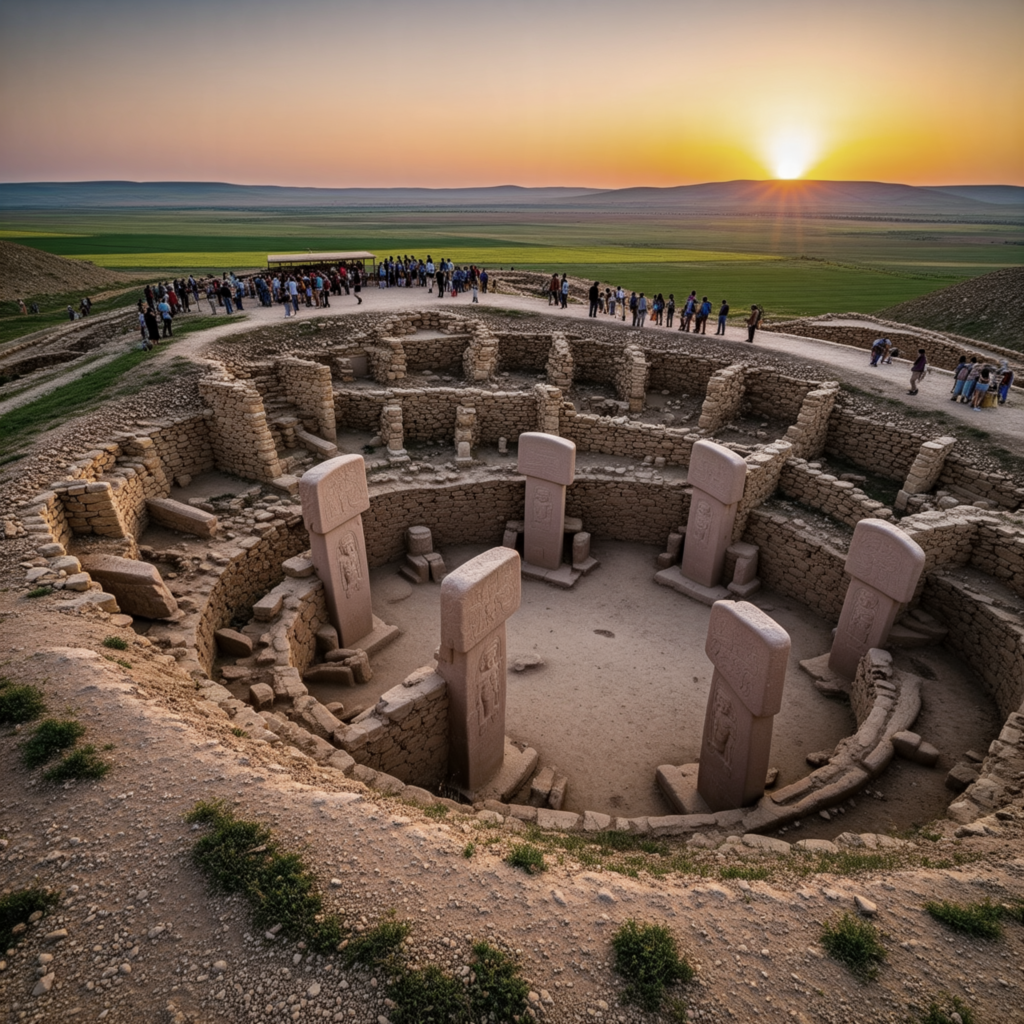
In my experience speaking with archaeologists, the discovery of Göbekli Tepe is often described with a sense of disbelief that borders on the sacred. In the mid-1990s, on a windswept hill in southeastern Turkey, a team led by the late German archaeologist Klaus Schmidt unearthed something that should not, according to all textbooks, have existed. They found massive, exquisitely carved stone pillars—some weighing over 20 tons—arranged into great stone circles. The mind-bending fact? These monuments were erected around 9600 BCE, over 7,000 years before Stonehenge and a staggering 6,000 years before the Great Pyramid of Giza.
This date places Göbekli Tepe firmly in the Pre-Pottery Neolithic (PPN), a time when humanity was supposedly composed of small, mobile bands of hunter-gatherers, living hand-to-mouth. There was no agriculture, no domesticated animals (except possibly the dog), no permanent settlements, no pottery, and certainly no organized labor for monumental construction. Yet, here it was: a spectacular, ritual complex of breathtaking scale and artistic sophistication.
Göbekli Tepe has forced a fundamental rewrite of human history. It challenges the long-held “materialist” sequence of the Neolithic Revolution: that agriculture came first, providing food surplus, which then led to sedentary life, population growth, social hierarchy, and finally, organized religion and monumental art. Göbekli Tepe inverts this logic. It suggests that collective ritual, a shared belief system, and the need to build a sacred place may have been the catalyst that brought people together, fostering the cooperation, organization, and settled life that later made agriculture not just possible, but necessary. This is not just an archaeological site; it is a philosophical bombshell about what drives human civilization.
Part 1: Background & Context – The Old Story vs. The New Evidence
The Classic Neolithic Narrative (The Old Story)
For decades, the dominant model of how civilization began followed a clear, logical progression, primarily developed from evidence in the Fertile Crescent (the Levant, Mesopotamia):
- Climate Stability (~9600 BCE): The end of the last Ice Age (Younger Dryas) brought a warmer, wetter, more stable climate.
- Incidental Cultivation: Hunter-gatherers began to selectively protect and later cultivate wild grasses (like einkorn wheat) and legumes.
- Sedentism: As they tended these plants, they became less mobile, building permanent or semi-permanent villages (e.g., Jericho, Çatalhöyük).
- Domestication: Through generations of selection, plants and animals (sheep, goats) were fully domesticated, creating a reliable food surplus.
- Population Growth & Social Complexity: Surplus allowed population to expand beyond kinship bands. Specialized roles emerged (leaders, priests, artisans). Social stratification and hierarchy developed.
- Monumental Architecture & Organized Religion: With a large, sedentary population under centralized control, society could now marshall labor to build temples, monuments, and defensive walls to serve the gods and the elite.
In this model, the temple is a product of an already complex, agricultural society. It is the pinnacle, not the foundation.
Göbekli Tepe: The Anomaly That Demands a New Story
Göbekli Tepe, dating to the very beginning of this climatic stability (the early PPN A), presents a startling contradiction to every step from (3) onward.
- No Agriculture: Plant remains from the site are entirely wild. The builders were hunter-gatherers.
- No Permanent Domestic Settlement: While there is evidence of temporary shelters for builders, there are no signs of a large, permanent residential village on the scale needed to house the builders. It appears to have been a pilgrimage center.
- No Social Hierarchy (in the traditional sense): There is little evidence of a permanent, ruling elite living at the site. The labor appears to have been communal and perhaps seasonal.
- BUT… Monumental Architecture Exists: And it exists on a breathtaking scale, requiring a level of planning, coordination, skilled labor, and artistic vision that was previously unimaginable for this period.
The site forces us to ask: What motivated hundreds, perhaps thousands, of people to come together, quarry, carve, transport, and erect these colossal stones, if not the command of a king or the surplus of a farmer? The answer emerging points to a powerful, unifying ideology or belief system.
Part 2: Key Concepts Defined
- Pre-Pottery Neolithic (PPN): The earliest phase of the Neolithic period in the Near East, split into PPN A (~9600-8800 BCE) and PPN B (~8800-7000 BCE). Characterized by the first experiments with plant cultivation and animal management, but before the widespread use of pottery. Göbekli Tepe belongs to the PPN A.
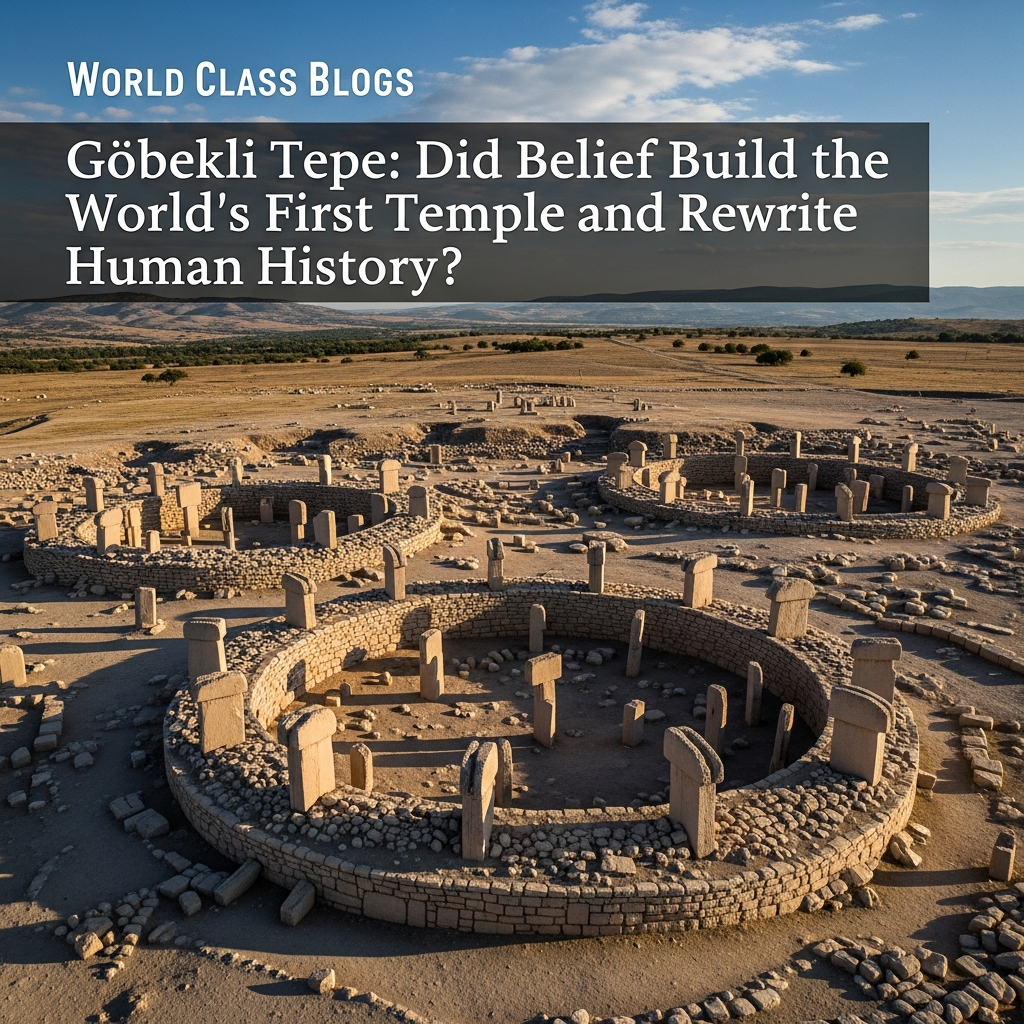
- T-shaped Pillars: The defining architectural feature of Göbekli Tepe. Massive limestone pillars are often interpreted as stylized human forms. The “head” of the T is the broad, top part. Many are adorned with elaborate relief carvings of animals, abstract symbols, and items of clothing (belts, loincloths).
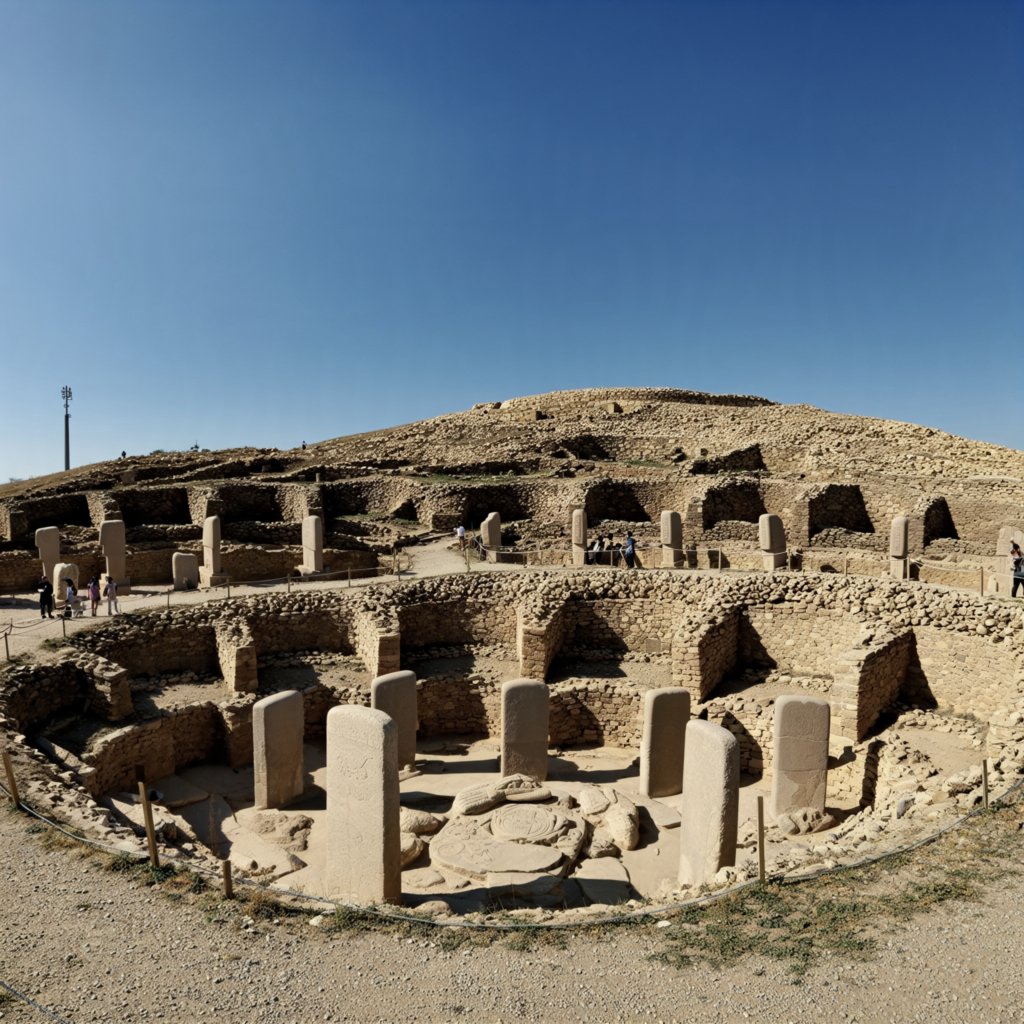
- Enclosures/Circles: The site contains multiple circular or oval structures, each defined by a ring of these T-pillars connected by walls, with two even larger pillars positioned centrally. At least 20 such enclosures have been identified through geophysical survey, though only 6 have been excavated.
- Pillar 43 (The “Vulture Stone”): One of the most famous and debated pillars. It features a large vulture, a scorpion, a headless human, a disc-like object, and a series of abstract symbols (H-shaped bags, crescents). Some interpretations suggest it depicts a celestial event or a funerary ritual.
- The “Belly Stone” (Pillar 18): A central pillar with a human-like face, arms, hands, and a belt, with the arms ending in hands that appear to hold the belt/loincloth. This is the clearest evidence that the pillars represent stylized humans, possibly ancestral beings or deities.
- Karahan Tepe & the “Taş Tepeler” (Stone Hills): Göbekli Tepe is not alone. It is the flagship site within a much larger cultural phenomenon now called the Taş Tepeler (“Stone Hills”) region. Karahan Tepe, a sister site just 35 km away, is currently under intense excavation and features similar T-pillars, carved heads, and complex architecture, confirming Göbekli Tepe was part of a widespread ritual landscape.
- Intentional Burial (The “Sandwich” Model): A unique feature of Göbekli Tepe. Around 8000 BCE, after over a millennium of use, the enclosures were deliberately and carefully backfilled with enormous amounts of rubble, soil, and bone fragments. This was not collapse or abandonment; it was a ritual act of closure, which is why the carvings are so perfectly preserved.
Part 3: How It Works – Deconstructing the “First Temple”
Understanding Göbekli Tepe requires examining its construction as a socio-technological feat by pre-agricultural people.
Step 1: The Conceptual Phase – The “Why”
Before a single stone was quarried, a powerful idea had to unite disparate bands of hunter-gatherers across the region. Archaeologists speculate this was a shared cosmological belief—perhaps a cult of the dead, a veneration of powerful animal spirits, or a mythologized connection to ancestral founders. The need to periodically gather, enact rituals, and build a permanent home for these beliefs provided the social “glue.” This transforms our view of early society from purely utilitarian to deeply symbolic.
Step 2: Quarrying & Initial Shaping
The limestone bedrock of the hill itself was the source. Using stone tools (flint picks, hammerstones), workers carved trenches around the base of a pillar still attached to the bedrock. The pillar was then levered free. In my experience looking at the quarry areas, the skill is evident; the negative spaces where pillars were extracted are still visible. Initial shaping likely happened nearby to reduce weight before transport.
Step 3: Transport & Engineering
This is the most debated logistical challenge. The largest pillars weigh 10-20 metric tons. Without wheels, draft animals, or metal tools, how were they moved? The prevailing theory involves a combination of:
- Wooden sledges on log rollers.
- Ropes made from plant fibers (evidence of linseed cultivation for oil and possibly fiber exists in the region).
- Human power was coordinated through large, seasonal gatherings (perhaps during times when wild food resources were plentiful). The distance from the quarries to the enclosures was relatively short (a few hundred meters), but over uneven terrain.
Step 4: Carving & Artistry
Once positioned, master artisans carved the intricate reliefs using fine flint and obsidian tools. The artistry is not primitive; it is confident, symbolic, and narrative. The animals (foxes, snakes, wild boar, cranes, vultures, scorpions) are not random. They likely held specific symbolic meanings—perhaps representing different clans, spiritual guides, or elements of a creation story.
Step 5: Assembly & Ritual Use
The pillars were erected into their sockets in the bedrock floor. The central pillars of Enclosure D stand over 5.5 meters tall. The spaces were likely roofed with wood, hides, or reed mats. The interiors would have been dark, smoky, and charged with ritual significance. Evidence points to large-scale feasting (remains of wild aurochs, gazelle, and tons of butchered bones) and possibly the use of psychoactive substances or beer from wild grains.
Step 6: Ritual Closure & Backfilling
Centuries later, in a final act of reverence or transformation of belief, the communities systematically buried their temples under thousands of tons of material, creating the artificial hill (“Tepe”) we see today.
Key Takeaway Box: The Göbekli Tepe Revolution – Inverted Causality
Old Model (Materialist):
Agriculture → Food Surplus → Sedentism → Social Hierarchy → Organized Religion → Monumental TemplesNew Model (Ideational/Social):
Shared Belief / Ritual Gathering → Social Cooperation & Organization → Need for Permanent Ritual Space (Temple) → Increased Demand for Food → Sedentism & Experimentation → Incipient Agriculture
Göbekli Tepe suggests belief and community may have been the engine, not the caboose, of civilization.
Part 4: Why It’s Important – Implications for Understanding Humanity

Göbekli Tepe’s significance radiates far beyond archaeology, touching psychology, sociology, and our fundamental self-conception.
1. Redefining “Civilization” and Human Potential:
It shatters the prejudice that hunter-gatherers were simple, brutish, or incapable of complex achievement. It demonstrates that the human capacity for abstract thought, symbolic art, large-scale cooperation, and engineering existed long before farming. “Civilization” may begin with shared ideas, not surplus grain.
2. The Primacy of the “Cognitive Revolution”:
The site is powerful evidence for the theory that a shift in human cognition—the ability to believe in shared fictions, as Yuval Noah Harari puts it—preceded and enabled large-scale cooperation. The temple is a physical manifestation of a shared story powerful enough to command labor across generations.
3. Re-interpreting the Neolithic Revolution:
The site provides a new “pull” factor for sedentism. People may have settled down not just to tend crops, but to be near a sacred center. The need to feed large, periodic gatherings at Göbekli Tepe could have been the pressure cooker that accelerated the domestication of plants (like einkorn wheat, found wild in the region) and animals.
4. A New Model of Social Organization:
It challenges the inevitability of hierarchy. The construction may have been accomplished through non-hierarchical, task-oriented, and seasonal labor—a form of “communal cult” organization. This suggests complex achievements are possible without kings, slaves, or rigid class structures.
5. A Lesson in Cultural Fragility & Transformation:
The deliberate burial of the site around 8000 BCE is as significant as its construction. It marks a profound cultural shift—perhaps the rise of new belief systems centered on the household, ancestors, or domesticated life, as seen at later sites like Çatalhöyük. The great communal project of the hunters gave way to a new, agricultural world.
Part 5: Sustainability in the Future – Preservation vs. Progress
Göbekli Tepe faces immense modern pressures, making its sustainable management a critical case study in heritage conservation.
- The Tourism Paradox: Designated a UNESCO World Heritage Site in 2018, Göbekli Tepe now attracts hundreds of thousands of visitors annually. While tourism brings revenue and global awareness, it poses direct threats: physical wear on the ancient floors and pillars, microclimatic changes from breath and body heat in the new protective shelters, and pressure for disruptive infrastructure.
- The 2025 Conservation Strategy: The Turkish Ministry of Culture and Tourism, with international partners, has implemented a visitor management system featuring timed ticketing, restricted walking paths on suspended gangways, and state-of-the-art lightweight, climate-controlled shelters that protect the enclosures from the elements without trapping humidity. The goal is “preservation through controlled access.”
- The Threat of Urban Encroachment: The city of Şanlıurfa is expanding. Balancing the economic development of the region with the protection of the archaeological landscape (including unexcavated mounds) is an ongoing challenge.
- Climate Change: Increasingly erratic rainfall and temperature swings in southeastern Turkey threaten the delicate limestone with new erosion patterns and salt crystallization. Monitoring systems are now in place to track these changes.
- Ethical Archaeology & Community: The project increasingly involves training and employing local community members, not just as laborers but as site guards, conservators, and guides. This builds local stewardship and ensures the site’s benefits are shared, akin to principles of equitable development discussed in our Nonprofit Hub.
Part 6: Common Misconceptions
- “Göbekli Tepe is the oldest temple in the world.” PROBABLY, BUT… It is the oldest megalithic (large stone) temple we have found. There are earlier ritual sites (like the stone circles at Stonehenge’s precursor, or the painted cave of Lascaux), but none combine monumental architecture, sophisticated art, and organized labor on this scale at this early date.
- “It was built by aliens or a lost advanced civilization.” A PSEUDOSCIENTIFIC CLAIM. The tools (flint, limestone), the faunal remains (wild animals), and the gradual stylistic development seen in the Taş Tepeler region all confirm it was built by Neolithic hunter-gatherers using known technologies, motivated by profound human ingenuity and belief.
- “The pillars are arranged like Stonehenge to track the stars.” SPECULATIVE. While some pillars (notably Pillar 43) have intriguing carvings that might have astronomical significance, there is no consensus that the enclosures were precise observatories. Their primary function was almost certainly ritual and social.
- “Göbekli Tepe is where agriculture was invented.” NOT DIRECTLY. It is not a farming village. However, it likely played a catalytic role. The need to provision gatherings there put intense selective pressure on wild grasses and animals in the region, potentially accelerating the domestication process that was happening elsewhere in the Fertile Crescent.
- “The site was completely buried and lost until 1994.” NOT QUITE. The hill was known and even partially excavated in the 1960s by University of Chicago and Istanbul University archaeologists, who dismissed it as a medieval cemetery. It was Klaus Schmidt who, visiting the site in 1994, recognized the Neolithic stone tools and the true nature of the mounds.
Part 7: Recent Developments (2024-2025) – The Taş Tepeler Revolution
The story is rapidly expanding beyond Göbekli Tepe itself.
- Karahan Tepe Takes Center Stage: Ongoing excavations at Karahan Tepe, led by Prof. Necmi Karul, are producing stunning finds. The site features over 250 T-pillars, many still standing. A 2024 discovery of a structure with 11 phallus-shaped pillars surrounding a carving of a human head adds a new, explicit dimension to the iconography. A life-sized limestone sculpture of a human, discovered in 2023, provides unprecedented detail on Neolithic representation.
- Geophysical Surveys Reveal a “Metropolis of Ritual”: Ground-penetrating radar and geomagnetic surveys across the Taş Tepeler region have identified at least 15 other major sites with similar monumental architecture, including Sayburç, Sefer Tepe, and Çakmaktepe. This confirms Göbekli Tepe was not an isolated miracle but the heart of a vast, interconnected ritual landscape spanning 200 km.
- Bioarchaeology & Diet: Isotopic analysis of human remains from surrounding areas is clarifying the builders’ diet. A 2025 study confirms a heavy reliance on wild resources but also shows increased consumption of cultivated-type (but not yet fully domesticated) grains among populations likely linked to the ritual centers, supporting the “catalytic” hypothesis.
- The “Bone Tool Enigma” Solved? The site yielded thousands of bone tools. New high-magnification use-wear analysis in 2024 suggests many were used for working limestone and preparing hides, giving us a clearer picture of the toolkit and activities at the site.
Part 8: Success Stories & Real-Life Examples of the New Paradigm
1. The Feasting Hypothesis:
The sheer volume of animal bones at Göbekli Tepe—tons of them, primarily from wild gazelle, aurochs, and wild ass—paints a picture of massive, recurring feasts. This is not everyday subsistence waste. Archaeozoologists have shown the animals were hunted in the surrounding hills and brought to the site for large-scale consumption. This ritual feasting is a powerful social mechanism that builds community, creates obligation, and reinforces shared identity. It’s a tangible example of how ritual drove economic activity (cooperative hunting) and social cohesion.
2. The “Skull Cult” Connection at Later Sites:
While not directly evidenced at Göbekli Tepe (yet), a fascinating link exists to later PPN sites like Jerf el Ahmar and Çatalhöyük, where the skulls of ancestors were often retrieved, plastered, painted, and displayed in homes. This “skull cult” suggests a deep concern with ancestry and the spirit world. The stylized human forms of Göbekli Tepe’s T-pillars, some researchers suggest, could represent deified ancestors or founders, making the enclosures literal houses for collective ancestral memory—a monumental version of the later skull cult.
3. The Domestication of Social Structures:
Göbekli Tepe can be seen as an experiment in “domesticating” human society itself. Bringing large groups together for sustained periods required new rules, norms, and conflict-resolution mechanisms. The successful management of such a project for centuries was a social technology as important as the later domestication of plants. It created a template for large-scale cooperation that would be essential for later urban life.
Part 9: Conclusion and Key Takeaways
Göbekli Tepe stands as a silent, stone rebuttal to simplistic materialist histories. It is a testament to the power of the human mind to conceive of the abstract, the sacred, and the communal, and to translate those conceptions into physical reality through staggering collective effort.
The key lessons from this 12,000-year-old hill are profound:
- Ideas Precede Empires: The most powerful force in early human societal development may not have been the control of food, but the control of meaning. Shared belief systems provided the “software” for large-scale cooperation before the “hardware” of agriculture and states existed.
- Hunter-Gatherers Were Not Primitive: They possessed the cognitive complexity, artistic skill, and organizational ability to execute projects that still inspire awe. We must discard hierarchical views of cultural evolution.
- Civilization Had Multiple Pathways: The classic Fertile Crescent model is not wrong, but it is incomplete. Göbekli Tepe reveals an alternative, possibly parallel, pathway where ritual and communal construction were primary drivers, intertwining with the slower process of domestication.
- We Are Symbolic Creatures First: Humans are not just Homo sapiens (wise man); we are Homo symbolicus. Our unique trait is the creation of shared symbolic worlds—myths, gods, art—and Göbekli Tepe is perhaps the oldest and grandest architectural expression of this trait yet discovered.
- The Story is Still Being Uncovered: With the ongoing Taş Tepeler project, we are only at the beginning. Each season at Karahan Tepe and other sites promises new data that will further refine, and perhaps revolutionize again, our understanding of this pivotal era.
Final Thought: What I’ve found, reflecting on Göbekli Tepe, is that it offers a humbling and inspiring corrective. In an age obsessed with technology and material progress, it reminds us that the deepest human projects—the ones that truly last—are often those built not for utility, but for meaning. The builders sought not to store grain, but to answer the great questions of existence, to honor the forces of nature, and to forge a collective identity. In that sense, their temple, though buried for millennia, speaks more directly to the core of the human experience than many of our modern wonders.
Part 10: FAQs (Detailed Q&A)
1. How do we know the date of Göbekli Tepe is 9600 BCE?
Through radiocarbon dating of organic materials found in the construction fill, primarily charcoal from short-lived plants. Dozens of dates consistently cluster around 9600-8800 BCE for the main construction phase.
2. Who was Klaus Schmidt?
A German archaeologist who, having worked at Neolithic sites like Nevalı Çori, visited the mound in 1994 and immediately recognized the Neolithic stone tools eroding from the surface. He dedicated the rest of his life (until his death in 2014) to excavating and promoting the site’s significance.
3. What do the animal carvings mean?
We can’t know for certain, but theories abound: they may represent totemic symbols of different clans that contributed labor; dangerous or powerful spirit guides; elements of a creation mythology; or symbolic protections for the sacred space. The absence of many docile, later-domesticated animals is notable.
4. Is there any writing at Göbekli Tepe?
No. The abstract symbols (H’s, crescents, discs) are not a writing system but likely held symbolic meaning. They are part of a symbolic communication system that preceded writing by thousands of years.
5. How was such precise carving done with stone tools?
Through incredible skill, patience, and the use of fine-grained, hard stones like flint and obsidian for chisels and engraving tools. The limestone is relatively soft when first quarried, hardening on exposure to air.
6. Why is there no evidence of houses?
There are small, rectangular structures on the plateau that may have been temporary shelters or workshops for the builders. The consensus is that the permanent population was small (a caretaker priestly class?), with the bulk of the labor force coming from surrounding hunter-gatherer groups for seasonal work and festivals.
7. What happened to the people who built it?
They didn’t vanish. Their culture evolved. Around 8000 BCE, the great enclosures were buried, and focus seems to have shifted to smaller, village-based life and the developing agricultural economy. The descendants of the Göbekli Tepe builders likely became the farmers of the later PPN B villages in the region.
8. How does this relate to the biblical Garden of Eden?
Some popular writers have speculated about a connection due to the region’s location near the headwaters of the Tigris and Euphrates. This is purely speculative and not supported by archaeology. The site is fascinating enough without needing biblical parallels.
9. Can I visit Göbekli Tepe?
Yes. It is open to the public near Şanlıurfa, Turkey. It’s essential to visit with respect, stay on designated paths, and follow all guidelines to help preserve this irreplaceable site for future generations.
10. How does this change the view of sites like Stonehenge?
It provides a much deeper antiquity for the human impulse to build megalithic ritual centers. Stonehenge is no longer seen as a unique, early phenomenon but as a very late manifestation of a tradition that began at the dawn of the Neolithic, over 6,000 years earlier.
11. What role did women play at Göbekli Tepe?
This is a critical and under-studied question. The iconography is dominated by animals and male-associated symbols (belts, phallic pillars at Karahan Tepe). However, small female figurines have been found in later layers. Women were undoubtedly integral to the community—gathering food, preparing feasts, raising children, and likely participating in rituals. Their full social role is a key research question.
12. Has any human burial been found at the site?
A few fragmentary human bones have been found in the backfill, but no intact burials within the enclosures. This is puzzling for a presumed ritual center. Burials may be located in areas not yet excavated, or the treatment of the dead may have been different (exposure, as suggested by the vultures on Pillar 43?).
13. Are there any 3D models of the site available online?
Yes. The German Archaeological Institute (DAI) and Google Arts & Culture have created detailed 3D models and virtual tours, allowing anyone to explore the enclosures remotely.
14. How is the site funded?
Excavations have been funded by a combination of the German Archaeological Institute, the Turkish Ministry of Culture and Tourism, and research grants from various universities and foundations. The massive tourism revenue now contributes significantly to conservation.
15. What’s the biggest unanswered question?
The nature of the rituals performed there. Were they funerary? Initiatory? Astronomical? Shamanic? Without textual records, we can only infer from the art and architecture. The answer lies in the careful analysis of micro-residues, spatial use patterns, and comparisons with ethnographic analogies.
16. How does this relate to modern theories of social organization?
It provides a prehistoric case study for how large-scale collaboration can emerge without top-down coercion. This has relevance for understanding decentralized networks, collective action problems, and the role of narrative in modern organizations, topics often explored in fields like Artificial Intelligence & Machine Learning when designing cooperative AI systems.
17. Were drugs or alcohol used at the site?
There is circumstantial evidence. Large quantities of wild barley and evidence of fermentation vats at slightly later sites suggest the production of a primitive beer was possible. Such communal intoxicants could have played a role in ritual ecstasy and social bonding.
18. What is the “H-symbol” or “bag” carving?
A recurring motif that looks like an H or a stylized bag with curved handles. It appears on Pillar 43 and elsewhere. Some interpret it as a constellation, a tool, or a symbol of authority/divinity. It remains one of the most enigmatic symbols.
19. Is the site connected to Armenia’s Karahunj or other megalithic sites?
Geographically and chronologically, it is much older and distinct from Caucasian or European megaliths. However, it stands as a potential, very deep ancestral inspiration for the global megalithic phenomenon, showing the idea of monumental stone ritual architecture has extremely ancient roots.
20. Where can I follow the latest research?
Follow the German Archaeological Institute’s (DAI) project page, the work of Prof. Necmi Karul on Karahan Tepe, and publications in journals like Antiquity, Science, and Archaeology Journal.
Part 11: About the Author
This article was authored by the World Class Blogs Editorial Team, a collective dedicated to uncovering and explaining the pivotal discoveries that reshape our understanding of the human journey. Our writers combine on-the-ground research insights with a passion for narrative clarity, striving to make complex archaeological breakthroughs accessible and compelling. We believe that exploring our deepest past is key to understanding our present and future. Learn more about our editorial standards and mission on our About Us page.
Part 12: Free Resources
- Virtual Tours & Databases:
- Google Arts & Culture: “Göbekli Tepe: The Dawn of Civilization” – High-resolution imagery and virtual walks.
- German Archaeological Institute (DAI) Göbekli Tepe Project Website – The most authoritative source for excavation reports, photos, and maps.
- Documentaries:
- “Göbekli Tepe: The World’s First Temple?” (National Geographic)
- “The Gift of the Stones” (BBC) – Focuses on the site’s discovery and significance.
- “10,000 BC – The Cradle of Civilisation” (History Channel) – Places Göbekli Tepe in broader context.
- Key Books:
- Klaus Schmidt: Göbekli Tepe: A Stone Age Sanctuary in South-Eastern Anatolia (the definitive work by the discoverer).
- Steve Mithen: *After the Ice: A Global Human History, 20,000-5000 BC* (includes an excellent chapter on Göbekli Tepe).
- For More on Transformative Discoveries & Innovation: The story of Göbekli Tepe is a testament to how a single discovery can overturn entrenched paradigms. For insights into how such transformative thinking applies in the modern business and technological world, explore our partner network’s guide on Business Partnership Models.
Part 13: Discussion
Göbekli Tepe forces us to re-evaluate what drives human progress. Was it the practical need for food, or the spiritual need for meaning and community that truly built the first civilizations? Does this discovery make you more optimistic about human nature’s capacity for cooperation, or does it highlight a lost form of social organization we can no longer access?
We invite your reflections and questions on this paradigm-shifting site. For further discussion or to suggest other historical frontiers for exploration, please contact us via our Contact Us page. Delve into more world-changing topics in our main Blogs category and our curated Our Focus sections.


