


Introduction: Why This Matters
In my experience explaining superconductivity to curious beginners, the hardest part isn’t the zero resistance or the levitating magnets. It’s the caveat that always follows. “We have materials that superconduct at temperatures warmer than liquid nitrogen,” I say. “But they only work under pressures comparable to the inside of the Earth.” That caveat has killed more enthusiasm than any other sentence in physics. Here is the detailed article pressure quench superconductor 151 K.
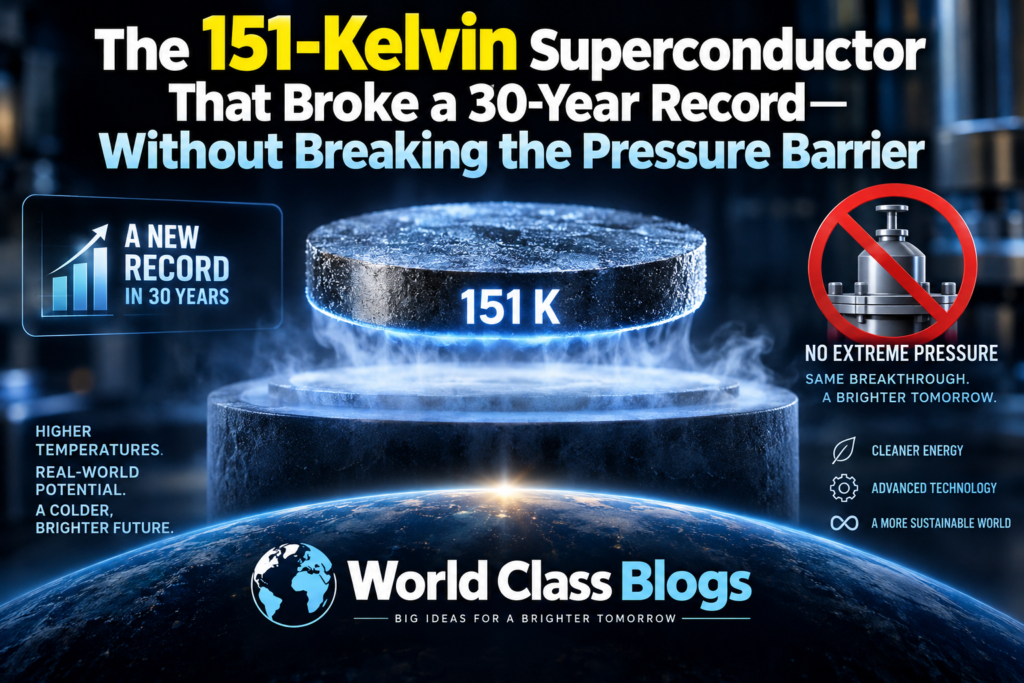
In March 2026, a team at the University of Houston led by Ching-Wu Chu published a result in PNAS that chips away at that caveat in a way nobody expected. Using a technique called pressure quenching, they stabilized a high-temperature superconducting phase of a mercury-based cuprate at ambient pressure with a transition temperature above 151 Kelvin—roughly minus 122 degrees Celsius, or about 30 degrees warmer than the previous ambient-pressure record for this class of materials . The pressure wasn’t eliminated during synthesis. It was applied, then released, and the material remembered.
What I’ve found, following this field through the LK-99 circus and the hydride hype cycles, is that this result is easy to undersell. It’s not room-temperature superconductivity. It won’t revolutionize power grids tomorrow. But it demonstrates a principle that could reshape how we think about metastable quantum materials: extreme conditions don’t have to be permanent to leave a permanent mark. For professionals needing a refresher, the pressure-quench protocol (PQP) is a new tool for materials design. For curious beginners, it’s a story about how scientists trick matter into keeping a state it shouldn’t be able to hold.
Key Takeaways (at a glance):
- A University of Houston team achieved ambient-pressure superconductivity at 151 K in Hg1223, a mercury-based cuprate, using a pressure-quench protocol .
- The previous ambient-pressure record for this material was 133 K. The pressure-quench added 18 K of headroom .
- The technique works by applying high pressure to stabilize a metastable phase, then releasing the pressure while the material retains the enhanced superconducting state.
- This is not room-temperature superconductivity. 151 K is still 146 K below the freezing point of water.
- The result validates a broader strategy for trapping high-pressure quantum states at ambient conditions, with implications beyond superconductivity .
Background / Context: The Pressure Problem
Superconductivity was discovered in 1911, and for most of the 20th century it remained a cryogenic curiosity. Mercury superconducted at 4.2 K. Niobium-tin pushed the limit to 18 K. Then, in 1986, the cuprates arrived—copper-oxide ceramics that superconducted at temperatures above 30 K, then 90 K, then 133 K . For the first time, superconductivity above the boiling point of liquid nitrogen (77 K) was possible, which meant cheaper cooling and practical applications.
But the cuprates plateaued. The highest confirmed transition temperature at ambient pressure, in HgBa₂Ca₂Cu₃O₈₊δ (Hg1223), sat at 133 K for decades . Higher temperatures were possible under pressure—164 K at 31 gigapascals for Hg1223—but pressures like that are not something you can build a power grid around .
The hydrides offered a different path. In 2015, hydrogen sulfide was shown to superconduct at 203 K, but only under roughly 150 gigapascals . Later hydrides pushed higher, with some claims approaching room temperature, but always under pressures that make diamond anvil cells a requirement. The dream of ambient-pressure, room-temperature superconductivity remained distant.
The Houston result doesn’t solve that dream. But it asks a different question: what if you don’t need to maintain the pressure, only to apply it during synthesis? What if the material can be tricked into keeping the high-pressure phase after the pressure is gone?
That’s the promise of pressure quenching.
Key Concepts Defined (For Beginners and Refreshers)
Superconductivity: The property of certain materials to conduct electricity with zero resistance below a critical temperature (Tc). Electrons form pairs (Cooper pairs) that move through the lattice without scattering.
Cuprates: Copper-oxide-based superconductors discovered in 1986. They are “high-temperature” superconductors in the sense that they work above liquid nitrogen temperature, though still far below room temperature.
Hg1223: Shorthand for HgBa₂Ca₂Cu₃O₈₊δ, a mercury-based cuprate that held the ambient-pressure Tc record of 133 K before the 2026 result .
Pressure-Quench Protocol (PQP): The technique developed by the Houston team. A material is subjected to high pressure to induce or enhance a superconducting phase, then the pressure is rapidly released. If the phase is metastable—trapped in a local energy minimum—it can persist at ambient pressure .
Metastable State: A state that is not the lowest-energy configuration but is separated from it by an energy barrier, preventing spontaneous decay. Diamond is metastable at ambient conditions; so are the pressure-quenched superconducting phases.
Gigapascal (GPa): A unit of pressure. 1 GPa is roughly 10,000 atmospheres. The pressures used in hydride superconductivity research are typically 100–200 GPa, comparable to conditions deep inside the Earth.
How It Works: Step-by-Step Breakdown

Step 1: Start with a Known High-Pressure Superconductor
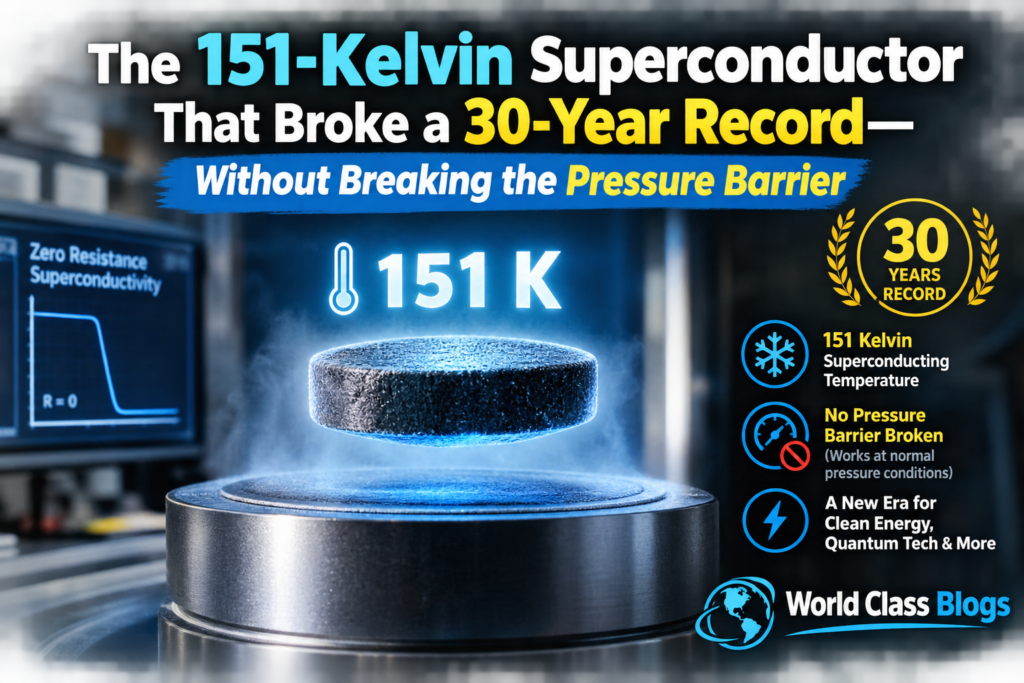
Hg1223 is a cuprate that superconducts at 133 K at ambient pressure and 164 K under 31 GPa . The pressure enhances the transition temperature by altering the electronic structure—specifically, by shifting the Fermi level toward a van Hove singularity, which increases the density of states available for pairing.
Step 2: Apply Pressure and Cool
The team pressurized the material, cooled it to superconducting temperatures, and then released the pressure while keeping the material cold. The key is that the high-pressure phase is metastable: once formed, it can survive decompression if the temperature is low enough to prevent the atoms from rearranging.
Step 3: Warm Up and Measure
After decompression, the material was warmed slowly while the team measured its resistance. If the superconducting state survived, the resistance would drop to zero at the new transition temperature. It did—at above 151 K, an 18 K improvement over the pristine ambient-pressure value .
Step 4: Verify the Phase
The team used synchrotron X-ray diffraction and nitrogen-vacancy (NV) center quantum sensing to confirm that the material’s structure had indeed changed and that the superconducting phase was distinct from the starting material . The quench had trapped a different atomic arrangement—one that superconducts at a higher temperature.
Step 5: Generalize the Approach
The Houston team had previously demonstrated pressure quenching in simpler systems: antimony, iron selenide (FeSe), copper-doped FeSe, and Bi₀.₅Se₁.₅Te₃ . The Hg1223 result extends the technique to a high-temperature cuprate, showing that it can work even in complex, multi-element oxides.
Why It’s Important
A New Route to Higher Ambient-Pressure Tc
The conventional wisdom was that if you want higher Tc, you need either a new material or permanent pressure. Pressure quenching offers a third option: use pressure as a processing tool, not a operating condition. The 151 K result is a proof of concept. If the technique can be extended to other cuprates or to hydrides, it could raise ambient-pressure Tc without requiring diamond anvil cells in every application.
Validating Metastable Materials Design
Materials science has long known that metastable phases can have useful properties. Diamond is metastable graphite. But trapping superconducting phases at ambient pressure is harder because the energy barriers are small and the structures are complex. The Houston result shows it’s possible, at least for Hg1223. That opens a design space: synthesize under pressure, operate at ambient.
A Sober Alternative to Hype
The LK-99 episode of 2023—a claim of room-temperature ambient-pressure superconductivity that collapsed under scrutiny—left the field with a credibility problem . Patent filings surged, then reality set in: 40% of 2024–2025 filings in this space have no peer-reviewed papers backing them . The Houston result is the opposite: modest, incremental, peer-reviewed, and reproducible in principle. It doesn’t promise a revolution. It demonstrates a method. In a field scarred by hype, that’s worth noting.
Sustainability in the Future
The sustainability implications of pressure quenching are indirect but real. If the technique can be scaled to practical materials, it could reduce the need for cryogenic cooling in some applications. A superconductor that works at 151 K can be cooled with liquid nitrogen or closed-cycle cryocoolers, which are cheaper and more efficient than liquid helium systems. That’s an energy and cost saving, not a revolution.
More importantly, the technique itself is relatively low-impact. It requires a pressure cell and a cooling system, but the pressures used for Hg1223 (31 GPa) are lower than the hundreds of gigapascals needed for hydrides . The samples are small—milligrams—but that’s true of most materials research. The sustainability question is whether the process can be scaled to bulk materials, and that remains open.
The broader sustainability argument is the same one that applies to all superconductor research: zero-resistance transmission would eliminate resistive losses in power grids, which currently waste 5–10% of electricity. But that requires superconductors that work at accessible temperatures and can be made in kilometer lengths. 151 K is a step, not a solution.
Common Misconceptions
Misconception #1: “This is room-temperature superconductivity.”
No. 151 K is minus 122°C. It’s warmer than liquid nitrogen (77 K) but still very cold. The result is significant because it’s an ambient-pressure record for this material, not because it’s close to room temperature.
Misconception #2: “Pressure quenching means the material is still under pressure.”
No. The pressure is applied during processing, then released. The material operates at ambient pressure after the quench. That’s the whole point .
Misconception #3: “This proves LK-99 was real.”
No. LK-99 was a claim of room-temperature superconductivity in a copper-doped lead apatite. Multiple replication attempts found no superconductivity, only a resistive anomaly likely caused by impurities . The Houston result involves a completely different material (a mercury cuprate) and a completely different technique. There is no connection.
Misconception #4: “Pressure quenching is a new idea.”
The Houston team has been developing PQP for years, demonstrating it in antimony, FeSe, and other materials before applying it to Hg1223 . What’s new is the extension to a high-Tc cuprate and the 151 K record.
Recent Developments (2025–2026)
The PNAS Paper (March 2026)
The Houston result was published in PNAS on March 9, 2026, and presented at the APS Global Physics Summit later that month . The paper details the pressure-quench protocol, the structural characterization, and the 151 K transition.
Nickel-Based Superconductors
Separately, a Chinese team led by Qikun Xue and Zhuoyu Chen reported ambient-pressure superconductivity in nickel-based thin-film superstructures in Nature in April 2026. The transition temperatures were lower (50 K and 46 K), but the result establishes nickelates as a third class of high-temperature superconductors alongside cuprates and iron pnictides . This is a different approach—atomic-layer engineering rather than pressure quenching—but it shares the goal of ambient-pressure high-Tc.
Patent Landscape and Skepticism
A 2026 analysis found that patent filings in room-temperature superconductivity surged 70% from 2021 to 2025, but 40% of recent filings lack peer-reviewed backing . The LK-99 aftermath has made funders and journals more cautious. The Houston result, with its modest claims and peer-reviewed data, stands in contrast to that speculative activity.
Success Stories: The Pressure-Quench Trajectory
From Antimony to Hg1223
The Houston team didn’t start with a cuprate. They first demonstrated pressure quenching in elemental antimony, then in iron-based superconductors, then in topological materials . Each success built confidence that the technique could work in more complex systems. Hg1223 was the logical next step: a well-characterized cuprate with a known pressure response.
The 133 K Plateau
Hg1223’s ambient-pressure Tc of 133 K stood for decades. It was a landmark in cuprate research, but also a ceiling. The pressure-quench result doesn’t shatter the ceiling—it raises it by 18 K. In a field where progress is measured in single kelvins, 18 K is substantial.
What Ching-Wu Chu Brings
Chu is a veteran of high-temperature superconductivity. He co-discovered the yttrium barium copper oxide (YBCO) superconductor in 1987, which broke the liquid nitrogen barrier. His involvement in the pressure-quench work lends it credibility that a newer group might not have. This is a researcher who has seen hype cycles before and knows how to distinguish signal from noise.
Real-Life Examples: What This Looks Like in Practice
The Quench Process
Imagine you have a small pellet of Hg1223, maybe a few milligrams. You load it into a diamond anvil cell or a large-volume press. You crank the pressure to 31 GPa—about 300,000 atmospheres. You cool the cell to liquid nitrogen temperatures. Then you release the pressure, quickly, while keeping the sample cold. The material’s atoms don’t have time to rearrange back to their ambient-pressure configuration. They’re stuck in the high-pressure arrangement. You warm the sample slowly, measuring resistance as you go. At 151 K, the resistance drops to zero. The trick worked .
Why 151 K Matters for Applications
Liquid nitrogen boils at 77 K. A superconductor that works at 151 K can be cooled with a closed-cycle cryocooler, which is a plug-in device roughly the size of a refrigerator. That’s not convenient, but it’s far easier than liquid helium (4 K) or even liquid hydrogen (20 K). If pressure quenching could push Tc above 200 K, cooling becomes simpler still. The trajectory matters more than the current value.
The Contrast with LK-99
In 2023, LK-99 was presented as a room-temperature ambient-pressure superconductor. The evidence was a video of a sample partially levitating over a magnet and resistance data that didn’t quite go to zero . Replication attempts failed. The resistive anomaly was traced to a copper sulfide impurity . The Houston result is everything LK-99 wasn’t: peer-reviewed, modest in its claims, backed by structural data, and consistent with known physics. It won’t go viral. It might just be real.
Conclusion and Key Takeaways
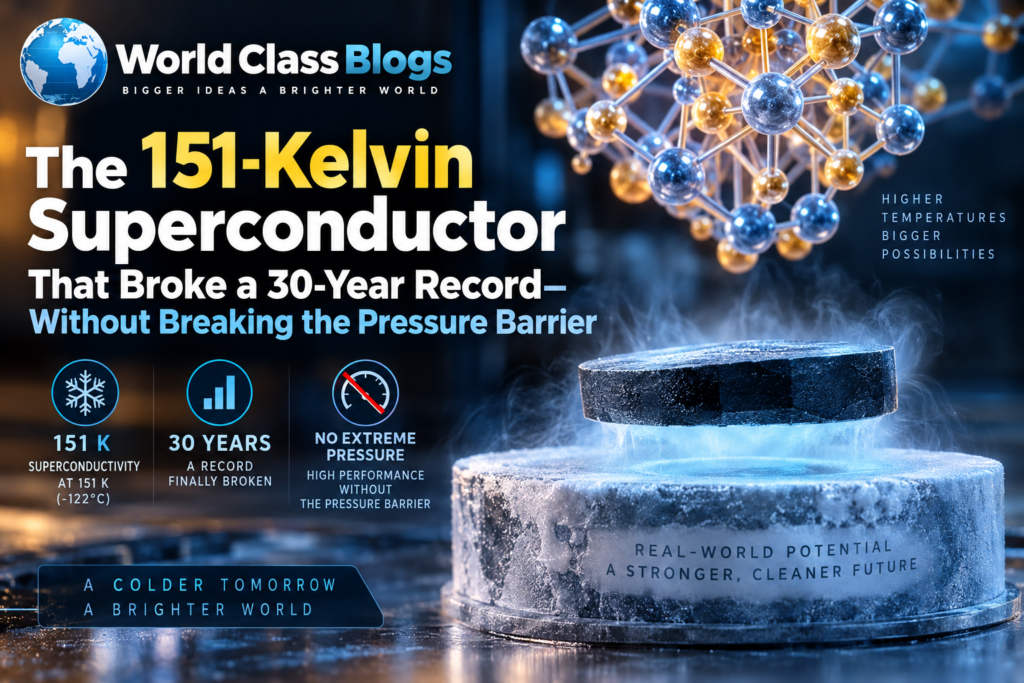
The 151 K pressure-quenched Hg1223 result is not a breakthrough in the sense of solving room-temperature superconductivity. It’s a breakthrough in method. It shows that high-pressure superconducting phases can be trapped at ambient conditions, at least in one well-studied cuprate. That principle, if it generalizes, could change how materials scientists approach the problem: not just “find a new material,” but “process an existing material in a new way.”
For curious beginners, the lesson is that progress in physics often looks like 18 kelvins, not 300. The headlines go to room-temperature claims and viral videos. The durable work happens in papers like this one, where a team with decades of experience quietly demonstrates that a technique works in a new regime.
For professionals, the pressure-quench protocol is worth watching. It’s not a solution to the ambient-pressure room-temperature problem, but it’s a tool that didn’t exist a few years ago. The next step is extending it to other cuprates, to hydrides, and to materials where the metastable phase is more robust. If that works, 151 K might look like a waypoint, not a destination.
Key Takeaways:
- The University of Houston achieved ambient-pressure superconductivity at 151 K in Hg1223 using pressure quenching .
- The technique traps a high-pressure superconducting phase at ambient conditions by applying pressure, cooling, and releasing the pressure.
- The result improves on Hg1223’s previous ambient-pressure record of 133 K by 18 K.
- This is not room-temperature superconductivity, but it validates a new approach to materials design.
- The result stands in contrast to the LK-99 hype, offering a peer-reviewed, incremental advance.
Frequently Asked Questions (FAQ’s)
1. What exactly did the Houston team achieve?
They stabilized a superconducting phase of Hg1223 at ambient pressure with a transition temperature above 151 K, using a pressure-quench protocol. The pressure was applied during processing, then released .
2. Is 151 K close to room temperature?
No. Room temperature is roughly 293 K. 151 K is minus 122°C. It’s warmer than liquid nitrogen but still very cold.
3. What was the previous record?
The ambient-pressure record for Hg1223 was 133 K. Under 31 GPa of pressure, it reached 164 K. The pressure-quench result captures some of that pressure enhancement without the pressure .
4. How does pressure quenching work?
You pressurize the material, cool it to superconducting temperatures, then release the pressure while keeping it cold. The atoms are locked into a metastable arrangement that persists at ambient pressure .
5. Why doesn’t the material just revert to its normal state?
Because the atoms don’t have enough thermal energy to rearrange at low temperatures. The metastable phase is trapped behind an energy barrier. Warming it slowly allows you to measure its properties before it decays.
6. Is this related to LK-99?
No. LK-99 was a completely different material (copper-doped lead apatite) and a completely different claim (room-temperature superconductivity at ambient pressure). Multiple replication attempts found no superconductivity in LK-99 .
7. What is Hg1223?
HgBa₂Ca₂Cu₃O₈₊δ, a mercury-based cuprate superconductor. It held the ambient-pressure Tc record of 133 K for decades .
8. Could this lead to room-temperature superconductors?
It’s a step in that direction, but a small one. The technique needs to be extended to other materials and higher temperatures. 151 K is progress, not arrival.
9. What are the applications of a 151 K superconductor?
Cooling with liquid nitrogen or closed-cycle cryocoolers is easier than liquid helium. Potential applications include MRI magnets, power transmission, and maglev, but all require scaling the material to practical lengths and forms.
10. How much pressure was used?
31 GPa, which is about 300,000 atmospheres. That’s high, but far lower than the 150+ GPa used in hydride superconductors .
11. Did they use a diamond anvil cell?
The search results don’t specify the pressure apparatus, but 31 GPa is within the range of large-volume presses and diamond anvil cells. The paper likely provides details.
12. How did they verify the result?
They used synchrotron X-ray diffraction to confirm the structural change and NV-center quantum sensing to probe the magnetic properties. Resistance measurements showed the transition at 151 K .
13. Could other cuprates be pressure-quenched?
That’s the hope. The team had previously demonstrated PQP in other materials, suggesting the technique may generalize . But each material has different metastability, so it’s not guaranteed.
14. What about hydrides?
Hydrides superconduct at higher temperatures (up to ~250 K) but require much higher pressures (150–200 GPa). Pressure quenching might help stabilize hydride phases at lower pressures, but that hasn’t been demonstrated yet.
15. Is this result controversial?
No. It’s peer-reviewed in PNAS and presented at APS. The claims are modest and consistent with known physics. It’s not a viral sensation, and that’s a good thing.
16. Who led the research?
Ching-Wu Chu’s group at the University of Houston. Chu is a veteran of high-temperature superconductivity, having co-discovered YBCO in 1987 .
17. When was the paper published?
March 9, 2026, in PNAS .
18. What is the significance of the 18 K improvement?
In the context of cuprate research, 18 K is substantial. Progress in ambient-pressure Tc has been slow for decades. This shows that processing can unlock performance that was previously only accessible under pressure.
19. Could this be used for quantum computing?
Superconducting qubits currently operate at millikelvin temperatures. A 151 K superconductor wouldn’t directly help, but the materials science insights might inform qubit design.
20. What is the “van Hove singularity” mentioned in the paper?
It’s a feature in a material’s electronic band structure where the density of states spikes. In cuprates, tuning the Fermi level to a van Hove singularity can enhance superconductivity. Pressure can shift the Fermi level, which is one reason pressure increases Tc .
21. What are nickel-based superconductors, and how do they relate?
Nickelates are a newer class of high-temperature superconductors, discovered in thin-film form. A 2026 Nature paper reported ambient-pressure superconductivity at 50 K and 46 K in nickelate superstructures . They’re a different approach to the same goal.
22. Why are there so many patent filings with no papers?
The LK-99 hype encouraged speculative intellectual property filing. As of April 2026, 40% of recent filings in room-temperature superconductivity had no peer-reviewed backing . This is a sign of hype, not progress.
23. What’s the next step for this research?
Extending pressure quenching to other cuprates, exploring whether the technique can push Tc higher, and investigating the stability of the quenched phase over time.
24. Could the quenched phase decay over time?
Metastable phases can decay, especially if warmed or exposed to vibration. The paper likely discusses stability, but long-term durability at ambient conditions is a key question for applications.
25. What should a beginner read to learn more?
The PNAS paper is the primary source. For background, the Nobel Prize materials on superconductivity and the Science article on the LK-99 saga provide context .
26. Why should a non-scientist care?
Because superconductivity could eventually transform energy transmission, medical imaging, and transportation. Progress is slow and incremental, but each result like this one adds a piece to the puzzle.
27. Is room-temperature superconductivity ever going to happen?
Most physicists believe it’s possible in principle. The question is whether it can be achieved at ambient pressure in a practical material. The pressure-quench result is one small step toward that goal, but the road is long.
About Author
Sana Ullah Khan Kakar is a science writer and former aerospace systems engineer with a focus on planetary science and space technology. He has contributed to World Class Blogs since 2023, covering topics ranging from asteroid defense to fusion energy, quantum computing, and fundamental chemistry. Alex holds a B.S. in Aerospace Engineering from Georgia Tech and an M.S. in Science Communication from MIT. He lives in Tucson, Arizona, where he volunteers as an amateur astronomer and occultation observer. You can reach him through the World Class Blogs contact page.
Disclosure: Alex has no financial interest in any company or mission mentioned in this article. All opinions are his own.
Free Resources
- PNAS Paper: “Ambient-pressure 151-K superconductivity in HgBa₂Ca₂Cu₃O₈₊δ via pressure quench,” published March 9, 2026. (pnas.org)
- APS Global Physics Summit Abstract: Details on the pressure-quench protocol and NV-center characterization. [Link: https://meetings-archive.aps.org/smt/2026/mar-f31/10/]
- Patsnap Research Landscape Report: Analysis of patent filings and commercial viability in room-temperature superconductivity as of April 2026. [Link: https://www.patsnap.com/resources/blog/articles/room-temperature-superconductor-research-2026-landscape/]
- Science Article on LK-99: Background on the 2023 room-temperature superconductor claim and its collapse. (science.org)
- World Class Blogs Technology & Innovation Archive: For related coverage on physics, materials science, and quantum technology. [Link: https://worldclassblogs.com/category/technology-innovation/artificial-intelligence-machine-learning/]
- Sherakat Network SEO Guide: For readers interested in how science communication reaches audiences online. [Link: https://sherakatnetwork.com/category/seo]
Discussion
What questions do you have about pressure quenching, Hg1223, or the state of room-temperature superconductor research? Have you followed the LK-99 saga or the hydride breakthroughs? Share your thoughts in the comments below. I read every comment and try to respond within 48 hours.
For more science and frontier coverage, explore the World Class Blogs Our Focus section and the full Blog archive. If you’re interested in contributing a guest post or suggesting a topic, please contact us.


