


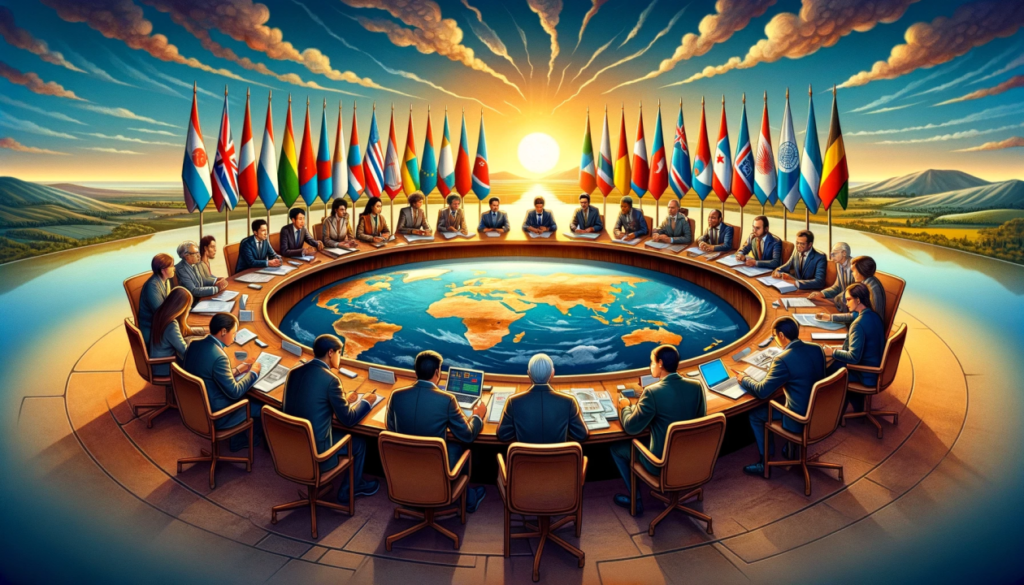
When official political channels are frozen, unconventional diplomacy—leveraging the universal languages of arts, sports, and humor—can create unexpected openings for dialogue, humanize entrenched enemies, and rebuild the social fabric torn apart by conflict.
In the shadow of high-level summits and tense ceasefire negotiations, a quieter, more human form of peacebuilding is taking place on stages, football pitches, and in comedy clubs across the world’s most divided regions. This is the realm of unconventional diplomacy, where the tools are not treaties and demarches, but paintbrushes, soccer balls, and shared laughter. It operates on a simple, profound truth: before political solutions are possible, people must see their adversaries as human beings. In societies fractured by generations of violence—from Israel and Palestine to Cyprus and Rwanda—arts and sports create neutral, apolitical spaces where former enemies can interact not as representatives of their side, but as fellow musicians, athletes, or audience members. A 2023 report from the Institute for Economics and Peace found that societies with high levels of cultural participation and social cohesion are significantly more resilient to conflict. This guide explores how these “soft” tools are creating hard impacts, building the psychological and social foundations without which no peace agreement can ever be truly sustainable.
Introduction – Why Culture and Play Matter in the Hard World of Conflict
Traditional diplomacy often tackles conflict at the level of interests and positions—borders, resources, and political power. Unconventional diplomacy works at the deeper level of identities, emotions, and perceptions. It addresses the human wiring that sustains conflict: fear, dehumanization, and the entrenched “us vs. them” narratives that are passed down through generations.
What I’ve witnessed in post-conflict communities is that while a peace accord can stop the shooting, it cannot automatically repair broken relationships or heal collective trauma. This is where a play, a joint mural, or a friendly football match becomes a form of social acupuncture. It targets the precise points of tension and isolation. For example, in post-genocide Rwanda, the government’s support for traditional dance troupes that include both Hutu and Tutsi performers is not mere entertainment; it is a deliberate strategy to reconstruct a shared national identity and visibly model reconciliation.
The power of this approach lies in its ability to bypass political rhetoric. A young Israeli and Palestinian collaborating on a film about water scarcity in the region are not debating final status issues; they are solving a shared practical and creative problem. In that collaboration, stereotypes break down. They discover commonalities in their sense of humor, their family dynamics, and their hopes. This micro-level humanization is the antidote to the macro-level hatred that fuels conflict. It creates what peacebuilder John Paul Lederach calls the “moral imagination”—the capacity to envision a shared future with one’s enemies. While arts and sports alone cannot write a peace treaty, they can create the transformed relationships and public willingness that make a political settlement conceivable, and ultimately, viable.
Background / Context: From Ancient Olympics to Modern Peacebuilding
The use of culture and sport as tools for peace is ancient. The Olympic Truce (Ekecheiria) in ancient Greece mandated a cessation of hostilities among city-states to allow safe passage for athletes and spectators to the Games. This recognized sport as a transcendent value that could momentarily override political and military rivalry.
In the modern era, the concept was notably employed during the Cold War. “Ping Pong Diplomacy” in 1971, where American table tennis players were invited to China, thawed two decades of frozen Sino-American relations and paved the way for President Nixon’s historic visit. It demonstrated that small, symbolic cultural exchanges could crack open doors that formal diplomacy could not.
The field institutionalized in the 1990s with the rise of “People-to-People” (P2P) programs as part of the Oslo Peace Process between Israelis and Palestinians. These programs, funded by international donors, brought together teachers, journalists, doctors, and youth from both sides for joint projects. While the political process ultimately stalled, these contacts created a lasting network of individuals committed to coexistence.
Today, unconventional diplomacy is a recognized subset of Track II and Track III diplomacy. Major international bodies support it: UNESCO champions cultural heritage as a tool for reconciliation; the International Olympic Committee promotes sport for development and peace; and organizations like Search for Common Ground and the British Council run large-scale arts and sports for peace programs in conflict zones worldwide.
Key Concepts Defined

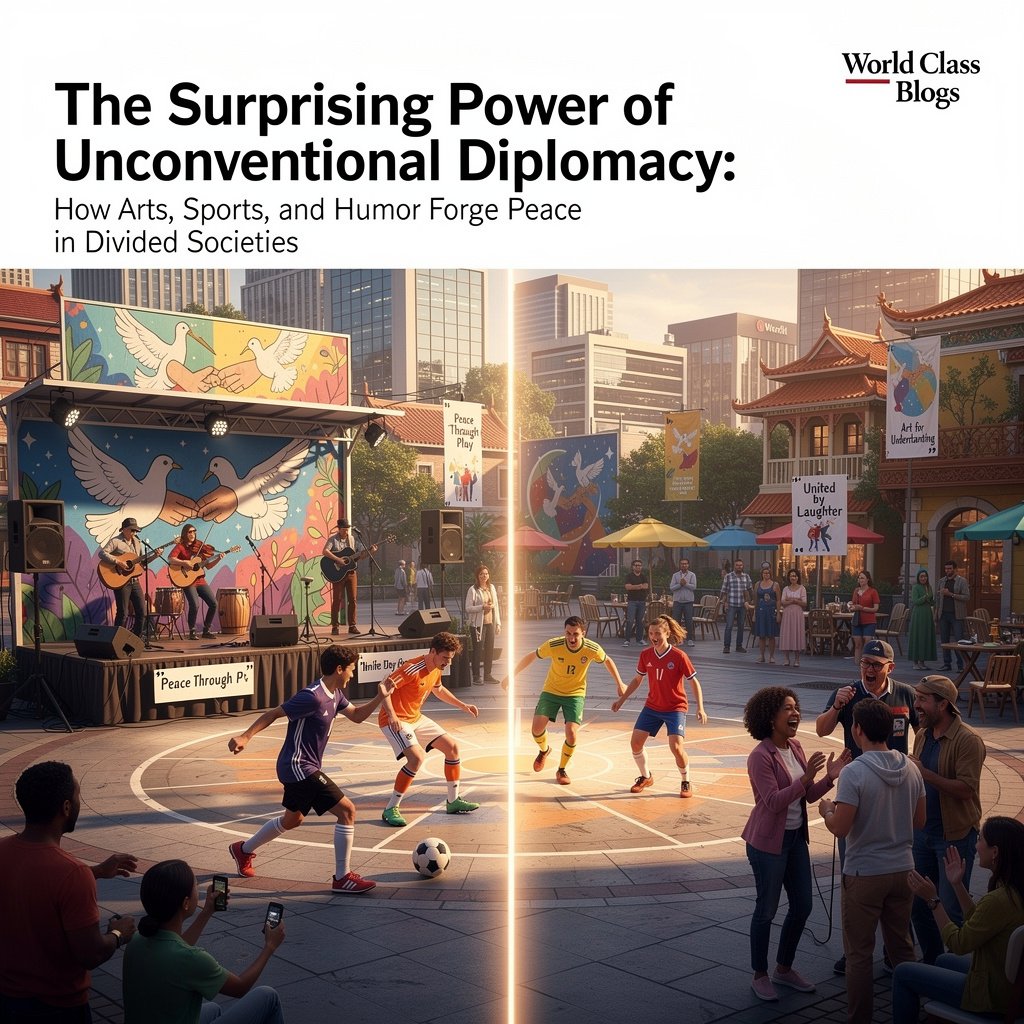
- Cultural Diplomacy: The use of a nation’s arts, language, and heritage to foster mutual understanding and build relationships with foreign publics. In conflict settings, it shifts to inter-community cultural diplomacy—using shared cultural activities to bridge divides within a fractured society.
- Sports Diplomacy: The use of sport as a means to influence diplomatic, social, and political relations. In peacebuilding, it focuses on sport for social cohesion, using team sports to teach cooperation, respect for rules, and trust across ethnic or religious lines.
- Humor and Comedy in Conflict Transformation: The strategic use of satire, stand-up, and comedy to subvert hostile narratives, expose shared absurdities in a conflict, and create a space for reflexive laughter that can reduce tension and open minds. It is a high-risk, high-reward tool.
- Contact Hypothesis: A foundational social psychology theory positing that under appropriate conditions (equal status, common goals, cooperation, and institutional support), interpersonal contact is one of the most effective ways to reduce prejudice between groups. Arts and sports programs are practical applications of this hypothesis.
- Narrative Change: A core goal of unconventional diplomacy. It involves supporting individuals and communities to develop and share counter-narratives to the dominant stories of hatred and victimhood, often through personal storytelling in theater, film, or literature.
- Safe / Brave Space: A critical concept for facilitators. A safe space is physically and emotionally secure. A brave space goes further—it is where participants feel secure enough to take risks, express difficult emotions, and confront painful truths about themselves and the conflict. Arts and sports can create these spaces.
How It Works: Mechanisms of Change
Unconventional diplomacy facilitates peace through several interconnected psychological and social pathways.
1. Humanization and Empathy Building
This is the most direct effect. By working side-by-side on a collaborative art project or training as teammates, individuals from opposing groups witness each other’s competence, vulnerability, and humanity. A Serbian and Albanian actor rehearsing a scene together must try to understand and express each other’s emotional reality. This experiential learning shatters monolithic stereotypes. Neuroscientific research even shows that collaborative creative activity can synchronize brain waves and increase oxytocin levels, fostering bonding.
2. Creating Superordinate Identities
Conflict entrenches divisive identities (Catholic/Protestant, Hutu/Tutsi). Arts and sports can create new, shared identities that temporarily supersede the old ones. On a mixed-ethnicity football team, the primary identity becomes “teammate.” In a cross-community choir, it becomes “fellow singer.” This doesn’t erase original identities but creates a broader, inclusive category that can hold multiple loyalties, reducing the perception of a zero-sum conflict.
3. Facilitating Non-Verbal and Emotional Communication
Deep trauma and grievance are often beyond words. The arts provide alternative languages. Theater of the Oppressed techniques allow participants to act out scenes of injustice and explore solutions physically. Joint mural painting allows communities to visually express hopes for the future. These modalities can access and process emotions that formal dialogue cannot, which is essential for healing.
4. Building Trust and Social Capital
Successful collaboration in a play or a sports tournament requires and builds trust, reciprocity, and shared rules. These are the very elements of social capital that conflict destroys. A series of successful joint projects creates a network of individuals who have proven they can work together. This network becomes a latent “peace infrastructure” that can be mobilized during crises or to support formal political processes.
5. Subverting Conflict Narratives with Humor
Humor is a potent tool for cognitive disarming. A well-crafted joke about the absurdities of checkpoints or propaganda can allow people to see their situation from a new, less entrenched perspective. It can “punch up” at powerful leaders or ideologies in a way that direct criticism cannot. Comedy clubs in places like Israel and Lebanon have become rare spaces where the “other side” can be discussed with irreverence and insight, subtly challenging taboos.
Why It’s Important: The Unique Value Proposition
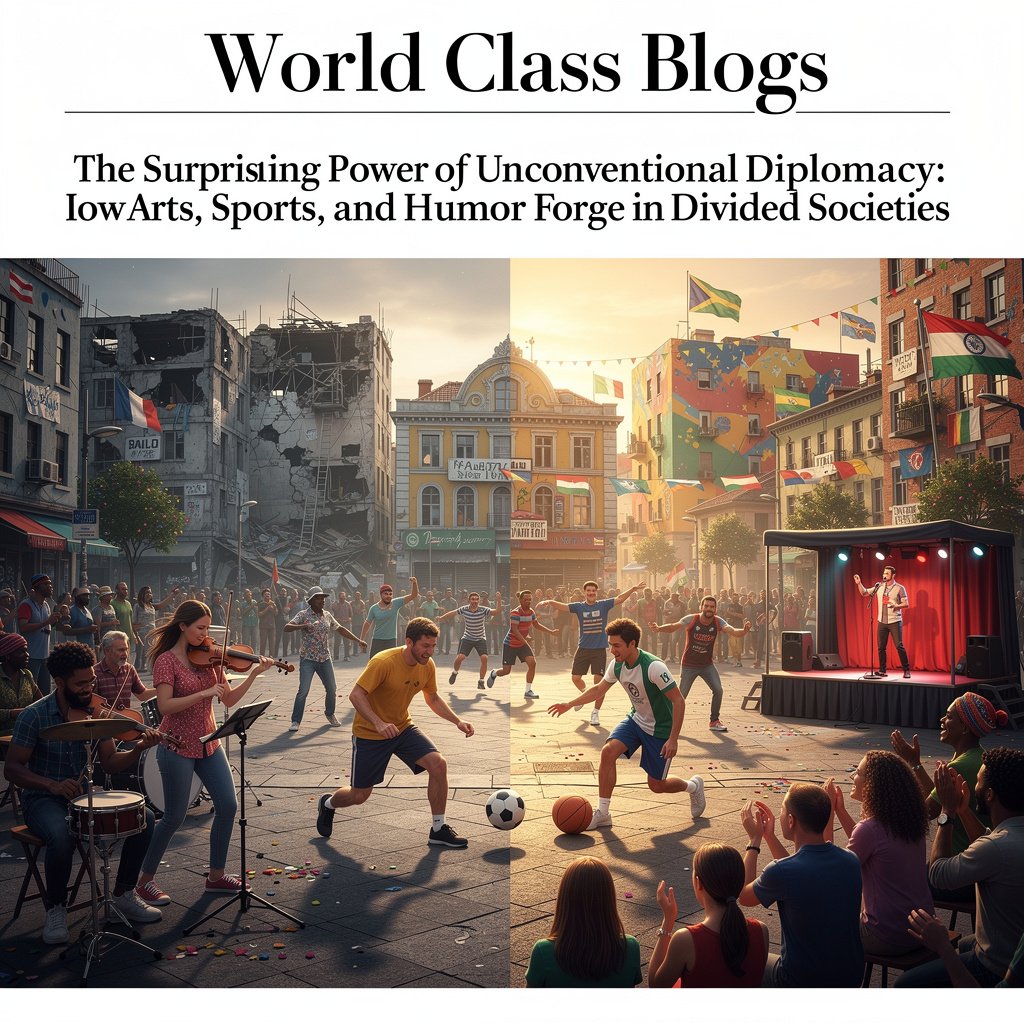
In a landscape dominated by hard security concerns, why invest in theater workshops or youth sports leagues?
- It Reaches Where Politics Cannot: When political leaders are locked in confrontation, cultural and sports exchanges can often continue, maintaining a vital human connection below the radar of official hostility. These connections keep embers of cooperation alive for when the political climate changes.
- It Works at the Grassroots Level: Top-down peace agreements can be alienating to ordinary citizens who bear the brunt of war. Unconventional diplomacy is inherently participatory. It engages people directly in the process of building peace, giving them ownership and making the abstract concept of “reconciliation” tangible.
- It Addresses the Emotional Legacy of War: Conflicts leave deep psychological wounds—trauma, grief, humiliation. Political negotiations rarely have the tools or mandate to address this. Arts-based therapy and sports for psychosocial support are specifically designed to help individuals and communities process these emotions, which is a prerequisite for letting go of the past.
- It Builds Long-Term Resilience: By fostering inter-community relationships and creating shared cultural products (a song, a mural, a sports league), these initiatives create positive facts on the ground. They create constituencies for peace that can pressure leaders and resist the pull of renewed violence.
- It is Often Low-Cost and High-Impact: Compared to multi-billion-dollar peacekeeping missions or state-building projects, funding a network of youth football leagues or community theaters is extremely cost-effective. The return on investment in terms of social cohesion and conflict prevention can be enormous.
Sustainability and the Future: Mainstreaming the Unconventional
For this field to have a lasting, systemic impact, it must move from the margins to the mainstream of peacebuilding strategy.
- From Project-Based to Ecosystem-Based: Many initiatives are short-term donor projects. The future requires building sustainable local institutions—community arts centers, permanent sports academies for peace—that outlive specific grants and become permanent features of the civic landscape.
- Rigorous Monitoring and Evaluation: Proving the impact of a theater workshop is harder than counting disarmed combatants. The field needs better tools for measuring changes in attitudes, social networks, and behavioral intentions. Mixed-methods research combining surveys with qualitative stories is essential to demonstrate value to skeptical policymakers.
- Integration with Formal Processes: The most powerful model is when unconventional diplomacy feeds into and supports Track I efforts. This could mean having participants from arts dialogues brief negotiators, or incorporating community-generated artistic visions of the future into official peacebuilding frameworks, as was attempted in Colombia.
- Navigating the “Normalization” Critique: In asymmetric conflicts (like Israel-Palestine), critics argue that joint arts projects create a false sense of normalcy and cooperation that lets an oppressive status quo continue unchallenged. Facilitators must be ethically sophisticated, ensuring programs do not inadvertently legitimize injustice but instead empower marginalized voices and explicitly address power imbalances.
- Digital Expansion: The digital world offers new frontiers. Online gaming communities can bring together youth from conflicting nations. Collaborative digital storytelling platforms and virtual reality experiences that allow users to “walk in the shoes” of the other are emerging as powerful empathy-building tools, especially when physical travel is impossible.
Common Misconceptions
- Misconception: It’s just “kumbaya” – naive and ineffective.
Reality: The work is psychologically sophisticated and often intensely difficult. Facilitators manage highly charged emotions and deep trauma. Outcomes are measured not in instant peace, but in shifted attitudes, expanded networks, and reduced propensity for violence, which are preconditions for political progress. - Misconception: It replaces the need for political and justice solutions.
Reality: Practitioners are the first to say this is complementary, not alternative. Arts and sports build the social and psychological foundation; politics and law build the structural framework. Both are needed. You cannot reconcile over a mass grave without justice, but you cannot build a shared society with justice alone. - Misconception: One joint football game can end a conflict.
Reality: The impact is cumulative and long-term. Change happens through repeated, structured contact over time, not one-off events. The goal is to create a critical mass of individuals with transformed perspectives who can influence their communities. - Misconception: It’s only for artists and athletes.
Reality: While practitioners are often cultural or sports professionals, the participants are ordinary community members—teachers, students, farmers, parents. The activities are a vehicle for engagement, not an end in themselves. - Misconception: Humor is disrespectful in the face of suffering.
Reality: When used ethically and by communities themselves, humor can be a profound coping mechanism and a form of agency. It is not about making light of tragedy, but about reclaiming power from painful narratives and finding shared humanity in absurdity.
Recent Developments (2023-2025)
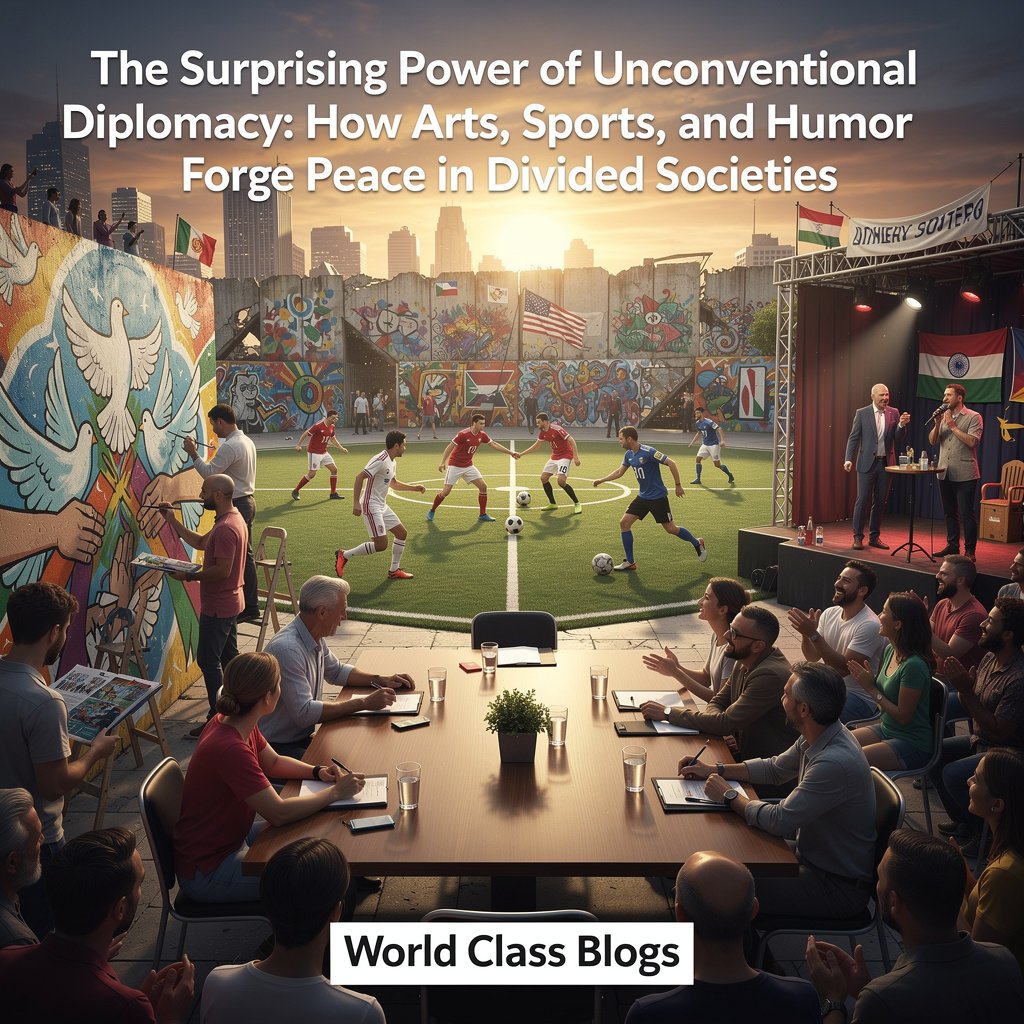
- Ukraine: Cultural Frontlines: Amidst the war, Ukrainian artists are using music, film, and street art as acts of cultural resistance and international diplomacy. Simultaneously, organizations are facilitating virtual exchanges between Ukrainian and Russian anti-war artists, preserving lines of communication. The Kiev-based “Museum of Civilian Voices” uses immersive audio and art to document war experiences, serving as both a historical record and a future tool for reconciliation.
- Climate Change and Sports Diplomacy: In regions where climate stress fuels conflict (like the Sahel), new programs use sports tournaments centered around water conservation messages or community theater to mediate farmer-herder disputes over shrinking resources. This integrates environmental peacebuilding with cultural tools.
- The “Comedy for Peace” Movement: Stand-up comedians from conflicting regions are increasingly collaborating. The “Stand-Up for Peace” network features duo acts with, for example, an Indian and Pakistani comedian or an Iranian and Israeli, using shared stages to deconstruct national stereotypes and model respectful disagreement through laughter.
- E-Sports Diplomacy: Recognizing the global reach of gaming, pilot projects are bringing together young Palestinians and Israelis, or Armenians and Azerbaijanis, in structured online gaming tournaments with facilitated dialogues before and after. This meets youth where they are and uses a shared passion as a bridge.
- AI-Generated Art for Dialogue: Experimental projects are using AI image generators (like DALL-E) in workshops. Participants from different sides input descriptive words about “peace” or “the future,” and the AI creates a blended visual. This becomes a catalyst for discussion about shared and divergent hopes, using technology as a neutral creative intermediary.
Success Stories
- The West-Eastern Divan Orchestra: Founded by the late Daniel Barenboim and Edward Said, this orchestra brings together young Arab and Israeli musicians to perform under one roof. It is perhaps the world’s most famous example of cultural peacebuilding. The discipline of creating harmony in music literally requires listening to the other. While not a political solution, the orchestra is a living, touring testament to the possibility of coexistence. Barenboim famously said, “The Divan is not a love story, and it is not a peace story. It has very flatteringly been described as a project for peace. It isn’t. It’s a project against ignorance.”
- Football for Peace in Colombia: In the aftermath of the 2016 peace deal, Fútbol por la Paz (Football for Peace) leagues were established in former FARC territories. These leagues mix former guerrilla fighters, military veterans, and community youth on the same teams. The shared goal of winning games, the regulated competition, and the collective identity of the team have been instrumental in normalizing relations and easing the reintegration of ex-combatants at the local level.
- The “Theatre of the Oppressed” in Myanmar: During the decade of democratic opening, practitioners used Augusto Boal’s interactive theater methods to help communities in Rakhine State and other conflict-affected areas act out scenarios of ethnic tension, land disputes, and police brutality. This allowed marginalized groups to safely explore their reality, rehearse responses, and build solidarity. Though the space for such work has drastically closed since the 2021 coup, the networks and skills built remain.
Real-Life Examples
- Rapper and former child soldier Emmanuel Jal (South Sudan): Jal uses his music and personal story of being a child soldier turned peace activist to campaign against war and promote reconciliation. His work demonstrates how hip-hop and personal narrative can be powerful tools for trauma healing and advocacy, reaching global youth audiences with messages from one of the world’s worst conflicts.
- The “Humans of New York” (HONY) in Pakistan and Iran: Photographer Brandon Stanton’s project, which shares intimate portraits and stories of ordinary people, did a special series in Pakistan and Iran. By showcasing the universal human experiences—love, worry, ambition—of people in nations often vilified in American media, HONY performed a massive act of public diplomacy and humanization, reaching tens of millions of viewers and challenging monolithic stereotypes.
- The “Cyprus Friendship Program” and Sailing: This program brings together Greek Cypriot and Turkish Cypriot teenagers for a summer sailing camp in the United States. Removed from the polarized environment of the divided island and forced to cooperate to sail a boat, the teens form deep friendships. The program has a remarkable track record of creating lasting bonds and youth ambassadors for peace who return home to advocate for reconciliation within their own communities.
- The “Rivers of Emotion” Project (Balkans): This long-term theater project brought together actors from all former Yugoslav republics to collaboratively create plays about the war’s legacy. The process of actors from Serbia, Croatia, Bosnia, etc., sharing their personal and national stories in a rehearsal room was itself an act of reconciliation. The resulting performances toured the region, offering audiences a mirror to their shared, painful history and the possibility of a shared artistic present.
Conclusion and Key Takeaways
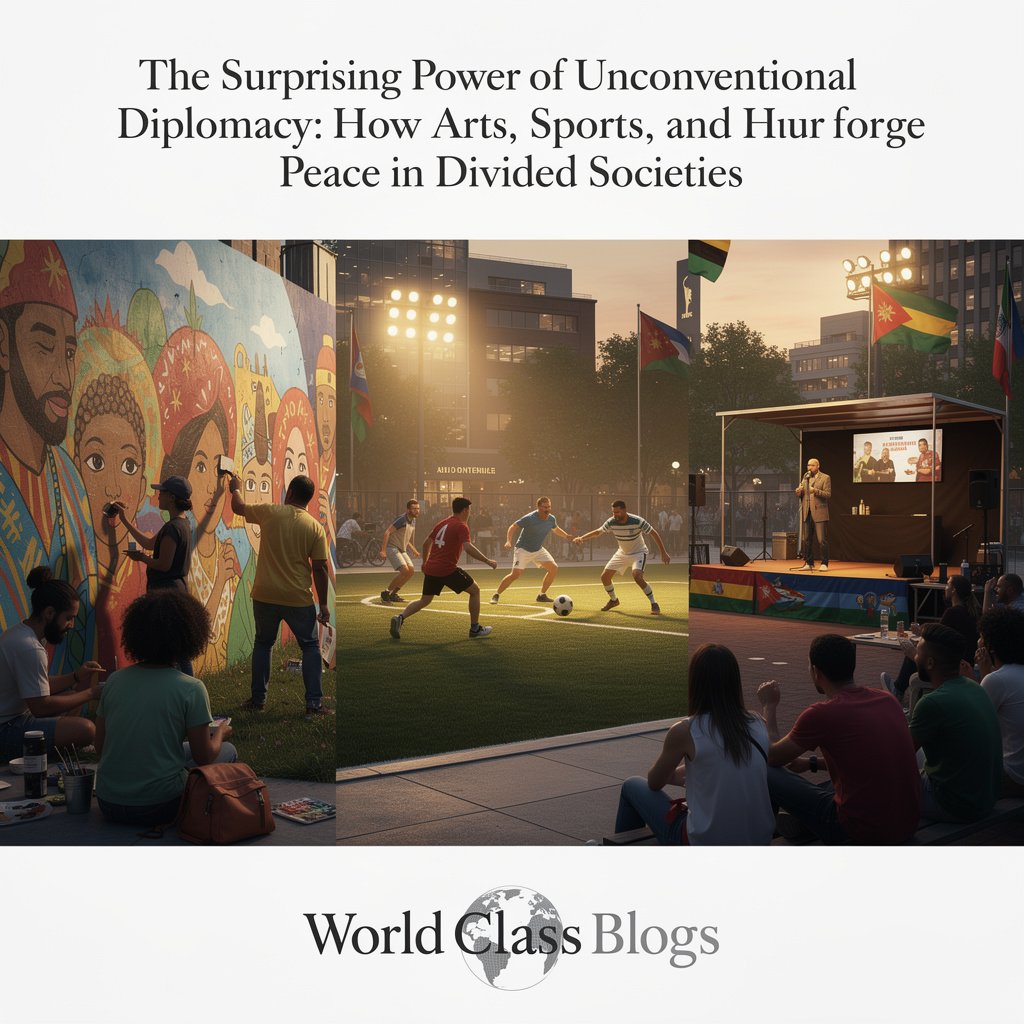
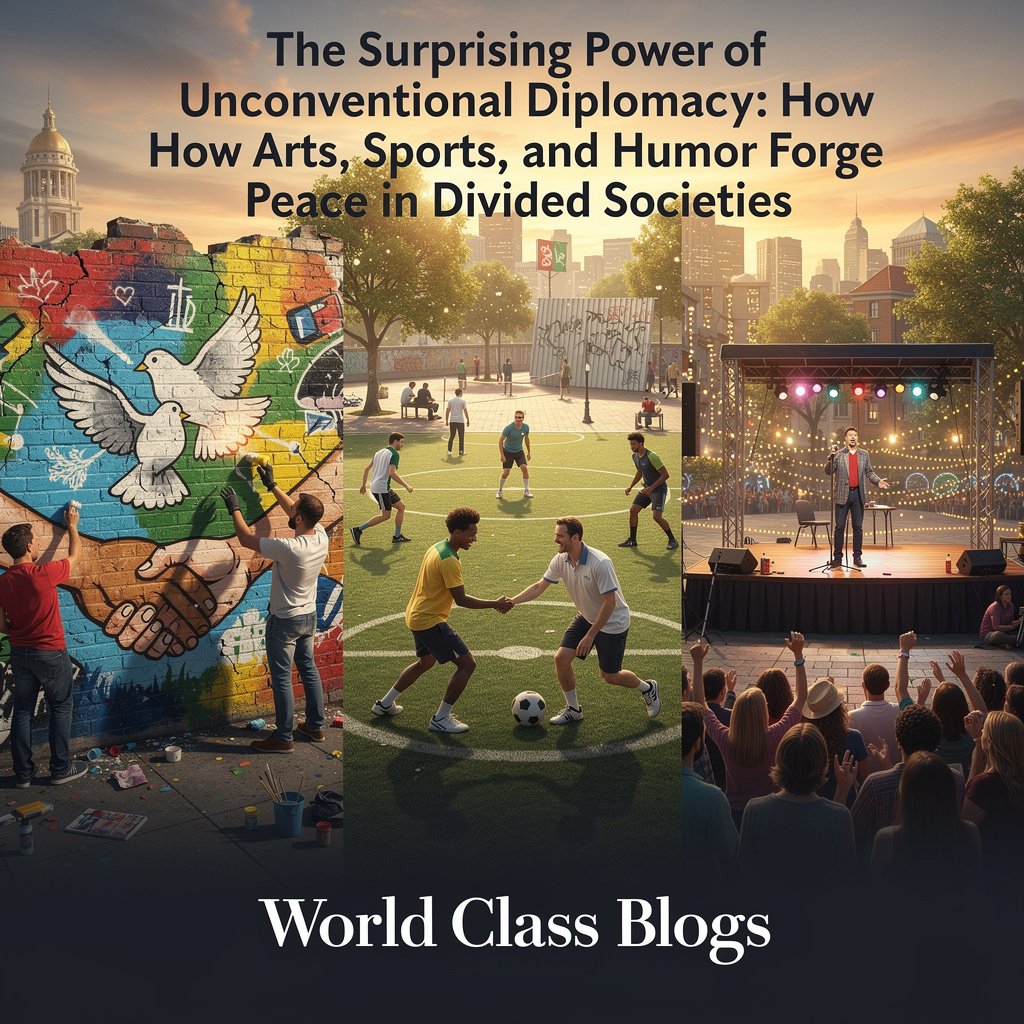
Unconventional diplomacy through arts, sports, and humor is not a soft option in a hard world; it is a necessary complement to hard political and security work. It operates on the fundamental understanding that conflicts are sustained by human hearts and minds, and therefore must be resolved there as well. While it cannot demilitarize a zone or draft a constitution, it can disarm hatred and draft a new story of shared identity.
Key Takeaways:
- Humanization is the First Step: Lasting political compromise is impossible as long as the “other side” is viewed as sub-human or purely evil. Arts and sports create the face-to-face encounters that restore individual humanity, which is the bedrock of any peace.
- Create Spaces, Not Just Speeches: Peace requires environments where new types of interaction can occur. A theater, a football field, a comedy club, or a digital gaming platform can be a “container” for transformation where the normal rules of conflict are temporarily suspended.
- Work at Multiple Levels: Effective cultural peacebuilding engages individuals (healing trauma), groups (building trust across lines), and societies (changing public narratives through performance and media). It is multi-scalar by design.
- Embrace the Power of Co-Creation: The act of creating something beautiful or achieving a goal together—a symphony, a goal, a mural, a laugh—forges a powerful bond. This shared positive experience becomes a tangible reference point for what is possible between communities.
- Patience and Proximity are Vital: This work yields results not in election cycles but in generational shifts. It requires long-term commitment and a willingness to work in close proximity to pain and complexity, holding space for ambiguity and gradual change.
In an era of deep polarization and digital echo chambers, the need to create real, embodied experiences of shared humanity is more urgent than ever. The musicians, athletes, artists, and comedians working on the frontlines of empathy are not just creating art or entertainment; they are, in their own way, engineering the social and psychological infrastructure for a more peaceful world. For more on the collaborative models that make such sustained work possible, explore our guide on building successful strategic alliances.
Frequently Asked Questions (FAQs)
Q1: How do you measure the success of an arts or sports peacebuilding project?
Success is measured through a combination of qualitative and quantitative indicators. Qualitatively: participant testimonials, observed changes in group dynamics, and the quality of collaborative outputs (e.g., the play, the mural). Quantitatively: pre- and post-workshop surveys measuring changes in empathy, trust, and negative stereotypes; tracking the sustainability of new cross-group friendships; or even measuring reductions in local violence in areas where programs are密集. The most important metric is often behavioral change over time.
Q2: What are the biggest risks or dangers in this work?
Major risks include: Retraumatization of participants if activities trigger painful memories without proper psychosocial support; Backlash and security threats from hardliners in the community who view cross-group contact as betrayal; The “re-entry problem” where a participant has a transformative experience in a workshop but returns to a hostile home environment, causing psychological distress; and Co-optation where projects are used for propaganda (“window-dressing”) by authorities without addressing real injustices.
Q3: Can these methods work in active, hot conflict zones?
They can, but the approach must be adapted. In active war, the focus often shifts to intra-group psychosocial support and resilience-building (e.g., art therapy for traumatized children) rather than immediate inter-group dialogue. However, even in hot conflicts, discreet “backchannel” cultural exchanges between artists or athletes can sometimes be maintained, preserving a thread of communication. Safety and “do no harm” principles are paramount.
Q4: Who funds these kinds of initiatives?
Funding comes from a mix of: International development agencies (e.g., USAID, Sida, GIZ), private foundations (e.g., Robert Bosch Stiftung, Aga Khan Foundation), cultural institutions (e.g., British Council, Goethe-Institut), corporate social responsibility (CSR) programs, and crowdfunding/donations. Funding is often project-based and highly competitive, posing a challenge to long-term sustainability.
Q5: How do you select participants to ensure the program is effective?
Selection is critical. Facilitators look for individuals who are influential within their own communities (not just isolated liberals), are at a “readiness” stage where they are questioning conflict narratives, and represent a diversity of views. There’s often an application and interview process. The goal is to create a group where dialogue will be challenging but not explosive, and where participants have the potential to become “multipliers” of change back home.
Q6: What’s the difference between cultural exchange and cultural peacebuilding?
Cultural exchange is broad and aims for mutual appreciation (e.g., a French film festival in Japan). Cultural peacebuilding is targeted and transformative. It specifically brings together groups in conflict, uses facilitated processes to address the conflict directly or indirectly, and has explicit goals of changing attitudes, relationships, and narratives related to that conflict.
Q7: Can humor ever backfire?
Absolutely. Humor is culturally specific and can easily cause offense if not crafted with deep sensitivity. Self-deprecating humor is generally safer than humor targeting the other group. The most effective peacebuilding comedy is often that which laughs at the shared absurdities of the conflict situation or at the follies of leaders on all sides, rather than at the suffering of the other. It requires skilled comedians who understand the delicate balance.
Q8: How does sports teach peace?
Beyond the contact hypothesis, sports teach core peace competencies: playing by agreed rules (respect for law), having a referee (third-party arbitration), being on a team that requires cooperation with diverse teammates (social cohesion), learning to lose gracefully (managing frustration), and striving for a common goal. Well-designed sports programs explicitly debrief these lessons, translating the experience on the field to lessons for life off it.
Q9: What role do famous artists or athletes play?
Celebrities can bring visibility and credibility to peacebuilding efforts. When a beloved national sports star advocates for reconciliation or a famous musician from one side collaborates with an artist from the other, it can give permission for their fans to reconsider their prejudices. However, their involvement must be substantive and sustained, not just a photo-op, to be effective.
Q10: How do you deal with language barriers?
The arts themselves are a language. Music, dance, and visual art are non-verbal media. In theater or dialogue, professional translators are used, but facilitators also employ techniques that reduce dependency on words: physical theater, image theater, and joint drawing. Sometimes, the effort to communicate across a language barrier itself becomes a bonding experience and a metaphor for the broader conflict.
Q11: Is there evidence that this works in the long term?
Longitudinal studies are rare but growing. Research on the “Seeds of Peace” camp, which brings together youth from conflict regions, shows that alumni maintain more moderate views and larger cross-group networks years later. Case studies from Northern Ireland show how community arts programs in the 1990s contributed to creating a social climate receptive to the political Good Friday Agreement. The evidence points to a cumulative, long-term impact when programs are part of a sustained ecosystem.
Q12: Can digital art or virtual reality (VR) be as effective as in-person work?
Digital tools are powerful supplements and gateways. They can connect people when physical meetings are impossible (due to borders or security). VR can create powerful empathy experiences. However, most research suggests that for deep relationship building, in-person, embodied interaction is still superior. A hybrid model—digital connection leading to eventual in-person meetings—is often most promising.
Q13: What is “conflict-sensitive” art?
It’s art that is created with an awareness of the conflict context. It avoids reinforcing stereotypes, glorifying violence, or taking simplistic partisan stands. Instead, it explores complexity, humanizes all sides, questions entrenched narratives, and ultimately, opens space for reflection and dialogue rather than shutting it down.
Q14: How do you scale up these small, personal experiences to societal change?
Through networking and multiplication. Participants become ambassadors in their communities. Their artworks (films, plays) are shared with wider audiences. Sports leagues can grow to include more teams and communities. Media partnerships can broadcast stories of transformation. The goal is to create a critical mass of individuals and communities engaged in this work, shifting public opinion and creating demand for political change.
Q15: Are some art forms more effective than others?
It depends on the context and the goal. Theater is excellent for exploring narratives and rehearsing new behaviors. Music builds non-verbal harmony and collective joy. Visual arts (mural painting) create lasting public symbols of cooperation. Sports build trust and teamwork through physical activity. The best programs often use a combination of art forms to engage different senses and learning styles.
Q16: How do religious or conservative communities react to these programs?
Engagement requires cultural fluency. Framing is key—presenting a sports league as promoting “youth health and leadership” or a music program as “preserving cultural heritage” can gain entry. Working with respected local leaders (imams, priests, community elders) as partners or advisors is essential for legitimacy. The activities themselves must respect local norms.
Q17: Can economic incentives be combined with cultural peacebuilding?
Yes, effectively. “Culture for development” programs train participants in marketable artistic or sports coaching skills. Joint tourism ventures (e.g., a cross-community guided historical tour) or craft cooperatives that sell products from collaborative projects create economic interdependence, giving people a material stake in peace.
Q18: What is the role of the facilitator?
The facilitator is not a teacher or a therapist, but a skilled “container-holder” and process guide. They create a safe/brave space, manage group dynamics, ensure everyone is heard, translate experiences into lessons about the conflict, and provide emotional and logistical support. Their neutrality, empathy, and skill are the most important factors for success.
Q19: How do you deal with participants who are very angry or resistant?
Anger is a normal and valid emotion in conflict. Facilitators allow space for its expression in constructive ways (e.g., through role-play, writing, or guided debate). The goal is not to suppress anger but to help individuals understand its roots and explore whether it serves their long-term interests. Often, the most resistant participants undergo the most profound transformations if they feel truly heard.
Q20: Where can I train to become a practitioner in this field?
Specialized Master’s programs exist in Peace and Conflict Studies or Arts in Transformation. Organizations like Search for Common Ground, the Fletcher School’s Conflict Resolution program, and the International Peace & Development Training Centre offer workshops and certificates. Most importantly, gain experience in both conflict resolution/mediation AND a specific artistic or sports discipline.
About the Author
This article was authored by a cultural anthropologist and practitioner specializing in arts-based peacebuilding with over 12 years of field experience. They have designed and facilitated theater, music, and sports programs in post-conflict settings across Southeast Asia, the Balkans, and East Africa. Their work focuses on how aesthetic experiences can create cognitive and emotional shifts that support reconciliation and collective identity transformation. They advise international NGOs and UN agencies on integrating cultural approaches into peacebuilding strategy and are a passionate advocate for the role of creativity in forging more humane and resilient societies. For more insights into innovative approaches to global challenges, explore our hub at World Class Blogs.
Free Resources
- The International Peace Institute’s “Culture and Peace” Publications: Research and policy briefs on the role of cultural heritage and arts in conflict settings.
- The Open Society Foundations’ “Arts and Culture” Program Resources: Case studies and evaluations of arts for social change projects worldwide.
- The “Playing for Peace” Toolkit by Search for Common Ground: A practical guide for using sports to build peace in communities, available for free download.
- The IMPACT Blog from the University of Notre Dame’s Kroc Institute: Features articles and analysis on measuring peacebuilding impact, including cultural initiatives.
- The “HowlRound Theatre Commons”: An online journal with a wealth of essays and resources on socially engaged, community-based theater practice.
- The Sport for Development and Peace International Working Group (SDP IWG) Knowledge Hub: A centralized resource for research, policy, and toolkits on sport for peace.
- The “Comedy for Change” Podcast: Interviews with comedians and activists using humor to address social and political issues.
- The UNESCO “Culture for Peace” Database: A collection of projects and best practices on safeguarding heritage and promoting cultural dialogue in conflict zones.
Discussion
Unconventional diplomacy forces us to rethink what constitutes “serious” peace work. Does prioritizing empathy and human connection risk overlooking hard power realities and the need for justice? Can shared laughter or a football game genuinely counteract decades of propaganda and violence? We invite you to reflect on your own experiences. Has a film, a song, or a sports event ever changed your perception of a group or a conflict? Where do you see the most potential—or the greatest pitfalls—for these approaches in today’s world? For further exploration of partnership models essential for executing such collaborative projects, consider this guide on business partnership models and strategic alliances. To join our conversation or learn more, visit our blogs or contact us.


