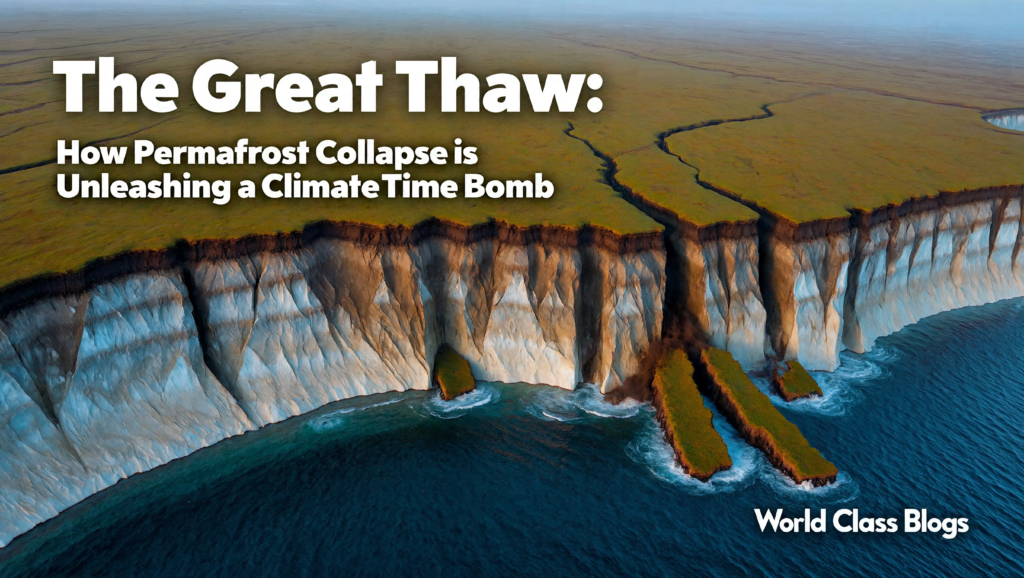
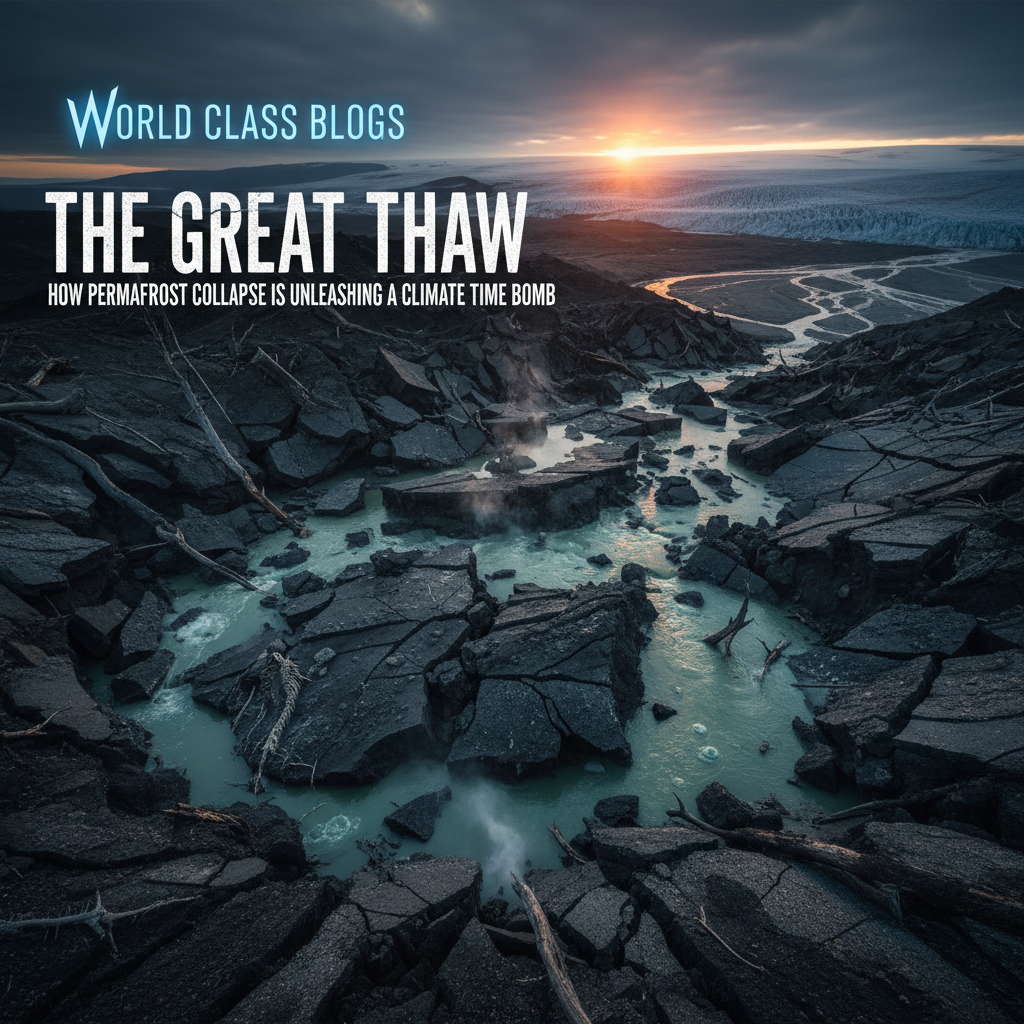
The Great Thaw: How Permafrost Collapse is Unleashing a Climate Time Bomb

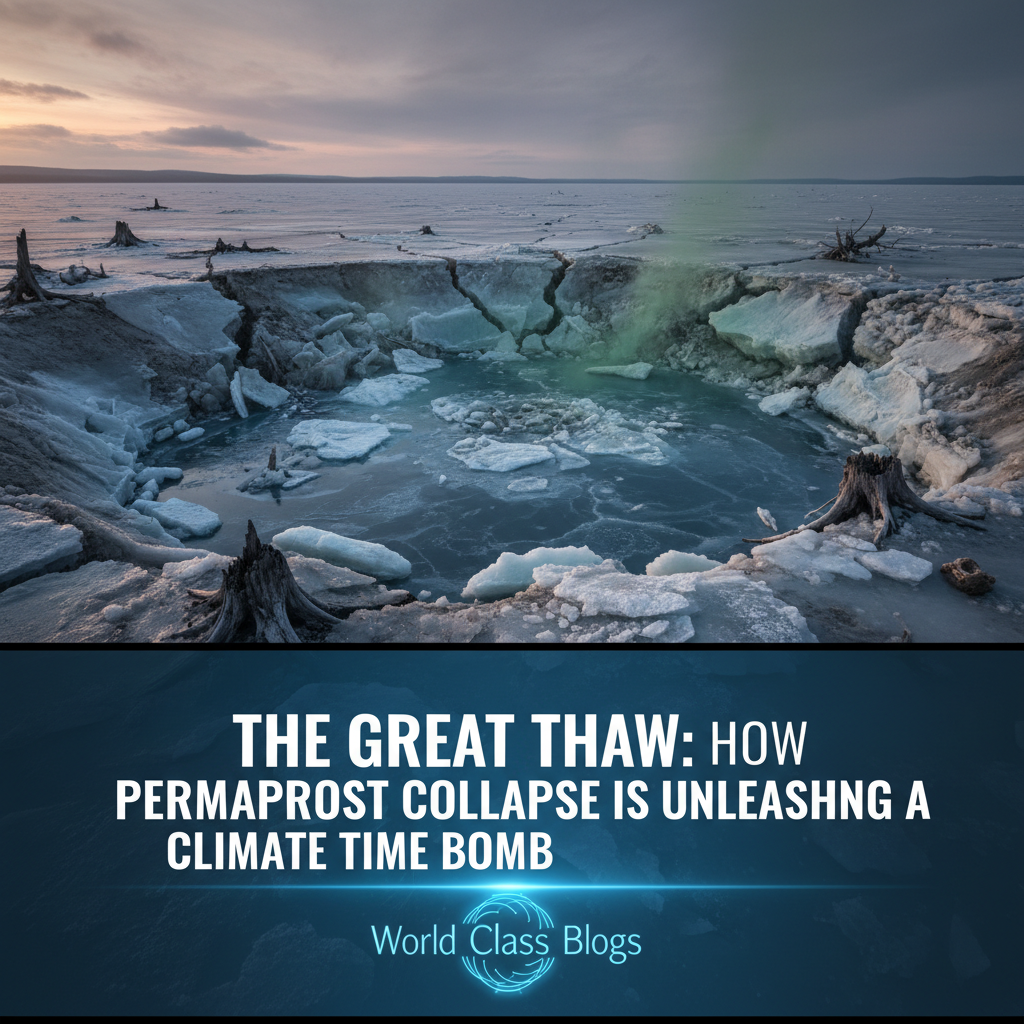
The key physical and biological processes of permafrost thaw, illustrating how warming triggers ground collapse and microbial greenhouse gas production, creating a positive feedback loop.
Introduction – Why This Matters: The Sleeping Giant Stirs
Beneath the vast, frozen expanses of the Arctic lies a sleeping giant of the climate system: permafrost. This perpetually frozen ground, covering nearly 25% of the Northern Hemisphere’s land surface, is not just barren ice. It is a colossal freezer, storing an estimated 1,500 to 1,700 billion metric tons of organic carbon—roughly twice the amount currently in the Earth’s atmosphere. For millennia, this carbon has been locked away, preserved by the cold.
Now, the freezer door is swinging open. The Arctic is warming at least three to four times faster than the global average—a phenomenon known as Arctic Amplification. In my experience analyzing climate data from the high latitudes, the speed of change is not just a line on a graph; it’s a physical transformation reshaping the land itself. What I’ve found, speaking with field researchers, is that the ground is literally giving way beneath their feet, revealing not just ice, but the preserved remains of mammoths, ancient forests, and millennia of accumulated organic matter, now beginning to decompose.
This Great Thaw is one of the most critical, yet often overlooked, climate feedback loops. As permafrost thaws, microbes awaken and decompose the ancient organic material, releasing greenhouse gases—carbon dioxide (CO₂) and methane (CH₄)—which amplify global warming, leading to more thaw. It’s a self-reinforcing cycle with potentially catastrophic consequences for global climate targets. This guide will delve into the complex science of permafrost, explore the startling on-the-ground realities, assess the latest 2026 projections, and explain why this remote phenomenon matters to every person on the planet.
Background / Context: Ice, Time, and Carbon
Permafrost is defined as ground (soil, sediment, or rock) that remains at or below 0°C (32°F) for at least two consecutive years. It can be dozens to over a thousand meters thick. It underlies vast regions of Alaska, Canada, Siberia, and the Tibetan Plateau.
There are two key layers:
- Active Layer: The top layer that thaws in summer and refreezes in winter.
- Permanently Frozen Layer: The permafrost proper, which remains frozen year-round.
The carbon within it comes from dead plants, animals, and microbes that accumulated over thousands of years during the glacial periods. Cold and wet conditions inhibited decomposition, allowing this organic matter to build up like layers in a freezer.
Human awareness of its climate significance grew in the mid-20th century, but it was considered a slow, long-term process. That view has shattered in the 21st century. The IPCC’s Special Report on the Ocean and Cryosphere (2019) marked a turning point, stating with high confidence that widespread permafrost thaw is underway and will increase with further warming. The COP28 negotiations in Dubai saw the first formal inclusion of permafrost thaw feedbacks in global stocktake discussions, signaling its arrival on the high-level policy agenda.
Key Concepts Defined: The Lexicon of the Thaw
- Permafrost: Ground that remains completely frozen for at least two consecutive years.
- Active Layer: The surface layer of ground above permafrost that thaws each summer and refreezes each winter.
- Talik: A layer or body of unfrozen ground within a permafrost area, often acting as a conduit for water and heat.
- Thermokarst: The process and landforms that result from the thawing of ice-rich permafrost. It causes ground subsidence, collapse, and the formation of pits, mounds, and thaw lakes.
- Yedoma: Ice-rich permafrost from the Pleistocene epoch, exceptionally rich in organic carbon (2-5% carbon by weight), found predominantly in Siberia and Alaska.
- Arctic Amplification: The phenomenon where the Arctic warms at a much faster rate than the rest of the globe, primarily due to ice-albedo feedback (less ice = less reflection of sunlight = more warming).
- Abrupt Thaw: A rapid, often localized collapse of permafrost due to ice loss, as opposed to gradual top-down thaw. Responsible for a disproportionate share of greenhouse gas emissions.
- Positive Feedback Loop: A process where an initial change (warming) triggers a secondary change (permafrost thaw and GHG release) that amplifies the original change (more warming).
- Methane Clathrates (Hydrates): Ice-like structures of methane trapped within permafrost or in ocean sediments. Their stability is temperature- and pressure-dependent.
- Carbon Flux: The net transfer of carbon between a reservoir (e.g., permafrost) and the atmosphere.
How It Works: The Science of Thaw and Release (Step-by-Step Breakdown)
The process is deceptively simple in concept but devastatingly complex in detail.
Step 1: The Trigger – Warming and Disturbance
- Climate Warming: Rising air temperatures conduct heat downward, gradually thawing permafrost from the top. This is gradual thaw.
- Disturbances: Wildfires (increasing in frequency and intensity in the Arctic) burn the insulating organic layer, exposing permafrost to summer heat. Changes in snow cover (depth, timing) alter insulation. Human infrastructure (roads, buildings) disrupts the thermal regime.
Step 2: Physical Collapse – Thermokarst
In ice-rich permafrost, thaw isn’t gradual; it’s catastrophic. When ground ice (which can make up 50-90% of volume) melts, the ground structure collapses, forming:
- Thaw Slumps: Giant, eroding scars on hillsides that can retreat over 15 meters per year.
- Thermokarst Lakes: Water fills depressions, and because water is more efficient at transferring heat than air, it accelerates thaw beneath and around the lake margins in a runaway process.
Step 3: Microbial Awakening and Greenhouse Gas Production
Once thawed and oxygen becomes available, ancient organic matter becomes food for microbes.
- Aerobic Decomposition (with oxygen): Produces primarily Carbon Dioxide (CO₂). This is the dominant process in well-drained, upland soils.
- Anaerobic Decomposition (without oxygen): In waterlogged conditions like thermokarst lakes and saturated soils, microbes produce Methane (CH₄). Methane has a global warming potential 82.5 times stronger than CO₂ over 20 years. Yedoma permafrost is particularly prone to forming methane-producing conditions.
Step 4: The Feedback Loops
- Direct GHG Feedback: Released CO₂ and CH₄ contribute to atmospheric warming.
- Albedo Feedback: Thaw can replace light-reflecting tundra with dark water (lakes) or soil, absorbing more heat.
- Vegetation Shift: Warmer conditions allow shrubs and trees to move north, which can insulate the ground (slowing thaw) but also darken the surface (accelerating warming). The net effect is an area of intense research.
- Thermokarst Lake Feedback: Lake formation accelerates local thaw, potentially releasing more methane, and expanding the lake further.
Key Distinction: Gradual vs. Abrupt Thaw
| Feature | Gradual (Top-Down) Thaw | Abrupt (Thermokarst) Thaw |
|---|---|---|
| Process | Slow, conductive heating from the surface. | Rapid physical collapse due to ground ice melt. |
| Landscape | Widespread, subtle subsidence. | Dramatic: slumps, pits, lakes. |
| Carbon Release | Mostly CO₂, from drier soils. | Disproportionately high; can release ancient, deep carbon quickly; significant CH₄ from waterlogged areas. |
| Model Inclusion | Included in most climate models. | Largely missing from major IPCC-class models, leading to underestimation. |
A 2022 study in Nature Reviews Earth & Environment concluded that abrupt thaw processes could double the permafrost carbon feedback compared to models that only include gradual thaw.
Why It’s Important: A Global Threat Unfolding at the Poles
- A Major Climate Feedback: Permafrost is not currently included in most global carbon budgets as an active feedback (it’s treated as a static carbon store). Once activated, it becomes a source, making the remaining carbon budget for 1.5°C or 2°C targets even smaller and harder to achieve. The Permafrost Carbon Network estimates current net emissions from permafrost regions are already on par with a mid-sized industrialized nation.
- Infrastructure Catastrophe: Up to 70% of infrastructure in the Arctic is built on permafrost. Thaw causes buckling roads, collapsing buildings, ruptured pipelines, and destabilized airstrips. The cost of adaptation and repair in the Arctic Circle is estimated to be in the hundreds of billions of dollars by 2050.
- Ecosystem Transformation: Tundra ecosystems are adapted to frozen ground. Thaw alters hydrology, vegetation, and wildlife habitats. It can release mercury and other legacy pollutants stored in the ice.
- Cultural Disruption: Indigenous communities across the Arctic have lived on and with permafrost for millennia. Thaw disrupts hunting trails, damages homes and ice cellars (traditional food storage), and threatens entire ways of life that are inextricably tied to the frozen landscape.
- Global Sea Level Rise: While not a direct contributor like melting ice sheets, permafrost thaw along Arctic coastlines leads to massive erosion, dumping sediment and carbon into the ocean and causing rapid coastline retreat.
Sustainability in the Future: Can We Refreeze the Giant?
Stopping permafrost thaw requires stopping global warming. Mitigation of human emissions is the only large-scale solution. However, researchers are exploring local and theoretical interventions:
- Rapid Global Decarbonization: The primary solution. Every fraction of a degree of warming avoided limits the depth and extent of thaw. Meeting the Paris Agreement targets is the single most important action.
- Arctic-Specific Interventions (Geoengineering Proposals):
- Refreezing with Insulation: Using materials like mulch or foam to insulate vulnerable permafrost under infrastructure or key carbon-rich areas (like yedoma).
- Restoring the Mammoth Steppe: A controversial concept of reintroducing large herbivores to trample snow, increasing ground insulation in winter and promoting grassland over dark forest.
- Draining Thermokarst Lakes: Intentionally draining lakes to stop methane production and allow re-vegetation. Logistically immense and ecologically disruptive.
- Improved Monitoring and Modeling: Deploying networks of sensors, using satellites (like NASA’s ABoVE campaign) to track subsidence and gas emissions, and incorporating abrupt thaw processes into the next generation of climate models (CMIP7) are critical for accurate forecasting.
- Adaptation for Arctic Communities: Relocating infrastructure, using innovative foundation designs (thermosyphons), and integrating Indigenous knowledge into planning are essential for resilience.
The future hinges on the speed of our global emissions cuts. Under a high-emissions scenario (SSP5-8.5), models project a loss of nearly 70% of near-surface permafrost by 2100. Under a low-emissions scenario (SSP1-2.6), that loss could be limited to around 30%.
Common Misconceptions
- Misconception: “Permafrost thaw will release a giant ‘puff’ of methane and cause sudden, runaway warming.”
- Reality: This is an oversimplification. The release is a century-scale process, not a single event. While abrupt thaw spots are dramatic, the global feedback will be a persistent, growing source of emissions that steadily worsens climate change, not an instant switch.
- Misconception: “It’s all about methane.”
- Reality: Carbon dioxide will be the dominant emitted gas by volume from permafrost thaw over the long term (centuries). However, methane’s potency in the short term (decades) makes it critically important for near-term warming. The ratio depends heavily on local hydrology.
- Misconception: “Permafrost is only in unpopulated areas, so it doesn’t affect me.”
- Reality: The greenhouse gases released mix into the global atmosphere, contributing to warming, sea-level rise, and extreme weather everywhere. Furthermore, the economic costs of Arctic infrastructure damage ripple through global supply chains and insurance markets.
- Misconception: “If permafrost thaws, new plants will grow and absorb all the carbon being released.”
- Reality: This is “Arctic greening” and it does act as a partial offset. However, scientific consensus is that the carbon released from thawing ancient stocks will far outweigh the new carbon taken up by increased plant growth in the region. The system becomes a net carbon source.
Recent Developments (2024-2026): Alarming Acceleration
- Record-Thaw Winters: The winter of 2024-2025 saw unprecedented winter thaw events in Svalbard and northern Siberia, where rain-on-snow and warm spells caused active layer deepening during a period when the ground should be freezing solid. This is a worrying new phenomenon.
- Methane “Hotspots” Mapped: A 2025 study using high-resolution satellite spectrometry (GHGSat) identified thousands of new, persistent methane point sources in Western Siberia linked to thermokarst lake expansion, suggesting previous inventories underestimated these emissions.
- Viruses and Unknowns: The thaw of a 30,000-year-old permafrost layer in the Canadian Arctic in 2025 led to the discovery of viable, previously unknown giant viruses. While not a human threat, it underscores that permafrost is a repository of ancient biological activity with unknown consequences for modern ecosystems.
- Model Breakthroughs: Research teams have successfully integrated first-generation abrupt thaw modules into Earth System Models. Early results presented at the 2026 American Geophysical Union (AGU) Fall Meeting show these models project up to 50% more carbon release by 2100 than standard models.
- Policy Recognition: The Arctic Council’s 2025 ministerial statement included, for the first time, a specific working group mandate to develop a pan-Arctic strategy for monitoring and responding to permafrost-derived greenhouse gas emissions.
Success Stories: Science and Adaptation in Action
Case Study 1: The Nunavut Climate Centre’s Community-Based Monitoring
In Canada’s Nunavut territory, Inuit communities are partnering with scientists through the Nunavut Climate Centre to document permafrost thaw. Using smartphones, drones, and traditional knowledge, they map dangerous thaw slumps near hunting trails, monitor coastal erosion threatening homes, and track changes in ice cellars. This data directly informs local adaptation planning, such as relocating trails or designing new community infrastructure. It’s a powerful model of co-production of knowledge, where science serves community-identified needs.
Case Study 2: The Qinghai-Tibet Railway – An Engineering Feat on Thawing Ground
The railway to Lhasa, built on high-altitude permafrost, is a massive adaptation experiment. Engineers employed a suite of innovative techniques: thermosyphons (passive heat pipes that cool the ground), sunshades to reduce solar radiation on embankments, and duct-ventilated embankments. Over 15 years of operation, despite significant warming, these measures have largely stabilized the track. It demonstrates that targeted, expensive engineering can protect specific linear infrastructure, though it is not a scalable solution for the entire landscape.
Case Study 3: The Northeast Science Station, Chersky, Siberia
For over 30 years, scientists like Sergey and Nikita Zimov at this remote station have conducted groundbreaking research. They famously established “Pleistocene Park,” an experiment to test if reintroducing herbivores can restore grassland ecosystems and stabilize permafrost. Their long-term carbon flux measurements from thermokarst lakes have been instrumental in quantifying methane emissions. This station is a testament to the vital role of sustained, on-the-ground observation in this extreme environment.
Real-Life Examples: Portraits of a Thawing World
- The Batagaika Crater, Siberia: Dubbed the “Gateway to the Underworld,” this massive thermokarst megaslump is over 1 km long and 100 meters deep. It began in the 1960s due to deforestation and is growing by 10-30 meters per year. It exposes ice and sediment layers over 650,000 years old, offering a stark geological window into the thaw process.
- Sinking Cities: Norilsk and Yakutsk: The industrial city of Norilsk, Russia, is built entirely on permafrost. Over 60% of its buildings have sustained damage from thaw, with repair costs in the billions. In Yakutsk, residents report doors and windows warping, and foundations cracking as the ground shifts.
- The Disappearing Arctic Coastline: In some parts of the Alaskan Beaufort Sea, coastal erosion rates exceed 20 meters per year as wave action eats into ice-rich permafrost bluffs. Entire Indigenous heritage sites are being lost to the sea.
- “Drunken Forests”: Across Alaska and Siberia, trees tilt at surreal angles as the ice-rich ground beneath them thaws and subsides unevenly, creating a forest that looks intoxicated—a visible sign of widespread ground instability.
Conclusion and Key Takeaways: Confronting the Thaw
The permafrost feedback is no longer a theoretical future risk; it is an active, accelerating process. Its integration into our climate reality means the task of stabilizing our climate is even more urgent and challenging than previously accounted for.
Key Takeaways for Professionals and Concerned Citizens:
- A Major Climate Wildcard: Permafrost thaw is a significant positive feedback loop that is still inadequately represented in policy planning. It effectively shrinks the remaining global carbon budget.
- Abrupt Thaw is the Game-Changer: The most severe threats and largest emissions come from rapid, localized collapse (thermokarst), not slow top-down thaw. Our current models are likely underestimating the pace and impact.
- Methane is a Critical Short-Term Threat: While CO₂ dominates long-term release, methane emissions from waterlogged thaw zones provide a powerful near-term warming punch, potentially accelerating other tipping points.
- Local Impacts are Severe and Costly: Thaw is causing billions in infrastructure damage, displacing communities, and transforming Arctic ecosystems and Indigenous lifeways.
- Mitigation is the Only True Solution: Local engineering can protect specific assets, but only rapid, deep global cuts in human-caused greenhouse gas emissions can slow and eventually stop the Great Thaw. This underscores the interconnectedness of our climate system, a theme explored in our section on Science and Frontiers.
The frozen ground of the Arctic is a sentinel for the planet. Its rapid transformation is a clear warning that the Earth’s system is responding to our emissions in profound and irreversible ways. Understanding the Great Thaw is essential for grasping the full scope of the climate challenge we face.
FAQs (Frequently Asked Questions)
- Q: How much carbon is in permafrost compared to the atmosphere?
- A: Permafrost holds an estimated ~1,500-1,700 gigatons (billion metric tons) of organic carbon. The atmosphere currently contains ~880 gigatons of carbon (as CO₂). So, permafrost holds roughly twice the carbon currently in the atmosphere.
- Q: Is permafrost thaw irreversible?
- A: On human timescales (centuries), yes. Once deep permafrost thaws, it would take a return to an ice-age climate to refreeze it. The carbon released as CO₂ will remain in the climate system for thousands of years. This is why it’s considered a potentially irreversible tipping element.
- Q: How do scientists measure permafrost thaw and emissions?
- A: Through a multi-pronged approach: Ground measurements (temperature probes, flux chambers), Aircraft surveys (measuring gas concentrations over large areas), Satellite remote sensing (tracking land surface subsidence via InSAR), and Laboratory experiments on thawed permafrost cores.
- Q: What is the current net flux from permafrost? Is it already a source?
- A: Yes, the scientific consensus is that the Arctic permafrost region transitioned from a net carbon sink to a net carbon source sometime in the last 10-15 years. Estimates vary, but recent syntheses suggest it is emitting hundreds of millions of tons of net CO₂-equivalent per year already.
- Q: Does permafrost thaw contribute to sea level rise?
- A: Not directly, like melting ice sheets. However, thawing permafrost along coastlines leads to massive coastal erosion, adding sediment and water to the ocean. More importantly, the greenhouse gases it releases contribute to global warming, which does drive thermal expansion and land ice melt, raising sea levels globally.
- Q: What are methane hydrates/clathrates, and are they the same as permafrost?
- A: They are related but distinct. Methane hydrates are ice-like cages of water molecules trapping methane gas. They exist in marine sediments on continental shelves and within and beneath terrestrial permafrost. Thawing terrestrial permafrost can destabilize shallow hydrates, adding another source of methane. Deep marine hydrants are less vulnerable this century.
- Q: Could we see a “methane bomb” from permafrost?
- A: A sudden, catastrophic release of most stored methane is considered geophysically unlikely. The thaw is a widespread but patchy process. However, the steady, increasing flow of both CO₂ and methane from countless thaw sites constitutes a major and growing “leak” that fundamentally alters the global carbon cycle.
- Q: How does wildfire interact with permafrost?
- A: Wildfires are a major accelerator. They burn away the insulating peat and vegetation layer, exposing the permafrost to summer heat. A single severe fire can deepen the active layer by several years’ worth of gradual warming. The 2024 fire season in Siberia and Canada was particularly devastating in this regard.
- Q: Are there any potential benefits from permafrost thaw?
- A: In the very narrow sense, it could open up new areas for agriculture and extend growing seasons in the far north. However, these are vastly outweighed by the global negatives: the carbon feedback, infrastructure destruction, ecosystem disruption, and release of pathogens or pollutants.
- Q: What is being done internationally to address this?
- A: It is primarily a scientific monitoring and research effort (e.g., International Permafrost Association, NASA ABoVE). Diplomatically, it is gaining attention within the Arctic Council and UNFCCC discussions on loss, damage, and feedbacks. There is no dedicated “permafrost treaty,” as the solution lies in overarching climate mitigation.
- Q: How long will permafrost continue to emit GHGs once we stop warming?
- A: For centuries to millennia. This is due to the immense heat inertia in the climate system and the slow process of deeper thaw. Emissions would peak and then very slowly decline, but the permafrost carbon would continue to be a source long after human emissions cease.
- Q: What can I, as an individual, do about permafrost thaw?
- A: The only effective action is to reduce your carbon footprint and advocate for systemic climate policy. Supporting organizations that fund Arctic science or Indigenous-led adaptation can also help. The root cause is global warming; the solution is global decarbonization.
- Q: How accurate are the models predicting future thaw?
- A: They have large uncertainties, particularly because they have historically excluded abrupt thaw processes. The next generation of models (CMIP7) aiming for inclusion in the IPCC 7th Assessment Report (AR7) are working to incorporate these, which will likely lead to more alarming projections.
- Q: Is Antarctica’s permafrost a concern?
- A: Antarctica has much less ground-based permafrost due to its ice sheet cover. The concerns there are predominantly about ice sheet stability and subglacial processes. However, some permafrost exists in the ice-free regions (Dry Valleys), and its thaw is also being studied.
- Q: What is a “talik” and why is it important?
- A: A talik is an unfrozen layer within permafrost. It can act like a “permafrost tumor“—conducting heat and water, accelerating thaw from within. Talliks are often found beneath thermokarst lakes and are a key feature of abrupt thaw.
- Q: Can permafrost carbon be recaptured?
- A: Not practically. The emissions are diffuse across millions of square kilometers of remote, rugged terrain. The scale makes direct air capture or other geoengineering solutions focused on permafrost emissions economically and technically unfeasible compared to cutting emissions at source.
- Q: How does permafrost affect global weather patterns?
- A: Research suggests that Arctic warming, amplified by permafrost feedbacks, may be linked to changes in the jet stream, potentially contributing to more persistent weather patterns (like prolonged heatwaves or cold spells) in mid-latitudes (North America, Europe, Asia). This is an active area of research.
- Q: What is being done to protect Arctic infrastructure?
- A: Engineers use thermosyphons (passive cooling pipes), gravel pads for insulation, refrigerated foundations, and aim to site new infrastructure on bedrock or sand-rich areas with less ground ice. For existing structures, jacking and releveling are common but costly repairs.
- Q: Are there early warning signs for an abrupt thaw?
- A: Ground subsidence detected by satellite radar (InSAR) is a key indicator. The appearance of small ponds or soil slumping on hillsides are visual sign. Monitoring changes in ground temperature and the depth of the active layer can also provide warnings.
- Q: Where can I find reliable, up-to-date information on permafrost?
- A:
- International Permafrost Association (IPA): The central scientific body.
- NASA’s Arctic-Boreal Vulnerability Experiment (ABoVE): For satellite data and findings.
- NOAA’s Arctic Report Card: Annual update on the state of the Arctic, including permafrost.
- Permafrost Carbon Network: Synthesizes carbon cycle research.
- A:
About Author
Sana Ullah Kakar is an environmental geoscientist with a specialization in cryosphere-climate interactions. They have participated in field campaigns in Alaska and Svalbard, measuring greenhouse gas fluxes from thawing permafrost. Their work focuses on translating complex cryospheric science into clear assessments of risk for policymakers and the public. They view the Arctic as the frontline of climate change, where its most profound feedbacks are first visible. This article is part of World Class Blogs’ commitment to covering critical frontier science, which you can find more of in our Our Focus section. To connect with our team, please visit our Contact Us page.
Free Resources
- NOAA Arctic Report Card – Permafrost Chapter: Annual authoritative summary of permafrost conditions and trends. (Website: arctic.noaa.gov/Report-Card)
- NASA ABoVE Data Portal: Access to a wealth of satellite and field data on Arctic change, including permafrost. (Website: above.nasa.gov)
- International Permafrost Association (IPA) Datasets: Global permafrost maps, temperature databases, and literature. (Website: ipa.arcticportal.org)
- National Snow and Ice Data Center (NSIDC) – Frozen Ground Data Center: Extensive repository of permafrost data and educational resources. (Website: nsidc.org/fgdc)
- UNEP Frontiers 2022 Report: “The Rising Threat of Permafrost Thaw”: A concise, impactful overview of the issue from a policy perspective. (PDF available on UNEP website)
Discussion
The permafrost feedback represents a stark example of how human actions can trigger vast, slow-moving Earth system processes. Does learning about this “commitment to future warming” change your perspective on the urgency of climate action? For those in engineering or finance, how should this risk be factored into long-term projects and investments? What responsibility do lower-latitude nations have to support Arctic communities facing the direct impacts? Share your thoughts, concerns, and questions about this sleeping giant in the comments below. For insights into managing complex, large-scale systemic risks in other domains, consider reading our partner’s guide on global supply chain management.