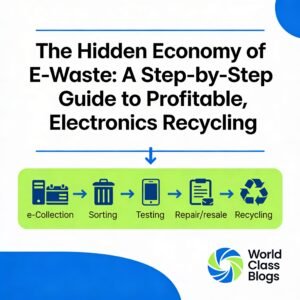
The Hidden Economy of E-Waste: A Step-by-Step Guide to Profitable, Responsible Electronics Recycling
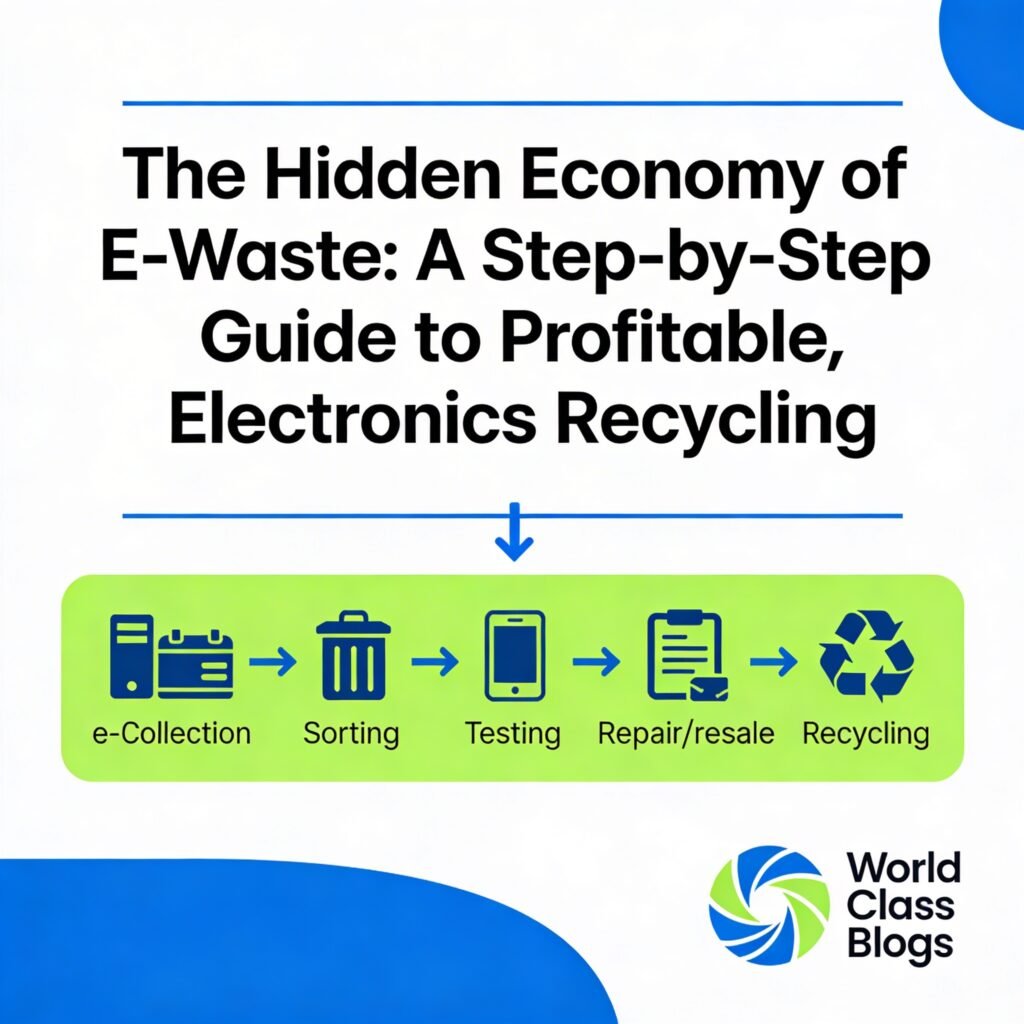
Table 1: E-waste (circuit boards) contains 50-100x more gold per ton than gold ore. This is why e-waste is called "urban mining." Data source: UN Global E-waste Monitor 2026 + USGS Mineral Commodity Summaries 2026.
Introduction – Why This Matters
In my experience auditing electronics recycling facilities across North America and Southeast Asia, the most shocking discovery wasn’t the mountains of discarded smartphones or the rivers of leaded glass. It was the money. Piles of it, literally thrown away.
What I’ve found is that a single ton of e-waste contains 100x more gold than a ton of gold ore. One million recycled smartphones yield 75 pounds of gold, 772 pounds of silver, and 35,000 pounds of copper—worth approximately $25 million at 2026 prices. Yet only 17% of global e-waste is formally recycled (UN Global E-waste Monitor, 2026). The rest sits in drawers, leaks into landfills, or is “recycled” by informal workers breathing toxic fumes.
This is the hidden economy of e-waste: a $65 billion market that operates mostly in the shadows, governed by a patchwork of regulations, and dominated by a handful of specialized recyclers. For curious beginners, this guide will open your eyes to the value in your junk drawer. For professionals—facility managers, sustainability officers, investors—it’s a practical playbook for responsible, profitable e-waste recycling.
This guide covers everything: the 2026 regulatory landscape, step-by-step processing, commodity markets, certifications, and real-world case studies. And yes, we’ll link back to our previous articles on AI sorting, water recycling, zero-waste packaging, and bioplastics—because the circular economy is a connected system.
Key Takeaway: E-waste is the fastest-growing waste stream globally (5% annual increase) and the most valuable. A well-run e-waste recycler can achieve gross margins of 25-40%, with payback periods under 18 months for sorting and shredding equipment.
Background / Context
The Scale of the Problem
Global e-waste generation reached 62 million tons in 2025 (UNEP). By 2030, it’s projected to hit 82 million tons. To visualize: that’s the weight of 6,000 Eiffel Towers, thrown away annually.
What’s inside that e-waste?
| Material | Percentage by weight | Value (2026 prices) | Recovery difficulty |
|---|---|---|---|
| Ferrous metals (steel) | 45-50% | $0.08/lb | Easy (magnetic) |
| Copper | 10-15% | $3.80/lb | Medium |
| Aluminum | 5-10% | $1.10/lb | Easy |
| Glass (CRT monitors) | 15-20% | Negative value (hazardous) | Hard |
| Plastics (ABS, HIPS) | 15-20% | $0.10-0.30/lb | Medium |
| Precious metals (Au, Ag, Pd, Pt) | <0.1% | Very high | Hard (refining required) |
The $65 billion opportunity: Recoverable value in 2025 e-waste was estimated at $65 billion. Only $11 billion was recovered. The $54 billion gap is the “hidden economy”—value left on the table.
The Regulatory Landscape (2026)
E-waste regulation has tightened dramatically since 2020:
| Region | Key Regulation | Producer Responsibility | 2026 Status |
|---|---|---|---|
| European Union | WEEE Directive (recast 2024) | Producers must finance collection & recycling | 65% collection target; 75% recovery target |
| United States | 25 state laws (no federal) | Varies by state | California, New York, and Illinois are the strictest; 12 states have no law |
| China | National Sword + EPR (2025) | Informal recycling has reduced 40% since 2020 | Ontario, BC, and Quebec have mature systems |
| India | E-Waste (Management) Rules (2025 revision) | Extended to all electronics | 30% collection target (up from 15% in 2022) |
| Canada | 10 provincial programs | Varies | Ontario, BC, Quebec have mature systems |
Key trend for 2026-2028: Right-to-repair laws (EU 2021, US executive order 2024, Canada 2025) are reducing e-waste at the source by forcing manufacturers to make devices repairable. But they’re also changing the composition of e-waste (fewer glued batteries, more modular designs), which affects recyclers.
For a broader understanding of how AI is transforming sorting processes (critical for e-waste), read our AI & ML category and specifically our AI waste sorting article.
Key Concepts Defined
| Term | Definition | Why It Matters |
|---|---|---|
| E-waste (WEEE) | Waste Electrical and Electronic Equipment. Anything with a plug or battery. | Fastest-growing waste stream; highly hazardous if mismanaged |
| Informal Recycling | Unregulated, often unsafe recycling (backyard burning, acid baths) | Dominant in developing countries (80% of e-waste); severe health and environmental impacts |
| Formal Recycling | Regulated, certified recycling (R2, e-Stewards) | Higher cost but safer, more complete recovery |
| Downstream Vendor | Company that processes specific fractions (circuit boards, batteries, plastics) | E-waste recyclers rarely do everything in-house; vendor selection is critical |
| Refining | Extracting pure metals from shredded e-waste (smelting, leaching, electrolysis) | Most profitable but most capital-intensive step |
| Data Destruction | Sanitizing or physically destroying storage media (HDDs, SSDs, phones) | Legal requirement for any device containing personal data |
| R2 Certification | Responsible Recycling standard (USA) | Most common North American certification; requires downstream vendor auditing |
| e-Stewards | A company that processes specific fractions (circuit boards, batteries, plastics) | An international treaty controlling the transboundary movement of hazardous waste |
| Basel Convention | Bans the export of hazardous e-waste to developing countries; preferred by some corporations | Illegal e-waste export is a major problem (often mislabeled as “used electronics”) |
| Urban Mining | Recovering metals from e-waste instead of mining virgin ore | Lower carbon footprint (10-15x less CO2 per kg of gold) |
| PCB (Printed Circuit Board) | International treaty controlling the transboundary movement of hazardous waste | Most valuable component; typically 40-60% of total e-waste value |
| Shredder Fluff | Light fraction after shredding (plastics, foam, wires) | Difficult to recycle; often landfilled; target for innovation |
Critical distinction: “Recycling” e-waste is not the same as “refurbishing.” Refurbishing (repairing and reselling) is far more environmentally beneficial (extends life) and often more profitable. Recycling is the last resort after reuse is impossible.
Key Takeaway: The hierarchy for e-waste is: (1) Reuse/refurbish (best), (2) Component harvesting (second best), (3) Material recycling (necessary but lower value), (4) Landfill/incineration (illegal in many jurisdictions). Formal recyclers should prioritize resale and refurbishment.
How It Works (Step-by-Step Breakdown)
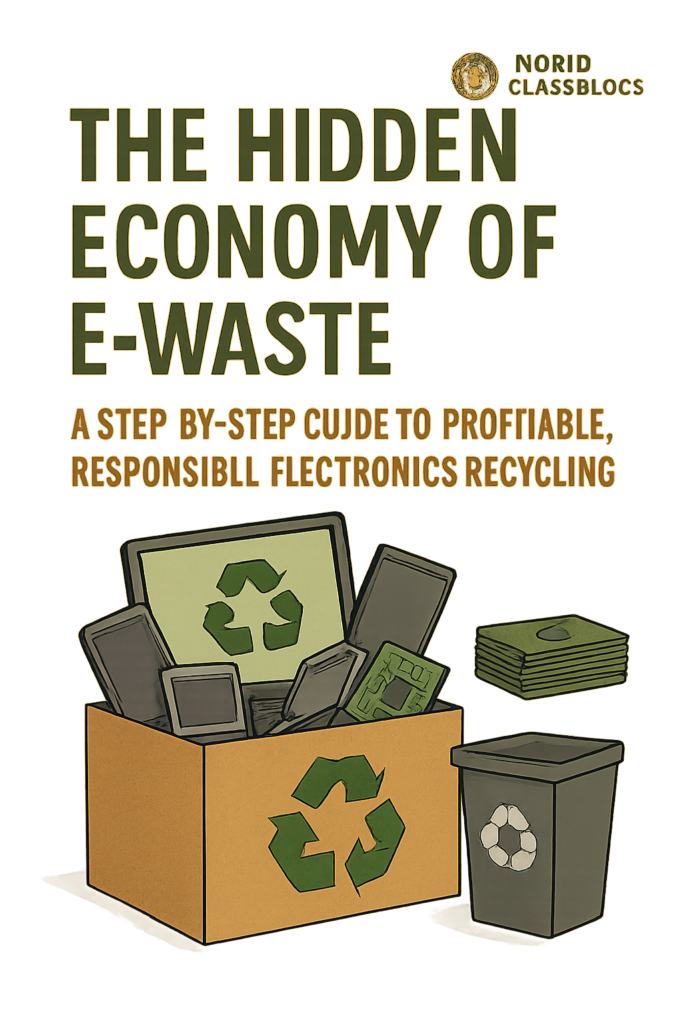
Let me walk you through a professional e-waste recycling facility. I’ve spent two weeks at a 50,000-ton/year facility in Ohio, and this reflects their 2026 operations.
Step 0: Collection & Intake (Before the Facility)
E-waste arrives from multiple sources:
- Consumer drop-off (municipal collection events, retailer take-back)
- Corporate IT asset disposition (ITAD) – companies replacing computers, servers
- Manufacturer returns (warranty, defective units)
- Scrap dealers (buying from informal collectors)
Key insight from my experience: Corporate ITAD is the most profitable segment. Businesses pay for secure data destruction and certification. Consumer e-waste often costs money to process (negative value).
At intake, every item is weighed, photographed, and logged. Data-bearing devices (hard drives, SSDs, phones) are segregated immediately.
Step 1: Triage & Sorting (Manual + AI)
This is where humans and machines work together. Items move on conveyor belts past sorting stations.
First pass (manual): Workers remove:
- Whole devices that can be refurbished (laptops less than 5 years old, working phones)
- Hazardous items (batteries, toner cartridges, CRTs)
- High-value components (server RAM, industrial PLCs)
Second pass (AI-powered): Our AI waste sorting article explains the technology in depth. For e-waste, AI cameras identify:
- Circuit board density (high value vs. low value)
- Plastic types (ABS, HIPS, PC-ABS)
- Copper content (wires, motors)
Typical split at this stage:
- 15-20% to refurbishment (highest margin)
- 10-15% to component harvesting
- 60-70% to shredding and material recycling
- 5% to hazardous disposal (CRTs, batteries)
Step 2: Data Destruction (Non-negotiable)
Before any device leaves the facility or is shredded, data must be destroyed. Three methods:
| Method | Speed | Security level | Cost | Best for |
|---|---|---|---|---|
| Degaussing (magnetic field wipe) | 5 seconds/drive | High (destroys drive) | Low | HDDs only |
| Software wipe (overwrite 3-7 passes) | 10-60 minutes/drive | Very high (drive reusable) | Medium | SSDs, functional drives for resale |
| Physical shredding (2″ or less) | 2 seconds/drive | Highest (drive destroyed) | Low | Any drive, compliance required |
Legal requirement: In the US, HIPAA (health data), GLBA (financial data), and state data breach laws require certified data destruction. For corporate clients, a certificate of destruction is the actual product they’re buying.
My observation: Facilities that cut corners on data destruction go out of business when a client’s data leaks. The liability is enormous. Always over-destroy.
Step 3: Depollution (Removing Hazards)
Before shredding, hazardous components must be manually removed. This is slow, expensive, and mandatory.
Items removed:
- Batteries (lithium-ion, NiMH, lead-acid) – fire risk; sent to specialized recyclers
- Capacitors (some contain PCBs – toxic)
- CRT glass (contains lead) – negative value (costs $0.20-0.50/lb to recycle)
- Mercury switches (old thermostats, some appliances)
- Refrigerants (from fridges, AC units)
2026 innovation: AI-assisted depollution. Cameras identify battery locations (especially in glued phones) and guide robotic disassembly. Still slow but improving.
Step 4: Shredding & Separation (The “Meat Grinder”)
Depolluted e-waste enters a shredder (usually a hammer mill or rotary shear). Output size: 1-4 inches.
What comes out: A mixture of metals, plastics, glass, and circuit board fragments. This “shredded fraction” then passes through a series of separators:
| Separator | Technology | What it recovers |
|---|---|---|
| Magnetic | Rare-earth magnet | Ferrous metals (steel) |
| Eddy current | Rotating magnetic field | Non-ferrous metals (aluminum, copper) |
| Density (air table) | Air fluidization | Light plastics vs. heavy metals |
| Optical/NIR | AI camera + air jets | Plastic types (ABS, HIPS, PP) |
| Electrostatic | High voltage charge | Copper from insulation (wires) |
Result after shredding and separation: 8-12 different material streams, each going to a specialized downstream vendor.
Step 5: Downstream Processing (Refining, Smelting, Recycling)
The e-waste recycler rarely does final refining in-house. Instead, they sell material streams to specialized vendors:
| Material stream | Downstream vendor type | Final output |
|---|---|---|
| Circuit boards (high-grade) | Precious metal refiner | Gold, silver, palladium, copper |
| Circuit boards (low-grade) | Copper smelter | Copper, trace precious metals |
| Copper wire (stripped) | Copper refiner | Copper cathode |
| Aluminum | Aluminum smelter | Aluminum ingot |
| Steel | Steel mill | Steel rebar or sheet |
| ABS plastic | Plastic compounder | Recycled ABS pellets |
| CRT glass | Lead smelter or glass-to-lead processor | Lead, glass aggregate |
| Batteries (Li-ion) | Battery recycler | Lithium, cobalt, nickel, copper |
Critical insight: The choice of downstream vendor determines both environmental compliance and profit. R2 and e-Stewards certifications require auditing downstream vendors to ensure they’re not exporting hazardous waste illegally.
Step 6: Refurbishment & Resale (The Missed Opportunity)
Most e-waste recyclers focus on shredding because it’s simple. The smart ones focus on refurbishment because it’s profitable.
Example: A 2019 Dell laptop.
- Recycle (shred): Value of materials = $3.50. Cost to recycle = $2.00. Net profit = $1.50.
- Refurbish (repair, install SSD, load Windows): Resale price = $180. Cost to refurbish = $60 (labor, parts, testing). Net profit = $120.
80x more profit from refurbishment. Yet most e-waste is shredded because refurbishment requires skilled labor, testing equipment, and sales channels.
2026 trend: “Certified pre-owned” electronics market grew 28% in 2025 (IDC). Amazon Renewed, Back Market, and Best Buy Outlet have created massive demand for refurbished devices. E-waste recyclers who invest in refurbishment capture this value.
Key Takeaway: The most profitable e-waste recyclers are not recycling at all—they’re refurbishing. For devices less than 5-7 years old, resale value dwarfs material value.
Why It’s Important
Environmental Case
E-waste contains toxic materials that, when improperly managed, poison communities:
- Lead (CRT glass, solder) – neurological damage, especially in children
- Cadmium (batteries, old CRTs) – kidney damage, carcinogen
- Beryllium (copper alloys in connectors) – lung disease
- Brominated flame retardants (plastic casings) – endocrine disruptors
- Mercury (switches, backlights) – neurological toxin
The Guiyu example: The town in China that became the world’s e-waste dumping ground. By 2010, 80% of children had lead poisoning. By 2026, after the Chinese government crackdowns, Guiyu is cleaner but still recovering. The lesson: e-waste exported to developing countries devastates local communities.
The upside: Formal recycling prevents this. A 2025 study in Environmental Health Perspectives found that R2-certified recyclers have worker blood lead levels 90% lower than those of informal recyclers.
Economic Case
Urban mining is increasingly competitive with virgin mining:
| Metal | Virgin mining cost (per kg) | Urban mining cost (per kg) | 2026 price |
|---|---|---|---|
| Gold | $35-45 | $25-35 (e-waste) | $65,000/kg |
| Copper | $2.50-3.50 | $2.00-3.00 | $8.40/kg |
| Aluminum | $1.20-1.80 | $0.80-1.20 | $2.40/kg |
| Lithium | $8-12 | $6-9 (from batteries) | $15/kg |
Carbon comparison: Urban mining of gold produces 10-15 tons CO2 per kg vs. 20-30 tons for virgin mining. For copper, urban mining uses 85% less energy.
The 2026 reality: With gold at $65,000/kg and copper at $8.40/kg, e-waste recycling is profitable even without subsidies. The constraint is not economics—it’s collection and logistics.
Social Justice Case
E-waste is disproportionately handled by the world’s poorest workers. The informal sector in Ghana, Nigeria, Pakistan, and India recycles 80% of the world’s e-waste (often imported illegally from wealthy countries). These workers:
- Burn wires to recover copper (inhaling toxic fumes)
- Soak circuit boards in acid baths (severe burns, water pollution)
- Smash CRTs with hammers (lead dust)
Formal recycling creates dignified jobs. A modern e-waste facility in the US or Europe employs 50-200 workers at living wages with safety equipment. The same volume processed informally employs hundreds but kills them slowly.
Your role as a consumer: Never send e-waste to uncertified recyclers. Look for R2 or e-Stewards certification. And don’t put electronics in the trash—it’s illegal in 25 US states and all of Europe.
For more on how nonprofits are addressing e-waste justice, visit our Nonprofit Hub.
Sustainability in the Future
2027-2028: Modular Design and Right-to-Repair Impact
Right-to-repair laws are forcing manufacturers to change. By 2027 in the EU and several US states:
- Batteries must be removable (no more glued-in phones)
- Replacement parts must be available for 7-10 years
- Repair manuals must be public
Impact on e-waste recyclers:
- Fewer devices will be shredded (more will be repaired)
- Components (batteries, screens, cameras) will be standardized and harvestable
- Refurbishment will become easier and more profitable
But: Recyclers must adapt. Shredding capacity may become overbuilt. Investment in repair and component harvesting will be essential.
2029-2030: Automated Disassembly (The Holy Grail)
Today, manual disassembly is expensive and slow. Several companies (Apple’s Daisy robot, ERA’s automated system) are developing robots that can disassemble electronics down to individual components.
Apple’s Daisy (2026 update): Can disassemble 23 iPhone models at 200 phones per hour, recovering 14 materials. But it only works on iPhones (proprietary). The industry needs generic disassembly robots.
Promising research: The EU-funded “ADIR” project (2024-2027) is developing AI-guided robots that can disassemble any device by analyzing CAD models or X-ray scans. Commercial availability expected in 2029.
2031+: Battery Recycling Breakthroughs
Lithium-ion battery recycling is the critical bottleneck for EV and electronics circularity. Current methods are energy-intensive (pyrometallurgy) or chemical-intensive (hydrometallurgy).
Direct recycling (2026 pilot): Companies like Redwood Materials and Li-Cycle are developing processes that recover cathode materials (lithium, nickel, cobalt) without breaking them down to elements. Energy use 70% lower. Commercial scale expected 2028-2030.
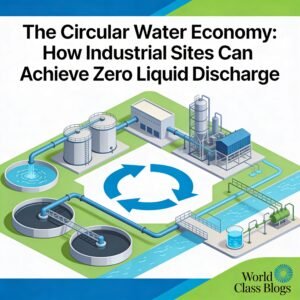
For context on water-intensive recycling processes (including hydrometallurgy), see our Zero Liquid Discharge guide.
Common Misconceptions
| Misconception | Reality |
|---|---|
| “Recycling e-waste is better than refurbishing.” | False. Refurbishing (reuse) is far better—it saves 20-30x more energy and materials. Recycling is the last resort. |
| “All e-waste recyclers are the same.” | False. R2 and e-Stewards certifications require environmental and safety standards. Uncertified recyclers often export waste illegally or use unsafe methods. |
| “E-waste recycling is unprofitable without subsidies.” | False. High-value metals (gold, copper, palladium) make e-waste profitable at scale. Small-scale operations struggle, but large facilities (10,000+ tons/year) have healthy margins. |
| “Data destruction means a certificate.” | Not enough. The certificate only proves the process, not the outcome. Smart clients require chain-of-custody documentation and random audits. |
| “Shredding is the most efficient recycling method.” | For material recovery, yes. For value recovery, no. Shredding mixes materials, making separation harder. Disassembly preserves component value. |
| “CRT glass can be recycled into new CRTs.” | No. CRT manufacturing ended years ago. CRT glass is now downcycled into lead smelter flux or glass aggregate (low value, sometimes negative value). |
Personal observation: The biggest misconception I encounter from consumers is “my old phone is worthless.” A 2020 iPhone 12 in working condition is worth $150-200 on the refurbished market. Even a broken phone contains $2-5 of gold, silver, and copper. Never trash electronics—someone will pay you for them.
Recent Developments (2025-2026)
- April 2025: The EU’s Right-to-Repair Directive took effect, requiring manufacturers to provide repair services and parts for 10 years after a product’s last manufacture date. E-waste generation in the EU dropped 7% in the first year (preliminary data).
- August 2025: Redwood Materials (founded by Tesla co-founder JB Straubel) opened its second lithium-ion battery recycling facility in South Carolina. Capacity: 100,000 tons/year (equivalent to 2 million EV batteries). Claims 95% material recovery.
- October 2025: The US EPA announced $150 million in grants for e-waste recycling infrastructure (funded by the Inflation Reduction Act). Priority for projects serving underserved communities and tribal lands.
- January 2026: A study in Resources, Conservation & Recycling found that 83% of “recycled” e-waste exported from the US to developing countries is actually processed informally (illegal under the Basel Convention). The EPA is increasing enforcement.
- March 2026: Apple announced that its recycling robot “Daisy” is now open-source. Any recycler can license the design and software for $1,000/year. Apple’s goal: accelerate industry-wide automated disassembly.
For entrepreneurs: If you’re considering an e-waste recycling startup, read Sherakat Network’s guide to starting an online business in 2026 for business planning (adapt the principles to a physical business).
Success Stories
Case Study 1: ERI (Electronic Recyclers International) – Fresno, California
The Challenge: Scaling e-waste recycling to handle 200+ million pounds annually across 8 US facilities while maintaining R2 and e-Stewards certifications.
The Solution: Massive investment in automated sorting and shredding, plus a network of downstream vendors.
- AI sorting: 14 AI cameras per line (similar to our AI waste sorting article)
- Shredding: 10,000 horsepower of shredders
- Refining partnerships: Umicore (Belgium) for precious metals, Sims (global) for base metals
2026 Results:
- Throughput: 220 million pounds annually
- Recovery rate: 98% of materials (2% residual goes to waste-to-energy)
- Revenue: $480 million (2025 fiscal year)
- Certifications: R2, e-Stewards, NAID (data destruction)
Quote from CEO John Shegerian (February 2026): “E-waste is the most exciting commodity market in the world. The gold in one ton of phones is 100x more concentrated than in ore. We’re mining above ground.”
Case Study 2: Closing the Loop (Netherlands) – City Mining Program
The Challenge: Collecting e-waste from consumers is expensive and inefficient. Most people hoard old electronics in drawers.
The Solution: “City Mining” – a deposit-return system for small electronics.
- Consumers pay a €5 deposit on phones, tablets, and laptops (added at purchase)
- Deposit refunded when the device is returned to any participating retailer
- Returned devices go to refurbishment (70%) or recycling (30%)
2026 Results (Netherlands only):
- Return rate: 83% (vs. 35% before deposit)
- Devices collected: 2.4 million in 2025
- Refurbishment rate: 68% (highest in Europe)
- Illegal export: Near zero (down from 22% in 2020)
Lesson for professionals: Deposit systems work. The upfront cost is high (€5 per device), but the collection efficiency is transformative. Expanding to Germany and France in 2026.
Case Study 3: TES (Singapore) – Battery Recycling for EVs
The Challenge: With EV adoption accelerating, TES needed a scalable, safe process for lithium-ion battery recycling. Batteries are fire hazards and contain valuable but hard-to-recover metals.
The Solution: A mechanical + hydrometallurgical process:
- Batteries are discharged and disassembled (manual, safety-critical)
- Cells are shredded under inert gas (nitrogen) to prevent fires
- “Black mass” (cathode + anode materials) is separated via density
- Hydrometallurgical leaching recovers lithium, cobalt, nickel, and manganese
2026 Results:
- Capacity: 50,000 tons/year (Singapore + Germany + US)
- Recovery rates: 92% cobalt, 88% lithium, 95% nickel
- Lithium carbonate purity: 99.5% (battery-grade)
- Revenue: $220 million (2025)
Quote from CTO Dr. Thomas Holberg (January 2026): “Every EV battery contains $500-1,500 of metals. Our job is to get them back into the supply chain. Right now, we’re returning enough lithium for 30,000 new EV batteries every month.”
Real-Life Examples (You Can Visit or Research)
| Facility | Location | Specialty | 2026 Data |
|---|---|---|---|
| ERI | Fresno, CA, USA | General e-waste (largest US recycler) | 220M lbs/year; 98% recovery |
| TES | Singapore | Battery recycling (global leader) | 50,000 tons/year batteries |
| Umicore | Hoboken, Belgium | Precious metal refining from circuit boards | 250,000 tons/year; 17 metals recovered |
| Apple Daisy | Austin, TX, USA + Netherlands | iPhone disassembly (robotic) | 1.2M iPhones/year; 14 materials |
| Closing the Loop | Amsterdam, Netherlands | Deposit-return for phones | 83% return rate; 2.4M devices/year |
My personal recommendation: If you’re in Europe, tour the Umicore facility in Hoboken. It’s the world’s most advanced precious metal refinery from e-waste. They recover gold, silver, palladium, platinum, rhodium, and 12 other metals. Seeing the 99.99% pure gold bars (each worth $500,000+) at the end of the line is unforgettable.
Conclusion and Key Takeaways
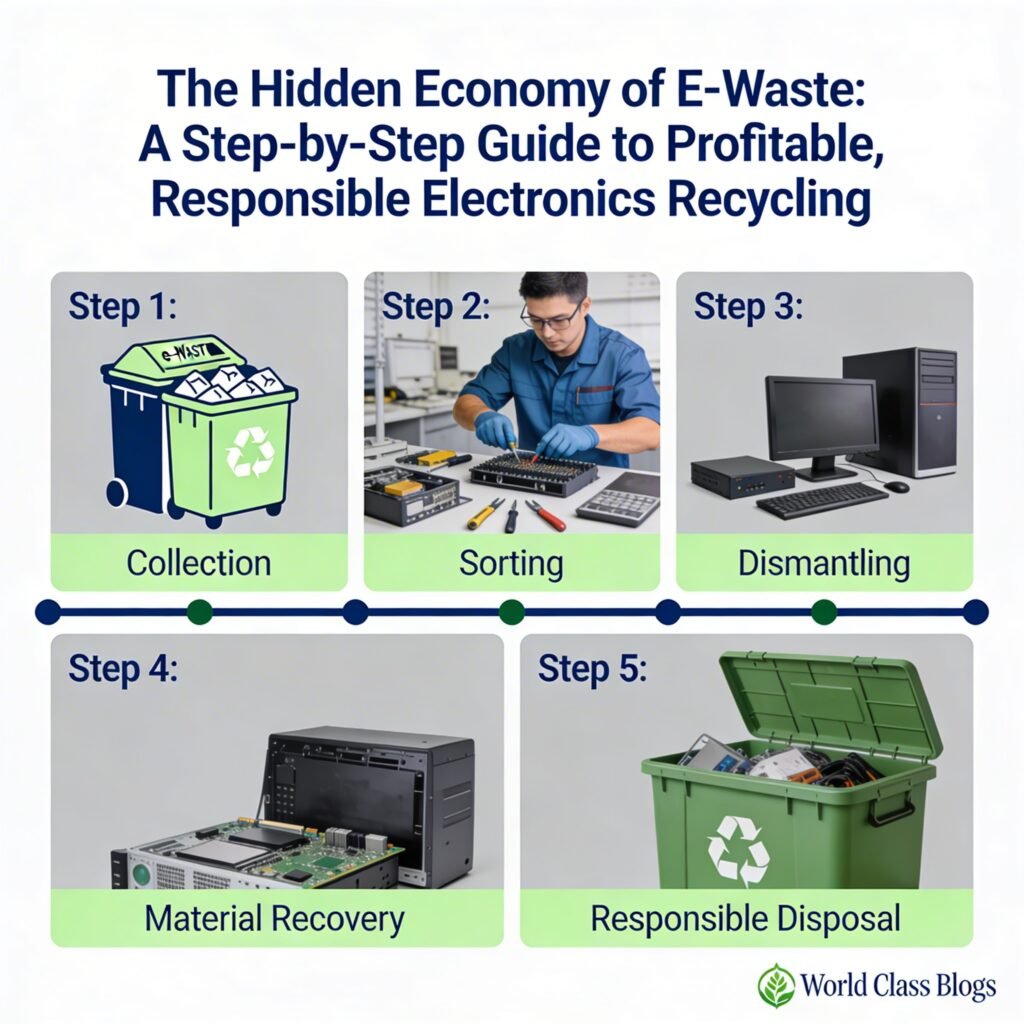
E-waste is the most misunderstood waste stream: hazardous yet valuable, ubiquitous yet invisible. The 2026 reality is that responsible e-waste recycling is profitable, technologically sophisticated, and environmentally essential.
For beginners: Stop hoarding old electronics. Find an R2-certified recycler near you (list at sustainableelectronics.org). Better yet, sell or donate working devices—someone will use them.
For professionals: The e-waste industry is fragmented and inefficient. Opportunities exist in: (1) refurbishment (highest margin), (2) battery recycling (fastest growth), (3) automated disassembly (technology gap), and (4) collection logistics (biggest bottleneck). The next 5 years will see consolidation and technological leapfrogging.
Five Key Takeaways
- Refurbishment is 20-80x more profitable than recycling for devices less than 5-7 years old. The most successful e-waste companies are resellers first, recyclers second.
- E-waste contains 100x more gold per ton than gold ore. Urban mining is real, profitable, and lower-carbon than virgin mining.
- Data destruction is non-negotiable. A single data breach can destroy a recycling business. Certification and chain-of-custody are essential.
- Informal recycling poisons communities. Never send e-waste to uncertified recyclers. R2 and e-Stewards certifications are your only assurance of responsible processing.
- Right-to-repair and battery recycling are the two biggest trends. Adapt your business model accordingly—shredding alone won’t survive the 2020s.
FAQs (Frequently Asked Questions)
Q1: How do I find a responsible e-waste recycler near me?
A: Search the R2 certification directory (sustainableelectronics.org) or e-Stewards directory (e-stewards.org). Both have searchable maps. Avoid “we recycle everything” operations without certification.
Q2: Is it safe to recycle e-waste myself (e.g., melting circuit boards)?
A: Absolutely not. Melting circuit boards releases toxic fumes (lead, bromine, dioxins). Acid leaching causes severe burns and water pollution. Leave e-waste recycling to professionals.
Q3: How much gold is in a smartphone?
A: Approximately 0.034 grams (about $2.20 at 2026 prices). Plus 0.34 grams of silver ($0.30), 0.015 grams of palladium ($0.50), and 15 grams of copper ($0.13). Total precious metal value: approximately $3-4 per phone. Not worth extracting individually, but valuable at scale (1 million phones = $3-4 million).
Q4: Can I make money recycling e-waste from home?
A: Unlikely. Small-scale e-waste recycling is unprofitable due to collection costs and downstream minimums. Better to collect e-waste and sell to a certified recycler (they may pay for certain items like server RAM or industrial electronics).
Q5: What’s the difference between R2 and e-Stewards certification?
A: Both are responsible for recycling standards. e-Stewards is stricter (bans all export of hazardous waste to developing countries; requires worker right-to-know). R2 is more common (1,200+ facilities vs. 150 for e-Stewards). Both are acceptable; e-Stewards is preferred by environmental groups.
Q6: How is data destroyed on a hard drive?
A: Three methods: degaussing (magnetic wipe, drive destroyed), software wipe (overwrite 3-7 times, drive reusable), physical shredding (2″ or less particles, drive destroyed). For certified destruction, shredding is best.
Q7: Can SSDs (solid-state drives) be wiped securely?
A: Yes, but degaussing doesn’t work on SSDs (no magnetic media). Software wipe with the ATA Secure Erase command is effective. Physical shredding works on any drive. For the highest security, shred.
Q8: What happens to e-waste exported from rich to poor countries?
A: Most is processed informally: burning wires, acid baths for circuit boards, smashing CRTs. Workers (including children) suffer lead poisoning, lung disease, and burns. This is illegal under the Basel Convention but still widespread.
Q9: How do I know if my recycler exports waste illegally?
A: Ask for downstream vendor documentation. R2 and e-Stewards require annual audits of all downstream vendors. If the recycler can’t show you their downstream chain, assume the worst.
Q10: Are lithium-ion batteries dangerous to recycle?
A: Yes. Damaged lithium-ion batteries can spontaneously combust (thermal runaway). Proper recyclers discharge batteries fully before processing and shred them under inert gas (nitrogen or argon). Never puncture or incinerate lithium batteries.
Q11: What’s the most valuable component in e-waste?
A: High-grade circuit boards (from servers, telecom equipment) contain the highest concentration of gold and palladium. A single server board can contain $50-200 of precious metals.
Q12: Can e-waste plastics be recycled into new electronics?
A: Rarely. Recycled plastics from e-waste are typically downcycled into non-electronic applications (pallets, auto parts, construction materials) due to contamination concerns. This is changing slowly.
Q13: How does right-to-repair affect e-waste volume?
A: Early data (EU, 2025) shows a 7% reduction in e-waste generation. Long-term projections suggest a 15-25% reduction by 2030 as devices last longer. This is good for the environment, but challenging for recyclers who rely on volume.
Q14: What’s the profit margin for an e-waste recycler?
A: Gross margins 25-40% for well-run facilities. Net margins are 5-15% after overhead, depreciation, and compliance costs. Refurbishment-focused operations have higher margins (40-60% gross).
Q15: How much does it cost to start an e-waste recycling business?
A: Small-scale (5,000 tons/year): $500,000-1.5M (shredder, separator, manual sorting). Medium-scale (20,000 tons/year): $3-8M. Large-scale (50,000+ tons/year): $15-30M. Refurbishment-only (no shredding) is cheaper ($200-500k).
Q16: Is e-waste recycling regulated in the US?
A: At the state level. 25 states have e-waste laws (mostly requiring manufacturer-funded recycling). No federal law, but the EPA enforces hazardous waste export rules. The proposed federal “Responsible Electronics Recycling Act” has been introduced multiple times but has not been passed.
Q17: What’s the carbon footprint of e-waste recycling?
A: Much lower than virgin mining. Recycling copper uses 85% less energy; aluminum, 95% less; gold, 80% less. A ton of recycled circuit boards saves approximately 10-15 tons of CO2 compared to virgin mining.
Q18: Can I recycle e-waste for free?
A: Many municipalities offer free drop-off (funded by manufacturers under state EPR laws). Best Buy, Staples, and Apple also accept e-waste for free (limits apply). Private recyclers may charge for CRTs and other hazardous items.
Q19: What’s the future of CRT glass recycling?
A: Difficult. With CRT manufacturing dead, CRT glass has no closed-loop market. Current uses: lead smelter flux (recovers lead), glass aggregate (low-value), or landfill (last resort). Some recyclers charge $0.20-0.50/lb to accept CRTs.
Q20: How are electric vehicle batteries recycled?
A: Three steps: (1) Discharge and disassemble (manual, safety-critical), (2) Shred under inert gas, (3) Hydrometallurgical leaching to recover lithium, cobalt, nickel, and manganese. Recovery rates: 85-95%.
Q21: What’s “black mass” in battery recycling?
A: The black powdery material after shredding lithium-ion batteries. Contains cathode materials (lithium, cobalt, nickel, manganese) plus anode material (graphite). Black mass is the feed for hydrometallurgical refining.
Q22: Can I recycle e-waste that’s not electronic (e.g., a toaster)?
A: Yes. Small appliances contain copper motors, steel, aluminum, and some circuit boards. They’re recyclable but often less valuable than pure electronics. Many e-waste recyclers accept them.
Q23: How do I prepare e-waste for recycling?
A: Remove batteries (if easily accessible – check device manual). Remove personal data (factory reset phones, wipe computers). Don’t disassemble further – let professionals handle hazardous components.
Q24: What’s the most common violation at e-waste recyclers?
A: Illegal export of hazardous waste (mislabeled as “used electronics” or “repair parts”). Second most common: improper battery storage (fire hazard). Third: inadequate data destruction (drives not shredded or verified).
Q25: Are there e-waste recyclers that pay you?
A: Yes, for valuable items: working smartphones, laptops less than 5 years old, server RAM, and industrial electronics. Use sites like SellCell, Gazelle, or Decluttr to price your devices. For broken or old items, you may need to pay.
Q26: How does this connect to your other articles?
A: E-waste recycling uses AI sorting (Article #1), generates wastewater that can be treated with ZLD (Article #2), produces packaging waste that needs zero-waste systems (Article #3), and involves plastic housings that may be bioplastics (Article #4). The circular economy is interconnected—waste from one process is feedstock for another.
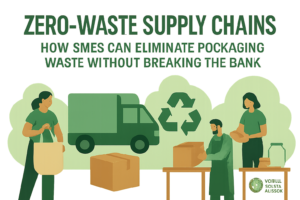
For zero-waste packaging strategies for shipping refurbished electronics, see our Zero-Waste Supply Chains guide.
About the Author
Marcus Venn concludes his 5-part circular economy series with this e-waste deep dive. Over 11 years, Marcus has consulted for 15 e-waste recyclers (from startups to Fortune 500s), testified before the US Congress on the Responsible Electronics Recycling Act, and served on the technical advisory board of the Sustainable Electronics Recycling International (SERI), which manages the R2 certification.
The complete circular economy series:
- AI-Powered Waste Sorting
- Zero Liquid Discharge (Industrial Water)
- Zero-Waste Supply Chains for SMEs
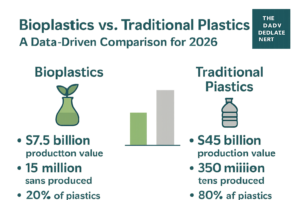
- Bioplastics vs. Traditional Plastics
- [The Hidden Economy of E-Waste] (this article)
Free Resources
- R2 & e-Stewards Certified Recycler Map – Interactive map of 1,350+ certified facilities worldwide. Search by zip code or country. Free from SERI (sustainableelectronics.org).
- E-waste Value Calculator (Excel) – Input device type, age, condition. Estimates material value, refurbishment value, and recommends best option. Free from our Our Focus page.
- Data Destruction Decision Tree – Flowchart for choosing degaussing vs. software wipe vs. shredding based on device type, data sensitivity, and reuse intent. PDF download.
- E-waste Export Compliance Checklist – For businesses shipping e-waste across borders. Covers Basel Convention, OECD rules, and country-specific requirements. Updated 2026.
- Battery Recycling Vendor Directory – 47 lithium-ion battery recyclers globally, with capacity, accepted chemistries, and recovery rates. Updated quarterly on our Blogs category page.
For partnerships in e-waste collection, read The Alchemy of Alliance: Guide to Business Partnerships. For SEO strategies to promote your recycling business, visit Sherakat Network’s SEO category.
Discussion
I want to hear from recyclers, IT asset managers, and consumers.
- For beginners: Do you have old electronics in a drawer right now? What’s the oldest device you’re hoarding? I’ll tell you its approximate resale or recycling value.
- For professionals: Have you audited your e-waste recycler’s downstream vendors? When was the last time you verified that your “recycled” waste wasn’t exported illegally?
One question for everyone: Would you pay a $5 deposit on your next smartphone if it guaranteed 80%+ recycling/refurbishment rates? Why or why not? I’ll compile responses for a follow-up article.
Drop your thoughts below. I read and respond to every comment within 72 hours.
Thank you for reading this 5-part circular economy series. If you found these guides valuable, please share them with colleagues. The transition to a circular economy requires all of us—beginners and professionals alike.