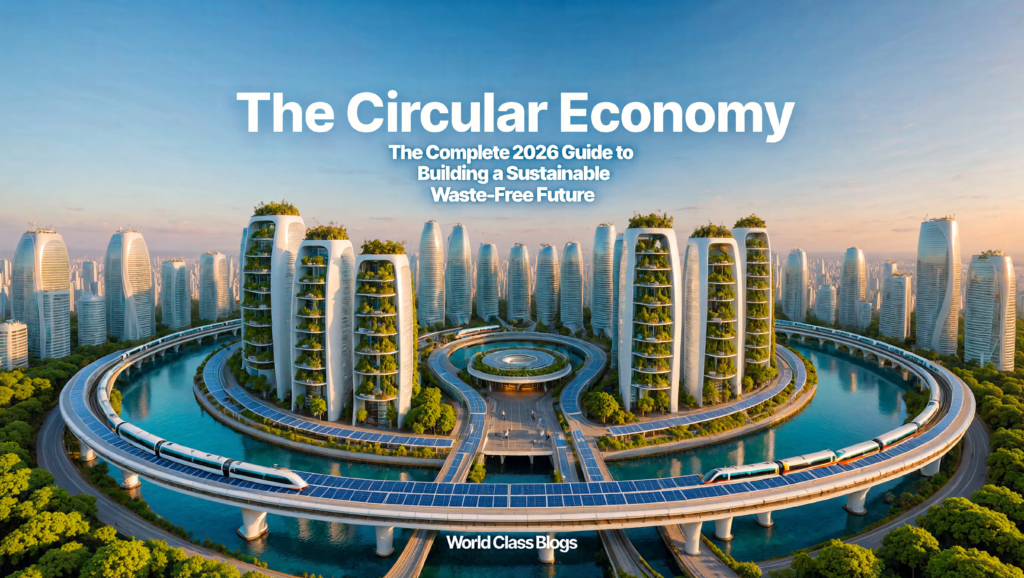
The Circular Economy: The Complete 2026 Guide to Building a Sustainable, Waste-Free Future
The iconic "butterfly diagram" of the circular economy, illustrating the continuous flows of biological and technical materials, designed by the Ellen MacArthur Foundation.
Introduction – Why This Matters: The End of the Linear Dead End
Our global economy is built on a flawed, centuries-old model: Take, Make, Waste. We extract finite resources, manufacture products with short lifespans, and discard them into landfills or incinerators at an astonishing rate. The result? According to the 2025 Global Circularity Gap Report, the world is only 7.2% circular—meaning over 92% of all materials we use are wasted, lost, or unavailable for reuse after just one lifecycle. This linear system is driving the triple planetary crisis: climate change, biodiversity loss, and pollution.
But there is a powerful alternative: the Circular Economy. It’s a systemic framework for designing out waste and pollution, keeping products and materials in use, and regenerating natural systems. In my experience working with companies on sustainability transitions, the most powerful insight is this: circularity is not just an environmental strategy; it is a profound driver of innovation, resilience, and long-term profitability. What I’ve found is that businesses that adopt circular principles uncover new revenue streams, reduce exposure to volatile resource prices, and build deeper customer loyalty.
This is not a niche concept. By 2026, projections indicate the circular economy will represent a $4.5 trillion global economic opportunity by reducing waste, stimulating innovation, and creating new industries. This comprehensive guide will move beyond the buzzword to provide a clear, actionable map. We’ll explore the core principles, the innovative business models making it real, the latest technologies and policies, and practical steps for both businesses and individuals to transition from a linear extractor to a circular regenerator.
Background / Context: From Industrial Revolution to Circular Revolution
The linear “take-make-waste” model accelerated with the Industrial Revolution, fueled by cheap energy and the assumption of infinite resources. The post-WWII consumer boom cemented disposability as a cultural and economic norm.
The intellectual seeds of the circular alternative were planted decades ago. In the 1960s, economist Kenneth Boulding described the Earth as a closed spaceship with limited resources. In the 1970s, Walter Stahel coined the term “Cradle to Cradle” (popularized later by William McDonough and Michael Braungart), advocating for a closed-loop industrial system. The Ellen MacArthur Foundation, launched in 2010, has been instrumental in quantifying the economic opportunity and building a global network of businesses, governments, and academia around the concept.
The urgency is now crystallizing in policy. The European Union’s Circular Economy Action Plan (2020, updated 2025) is a comprehensive legislative push, including the Right to Repair, Ecodesign for Sustainable Products Regulation (ESPR), and strict recycling targets. China has had circular economy promotion laws since 2008. In the U.S., the National Recycling Strategy and state-level Extended Producer Responsibility (EPR) laws are gaining traction.
The driver is clear: resource security. The 2024 World Economic Forum Global Risks Report ranked “resource shortages” as a top-5 risk over the next decade. The circular economy is the strategic response—a way to decouple economic growth from relentless resource consumption.
Key Concepts Defined: The Language of Circularity
- Circular Economy: An industrial system that is restorative or regenerative by intention and design. It replaces the end-of-life concept with restoration, shifts towards renewable energy, eliminates toxic chemicals, and aims for the elimination of waste through superior design of materials, products, systems, and business models.
- Linear Economy: The traditional model based on a straight line: resource extraction → production → use → disposal as waste.
- Cradle to Cradle® vs. Cradle to Grave: Cradle to Grave is the linear model (product ends in a “grave” like a landfill). Cradle to Cradle design ensures materials are perpetually cycled, either as biological nutrients that safely biodegrade or technical nutrients (polymers, metals) that are endlessly recovered and remanufactured.
- Biological vs. Technical Cycles: The two fundamental cycles of the circular economy. The Biological Cycle involves consumables (e.g., food, cotton, wood) designed to safely return to the biosphere. The Technical Cycle involves durable goods (e.g., phones, washing machines, car parts) designed for recovery, refurbishment, and remanufacturing.
- Industrial Symbiosis: Where waste or by-products of one industry become the raw materials for another. A classic example is a power plant’s excess heat warming nearby greenhouses.
- Extended Producer Responsibility (EPR): A policy approach where producers are given significant responsibility—financial and/or physical—for the treatment or disposal of post-consumer products.
- Product-as-a-Service (PaaS): A business model where a company retains ownership of a product and sells its use as a service (e.g., lighting as a service, tire miles as a service), aligning the producer’s incentive with durability, reparability, and recyclability.
- Urban Mining: The process of recovering valuable materials (metals, minerals) from urban waste streams (e.g., electronics, buildings) instead of traditional geological mining.
- Circular Design: Designing products from the outset for longevity, reparability, disassembly, and recyclability.
How It Works: The Principles and Business Models (Step-by-Step Breakdown)
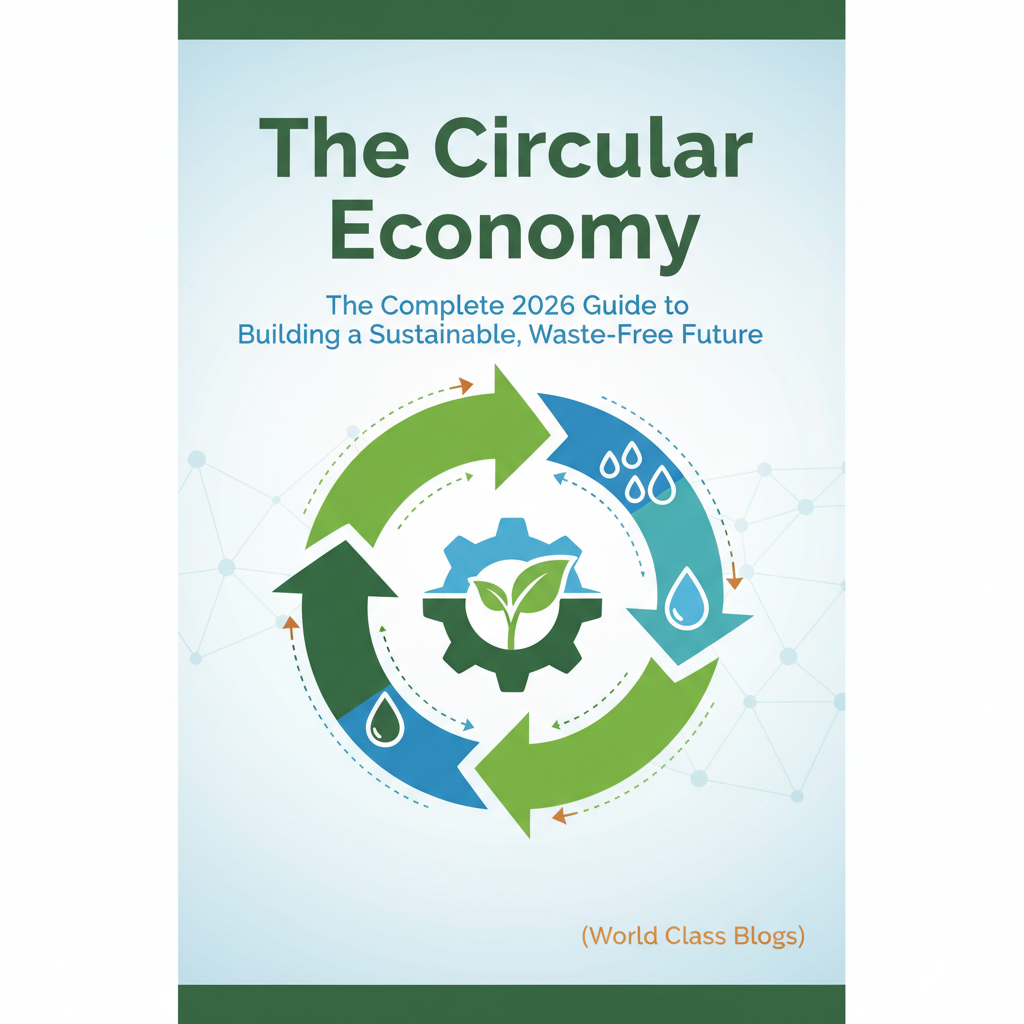
The circular economy is built on three core principles, driven by design and enabled by new business models.
Principle 1: Eliminate Waste and Pollution
This starts at the design stage. It asks: How can we design products so that waste (including pollution, greenhouse gases, and toxic leakage) is not an inherent outcome?
- Action: Use non-toxic, easily separable materials. Design for disassembly. Replace single-use items with reusable systems. Example: DyeCoo textile technology uses recycled CO₂ instead of water and chemicals to dye fabric, eliminating toxic wastewater.
Principle 2: Keep Products and Materials in Use
Maximize the utility and lifespan of products, components, and materials through cycles of use.
- Strategies:
- Maintain/Repair: Designing for easy repair. Supporting repair networks. Example: Framework Laptop sells modular, user-repairable/upgradable laptops.
- Reuse/Redistribute: Reselling or donating functional products. Example: REI’s Used Gear program.
- Refurbish/Remanufacture: Restoring a product to like-new condition, often with a warranty. Example: Caterpillar’s Certified Rebuild program for heavy machinery.
- Recycle: As a last resort, breaking down materials to create new feedstock. Advanced/chemical recycling aims to recover virgin-quality materials.
Principle 3: Regenerate Natural Systems
Move beyond “doing less harm” to actively improving the environment. This means returning valuable nutrients to the soil and enhancing ecosystems.
- Action: Shift to renewable energy. Use regenerative agricultural practices that rebuild soil organic matter and biodiversity. Use compostable materials that feed the biological cycle. Example: Patagonia’s regenerative organic cotton initiative.
The Business Model Revolution:
Circularity requires new ways of creating value. Here are the dominant models:
| Business Model | Core Value Proposition | Example Company | Circular Impact |
|---|---|---|---|
| 1. Product-as-a-Service (PaaS) | Sell performance/access, not ownership. | Philips (Lighting as a Service) | Producer retains ownership, designs for longevity & easy recovery. |
| 2. Sharing Platforms | Maximize asset utilization by enabling shared use/access. | Yerdle Recommerce (B2B) | Extends product life, reduces demand for new goods. |
| 3. Product Life Extension | Repair, upgrade, remanufacture, resell. | Back Market (Refurbished electronics) | Keeps products in use, reduces e-waste. |
| 4. Circular Supply Chains | Use recycled, bio-based, or fully renewable materials. | Adidas (Ultraboost shoes from ocean plastic) | Closes material loops, reduces virgin extraction. |
| 5. Resource Recovery | Recover useful resources/energy from waste streams. | AMP Robotics (AI for recycling sorting) | Turns waste into feedstock, enables urban mining. |
Why It’s Important: The Multidimensional Imperative
- Economic Resilience and Growth: It decouples growth from resource constraints. A 2025 report by Accenture and the WEF found that circular business models could unlock $1 trillion in materials savings for the global economy by 2030. It fosters innovation, creates local jobs in repair, remanufacturing, and recycling, and insulates businesses from commodity price shocks.
- Climate Change Mitigation: The Ellen MacArthur Foundation estimates that applying circular economy strategies in just five key areas (steel, plastics, aluminum, cement, and food) could eliminate 45% of global CO2 emissions by 2050. This comes from reducing energy-intensive extraction, manufacturing, and waste processing.
- Biodiversity and Ecosystem Protection: Reducing the need for virgin material extraction limits deforestation, mining, and drilling, thereby preserving habitats. Regenerative practices in agriculture and forestry can actively restore ecosystems.
- Reduced Pollution and Waste: It directly tackles the plastic in our oceans, chemicals in our soil, and electronic waste in our landfills. The UNEP Global Waste Management Outlook 2024 warns that without urgent action, annual waste generation will increase by 73% by 2050. Circularity is the only systemic solution.
- Consumer Benefits and Sovereignty: It can provide higher-quality, longer-lasting products, cost savings through sharing or service models, and the empowerment of repair. It aligns with growing consumer values around sustainability and transparency.
Sustainability in the Future: The 2030 Circular Vision
The future is not just “less bad” linear; it’s a fundamentally different, regenerative system. Here’s what a mature circular economy looks like:
- The Built Environment: Buildings are designed as “material banks.” Using digital material passports, every beam, pane, and fixture is tracked. At the end of life, buildings are carefully deconstructed, not demolished, with components and materials recovered for high-value reuse. Bio-based materials like cross-laminated timber (CLT) are becoming mainstream.
- The Food System: A regenerative and restorative food system prevails. Food waste is minimized through smarter logistics and consumption. Inedible by-products are converted into bio-materials, fertilizers, or energy. Packaging is compostable or reusable. Agriculture rebuilds soil health, drawing down carbon.
- Fashion & Textiles: The industry shifts from fast fashion to circular fashion. Clothing is designed for durability, repairability, and recyclability. Rental, resale, and repair are dominant models. At the end-of-life, garments are collected and broken down into fibers through mechanical or chemical recycling to spin new yarn, or composted if made from pure biological materials.
- Technology & Policy Enablers: Digital Product Passports (mandated in the EU from 2027) will be universal, providing a digital twin of a product’s materials, origin, and instructions for disassembly. Advanced robotics and AI (like that from AMP Robotics) will make sorting and recycling hyper-efficient. Circular economy metrics will be integrated into corporate ESG reporting and national GDP accounts, moving beyond GDP as the sole measure of progress.
Common Misconceptions
- Misconception: “The circular economy is just a fancy word for recycling.”
- Reality: Recycling is a last-resort, downstream tactic in a circular system. True circularity starts upstream with design to prevent waste. It prioritizes refuse, reduce, reuse, repair, and refurbish long before recycling. Recycling often results in “downcycling” (lower-quality material), whereas circular design aims for infinite “upcycling” loops.
- Misconception: “It’s only for environmentalists and will hurt the economy.”
- Reality: It is a competitiveness strategy. As resource prices rise and supply chains face disruption, circular companies are more resilient. It creates new industries (remanufacturing, reverse logistics) and jobs. The economic opportunity is in the trillions, as noted by institutions like the World Economic Forum.
- Misconception: “Consumers have to make all the sacrifices and pay more.”
- Reality: While some circular products may have higher upfront costs due to quality, the Total Cost of Ownership is often lower. A durable, repairable appliance lasts decades, not years. Service models (e.g., car-sharing) can provide access to high-quality goods without ownership costs. The goal is better value, not just greener products.
- Misconception: “It’s only relevant for manufacturing and physical products.”
- Reality: Circular principles apply to all sectors, including services, digital, and finance. A software company can design for longevity and upgradability instead of planned obsolescence. Banks can offer “pay-per-use” financing aligned with Product-as-a-Service models. It’s a systemic lens for all economic activity.
Recent Developments (2024-2026): The Acceleration
- Digital Product Passports (DPPs) Become Law: The EU’s Ecodesign for Sustainable Products Regulation (ESPR), finalized in 2025, will require DPPs for all regulated products (starting with electronics, batteries, textiles) by 2027. This is a game-changer for traceability and informed recycling/disassembly.
- The Right to Repair Gains Global Momentum: The EU’s Right to Repair directive took effect in 2025, mandating spare parts availability and repair information. Similar laws have passed in New York, California, and are being debated in over 20 U.S. states. Apple and Samsung have launched self-service repair programs in response.
- Corporate Scrutiny on Greenwashing: Regulators like the U.S. FTC and EU authorities are cracking down on vague “circular” and “sustainable” claims. The new EU Green Claims Directive (2026) will require rigorous, third-party-verified proof for any environmental marketing, forcing companies to substantiate their circularity efforts.
- Chemical/Advanced Recycling Scales (Amid Debate): Large-scale facilities for converting plastic waste back into chemical feedstocks (monomers) are coming online. While controversial due to energy use and emissions, proponents argue it’s essential for hard-to-recycle plastics. The debate highlights the hierarchy: reduction and reuse must come first.
- The Rise of “Recommerce” and Second-Hand Platforms: The second-hand market is projected to grow three times faster than the overall retail market by 2027. Luxury brands like Burberry and Gucci now have official resale platforms, signaling a major shift in brand perception and value retention.
Success Stories: Circularity in Action
Case Study 1: MUD Jeans – Lease a Jeans
This Dutch company epitomizes Product-as-a-Service in fashion. Customers lease a pair of jeans for a monthly fee. After a year, they can return them for recycling, swap for a new pair, or keep them. MUD Jeans uses organic cotton and post-consumer recycled cotton. They take back the old jeans, mechanically recycle them into new denim yarn (with a 40% recycled content blend), and close the loop. In my experience analyzing their model, the brilliance is the alignment of incentives: MUD profits from longevity and recyclability, not volume sales. They have recycled over 80,000 pairs of jeans since inception.
Case Study 2: Renault’s Refactored (Refurbished) Plant
The French automaker’s “Refactored” program is a masterclass in industrial remanufacturing. At a dedicated facility, skilled technicians disassemble used engines, transmissions, and other components. Worn parts are replaced, everything is cleaned, tested, and reassembled to original equipment specifications. These parts are sold with a full warranty at a 30-50% discount compared to new. This saves customers money, reduces waste, and saves Renault up to 80% in energy, 88% in water, and 92% in chemical products compared to manufacturing new parts. It’s a profitable, high-quality circular operation.
Case Study 3: The City of Amsterdam’s Circular 2050 Strategy
Amsterdam is a leading city implementing circularity at a municipal scale. Its strategy includes:
- Construction: Mandating the use of digital material passports for all city-funded buildings by 2025 and aiming for 50% of building materials to be reusable or biobased by 2030.
- Procurement: Using its massive purchasing power to demand circular products and services.
- Food & Organic Waste: Aiming to cut food waste in half by 2030 and process all organic waste into biogas and compost for local agriculture.
- Consumer Goods: Promoting sharing libraries for tools, toys, and appliances, and supporting repair cafes citywide. This systemic, city-wide approach demonstrates the multi-sector potential of circularity.
Real-Life Examples: From Global Brands to Grassroots
- IKEA’s Furniture Take-Back & Resale: IKEA now buys back used furniture in all its major markets, refurbishes it, and resells it in dedicated “Circular Hubs” in-store. This gives products a second life, educates consumers, and builds brand loyalty. Their goal is to be a fully circular business by 2030.
- Interface’s “Climate Take Back” and Carbon-Negative Carpet Tiles: The flooring company not only uses recycled nylon but has pioneered “proof positive” carpet tiles that store more carbon than is emitted in their production, thanks to bio-based materials. They also have a robust reclamation program to recycle old carpet tiles.
- The “Library of Things” Movement: Grassroots initiatives like London’s Library of Things allow members to borrow infrequently used items (drills, carpet cleaners, party supplies) for a small fee. This reduces consumption, saves money, and builds community—a perfect example of the sharing platform model at a local level.
- Aquaponics & Industrial Symbiosis: In numerous eco-industrial parks worldwide, the waste heat from a data center warms greenhouses, the CO2 from fermentation enriches plant growth, and the nutrient-rich water from fish farming (aquaponics) fertilizes crops. These closed-loop systems mimic natural ecosystems.
Conclusion and Key Takeaways: The Journey from Linear to Circular
The transition to a circular economy is not a minor tweak; it is a fundamental reimagining of how we create value. It requires collaboration across entire value chains—designers, manufacturers, retailers, consumers, waste managers, and policymakers.
Key Takeaways for Businesses and Individuals:
- Start with Design: Circularity is determined at the drawing board. Prioritize durable, modular, repairable designs with safe, separable materials.
- Embrace New Business Models: Explore how Product-as-a-Service, sharing, or resale models could create deeper customer relationships and more stable revenue in your sector. For insights on innovative business structures, see our partner’s guide to business partnership models.
- Think in Systems and Cycles: Map your material and product flows. Where does waste occur? Can it become an input for another process? Collaborate with unlikely partners (industrial symbiosis).
- Leverage Digital Technology: Use Digital Product Passports, IoT sensors, and AI to track products, optimize use, and enable efficient recovery and recycling.
- Policy is a Catalyst: Support and prepare for Extended Producer Responsibility (EPR), Right to Repair, and eco-design standards. They level the playing field and accelerate the transition.
The linear economy has brought prosperity to many, but its hidden costs are now unignorable. The circular economy offers a path to a future where economic activity restores, rather than depletes, the planet we call home. It is the ultimate design challenge of our time—and our greatest opportunity for innovation. For more on integrating sustainable thinking into core operations, explore our Nonprofit Hub for mission-driven strategies.
FAQs (Frequently Asked Questions)
- Q: What’s the difference between recycling and the circular economy?
- A: Recycling is a single process at the end of a product’s life. The circular economy is the entire system that makes recycling effective and minimizes the need for it. It encompasses design, business models, consumption patterns, and recovery logistics. Recycling is a subset, not the goal.
- Q: Is a circular economy possible in a capitalist system focused on growth?
- A: Yes, but it redefines “growth.” Instead of growth based on throughput (selling more stuff), it focuses on growth in value creation from existing assets—through services, performance, resale, and regenerative practices. It’s about qualitative growth (better, longer-lasting, more useful products) rather than just quantitative (more units).
- Q: How does circular economy address planned obsolescence?
- A: Directly. In a circular model, companies profit from product longevity, reparability, and the value of materials at end-of-life. This flips the incentive away from planned obsolescence. Policies like Right to Repair and design mandates further combat it.
- Q: What are the biggest barriers to a circular economy?
- A: 1) Linear Economics: Subsidies for virgin materials, cheap landfilling, and externalized environmental costs. 2) Design Legacy: Most existing products and infrastructure were not designed for circularity. 3) System Complexity: Creating reverse logistics and new cross-industry collaborations is hard. 4) Consumer Mindset: The cultural attachment to ownership and “new.”
- Q: Can we be 100% circular?
- A: In a physical world with entropy (energy loss), 100% is a theoretical goal, not a practical reality. Some material will always be lost to wear, dissipation, or contamination. The aim is to get as close as possible, continuously improving the cycles and minimizing virgin input and waste output.
- Q: What role do consumers play?
- A: A crucial one. Consumers drive demand by choosing durable, repairable products; using sharing and rental services; participating in take-back schemes; and properly sorting waste. Their advocacy also supports strong circular policies.
- Q: What is “green growth” and how does it relate?
- A: “Green growth” is economic growth that is environmentally sustainable. The circular economy is a primary engine for green growth, as it decouples prosperity from resource depletion and environmental degradation.
- Q: Are biodegradable plastics part of the circular economy?
- A: Only if they are part of a managed biological cycle. A compostable plastic cup tossed in a forest is pollution. But if it’s made from safe, certified materials and collected in a municipal composting system where it turns into nutrient-rich compost for soil, it is part of the circular economy’s biological cycle.
- Q: How does circular economy create jobs?
- A: It shifts employment from extractive and waste management sectors to higher-skill jobs in repair, remanufacturing, reverse logistics, material science, and circular design. A study by the International Labour Organization (ILO) estimates it could create a net 6 million new jobs globally by 2030.
- Q: What is “circular procurement”?
- A: When governments or large corporations use their purchasing power to buy goods and services that are reusable, repairable, refillable, made from recycled content, or offered as a service. This creates massive market demand for circular solutions.
- Q: How do you measure circularity?
- A: Key metrics include: Circularity Rate (% of materials cycled back), Virgin Material Use, Product Lifespan, Recycled Content, and Waste Generation. The Circularity Gap Reporting Initiative and the Ellen MacArthur Foundation’s Circulytics are leading assessment tools.
- Q: Is nuclear energy considered circular?
- A: It’s a complex debate. In terms of material flows, nuclear fuel is a finite resource (linear extraction), though some next-gen reactors can use recycled fuel. The high-level radioactive waste poses a massive challenge for safe, long-term cycling/storage. Most circular frameworks prioritize renewable energy (solar, wind) which harness perpetual flows.
- Q: Can fast-moving consumer goods (FMCG) be circular?
- A: Absolutely. It focuses on reusable packaging systems (refillable containers), concentrated products (reducing packaging), compostable materials for unavoidable packaging, and innovative delivery models (like loop systems for home delivery of products in durable containers that are collected, cleaned, and refilled).
- Q: What is the connection between the circular economy and climate change?
- A: It’s deeply connected. As mentioned, circular strategies in key sectors can cut nearly half of global emissions. This happens by: reducing energy for extraction/manufacturing, avoiding methane from landfills, sequestering carbon in products and soils (via biobased materials), and improving energy efficiency through shared assets.
- Q: Is digitalization good or bad for circularity?
- A: It’s a double-edged sword. Good: Enables tracking (DPPs), optimizes sharing platforms, facilitates repair via AR manuals, and improves recycling sorting. Bad: Drives rapid hardware turnover (e-waste), consumes vast energy/resources for data centers, and can enable more consumption through e-commerce. The key is to design digital systems with circular principles.
- Q: What are some simple first steps for a small business?
- A: 1) Conduct a waste audit. 2) Switch to reusable/refillable supplies. 3) Choose suppliers that take-back programs (e.g., for packaging or electronics). 4) Offer repair services for your products. 5) Explore product leasing if applicable.
- Q: How does the circular economy relate to the UN Sustainable Development Goals (SDGs)?
- A: It is a critical delivery mechanism for multiple SDGs: SDG 8 (Decent Work), 9 (Industry/Innovation), 11 (Sustainable Cities), 12 (Responsible Consumption & Production—directly), 13 (Climate Action), and 15 (Life on Land).
- Q: What is the “blue economy” in relation to the circular economy?
- A: The Blue Economy concept, as defined by Gunter Pauli, is inspired by ecosystems and aims for zero waste with multiple cash flows. It’s a closely related, biomimetic concept that often operates within the broader circular economy framework, emphasizing innovative uses for local resources.
- Q: Are there investment funds focused on the circular economy?
- A: Yes, a growing number of Circular Economy ETFs and Venture Capital funds. Examples include the Circular Economy Fund by BlackRock and Closed Loop Partners. They invest in companies enabling the transition from advanced recycling tech to circular business model platforms.
- Q: Where can I learn more and get involved?
- A:
- Ellen MacArthur Foundation: The leading think tank (reports, case studies, tools).
- Circle Economy: Publisher of the annual Circularity Gap Report.
- Platform for Accelerating the Circular Economy (PACE): A World Economic Forum platform.
- Local: Find a Repair Café, Tool Library, or Zero Waste group in your community.
- A:
About Author
Sana Ullah Kakar is a sustainable systems strategist and writer with over a decade of experience advising corporations and cities on circular economy transitions. They have worked on projects ranging from developing circular packaging solutions for Fortune 500 companies to mapping urban material flows for municipal governments. They believe the circular economy is the most practical and optimistic framework for addressing 21st-century challenges. This article is part of World Class Blogs’ dedication to providing actionable insights on critical global topics within our Focus category. To learn more about our platform, visit our About Us page.
Free Resources
- Ellen MacArthur Foundation Toolbox: A vast repository of reports, case studies, and educational materials, including the Circular Design Guide. (Website: ellenmacarthurfoundation.org)
- Circularity Gap Reporting Initiative: Access the annual flagship report detailing the state of global circularity. (Website: circularity-gap.world)
- European Commission Circular Economy Action Plan: Full policy documents, monitoring framework, and best practice examples. (Website: environment.ec.europa.eu/strategy/circular-economy-action-plan_en)
- Project Drawdown – Circular Economy Solutions: Review the ranked list of circular economy solutions and their emissions reduction potential. (Website: drawdown.org/sectors/industry)
- The Circular Podcast by Ellen MacArthur Foundation: Interviews with leaders driving the circular transition.
Discussion
The circular economy asks us to rethink everything from what we own to how we define value. Have you personally engaged with circular models (e.g., repaired an item, used a sharing platform, bought refurbished)? What barriers did you face? For businesses, what do you see as the biggest internal hurdle to adopting circular principles—is it cost, mindset, or supply chain complexity? Share your experiences, questions, and visions for a circular future in the comments below. For perspectives on building resilient and adaptive systems in other domains, explore our partner’s guide to optimizing worldwide business operations.