Solar Geoengineering: Navigating the High-Stakes Frontier of Climate Intervention
Explore solar radiation management (SRM), stratospheric aerosol injection (SAI), risks, governance, & 2026 research. A 9000-word deep dive into the ultimate climate tech debate. solar geoengineering, SRM, climate engineering, stratospheric aerosol injection, SAI, marine cloud brightening, climate intervention, climate change, geoengineering governance, climate ethics, solar radiation management, Harvard SCoPEx, UNEP, IPCC, risk assessment, climate policy, what is the termination shock in geoengineering, pros and cons of stratospheric aerosol injection, who decides on solar geoengineering, is solar geoengineering a solution to climate change, risks of marine cloud brightening, marine cloud brightening, termination shock, moral hazard, climate intervention, UNEP, Harvard SCoPEx, climate ethics, solar radiation management, solar geoengineering, SRM, stratospheric aerosol injection, climate engineering, geoengineering governance, SAI.
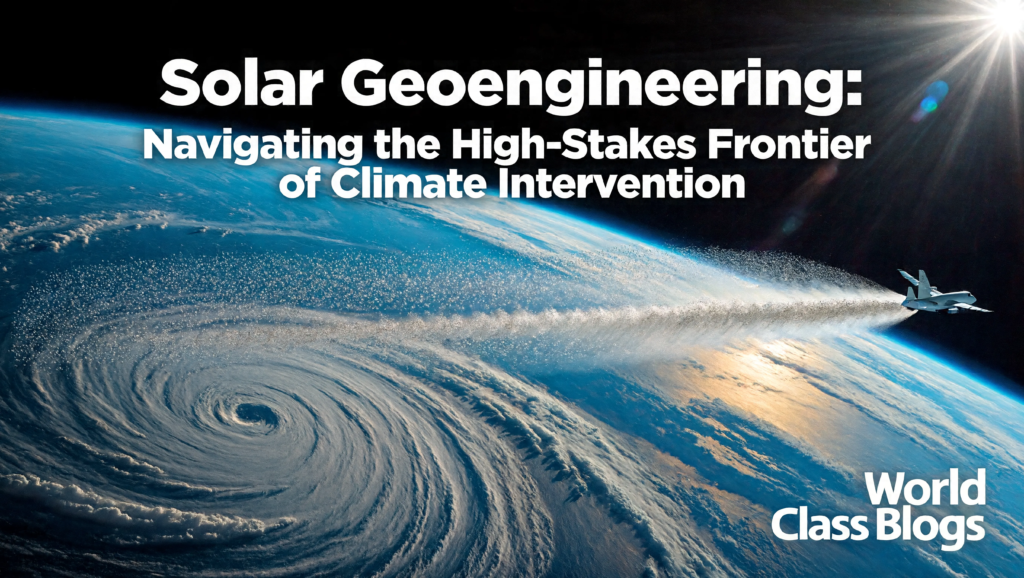
A visual comparison of the primary proposed solar geoengineering methods, their delivery mechanisms, and their scale of impact.
Introduction – Why This Matters: The Ultimate Technological Dilemma
Imagine a world where the escalating crisis of climate change triggers a desperate, global debate over a technological Hail Mary: deliberately spraying reflective particles into the upper atmosphere to dim the sun and cool the planet. This is not science fiction; it is the fiercely controversial realm of solar geoengineering (also called solar radiation modification, or SRM). As global temperatures shatter records year after year and the timeline for decarbonization stretches, this once-taboo topic is moving swiftly from the fringes of climate discourse into mainstream research agendas and policy discussions.
In my experience following climate technology and policy, nothing divides scientists, ethicists, and policymakers like solar geoengineering. What I’ve found, through conversations with researchers on both sides, is that it forces us to confront agonizing questions: Is it ethical to deploy a planetary-scale technology with potentially catastrophic side effects and profound governance challenges? Is it more ethical to withhold research on a tool that could theoretically reduce near-term human suffering from extreme heat? In 2025, a U.S. National Academies of Sciences report called for a “robust, interdisciplinary research program” while simultaneously urging a “strong international governance framework” before any consideration of deployment—a testament to the field’s dual nature as both a potential lifeline and a Pandora’s box.
This guide is a comprehensive, objective exploration of this ultimate technological dilemma. We will dissect the proposed methods, from stratospheric aerosols to marine cloud brightening. We will examine the profound known and unknown risks, the fractured global governance landscape, the latest 2026 research, and the deep ethical quandaries at its core. This is essential knowledge for any citizen, professional, or leader who may one day be asked to form an opinion on whether humanity should take direct, deliberate control of the Earth’s thermostat.
Background / Context: From Military Dreams to Climate Emergency
The core idea of reflecting sunlight to cool the Earth is old. In the 19th century, scientists pondering ice ages considered volcanic eruptions as natural analogues. The modern concept was first seriously proposed in the 1960s by Soviet climatologist Mikhail Budyko. However, early interest was often tied to military applications (e.g., weather modification).
The contemporary push for solar geoengineering research emerged in the mid-2000s, driven by two stark realities:
- The accelerating pace of climate impacts despite decades of climate talks.
- The observed cooling effect of large volcanic eruptions, like Mount Pinatubo in 1991, which injected sulfate aerosols into the stratosphere and temporarily reduced global temperatures by about 0.5°C for over a year.
The IPCC’s Fifth Assessment Report (2014) was the first to formally assess geoengineering, concluding SRM could offset some warming but carried substantial risks and did not address ocean acidification. The 2015 Paris Agreement, with its aspirational 1.5°C target, inadvertently increased attention on SRM as a potential “stop-gap” measure.
A pivotal moment came in 2022, when a U.S.-based startup made an unauthorized, small-scale ocean albedo test off the coast of Mexico, sparking international outrage and a de facto moratorium under the UN Convention on Biological Diversity. This “go-it-alone” act galvanized the urgent need for governance. Today, major research programs exist at Harvard (SCoPEx), the UK (SPICE), and in China, while over 350 scholars signed an open letter in 2025 calling for an international non-use agreement.
Key Concepts Defined: The Lexicon of Climate Intervention
- Solar Geoengineering / Solar Radiation Modification (SRM): The deliberate, large-scale intervention in the Earth’s climate system to reflect a small fraction of sunlight back into space to offset warming from greenhouse gases. It treats the symptom (heat) not the cause (GHGs).
- Carbon Dioxide Removal (CDR): The other main branch of geoengineering. Involves removing CO₂ from the atmosphere (e.g., direct air capture, enhanced weathering). It addresses the cause. SRM and CDR are fundamentally different.
- Stratospheric Aerosol Injection (SAI): The most studied SRM method. Involves injecting reflective particles (e.g., sulfates, calcium carbonate) into the lower stratosphere (18-25 km altitude) to create a sun-dimming haze.
- Marine Cloud Brightening (MCB): Spraying fine sea salt particles into low-lying marine stratocumulus clouds to increase their reflectivity (albedo).
- Cirrus Cloud Thinning: A less-studied idea to thin high-altitude cirrus clouds, which trap heat, allowing more infrared radiation to escape.
- Albedo Modification: Increasing the reflectivity of Earth’s surface (e.g., painting roofs white, growing more reflective crops).
- Termination Shock: The catastrophic, rapid warming that would occur if a large-scale SRM deployment were suddenly stopped, causing temperatures to rebound to the level dictated by accumulated greenhouse gases in a matter of years.
- Moral Hazard: The risk that the prospect of SRM could reduce political and public commitment to the essential work of emissions reduction and carbon removal.
- Governance: The system of rules, norms, and institutions needed to guide research, assess risks, and potentially govern deployment decisions for a global technology.
How It Works: The Proposed Methods (Step-by-Step Breakdown)
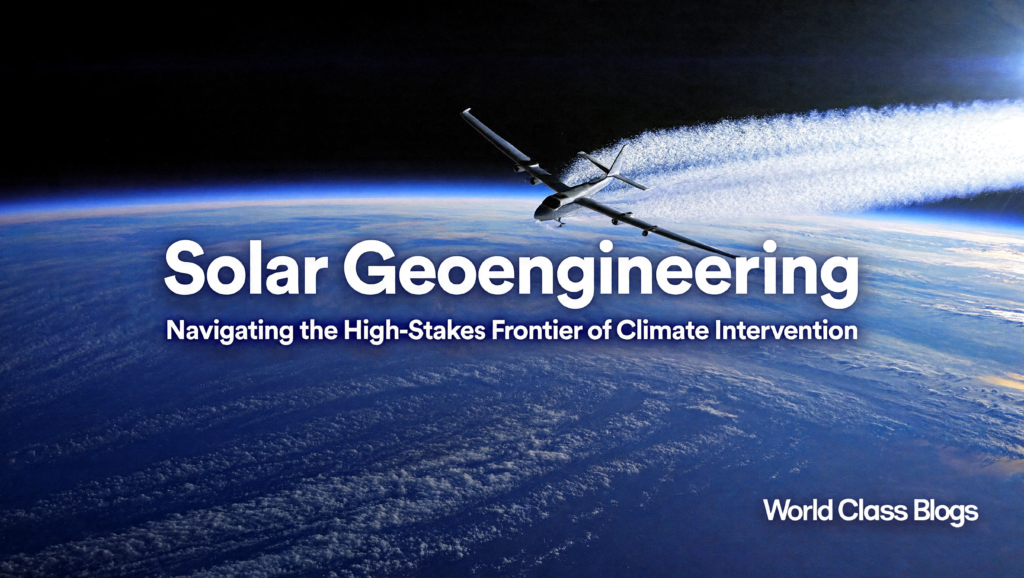
Method 1: Stratospheric Aerosol Injection (SAI) – The “Pinatubo” Model
This is the archetypal solar geoengineering proposal.
- Delivery: Aircraft, high-altitude balloons, or artillery would disperse millions of tons of reflective particles per year into the lower stratosphere, where there is little rain to wash them out.
- Particle Choice:
- Sulfates (e.g., SO₂): The natural analogue (volcanoes). Cheap and well-understood, but they contribute to ozone depletion and acid rain.
- Calcium Carbonate or Diamond Dust: Hypothetical alternatives that might reduce side effects, but are far less studied.
- Effect: The particles scatter incoming solar radiation, creating a diffuse haze. A 1% reduction in incoming sunlight could offset ~1.5°C of warming. The particles would need continuous replenishment (every 1-2 years) to maintain the effect.
Method 2: Marine Cloud Brightening (MCB)
- Delivery: Unmanned, wind-powered vessels (“albedo yachts”) spray a fine mist of seawater into the air below marine cloud decks.
- Mechanism: The salt particles act as cloud condensation nuclei. More nuclei lead to more, smaller water droplets in the cloud. A cloud with more numerous, smaller droplets is brighter and reflects more sunlight.
- Scope: Highly localized to specific cloud regimes (e.g., off the coasts of California, Peru, Angola). It could theoretically be used to protect sensitive ecosystems like coral reefs or polar ice.
Method 3: Cirrus Cloud Thinning & Surface Albedo Enhancement
- Cirrus Thinning: Seeding high, cold cirrus clouds with efficient ice-nucleating particles to encourage precipitation of ice crystals, thinning the heat-trapping cloud layer. This is highly speculative and may even warm the planet under certain conditions.
- Surface Albedo: Painting infrastructure white, developing paler crops, covering deserts with reflective film. These are small-scale, local interventions with minimal global impact but are often included in the broader SRM portfolio.
Table: Comparing Solar Geoengineering Methods
| Method | Mechanism | Potential Scale/Impact | Key Unknowns/Risks |
|---|---|---|---|
| Stratospheric Aerosol Injection (SAI) | Scatters sunlight globally from stratosphere. | Global, fast, potent. Could offset decades of warming in 1-2 years. | Ozone chemistry, precipitation shifts, ethical governance, termination shock. |
| Marine Cloud Brightening (MCB) | Increases reflectivity of specific low marine clouds. | Regional, moderate. Could cool specific ocean regions by ~1°C. | Impact on marine ecosystems, global weather pattern disruption, cloud lifetime. |
| Cirrus Cloud Thinning | Reduces heat-trapping by thinning high clouds. | Global, highly uncertain. Theoretical net cooling effect is debated. | Could cause warming; complex cloud microphysics. |
| Surface Albedo Enhancement | Increases land/ocean reflectivity. | Local, very small. Mitigates urban heat islands. | Minimal global effect, land-use trade-offs. |
Why It’s Important: The Stakes of the Debate
The importance of understanding solar geoengineering transcends its technical details. It is a lens through which we examine our relationship with the planet and our capacity for global stewardship.
- A Potential Emergency Tool: Proponents argue SRM could be a temporary, last-resort measure to avert or dampen climate tipping points (e.g., abrupt ice sheet collapse, Amazon dieback) while society completes the decades-long task of decarbonization. It is framed as a potential “painkiller” for the climate fever while the “antibiotic” of emissions cuts takes effect.
- Profound and Unequal Risks: The risks are global and potentially severe. Climate models suggest SAI could drastically alter precipitation patterns, potentially triggering droughts in the Sahel or disrupting the Asian Monsoon. It does nothing to stop ocean acidification. The impacts would be transboundary and unequal, raising deep issues of climate justice.
- Governance Challenge of the Century: SRM is inherently a global commons issue. Who decides to deploy? Who controls the “thermostat”? How are damages compensated? It presents governance challenges far beyond anything the international community has faced, touching on sovereignty, security, and equity.
- The Moral Hazard Dilemma: This is perhaps the most cited objection. The mere existence of a potential technological fix could erode political will for the difficult but essential work of cutting emissions. It offers a seductive narrative that we can avoid difficult socioeconomic transitions.
- Forcing a Conversation on Limits: The debate forces us to ask: Have we passed the point where “natural” climate stabilization is sufficient? Are we prepared to become active, conscious managers of the Earth system? It is a philosophical and ethical milestone for humanity.
Sustainability in the Future: A Governed Tool or a Forbidden One?
The future of solar geoengineering hinges on one question: Will it be governed or banned? There is no stable middle ground of unregulated research.
- Pathway 1: A Rigorous, Transparent, International Research Program
This path, advocated by many mainstream scientific bodies, involves:- Small-scale, controlled outdoor experiments (like Harvard’s postponed SCoPEx balloon test) to reduce critical uncertainties.
- International oversight bodies for research approval, perhaps under a UN umbrella like UNEP.
- Development of governance frameworks in parallel with research, not after.
- Strict separation of research from deployment advocacy and commercial interests.
- Pathway 2: An International Non-Use Agreement
This path, advocated by a growing coalition of scholars and Global South leaders, calls for:- An immediate ban on deployment and on outdoor experiments that carry any risk of transboundary impact.
- A ban on patenting SRM technologies.
- A ban on public funding for development and lobbying.
- Support for modeling and governance research only, to understand the risks we are choosing to avoid.
- Pathway 3: Unilateral or “Mini-lateral” Deployment (The Worst-Case Scenario)
A single nation or a small coalition (e.g., a “coalition of the warming”), facing catastrophic impacts, decides to deploy. This could lead to international conflict, “climate wars,” and a complete breakdown of global climate cooperation. This risk makes Pathways 1 or 2 urgent.
The 2026 report by the UN Environment Programme (UNEP) concluded that while SRM is “not yet ready for deployment,” the world is “profoundly unprepared” to make decisions about it. They called for an inclusive, global conversation informed by the best available science.
Common Misconceptions
- Misconception: “Solar geoengineering fixes climate change.”
- Reality: It only masks one symptom (temperature). It does nothing for the root cause: ocean acidification, which would continue unabated, threatening the entire marine food web. It is a supplement, never a substitute, for emissions cuts.
- Misconception: “We can just turn it off if we don’t like it.”
- Reality: This ignores termination shock. If deployment is sustained for decades while GHGs accumulate, suddenly stopping would cause extremely rapid warming, far faster than ecosystems or agriculture could adapt, potentially causing more damage than never starting.
- Misconception: “It’s just like a volcanic eruption, which is natural.”
- Reality: A volcanic eruption is a short-term, one-off pulse. Large-scale SRM would be a sustained, managed forcing of the climate system for decades or centuries. The long-term effects on atmospheric chemistry, circulation, and ecosystems are unknown and could be radically different.
- Misconception: “The technology is simple and cheap.”
- A: The direct costs of deploying SAI are surprisingly low—perhaps $10-20 billion per year to offset significant warming. This has led to talk of it being “cheap enough for a single billionaire.” However, the social, political, and potential damage costs are incalculably high. The low direct cost is what makes governance so critical.
Recent Developments (2024-2026): The Debate Intensifies
- The “Make Sunsets” Controversy: In late 2024, the startup Make Sunsets launched weather balloons from a third country after being banned in Mexico, attempting to release sulfur particles. This repeated provocation led to a UN Security Council briefing on the security threats of unilateral action in early 2025.
- EU Legislation: The European Union, in its 2025 Climate Law Amendment, included a clause prohibiting the funding, research, or deployment of solar geoengineering within EU territory or by EU entities abroad, taking a strong precautionary stance.
- China’s Research Program Expands: Peer-reviewed publications from Chinese research institutes in 2025-2026 show a significant increase in sophisticated climate modeling of SAI scenarios, focusing on impacts on East Asian monsoon patterns and agriculture. This signals serious national-level interest.
- The Global South Speaks Out: At COP29 (Baku, 2024), the Alliance of Small Island States (AOSIS) and the African Group issued a joint statement demanding a moratorium on real-world experiments and a seat at the table for all governance discussions, emphasizing their vulnerability to both climate change and SRM’s side effects.
- Insurance Industry Assessment: A major 2026 report from Lloyd’s of London modeled the liability and insurance implications of SRM deployment. It concluded that the “unknown risk” category is uninsurable under current frameworks and that deployment would create unprecedented liability challenges.
Success Stories: Governance and Research Frameworks as Models

Case Study 1: The Carnegie Climate Governance Initiative (C2G)
While not advocating for or against SRM, C2G has been instrumental in “building the conversation.” They convene diplomats, scientists, ethicists, and civil society from around the world in neutral settings to discuss governance. Their success lies in raising awareness among policymakers who may one day have to make decisions, ensuring the debate is informed and inclusive. In my experience observing their workshops, the most valuable outcome is demystifying the technology and focusing the discussion on the core governance dilemmas.
Case Study 2: The Harvard SCoPEx Experiment’s Governance Process
The Stratospheric Controlled Perturbation Experiment (SCoPEx), though postponed, established a groundbreaking precedent for research governance. It created an independent External Advisory Committee to review the experiment’s merits and risks. Most innovatively, they proposed a “stage-gated” process, where the experiment could not proceed from engineering test to particle release without a separate, thorough review. This model of transparent, multi-stakeholder oversight for research is now a benchmark for the field.
Case Study 3: The Oxford Principles
Developed in 2009 by a team at the University of Oxford, these five principles for geoengineering governance remain highly influential:
- Geoengineering to be regulated as a public good.
- Public participation in decision-making.
- Disclosure of research and open publication of results.
- Independent assessment of impacts.
- Governance before deployment.
These principles have been adopted by several professional societies and provide an ethical foundation for ongoing discussions.
Real-Life Examples: Analogues and Early Tests
- The Mount Pinatubo Eruption (1991): The best natural analogue for SAI. It injected 20 million tons of sulfur dioxide into the stratosphere, cooling the planet by ~0.5°C for over a year. It provided crucial data but also showed side effects: a predicted drop in global precipitation and contributed to the largest ozone hole ever recorded at the time.
- Ship Tracks: A visible, everyday example of marine cloud brightening. The exhaust from ships contains aerosol particles that seed brighter, longer-lasting clouds, visible as white “tracks” against the darker ocean in satellite imagery. This provides real-world evidence of the principle, albeit as an unintended side effect of pollution.
- The Great Geoengineering Divide: The differing national approaches are a live example of the governance challenge. The EU is moving toward a ban. The U.S. has a congressionally mandated research program focused on risk assessment. China is actively modeling impacts. Russia has a history of weather modification and its scientists have expressed interest. This patchwork is a recipe for future conflict.
- The 2023 “Cooling Crisis” Simulation: A war game run by the Center for Climate and Security simulated a scenario where India unilaterally deploys SRM to save its monsoon, triggering a drought in Pakistan and a diplomatic crisis. The simulation highlighted how quickly SRM could escalate into a geopolitical flashpoint.
Conclusion and Key Takeaways: At the Crossroads
Solar geoengineering places humanity at a profound crossroads. It is a technology born of desperation and technological hubris, offering a terrifying form of power over the planet. The decision of whether to research, develop, or even contemplate its use may be one of the most consequential of the 21st century.
Key Takeaways for Informed Citizens and Professionals:
- It’s About Risk Management, Not a Solution: Frame SRM not as a “fix” but as a high-risk, potential tool for managing even higher risks (climate catastrophes). The core comparison is “risks of SRM” vs. “risks of unmitigated climate change.”
- Governance is the Primary Challenge: The scientific and technical questions, while immense, may be simpler than the political, ethical, and legal questions of who decides, who controls, and who pays. This requires unprecedented global cooperation, as discussed in contexts like global business partnerships, but on a planetary scale.
- Moral Hazard is Real and Dangerous: The greatest near-term risk may be that talking about SRM undermines the absolute necessity of rapid decarbonization. Emissions reduction remains the non-negotiable priority.
- The Global South Must Lead the Debate: Countries most vulnerable to both climate change and SRM’s side effects must be at the center of governance discussions. Their consent is paramount.
- Transparency is Non-Negotiable: All research must be open, subject to international scrutiny, and free from commercial or singular national interests. Secrecy will breed distrust and conflict.
The solar geoengineering debate forces us to look in the mirror. It asks if we are wise enough, just enough, and united enough to wield a technology that could either cushion our fall from the climate cliff or push us over a new, more dangerous precipice. Our primary focus must remain on the hard work of cutting emissions and restoring ecosystems. But we can no longer afford to ignore the stark choices appearing on the horizon. For more on the intersection of technology, risk, and society, explore our coverage in Technology & Innovation.
FAQs (Frequently Asked Questions)
- Q: What’s the difference between solar geoengineering and carbon removal?
- A: They are fundamentally different. Solar Geoengineering (SRM) reflects sunlight to cool the planet quickly, but does nothing to reduce CO₂ levels. Carbon Dioxide Removal (CDR) takes CO₂ out of the atmosphere, addressing the root cause of climate change and ocean acidification, but it works slowly over decades. SRM is like taking a painkiller for a fever; CDR is like taking antibiotics for an infection.
- Q: Has any solar geoengineering been deployed yet?
- A: No responsible, large-scale deployment has occurred. There have been small, controversial, and unauthorized outdoor tests by private actors (e.g., Make Sunsets). All current work is confined to computer modeling and lab research, with proposed small-scale atmospheric experiments (like SCoPEx) still in the planning/permission stage.
- Q: Who is funding solar geoengineering research?
- A: Funding is a mix of private philanthropy (e.g., Bill Gates has funded Harvard research), government grants (from the U.S., UK, China), and academic institution funds. There is growing concern about the influence of private, unaccountable funding on the research agenda.
- Q: Could solar geoengineering be used as a weapon?
- A: Potentially, yes. This is a major international security concern. A nation could theoretically use it to weaponize weather, causing drought in an enemy’s agricultural region by altering precipitation patterns. The 1978 UN Environmental Modification (ENMOD) Convention bans hostile use of environmental techniques, but its applicability to SRM is untested.
- Q: What are the main ethical arguments against it?
- A: 1) Intergenerational injustice: We impose unknown long-term risks on future generations. 2) Distributive injustice: The benefits and harms will be unevenly distributed, likely harming the poorest. 3) Moral corruption: It represents an arrogant attempt to dominate nature rather than live within its limits. 4) Consent: It is impossible to get informed consent from all global citizens.
- Q: What would the sky look like with SAI?
- A: Models and volcanic analogues suggest sunsets and sunrises would be more intense and prolonged (brighter reds and oranges). The blue sky might appear slightly more whitish or hazy. The overall effect on daytime brightness would be a subtle, diffuse dimming, not a dramatic darkening.
- Q: Would solar geoengineering affect solar power generation?
- A: Yes. By scattering incoming sunlight, it would reduce the direct solar radiation that photovoltaic (PV) panels rely on, decreasing their efficiency. This is an example of a direct trade-off that must be considered.
- Q: Is there any international law governing it right now?
- A: No specific treaty exists. It falls into a legal gray area. Relevant frameworks include the UN Convention on Biological Diversity (which has a non-binding moratorium), the ENMOD Convention, and the Law of the Sea. General principles of international law, like the “no-harm” rule, would apply but are untested.
- Q: What is “solar dimming” from pollution, and how is it different?
- A: “Global dimming” in the late 20th century was caused by tropospheric aerosols from industrial pollution (soot, sulfates). These particles are lower, get washed out by rain quickly, and cause severe health problems. SRM proposes using cleaner particles at a higher altitude for a deliberate, controlled effect. Ending fossil fuel pollution would remove the unintended dimming, causing a rapid warming “unmasking.”
- Q: Could we use it to save specific ecosystems, like the Great Barrier Reef?
- A: Marine Cloud Brightening (MCB) is being researched specifically for this “targeted” use. The idea is to brighten clouds over the reef during marine heatwaves to reduce ocean temperatures and prevent coral bleaching. This raises its own ethical questions about “playing favorites” with ecosystems.
- Q: What do climate models say about their effects on the weather?
- A: Models consistently show that while SAI can reduce global average temperature, it would cause significant regional disruptions in precipitation and monsoon patterns. The tropics might see reduced rainfall, while high latitudes might see changes in storm tracks. The exact patterns are uncertain but almost certainly not uniform.
- Q: Is research itself dangerous?
- A: This is a core debate. Opponents argue that normalization through research creates a slippery slope toward deployment, attracts commercial interest, and diverts funding from mitigation. Proponents argue that ignorance is more dangerous, and we must understand the risks in case a country decides to deploy unilaterally or we face a true climate emergency.
- Q: What is the stance of environmental NGOs?
- A: Major groups like Greenpeace, Friends of the Earth, and the ETC Group are strongly opposed to solar geoengineering, advocating for a complete ban on research and deployment. They view it as a dangerous distraction. Some conservation groups are cautiously open to research but remain deeply skeptical.
- Q: How would we even decide to deploy? What’s the trigger?
- A: There is no agreed-upon trigger. Possibilities include: a climate tipping point being crossed (e.g., West Antarctic ice sheet collapse), sustained global temperatures above a certain threshold (e.g., 2.5°C), or a “climate emergency” declaration by a substantial majority of the UN General Assembly. Defining this is a monumental governance task.
- Q: What role do developing countries play in the research?
- A: Historically, very little. Most modeling has been done in the Global North. There is now a strong push for “capacity building” to ensure scientists and policymakers in vulnerable countries can conduct their own assessments and participate meaningfully in governance. The DECIMALS Fund is one initiative supporting such research in the Global South.
- Q: Could it affect plant growth and agriculture?
- A: Yes, complexly. Cooling could benefit crops in heat-stressed regions. However, diffuse light (scattered by aerosols) can actually enhance photosynthesis for some plants by reaching lower leaves. The larger threat is from precipitation shifts, which could cause droughts in major breadbaskets. The net effect is highly region- and crop-specific.
- Q: What about space-based methods (sunshades)?
- A: Concepts like placing giant mirrors or sunshades at the Lagrange L1 point between Earth and the Sun are sometimes discussed. They are generally considered far-future, exorbitantly expensive, and technically fantastical compared to atmospheric methods, and thus not a near-term focus.
- Q: What is the “free-driver” problem?
- A: The opposite of a “free-rider” problem in emissions cuts. Because SRM is perceived as cheap and can be deployed by a single actor, there is a risk that a “coalition of the willing” or even a single nation could impose it on the world, the “free-driver.” This underscores the need for strong governance to prevent unilateral action.
- Q: Where can I find balanced, non-sensational information?
- A:
- The Solar Radiation Management Governance Initiative (SRMGI): A neutral platform for information and dialogue.
- The National Academies of Sciences, Engineering, and Medicine reports on climate intervention.
- The IPCC reports (Working Group I and III) include assessments of SRM.
- The Forum for Climate Engineering Assessment (FCEA) at American University.
- A:
- Q: As an individual, what should I do?
- A: Get informed. This is a democratic issue that will require societal consensus. Advocate for transparency in any research happening in your country. Most importantly, redouble efforts to support rapid emissions reductions, adaptation, and carbon removal—the safer, proven pathways that make the desperate choice of SRM less likely.
About Author
Sana Ullah Kakar is a science policy analyst specializing in emerging technology and environmental governance. They have worked with intergovernmental organizations and academic think tanks to assess the societal implications of frontier climate technologies. Their writing is driven by the belief that the most complex technological challenges are, at their core, challenges of ethics, equity, and collective decision-making. This article is part of World Class Blogs’ commitment to exploring the most pressing and complex issues at the intersection of science and society. Learn more about our mission on our About Us page.
Free Resources
- The Solar Radiation Management Governance Initiative (SRMGI): The leading source for accessible primers, workshop reports, and a library of scientific publications. (Website: srmgi.org)
- National Academies of Sciences Report (2025): “Reflecting Sunlight: Recommendations for Solar Geoengineering Research and Research Governance” – The definitive U.S. consensus study. (Free PDF available)
- UNEP Frontiers Report 2023: “Solar Radiation Modification: A Technical Primer and Policy Considerations.” (Website: unep.org/resources/frontiers)
- The Geoengineering Monitor: A civil society platform providing critical perspectives, news, and analysis (offers a counterpoint to mainstream research narratives). (Website: geoengineeringmonitor.org)
- IPCC AR6 WG I Report, Chapter 4: Contains a section on “Solar Radiation Modification” with key findings from the latest climate science assessment.
Discussion
Solar geoengineering forces us to confront the limits of our political systems and our relationship with nature. Do you believe the potential to reduce near-term suffering justifies the colossal risks and governance challenges? Should we pursue research to understand the risks, or does that normalize a technology we should forever forbid? Who should have the authority to make such a decision for the planet? Share your ethical reflections, concerns, and perspectives on this ultimate technological dilemma in the comments below. For insights into managing complex risk and innovation in other sectors, explore our partner’s guide on starting an online business in 2026, which deals with uncertainty in a very different, but equally challenging, context.