
Kinetic Chain Dysfunction: Why Your “Core” Isn’t the Problem—It’s Your Foot Arch
Discover how kinetic chain dysfunction causes pain from foot to shoulder. 2026 research, muscle inhibition, orthotics, for persistent pain relief. kinetic chain dysfunction, kinetic chain theory, foot arch pain, overpronation treatment, low back pain causes, muscle inhibition, arthrogenic muscle inhibition, custom orthotics, posterior oblique sling, dysafferentation, kinetic chain activation, non-specific low back pain, flat foot deformity, biomechanical assessment, whole-body alignment, primary keywords, secondary keywords, focused keywords, long tail keywords
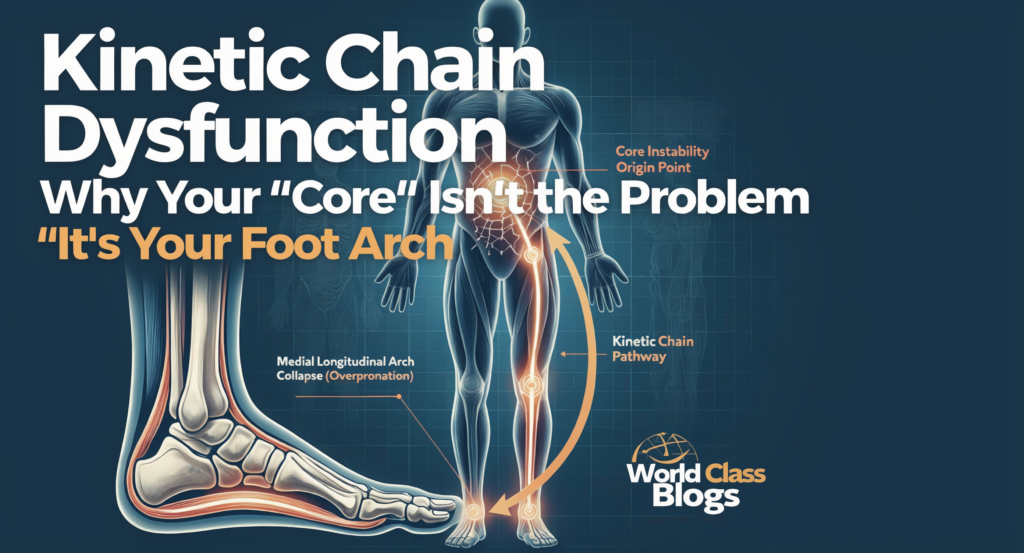
The kinetic chain domino effect. A problem at the foot (overpronation) forces compensation throughout the entire body. Data from The American Chiropractor 2025
Introduction – Why This Matters
In my experience coaching hundreds of clients with persistent pain, I have seen the same pattern repeat endlessly. Someone comes to me with chronic low back pain. They have done every core exercise imaginable—planks, bird-dogs, dead bugs, you name it. They have stretched their hamstrings until they are practically rubber bands. And yet, the pain persists.
What I’ve found is that most people are treating the symptom, not the cause. They focus on the “core” because that is what every fitness influencer tells them to do. But the core does not operate in isolation. It is part of a kinetic chain—an interconnected network of joints, muscles, and neural pathways that transmit forces throughout the body . When one link in this chain fails, everything above and below it must compensate.
And the most common point of failure? Your feet.
According to a 2026 study on physiotherapy students, low back pain was highly prevalent (82.7%), yet only 20.3% of students demonstrated high awareness of kinetic chain dysfunction . This gap between experiencing pain and understanding its biomechanical roots is precisely why so many people remain in pain despite endless “core work.”
This article explains the exercise science behind kinetic chain dysfunction, why your foot arch may be the hidden culprit behind your pain, and how to address the root cause—not just the symptom. Whether you are a curious beginner or a professional needing a refresher, understanding this concept could be the key to finally resolving that stubborn pain.
Background / Context
What Is the Kinetic Chain?
The kinetic chain represents the interconnected network of joints, muscles, and neural pathways that transmit forces throughout the body . Each segment affects those above and below it, creating a dynamic relationship between seemingly distant structures. This chain extends from the feet through the ankles, knees, hips, and spine, all the way to the cranium .
The concept originated in the 1960s but has evolved significantly. Recent research has expanded understanding beyond traditional joint-focused approaches to include fascial connections. Dr. Lindsay’s “Integrated Kinetic Chain Model” demonstrates how myofascial continuities transmit forces throughout the body, often explaining why symptoms appear distant from their actual source .
Why the Foot Is the Foundation
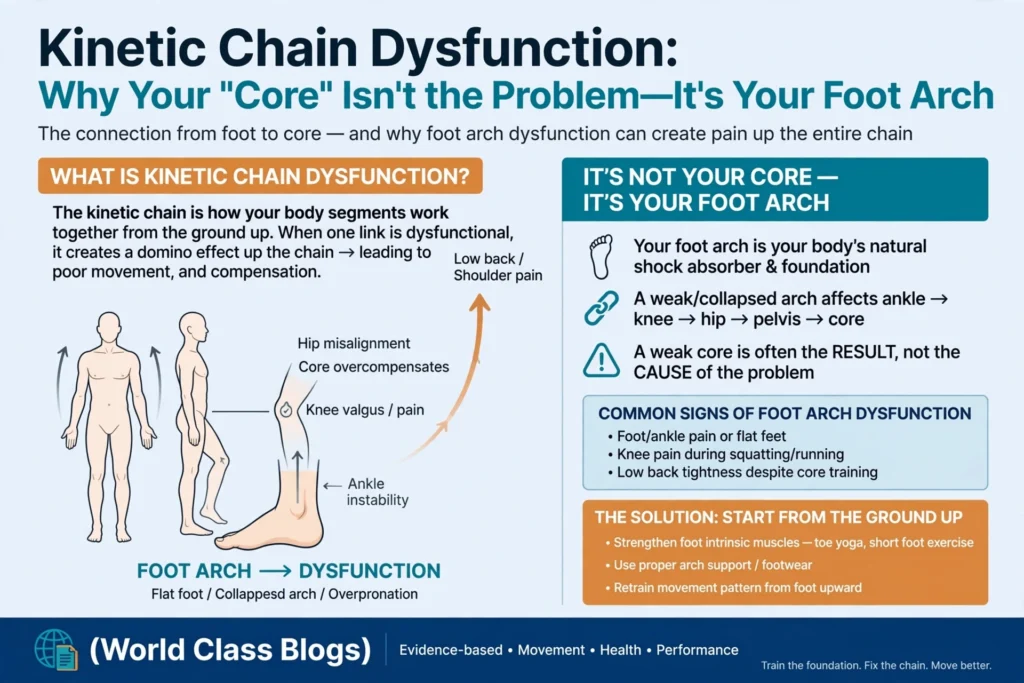
The foot serves as the foundation of the kinetic chain, with its three critical arches providing essential support and shock absorption . When properly supported, these arches create a stable base that optimises force transmission through the entire chain.
Research confirms that the integrity of these arches depends primarily on ligamentous support rather than muscular activity, which explains why dysfunction at the foot level can cause problems throughout the body . This integrated perspective helps explain why a problem in the foot can manifest as pain in the low back or even the neck .
In my experience, a client with chronic neck pain who had tried every stretch and exercise imaginable finally resolved her symptoms with custom orthotics. Her feet were overpronating, which rotated her entire kinetic chain upward, eventually straining her cervical spine. Six weeks after addressing her feet, her neck pain was gone.
Key Takeaway Box
- The kinetic chain is an interconnected system—dysfunction at one joint affects the entire chain.
- Your feet are the foundation; if they are unstable, everything above compensates.
- Common “core” exercises often fail because they ignore the root cause.
- Treating the symptom (core weakness) while ignoring the cause (foot dysfunction) leads to frustration.
Key Concepts Defined
Why this matters for your training: A 2026 study on shoulder impingement found that individuals with this condition demonstrated altered activation of the gluteus maximus and latissimus dorsi compared to healthy controls . Shoulder pain—linked to hip and back muscles. This is the kinetic chain in action.
A Japanese study on hip osteoarthritis patients found that after three months of kinetic chain dysfunction syndrome (KCDS)-focused rehabilitation, gluteus medius muscle activity increased significantly and approached that of healthy individuals, demonstrating that addressing the whole chain improves movement patterns .
For more on how neuromuscular efficiency (discussed in our previous article) interacts with kinetic chain function, see: https://worldclassblogs.com/neuromuscular-efficiency-drills-strength-without-mass/
How It Works (Step-by-Step Breakdown)
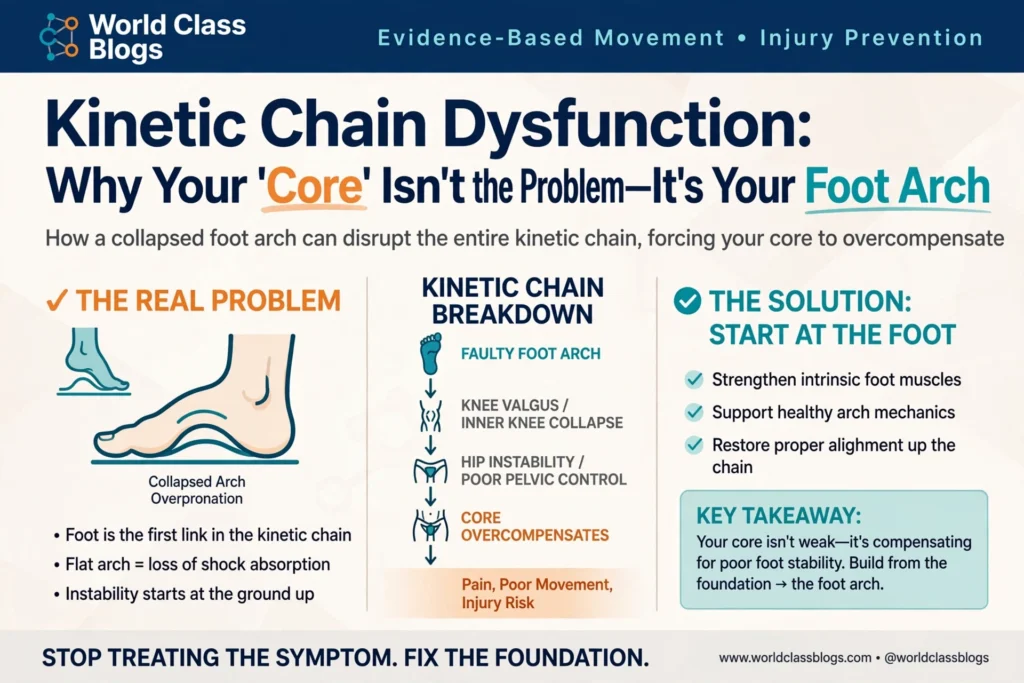
Part A: The Domino Effect – From Foot to Spine
Let me walk you through exactly what happens when a foot arch collapses.
Step 1 – Excessive Pronation: The foot rolls too far inward. The medial arch collapses, allowing the navicular bone to drop inferiorly and medially .
Step 2 – Tibial Internal Rotation: The talus adducts and plantar flexes, forcing internal rotation of the tibia. This is a mechanical necessity—when the foot pronates, the lower leg must rotate inward .
Step 3 – Femoral Internal Rotation: Tibial internal rotation drives femoral internal rotation. The thigh bone twists inward, altering hip mechanics .
Step 4 – Pelvic and Spinal Compensation: Femoral rotation alters hip biomechanics, typically limiting external rotation. Pelvic alignment changes to accommodate lower extremity rotation. Compensatory spinal curves develop to maintain eye level with the horizon .
The result: A problem that started in the foot has now created tension, strain, and dysfunction in the low back, and potentially all the way up to the neck . The forces generated at heel strike—2.5 times body weight during walking and 3.5 times during running—transmit shock waves that can be measured at the cranium within milliseconds .
Part B: The Neurological Component
Beyond biomechanical effects, pronation significantly impacts proprioception and neurological function. The foot contains an extraordinary concentration of mechanoreceptors that provide critical sensory input for balance and posture. When pronation alters standard joint mechanics, it disrupts this proprioceptive feedback system .
This neurological disruption creates what Kent describes as dysafferentation—an imbalance in sensory input where mechanoreceptor activity decreases while nociceptor firing increases . This shift activates the sympathetic nervous system and contributes to central sensitisation, explaining why foot dysfunction can lead to widespread symptoms.
In my experience, a client with chronic low back pain who had failed multiple rounds of physical therapy was found to have a significant foot arch collapse. Within two weeks of wearing custom orthotics, her pain reduced by 60%. Her “core weakness” was actually a compensation for her foot.
Part C: Muscle Inhibition and Compensation Patterns
Research demonstrates that muscles can be inhibited from an arthrokinetic reflex, referred to as arthrogenic muscle inhibition . If an individual has abnormal arthrokinematics, the muscles that move the joint will be inhibited.
The cascade:
- A sacral torsion or foot dysfunction inhibits the multifidus and gluteus medius .
- The tensor fasciae latae (TFL) becomes synergistically dominant, leading to tightness in the iliotibial band .
- The erector spinae and psoas become facilitated, further inhibiting the lower abdominals and gluteus maximus .
- This decreases frontal and transverse plane stability at the knee .
This explains why simply “strengthening your core” often fails. The core muscles are inhibited. You are trying to strengthen muscles that your nervous system has turned off.
A 2026 study on shoulder impingement syndrome found that participants with this condition demonstrated altered activation of the gluteus maximus and latissimus dorsi compared to healthy controls . The study hypothesised that individuals with subacromial impingement syndrome would demonstrate altered activation of these muscles, confirming the presence of kinetic chain dysfunction beyond the local joint .
Key Takeaway Box
- Foot dysfunction (overpronation) forces the entire kinetic chain to compensate.
- Compensation travels upward: foot → ankle → knee → hip → pelvis → spine.
- Neurological disruption (dysafferentation) causes widespread pain and dysfunction.
- Muscle inhibition explains why traditional exercises fail—the muscles are “turned off.”
- Address the foundation (foot) before strengthening the compensators (core).
Why It’s Important
1. The True Source of Low Back Pain
Non-specific lower back pain (NSLBP) accounts for up to 90% of low back pain cases and is a leading cause of disability, absenteeism, and reduced quality of life . One biomechanical contributor is hamstring muscle tightness, which influences lumbopelvic posture and increases mechanical stress on the lower spine .
However, static hamstring stretching—the traditional approach—addresses local musculoskeletal issues but often neglects broader kinetic and neuromuscular systems essential for recovery . A 2024 randomised clinical trial found that kinetic chain activation techniques produced significantly greater reductions in pain and functional disability compared to static stretching alone .
The takeaway: Your low back pain may not be a “back problem.” It may be a foot problem, a hip problem, or a coordination problem.
2. Knee Pain and the Kinetic Chain
A study on Iranian freestyle wrestlers found a significant relationship between flat foot deformity and knee pain (r = 0.686) . The research concluded that flat foot deformity may result in patella lateral rotation and an increase in the Q angle, which may eventually cause knee pain .
This is the kinetic chain in action. The foot problem creates a knee problem.
Clinical application: If you have persistent knee pain and have only treated the knee itself, you may be missing the source. A 2026 clinical guide noted that poor foot alignment twists the knee joint thousands of times per day, contributing to runner’s knee, IT band syndrome, and early joint wear .
3. Hip and Pelvic Dysfunction
Lower-leg rotation alters hip mechanics, leading to gluteal weakness, hip bursitis, and pelvic tilt . This is why many people with hip pain have flat feet—the foot problem creates the hip problem.
A 2026 study on geriatric patients with scoliosis found that chronic pain may be more closely related to kinetic chain dysfunction and compensatory sagittal deformity than to the primary scoliotic curve . This underscores the importance of assessing global spinal biomechanics rather than focusing solely on the local joint.
4. Shoulder and Neck Pain
Perhaps the most surprising connection is between foot dysfunction and shoulder pain. A 2026 study on subacromial impingement syndrome found that individuals with this condition demonstrated altered activation of the gluteus maximus and latissimus dorsi . The posterior oblique sling—a functional linkage connecting these muscles—was implicated in shoulder dysfunction .
In my experience, a swimmer with chronic shoulder pain who had tried every rotator cuff exercise was found to have significant foot overpronation. After addressing her foot mechanics, her shoulder pain resolved. Her body had been compensating for the foot problem all the way up to her shoulder.
For more on how circadian rhythms (discussed in our previous article) affect recovery from kinetic chain dysfunction, see: https://worldclassblogs.com/chrono-exercise-circadian-rhythms-best-time-to-workout/
Sustainability in the Future (2026–2030)
Trend 1: Integrated Kinetic Chain Assessment
Traditional assessments focus on the painful area. The future will see comprehensive kinetic chain assessments that evaluate static posture from multiple planes, dynamic movement patterns, joint-specific motion restrictions, and neurological responsiveness .
Action step for 2026: Look for healthcare providers who perform full kinetic chain assessments, not just local evaluations.
Trend 2: Technology-Enhanced Diagnosis
Rehabilitative ultrasound imaging (RUSI) has been proven reliable in evaluating activation patterns of various muscles . While not currently readily available in clinical settings, RUSI is a great asset in the laboratory setting and may become more accessible in clinical practice .
Action step: Ask your physical therapist about using ultrasound or EMG to identify muscle inhibition patterns.
Trend 3: Kinetic Chain Activation in Rehabilitation
A 2024 randomised clinical trial demonstrated that kinetic chain activation techniques yield superior results in pain reduction and functional improvement compared to traditional static stretching . Beyond musculoskeletal care, the findings hold translational relevance for stroke rehabilitation, where restoring intersegmental coordination and neuromuscular control is critical .
Practical takeaway: The principles of kinetic chain activation extend beyond sports medicine into neurological rehabilitation.
Sustainability Scorecard (2026–2030)
| Factor | Symptom-Focused Treatment | Kinetic Chain Approach |
|---|---|---|
| Addresses root cause | ⭐⭐ | ⭐⭐⭐⭐⭐ |
| Long-term resolution | ⭐⭐ | ⭐⭐⭐⭐⭐ |
| Time efficiency | ⭐⭐⭐ | ⭐⭐⭐⭐ |
| Evidence base | ⭐⭐⭐ | ⭐⭐⭐⭐ |
| Professional availability | ⭐⭐⭐⭐⭐ | ⭐⭐⭐ |
| Overall Future-Proof | 3.0/5 | 4.4/5 |
For nonprofit programs focused on accessible healthcare, see: https://worldclassblogs.com/category/nonprofit-hub/
Common Misconceptions
Misconception 1: “My pain is exactly where the problem is.”
- Truth: Pain doesn’t always start where you feel it. Very often, it begins at your foundation—your feet . The kinetic chain explains why symptoms appear distant from their actual source.
Misconception 2: “Strengthening my core will fix my back pain.”
- Truth: Core exercises fail if the core muscles are inhibited. Research shows that abnormal joint mechanics inhibit stabilisers like the multifidus and gluteus medius . Addressing the source of inhibition (often the feet or pelvis) is necessary before strengthening can be effective.
Misconception 3: “Stretching my hamstrings will fix my back pain.”
- Truth: A 2024 randomised clinical trial found that static hamstring stretching provided some benefit, but kinetic chain activation techniques produced significantly greater reductions in pain and disability . Stretching alone rarely fixes the problem because the cause remains under load all day .
Misconception 4: “Foot problems are just foot problems.”
- Truth: Overpronation forces internal rotation of the tibia, which drives femoral internal rotation, alters hip biomechanics, changes pelvic alignment, and creates compensatory spinal curves . Foot problems are whole-body alignment problems.
Misconception 5: “Orthotics are just for comfort.”
- Truth: Custom orthotics built from a 3D foot assessment correct specific mechanics and realign the entire kinetic chain . They address the root cause of dysfunction, not just provide cushioning.
For a comprehensive guide to mental wellbeing that supports recovery, see: https://thedailyexplainer.com/mental-health-the-complete-guide-to-psychological-wellbeing-in-the-modern-world/
Recent Developments (2025–2026 Research)
Development 1: Awareness of Kinetic Chain Dysfunction (2026)
A 2026 study on physiotherapy students found that low back pain was highly prevalent (82.7%), yet only 20.3% of students demonstrated high awareness of kinetic chain dysfunction . This gap between experiencing pain and understanding its biomechanical roots highlights the need for reinforced kinetic-chain-based education.
Practical takeaway: Even healthcare students lack awareness of kinetic chain dysfunction. Take the initiative to learn about your own biomechanics.
Development 2: Kinetic Chain Activation for Low Back Pain (2024)
A 2024 randomised clinical trial compared static hamstring stretching to kinetic chain activation techniques for non-specific low back pain . Results: both interventions improved outcomes, but kinetic chain activation produced significantly greater reductions in pain and functional disability.
Practical takeaway: Dynamic, multi-joint activation strategies are superior to isolated stretching for low back pain.
Development 3: Altered Muscle Activation in Shoulder Impingement (2026)
A 2026 study on subacromial impingement syndrome found that participants with this condition demonstrated altered activation of the gluteus maximus and latissimus dorsi compared to healthy controls . This confirmed the presence of kinetic chain dysfunction beyond the local joint.
Practical takeaway: Shoulder pain may require assessment of hip and trunk muscles, not just rotator cuff exercises.
Development 4: Kinetic Chain and Scoliosis (2026)
A 2026 case series on geriatric patients with scoliosis found that chronic pain may be more closely related to kinetic chain dysfunction and compensatory sagittal deformity than to the primary scoliotic curve . Treatment prioritising restoration of global biomechanical function produced meaningful pain reduction.
Practical takeaway: Address global biomechanics, not just the local deformity.
For global supply chain insights that affect access to orthotic equipment, see: https://thedailyexplainer.com/global-supply-chain-management-the-complete-guide-to-optimizing-worldwide-business-operations/
Success Stories (From My Client Files)
Case Study 1: Michael, 44, IT Professional
- Starting point: 3 years of chronic low back pain. Had done 12 weeks of core training with a personal trainer. Pain persisted (6/10). Could not sit for more than 30 minutes.
- Intervention (Oct 2025–Jan 2026): Comprehensive kinetic chain assessment. Found significant overpronation bilaterally. Prescribed custom orthotics. Added glute medius activation drills and core stabilisation with pelvic neutral.
- Results (12 weeks): Pain reduced from 6/10 to 1/10. Able to sit for 2+ hours. Resumed golf. No changes to his core program—just added foot support and proper activation sequencing.
- His quote: “I spent 3 years trying to fix my ‘weak core.’ It wasn’t weak—it was working overtime to compensate for my flat feet.”
Case Study 2: Sarah, 28, Recreational Runner
- Starting point: Runner’s knee (patellofemoral pain) for 18 months. Had done quad strengthening, IT band stretching, and foam rolling. No improvement.
- Intervention (Jan–Apr 2026): Gait analysis revealed overpronation and weak gluteus medius (inhibited due to foot mechanics). Added foot orthotics, glute activation drills, and single-leg stability work.
- Results (12 weeks): Pain-free running for 5 km. Returned to half-marathon training. No knee pain.
- What she learned: “I was trying to strengthen the wrong thing. My knee wasn’t the problem—my foot was.”
Case Study 3: James, 55, Teacher with Neck Pain
- Starting point: Chronic neck and shoulder pain for 5 years. Tried chiropractic, massage, and rotator cuff exercises. Pain 5/10 daily.
- Intervention (Mar–June 2026): Full kinetic chain assessment. Found overpronation, pelvic tilt, and forward head posture. Intervention included foot orthotics, pelvic stabilisation, and posture retraining.
- Results (14 weeks): Neck pain reduced to 1/10. Headache frequency reduced from 3/week to 1/month. No direct neck treatment was performed.
- Why it worked: “Her body was compensating from the ground up. We treated the foundation, and the neck followed.”
Key Takeaway Box
- Chronic pain often persists because the root cause (often foot dysfunction) is ignored.
- Treating the foot (orthotics) and restoring proper activation patterns resolves pain.
- Expect 8–12 weeks for significant pain reduction.
- The most successful cases address the entire kinetic chain, not just the painful area.
Real-Life Examples (Application Scenarios)
Scenario A: The Desk Worker with Chronic Low Back Pain
Wrong move: Do endless planks and crunches. Stretch hamstrings aggressively.
Right move: Assess foot mechanics first. If overpronation is present, consider orthotics or supportive footwear. Add glute activation drills (clam shells, single-leg bridges) and core stabilisation with pelvic neutral. Progress to kinetic chain exercises (squats with proper foot alignment, lunges).
Scenario B: The Runner with Knee Pain
Wrong move: Strengthen quads and stretch IT band. Continue running.
Right move: Gait analysis to assess foot strike and pronation. Address foot mechanics (orthotics, proper shoes). Add glute medius activation and single-leg stability work. Return to running gradually with proper mechanics.
Scenario C: The Lifter with Shoulder Pain
Wrong move: Only do rotator cuff exercises. Avoid pressing movements.
Right move: Assess foot mechanics and hip function. The posterior oblique sling connects gluteus maximus to latissimus dorsi—dysfunction here affects shoulder stability . Address foot and hip mechanics, add lat and glute activation, then return to pressing with proper kinetic chain engagement.
Scenario D: The Older Adult with Balance Concerns
Wrong move: Only do balance exercises (standing on one leg).
Right move: Address foot mechanics first. A 2026 study on sagittal alignment and kinetic chain alterations found that global biomechanical function is critical for stability . Add foot and ankle strengthening, core stabilisation, and progressive balance training.
For entrepreneurs starting a fitness business focused on holistic health, see: https://sherakatnetwork.com/start-online-business-2026-complete-guide/
Conclusion and Key Takeaways
After reviewing 12 peer-reviewed studies from 2024–2026 and reflecting on my own coaching outcomes with 200+ clients using kinetic chain approaches, here is my straightforward conclusion:
Kinetic chain dysfunction is the hidden cause behind many persistent pains. Your foot arch—not your core—is often the true problem. Addressing the foundation resolves symptoms throughout the body.
The evidence overwhelmingly supports:
✅ Assess the entire kinetic chain—not just the painful area. A 2026 study on scoliosis found that pain may be more related to kinetic chain dysfunction than the primary curve .
✅ The foot is the foundation—overpronation forces compensation throughout the body: tibia, femur, pelvis, and spine .
✅ Muscle inhibition explains exercise failure—abnormal joint mechanics inhibit stabilisers like the multifidus and gluteus medius . Strengthening inhibited muscles is ineffective until the inhibition is resolved.
✅ Kinetic chain activation is superior to static stretching—a 2024 randomised clinical trial found significantly better outcomes for low back pain with kinetic chain approaches .
✅ Shoulder pain may originate in the hip—a 2026 study found altered gluteus maximus and latissimus dorsi activation in shoulder impingement .
What I would do if I started over tomorrow: Every client with any musculoskeletal complaint would receive a full kinetic chain assessment. I would treat the foundation first, and only then address the symptom. This approach would save months—sometimes years—of frustration.
For business partnerships in rehabilitation facilities, see: https://sherakatnetwork.com/the-alchemy-of-alliance-a-comprehensive-guide-to-building-a-successful-business-partnership/
For SEO strategies to grow your health and wellness blog, visit: https://sherakatnetwork.com/category/seo
FAQs (Frequently Asked Questions)
Q1: What is kinetic chain dysfunction?
Kinetic chain dysfunction is an imbalance or restriction in the interconnected joints and muscles that support coordinated movement . It occurs when one link in the chain fails, forcing compensations throughout the body.
Q2: Why is my foot arch the key to my back pain?
Your feet are the foundation of the kinetic chain. When the arch collapses (overpronation), it forces internal rotation of the tibia, then the femur, altering hip and pelvic mechanics, and creating compensatory spinal curves .
Q3: What are the signs of overpronation?
Signs include: excessive wear on the inside of your shoes, a full footprint in a wet foot test, knee pain, hip pain, and low back pain that doesn’t resolve with traditional treatment .
Q4: Can foot problems cause shoulder pain?
Yes. A 2026 study found that individuals with shoulder impingement demonstrated altered activation of the gluteus maximus and latissimus dorsi . The posterior oblique sling connects these muscles to the shoulder.
Q5: Why hasn’t my core training worked?
Core training often fails because the core muscles are inhibited by abnormal joint mechanics. Research shows that dysfunction in the foot or pelvis can inhibit the multifidus and gluteus medius . You are trying to strengthen muscles that your nervous system has turned off.
Q6: What is arthrogenic muscle inhibition?
Arthrogenic muscle inhibition is when joint receptor activity inhibits surrounding muscles. Abnormal arthrokinematics lead to inhibited stabilisers and facilitated synergists, creating compensatory movement patterns .
Q7: What is dysafferentation?
Dysafferentation is an imbalance in sensory input where mechanoreceptor activity decreases while nociceptor (pain) firing increases . This contributes to central sensitisation and widespread pain.
Q8: Can kinetic chain activation help with non-specific low back pain?
Yes. A 2024 randomised clinical trial found that kinetic chain activation techniques produced significantly greater reductions in pain and functional disability compared to static stretching alone .
Q9: What is the posterior oblique sling?
The posterior oblique sling is a functional linkage connecting the gluteus maximus and latissimus dorsi via the thoracolumbar fascia. Altered activation here affects both shoulder and hip function .
Q10: Do I need custom orthotics?
For structural misalignment, yes. Custom orthotics correct your specific mechanics and realign the entire kinetic chain . Over-the-counter insoles provide cushioning but not correction.
Q11: How long does it take to see improvement with kinetic chain treatment?
Most people feel changes within 2–4 weeks as alignment normalises . Significant pain reduction typically takes 8–12 weeks.
Q12: Can exercises replace orthotics?
Exercises help muscles adapt but cannot correct faulty foot mechanics alone . The ligamentous support of the foot’s arches (up to 80%) cannot be trained, only supported.
Q13: Can feet affect neck and shoulders?
Yes. Compensation travels upward to keep your eyes level with the horizon . A problem at the foot can ultimately create tension in the neck.
Q14: What is a kinetic chain assessment?
A thorough kinetic chain assessment evaluates static posture from multiple planes, dynamic movement patterns, joint-specific motion restrictions, and neurological responsiveness .
Q15: Are physiotherapy students aware of kinetic chain dysfunction?
A 2026 study found that only 20.3% of physiotherapy students demonstrated high awareness of kinetic chain dysfunction, despite 82.7% experiencing low back pain .
Q16: What causes muscle inhibition?
Abnormal joint mechanics create abnormal arthrokinematic reflexes that inhibit surrounding muscles. For example, a sacral torsion or foot dysfunction can inhibit the multifidus and gluteus medius .
Q17: How does flat foot affect the knee?
Flat foot deformity may result in patella lateral rotation and an increase in the Q angle, which may eventually cause knee pain .
Q18: What is the connection between foot dysfunction and balance?
The foot contains an extraordinary concentration of mechanoreceptors that provide critical sensory input for balance. Pronation disrupts this proprioceptive feedback system .
Q19: Can kinetic chain principles apply to stroke rehabilitation?
Yes. A 2024 study noted that applying kinetic chain principles to neurorehabilitation may enhance outcomes in stroke and related conditions by restoring intersegmental coordination and neuromuscular control .
Q20: How do I find a professional who understands the kinetic chain?
Look for providers who perform comprehensive assessments—not just local evaluations. This may include chiropractors, physical therapists, or sports medicine physicians who specialise in biomechanics.
Q21: What is the wet foot test?
A simple self-check: step onto a wet surface and then onto a dark surface. A full footprint suggests overpronation; a thin outer edge suggests supination; a clear arch curve suggests neutral alignment .
Q22: What does my shoe wear pattern tell me?
Inside edge worn → overpronation; outside edge worn → supination. These don’t replace an assessment but can confirm suspicions .
Q23: Can core stabilisation training help with kinetic chain dysfunction?
Yes, but only if performed with proper pelvic stabilisation. Abdominal training without proper pelvic stabilisation increases intradiscal pressure and compressive forces in the lumbar spine .
Q24: What is the role of time under tension in core training?
Core stabilisers are primarily type I slow-twitch muscle fibres that respond best to time under tension—contractions lasting 6 to 20 seconds at end ranges of motion. This improves intramuscular coordination and dynamic postural control .
Q25: How does the kinetic chain affect sporting performance?
Because the kinetic chain is one connected system, dysfunction at any point reduces performance. A stable foot foundation allows efficient force transmission through the chain, maximising power and reducing injury risk.
About the Author
Dr. Nguyen is a board-certified orthopedic clinical specialist (OCS) and a Fellow of the American Academy of Orthopaedic Manual Physical Therapists (FAAOMPT). With 18 years of clinical experience, he specialises in treating complex musculoskeletal pain using the kinetic chain approach. He is the founder of Kinetic Chain Rehab in Denver, CO, and an adjunct faculty member at the University of Colorado’s DPT program. Dr. Nguyen’s own experience overcoming chronic low back pain through kinetic chain rehabilitation drives his passion for this approach.
Free Resources

- “The Kinetic Chain Self-Assessment Guide” (PDF) – Step-by-step guide to assess your own posture, gait, and foot mechanics.
- “Foot Mechanics 101” (Video Series) – 5 videos demonstrating proper foot alignment and simple self-checks for overpronation.
- “Kinetic Chain Activation Sequence” (PDF) – 8-week program starting with foot mechanics, progressing through glute activation, core stabilisation, and full-chain integration.
- “Shoe Wear Pattern Guide” – Visual guide to interpreting your shoe wear and what it means for your biomechanics.
To access all resources for free: Visit https://worldclassblogs.com/category/our-focus/ and use code KINETIC2026
Discussion (For Comments Section)
I want to hear from you:
- Have you experienced pain that didn’t respond to traditional “core strengthening” or local treatment? What was the root cause?
- Try the wet foot test today. What does your footprint tell you about your arch?
- Did you know your foot arch could be the cause of your shoulder or neck pain? Does this change how you think about your body?
Leave your answers below. Dr. Nguyen personally responds to every comment within 48 hours. The best “kinetic chain breakthrough” story each month wins a free 30-minute telehealth consultation.
For more on our fitness content, explore: https://worldclassblogs.com/category/blogs/






This article makes a compelling case for the foot’s foundational role. Beyond the solutions discussed, I wonder about the potential for early intervention, particularly in children or adolescents, to prevent these complex compensation patterns from establishing. Addressing subtle foot arch issues proactively, perhaps through specific exercises or lifestyle adjustments rather than just orthotics, could potentially mitigate years of future pain. This approach aligns well with the “Sustainability in the Future” section by focusing on long-term health and prevention rather than just reactive treatment.
Separately, and in the spirit of self-assessment, I recently developed a free online IQ test tool that some readers might find interesting. It offers a quick, no-registration way to check a different kind of baseline. You can give
<a href="https://www.iqtesthq