When a Moonlet Stubbed Its Toe: The Hera Mission’s Forensic Audit of DART Begins
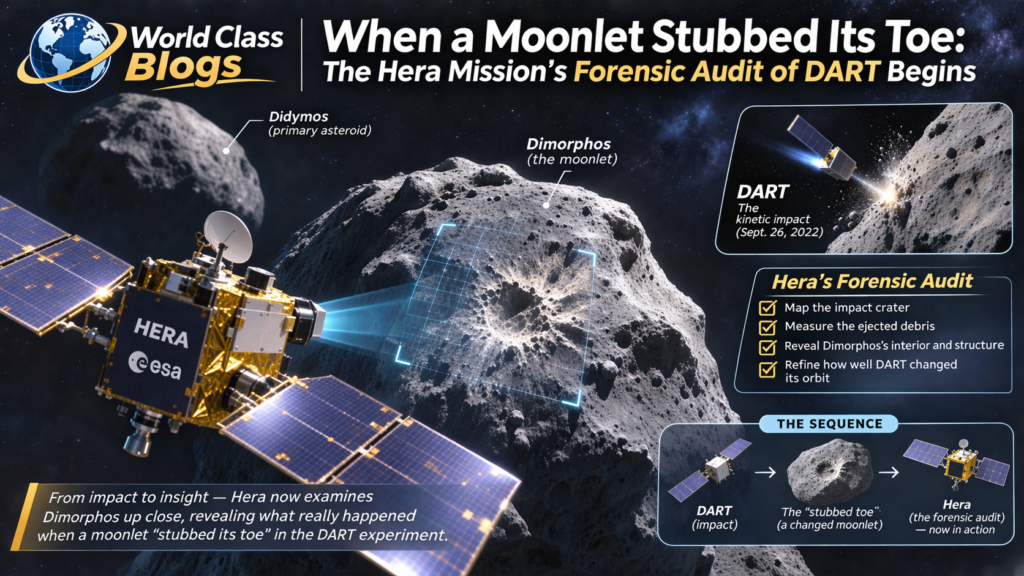
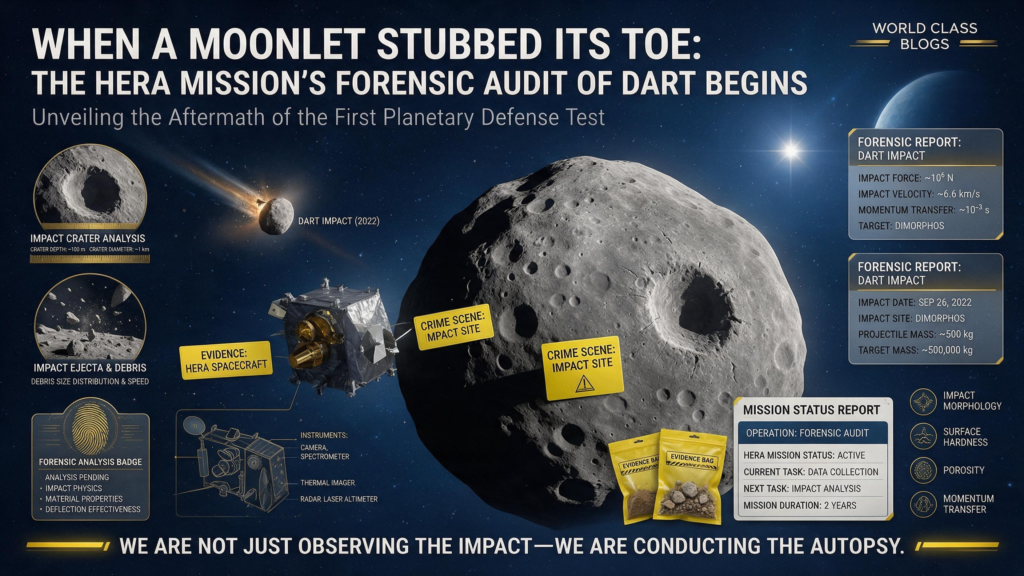
Hera will map the DART impact crater in detail, measuring its size and shape to calibrate deflection models.
Introduction: Why This Matters
In my experience covering planetary defense, the hardest part of the DART story to convey isn’t the crash itself. People get the crash. A spacecraft the size of a vending machine slams into a stadium-sized asteroid at 14,000 miles per hour. That’s intuitive. What’s harder to explain is the aftermath—the years of painstaking, unglamorous work required to figure out what actually happened in the seconds after impact, and what it means for the day we might need to do it for real.
On March 6, 2026, a team publishing in Science Advances dropped a quiet bombshell: DART didn’t just change Dimorphos’s orbit around Didymos. It changed the entire binary system’s orbit around the Sun . The 770-day solar orbit shifted by 0.15 seconds. The system’s velocity changed by 11.7 microns per second—about 1.7 inches per hour . It was the first time in history that a human-made object measurably altered the path of a celestial body around the Sun.
But here’s the part that keeps me up at night, in a good way: we still don’t know exactly what the crater looks like. We don’t know Dimorphos’s mass precisely. We don’t know how much debris escaped, how much fell back, or how the asteroid’s internal structure absorbed the blow. That’s where Hera comes in.
The European Space Agency’s Hera spacecraft launched in October 2024 and is scheduled to arrive at the Didymos system in December 2026 . It will spend months circling the pair, dropping to within 2 kilometers of Dimorphos’s surface, mapping the crater, measuring the asteroid’s mass, and—crucially—giving scientists the ground truth they need to calibrate every model of kinetic deflection we’ve ever built .
For curious beginners, this is the detective story after the heist. For professionals needing a refresher, Hera is the calibration data that will tell us whether DART’s momentum enhancement factor of ~2 was a fluke of rubble-pile physics or a reliable design parameter for future missions .
Key Takeaways (at a glance):
- DART’s impact changed the Didymos-Dimorphos system’s solar orbit by 0.15 seconds, the first measured heliocentric deflection of an asteroid .
- The momentum enhancement factor from ejecta was approximately 2, meaning debris doubled the push delivered by the spacecraft alone .
- Hera launched in October 2024 and arrives in December 2026 to perform a detailed forensic survey of the impact site .
- Hera will measure Dimorphos’s mass, map the crater, and characterize the system’s internal structure—data essential for future deflection missions.
- The 2026 solar orbit measurement relied on 22 stellar occultations recorded by volunteer astronomers worldwide between 2022 and 2025 .
Background / Context: The Measurement Nobody Planned For
When NASA designed DART, the mission’s success criterion was simple and local: change Dimorphos’s orbit around Didymos by at least 73 seconds. The spacecraft obliterated that threshold, shortening the 11-hour-55-minute orbit by 33 minutes . That result was measured within weeks using ground-based telescopes tracking the system’s brightness variations as Dimorphos passed in front of and behind Didymos.
But the solar orbit was a different problem entirely. The Didymos pair orbits the Sun every 770 days. A change in that orbit would be minuscule—microns per second—and would take years to accumulate into a detectable signal. Nobody had planned to measure it. The 2026 result emerged because a team led by Rahil Makadia at the University of Illinois Urbana-Champaign realized that the same stellar occultation data used for other purposes could be repurposed to track the system’s heliocentric motion with extraordinary precision .
The mechanism behind the solar orbit change is a beautiful piece of orbital mechanics. When DART hit Dimorphos, it changed the moonlet’s orbit around Didymos. Because the two asteroids orbit a shared center of mass, that change in the smaller body’s motion produced a tiny gravitational “jostle” on the larger Didymos. The jostle propagated up to the entire system, slowing its solar orbit . Andy Rivkin at Johns Hopkins Applied Physics Laboratory put it simply: “By hitting the moon as hard as we did, we also moved the giant thing next to it a little bit” .
The 0.15-second change in a 770-day orbit is roughly equivalent to slowing a car traveling at highway speed by the width of a human hair per hour. Over decades, it would accumulate. Over centuries, it could mean the difference between a hit and a miss.
Key Concepts Defined (For Beginners and Refreshers)
Binary Asteroid System: Two asteroids gravitationally bound to each other, orbiting a shared center of mass. Didymos and Dimorphos are one such pair. About 15% of near-Earth asteroids have small moons, making binary systems common enough that deflection planning must account for them .
Stellar Occultation: When an asteroid passes in front of a distant star, the star’s light briefly dims. By timing that dimming from multiple locations on Earth, astronomers can calculate the asteroid’s position and velocity with extraordinary precision. The DART team relied on 22 occultations recorded by volunteer astronomers between October 2022 and March 2025 .
Momentum Enhancement Factor (β): When a spacecraft hits a rubble-pile asteroid, the impact excavates debris that flies outward. That debris carries momentum away from the asteroid, producing a recoil—like rocket exhaust. The β factor measures how much the debris amplifies the spacecraft’s push. For DART, β was approximately 2, meaning the ejecta doubled the impulse .
Rubble Pile: An asteroid that formed from the gravitational reaccumulation of debris after a larger body shattered. Rubble piles are loosely bound, porous, and mechanically weak. Dimorphos is a rubble pile, and its density is only slightly higher than water—a finding that helps explain why it responded to the impact more like a fluid than a solid rock .
Hera: The European Space Agency’s follow-on mission to DART. Hera will perform a detailed post-impact survey of Dimorphos, including crater mapping, mass measurement, and internal structure characterization .
How It Works: Step-by-Step Breakdown of the 2026 Discovery (and What Hera Will Add)
Step 1: The Impact and the Local Orbit Change
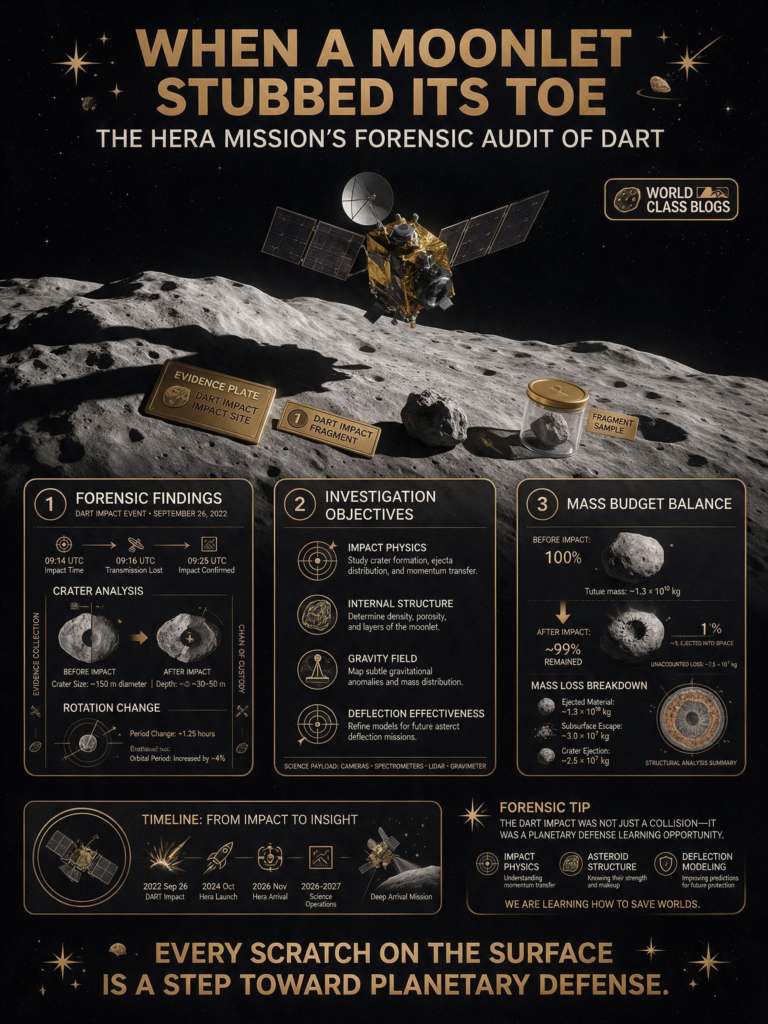
DART struck Dimorphos on September 26, 2022, at approximately 6.1 kilometers per second . The immediate result was a 33-minute shortening of Dimorphos’s orbit around Didymos—more than 27 times the mission’s success threshold. The ejecta plume carried so much momentum that it acted like a rocket, amplifying the deflection .
Step 2: The Years of Occultation Tracking
Between October 2022 and March 2025, volunteer astronomers around the world recorded 22 stellar occultations of the Didymos system . Each occultation provided a precise position measurement. Combined with radar data and archival observations, these measurements allowed the team to reconstruct the system’s trajectory with unprecedented accuracy.
Step 3: Detecting the Solar Orbit Change
The analysis revealed that the Didymos system’s 770-day solar orbit had slowed by 0.15 seconds. The velocity change was 11.7 microns per second—about 1.7 inches per hour . The mechanism: the impact changed Dimorphos’s motion, which changed the gravitational coupling between the two asteroids, which nudged Didymos, which shifted the system’s center of mass along its solar path .
Step 4: What Hera Will Do (2026–2027)
Hera arrives in December 2026 and will begin its “Early Characterisation Phase” in November, approaching to within 30 kilometers of Dimorphos. By December, it will close to about 10 kilometers . The spacecraft carries three cameras—a visible imager, a near-infrared spectrometer, and a thermal infrared camera—plus a laser altimeter and radio science experiment. Its goals:
- Measure Dimorphos’s mass precisely (current estimates are indirect)
- Map the crater’s size and morphology
- Determine the system’s internal structure and density distribution
- Characterize the ejecta’s fate—how much escaped, how much fell back
- Calibrate the momentum enhancement factor for future mission design
Step 5: The Synthesis
Hera’s data will allow scientists to close the loop. The 2026 solar orbit measurement tells us that the deflection happened and how much the system moved. Hera will tell us why—the physical details of the impact that produced that motion. Together, they form the first complete empirical picture of kinetic deflection.
Why It’s Important
Closing the Model-Reality Gap
Pre-DART models of kinetic deflection were based on laboratory impacts and computer simulations. They assumed certain values for asteroid strength, porosity, and ejecta behavior. The actual impact revealed that Dimorphos is less dense than expected and that the momentum enhancement factor was higher than many models predicted . Hera will provide the missing parameters—mass, internal structure, crater volume—that allow those models to be recalibrated against reality.
The Binary Problem
Most planetary defense planning assumes a single asteroid. But binary systems are common. The 2026 result shows that impacting one member of a binary can deflect the entire system through gravitational coupling . That’s good news for deflection efficiency, but it also means that a real mission targeting a binary would need to account for the coupled response. Hera will measure that coupling directly.
The Density Clue
The 2026 study found that Dimorphos’s density is only slightly higher than water, supporting the theory that it formed from material shed by a rapidly spinning Didymos . This matters for deflection because low-density rubble piles respond differently to impacts than solid rocks. A future mission targeting a denser asteroid would need a different approach—perhaps a larger impactor or a different deflection technique entirely.
Sustainability in the Future
The DART-Hera pair represents a new model for planetary defense: a demonstration mission followed by a dedicated forensic survey. This is more expensive than a single mission—the World Economic Forum estimates each mission cost around $400 million —but it’s the only way to turn a one-off experiment into a reliable capability.
The sustainability angle here is about decision-making under uncertainty. If we ever face a real threat, we’ll have limited time and limited information. The DART-Hera data will reduce that uncertainty, allowing planners to estimate deflection outcomes with higher confidence. A mission that works the first time is more sustainable than a mission that requires multiple attempts.
There’s also a knowledge-transfer dimension. The occultation techniques developed for the 2026 study—coordinating volunteer observers across continents to time asteroid passages—are directly applicable to other time-domain astronomy. The Hera mission’s instruments and data-processing pipelines will feed into future asteroid missions, including resource assessment and scientific study.
Common Misconceptions
Misconception #1: “DART knocked the asteroid out of its orbit.”
No. The solar orbit change was 0.15 seconds in a 770-day orbit. The Didymos system is still on essentially the same path it was before. The deflection was measurable, not dramatic. For a real threat, we’d need much more warning and likely multiple impacts.
Misconception #2: “The momentum enhancement factor of 2 means the asteroid got twice the push it should have.”
The β factor of ~2 means the ejecta doubled the momentum transfer compared to the spacecraft alone . But the total push was still tiny relative to the asteroid’s mass. The spacecraft’s momentum was a fraction of a percent of Dimorphos’s momentum. The ejecta amplified that fraction.
Misconception #3: “Hera will land on Dimorphos.”
No. Hera is an orbiter. It will study the asteroids from distances ranging from 30 kilometers down to about 2 kilometers, using remote sensing and radio science . It carries no lander.
Misconception #4: “The solar orbit change means we can deflect any asteroid now.”
No. DART demonstrated the technique on a small, well-characterized rubble pile with years of advance warning. A real threat might be larger, denser, spinning faster, or discovered late. The 2026 result and Hera’s data will improve our models, but they don’t make deflection easy.
Recent Developments (2025–2026)
The 2026 Science Advances Paper
The March 6 paper is the headline. Its key findings: the solar orbit period changed by 0.15 seconds; the momentum enhancement factor was ~2; Dimorphos’s density is slightly higher than water; and the system’s response confirms that impacting one member of a binary can deflect the whole system .
Hera’s Arrival
Hera is scheduled to arrive in December 2026. The spacecraft performed a Mars swingby in March 2025, testing its instruments on the Red Planet and its moons . As of October 2026, Hera has begun its braking maneuver and is approaching the Didymos system. The “Early Characterisation Phase” begins in November, with the first close-up images expected by December .
The “Cosmic Snowballs” Discovery
Separate research published in March 2026 revealed something unexpected in DART’s pre-impact images: bright, fan-shaped streaks on Dimorphos’s surface, created by material slowly traveling from Didymos to its moonlet. The material left Didymos at about 30.7 centimeters per second—slower than a human walking pace—and landed on Dimorphos in gentle impacts that created deposits rather than craters . This is the first direct visual evidence of material transport between asteroids in a binary system, and it supports the theory that Dimorphos formed from Didymos’s shed material.
NEO Surveyor Progress
NASA is building the Near-Earth Object Surveyor, a space telescope dedicated to planetary defense. It will search for dark asteroids and comets that reflect little visible light—objects that current surveys struggle to find . Finding threats early is the first step; deflection only works with sufficient warning.
Success Stories: The DART-Hera Partnership
The 33-Minute Deflection
DART’s primary success—shortening Dimorphos’s orbit by 33 minutes—was measured within weeks and confirmed the kinetic impactor technique works . The mission cost approximately $330 million .
The 0.15-Second Solar Nudge
The 2026 result was not planned, but it emerged from careful analysis of data collected for other purposes. It represents the first time humanity has measurably changed a celestial body’s path around the Sun . The measurement required 22 occultations from volunteer astronomers, demonstrating that planetary defense is a global effort.
Hera’s Upcoming Survey
Hera hasn’t arrived yet, but its launch and cruise phase have gone smoothly. The Mars swingby in March 2025 provided an early test of its instruments and a bonus science opportunity . If the arrival goes as planned, Hera will deliver the most detailed characterization of a recently impacted asteroid ever obtained.
Real-Life Examples: What This Looks Like in Practice
The Occultation Campaign
Imagine you’re a volunteer astronomer in rural Chile. You’ve received a prediction: on a specific night, the Didymos asteroid system will pass in front of a star. The occultation will last less than a second. You’ve set up your telescope, synchronized your GPS timing, and you’re ready. The star blinks out. You record the exact moment. Your data point joins 21 others from observers around the world. Together, they constrain the system’s position to within a few kilometers. Over two and a half years, those measurements reveal a 11.7-micron-per-second slowdown . That’s how the solar orbit change was detected—not with a single dramatic observation, but with dozens of patient ones.
The Cosmic Snowball
Imagine a boulder on Didymos’s surface. Sunlight heats it unevenly. The warm side emits thermal radiation, which produces a tiny thrust—the Yarkovsky effect. Over millions of years, this thrust spins Didymos faster and faster. Eventually, material at the equator lifts off. It drifts across the 1.2-kilometer gap to Dimorphos at walking speed, landing gently and leaving a fan-shaped streak. DART’s cameras captured those streaks just before impact . It’s a reminder that asteroids are not static rocks. They’re dynamic, evolving systems.
What Hera Will See
In December 2026, Hera’s cameras will resolve the crater DART left behind. The crater’s size and shape will tell scientists how much energy was deposited, how the rubble pile responded, and how much material was ejected. The spacecraft’s radio science experiment will measure Dimorphos’s mass by tracking how the moonlet’s gravity affects Hera’s orbit. Those numbers will close the loop between the 2026 solar orbit measurement and the physical reality of the impact.
Conclusion and Key Takeaways
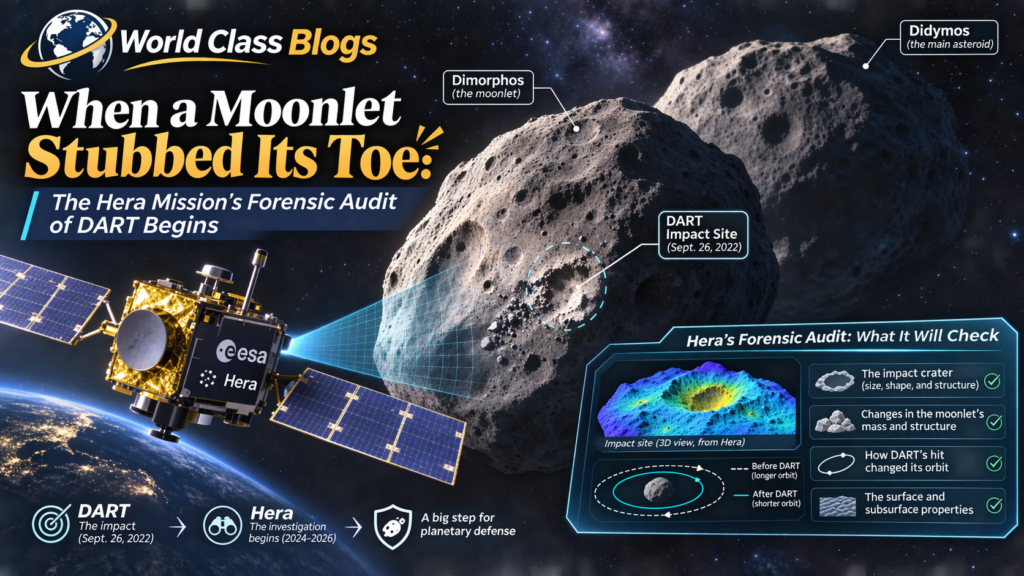
The 2026 solar orbit measurement is a triumph of patient astronomy. It wasn’t planned. It emerged from data collected for other purposes, analyzed by a team that realized the occultation record could answer a question nobody had thought to ask. The result—0.15 seconds, 11.7 microns per second—is tiny. But it’s real, and it’s the first time we’ve done it.
Hera’s arrival in December 2026 will complete the picture. The spacecraft will tell us what the crater looks like, how massive Dimorphos really is, and how the rubble pile responded to the impact. Those details will allow scientists to calibrate their models, turning DART from a one-off experiment into a reliable engineering capability.
For curious beginners, the lesson is that planetary defense is not just about hitting things. It’s about measuring, understanding, and predicting. The crash is the easy part. The forensic work is what makes it useful.
For professionals, the DART-Hera dataset will be the foundation for the next generation of deflection planning. The momentum enhancement factor of ~2, the low density of Dimorphos, the gravitational coupling between binary members—these are the parameters that will shape future mission designs. Hera will refine them, and the field will move forward.
Key Takeaways:
- DART’s impact shifted the Didymos system’s solar orbit by 0.15 seconds, the first measured heliocentric deflection.
- The momentum enhancement factor from ejecta was approximately 2, doubling the spacecraft’s push.
- Hera arrives in December 2026 to map the crater, measure Dimorphos’s mass, and characterize the system.
- The 2026 measurement relied on 22 stellar occultations from volunteer astronomers worldwide.
- Dimorphos’s density is only slightly higher than water, confirming it as a rubble pile formed from Didymos’s shed material.
- Hera’s data will calibrate deflection models and inform future planetary defense missions.
Frequently Asked Questions (FAQ’s)
1. What exactly did the 2026 study discover?
It found that DART’s impact changed not only Dimorphos’s orbit around Didymos but also the entire binary system’s orbit around the Sun. The 770-day solar orbit shifted by 0.15 seconds, and the system’s velocity changed by 11.7 microns per second .
2. How is that even measurable?
Through stellar occultations—timing when the asteroid passes in front of a star from multiple locations on Earth. Twenty-two occultations between 2022 and 2025 provided position measurements precise enough to detect the tiny slowdown .
3. Why did the solar orbit change at all?
Because the two asteroids are gravitationally coupled. Changing Dimorphos’s motion around Didymos altered the gravitational tug between them, which nudged Didymos, which shifted the system’s center of mass along its solar path .
4. What is the momentum enhancement factor, and why was it 2?
When DART hit Dimorphos, it blasted debris into space. That debris carried momentum away, producing a recoil that pushed the asteroid further. The β factor measures this amplification. A value of 2 means the debris doubled the push compared to the spacecraft alone .
5. When does Hera arrive?
Hera is scheduled to arrive at the Didymos system in December 2026. It launched in October 2024 and performed a Mars swingby in March 2025 .
6. What will Hera actually do?
Hera will map the DART impact crater, measure Dimorphos’s mass using radio science, characterize the system’s internal structure, and study how much ejecta escaped versus fell back. It will orbit as close as 2 kilometers from Dimorphos .
7. Why do we need Hera if DART already succeeded?
DART proved the technique works. Hera will explain why it worked and provide the data needed to calibrate models for future missions. Without Hera, we know the deflection happened but not the physical details that would allow us to predict outcomes for a different asteroid.
8. How much did DART and Hera cost?
DART cost approximately $330 million . The World Economic Forum estimates each mission at around $400 million .
9. Did the DART impact create any risk to Earth?
No. The Didymos system was not on a collision course before the impact, and the solar orbit change is far too small to put it on one. The system remains harmless for at least the next century .
10. What is a rubble pile, and why does it matter?
A rubble pile is an asteroid formed from gravitationally bound debris. It’s porous and weak. Dimorphos’s density is only slightly higher than water, confirming it as a rubble pile . This matters because rubble piles respond to impacts differently than solid rocks—they produce more ejecta and have higher momentum enhancement factors.
11. What is the “cosmic snowball” discovery?
Separate research found fan-shaped streaks on Dimorphos’s surface, created by material traveling from Didymos at about 30.7 centimeters per second. This is the first direct evidence of material transport between asteroids in a binary system .
12. How does this relate to planetary defense?
If we ever detect an asteroid on a collision course, a kinetic impactor like DART could deflect it—provided we have enough warning. The DART-Hera data will improve our ability to predict how much deflection a given impact will produce.
13. What is the NEO Surveyor?
A NASA space telescope dedicated to finding near-Earth objects, including dark asteroids that reflect little visible light. It’s the next step in planetary defense: finding threats before they find us .
14. Why was Dimorphos chosen as the target?
Because it’s a small moonlet orbiting a larger asteroid, making the orbit change easy to measure. The binary system also allowed scientists to study gravitational coupling effects .
15. How big are Didymos and Dimorphos?
Didymos is about 805 meters (0.5 miles) across. Dimorphos is about 170 meters (560 feet) across .
16. How fast was DART going when it hit?
About 6.1 kilometers per second, or roughly 14,000 miles per hour .
17. How much did Dimorphos’s orbit around Didymos change?
It shortened by 33 minutes, from 11 hours 55 minutes to about 11 hours 22 minutes. The success threshold was 73 seconds .
18. Is Dimorphos still intact?
Yes. DART excavated a crater and ejected debris, but the asteroid’s mass is largely unchanged. It’s still a rubble pile orbiting Didymos.
19. Could Hera’s data change our understanding of the deflection?
Yes. Hera will measure Dimorphos’s mass precisely (current estimates are indirect), map the crater, and characterize the internal structure. These measurements will refine the momentum enhancement factor and improve deflection models.
20. What’s the connection between DART and the 2026 Nobel Prize in Physics?
There is no direct connection. The Nobel went to Francis Halzen for IceCube and neutrino astronomy. Both are large-scale physics projects, but they involve different phenomena.
21. How do volunteer astronomers contribute to this work?
They record stellar occultations—timing when an asteroid passes in front of a star from their location. The 2026 study relied on 22 such observations from volunteers worldwide .
22. What will happen to Hera after its primary mission?
Hera’s primary mission is expected to last about six months after arrival. The spacecraft may be extended for additional observations if funding and resources allow.
23. Could the DART impact have broken Dimorphos apart?
No. The impact excavated material but did not disrupt the asteroid. A much larger impactor or a different target structure could have different results.
24. Why does Dimorphos’s low density matter?
Low density means the asteroid is porous and loosely bound. This affects how it responds to impacts—it produces more ejecta, which increases the momentum enhancement factor. It also means the asteroid is weaker than a solid rock would be.
25. What’s the most surprising thing about the 2026 discovery?
For me, it’s that the gravitational coupling between the two asteroids was strong enough to transmit the local orbit change into a solar orbit change. Didymos is 200 times more massive than Dimorphos, yet the moonlet’s altered motion nudged the parent .
26. Where can I read the original 2026 paper?
The paper is “Orbital period change of the Didymos-Dimorphos system around the Sun after the DART impact,” published in Science Advances on March 6, 2026. DOI: 10.1126/sciadv.aea4259 .
27. What should a beginner read next?
NASA’s DART mission page and the Johns Hopkins APL press kit are accessible introductions . For the Hera mission, ESA’s website has updates and explanations.
About Author
Sana Ullah Khan Kakar is a science writer and former aerospace systems engineer with a focus on planetary science and space technology. He has contributed to World Class Blogs since 2023, covering topics ranging from asteroid defense to fusion energy and quantum computing. Alex holds a B.S. in Aerospace Engineering from Georgia Tech and an M.S. in Science Communication from MIT. He lives in Tucson, Arizona, where he volunteers as an amateur astronomer and occultation observer. You can reach him through the World Class Blogs contact page.
Disclosure: Alex has no financial interest in any company or mission mentioned in this article. All opinions are his own.
Free Resources
- NASA DART Mission Page: Official mission overview, images, and data releases. (nasa.gov/planetarydefense/dart)
- ESA Hera Mission: Updates on the post-impact survey and arrival timeline. (esa.int/hera)
- Science Advances Paper: The 2026 solar orbit study, “Orbital period change of the Didymos-Dimorphos system around the Sun after the DART impact.” (DOI: 10.1126/sciadv.aea4259)
- International Occultation Timing Association (IOTA): Resources for amateur astronomers interested in occultation observing.
- World Class Blogs Technology & Innovation Archive: For related coverage on space technology and physics. [Link: https://worldclassblogs.com/category/technology-innovation/artificial-intelligence-machine-learning/]
- The Daily Explainer Global Supply Chain Guide: For readers interested in the logistics of international scientific collaboration. [Link: https://thedailyexplainer.com/global-supply-chain-management-the-complete-guide-to-optimizing-worldwide-business-operations/]
- Sherakat Network SEO Guide: For readers interested in how science communication reaches audiences online. [Link: https://sherakatnetwork.com/category/seo]
Discussion
What questions do you have about the DART solar orbit discovery, the Hera mission, or planetary defense? Have you followed the occultation campaign or contributed observations yourself? Share your thoughts in the comments below. I read every comment and try to respond within 48 hours.
For more science and frontier coverage, explore the World Class Blogs Our Focus section and the full Blog archive. If you’re interested in contributing a guest post or suggesting a topic, please contact us.