We Accidentally Moved an Asteroid Around the Sun: The DART Mission’s Unplanned Masterclass in Orbital Mechanics
NASA’s DART mission didn’t just move a moonlet—it shifted an entire asteroid system’s orbit around the Sun. Here’s the physics, the 2026 data, and why it matters for planetary defense. DART mission, planetary defense, asteroid deflection, Didymos Dimorphos, orbital mechanics, NASA DART, kinetic impactor, momentum enhancement, stellar occultation, space physics, 2026 science breakthrough, asteroid orbit change, Hera mission, near-Earth objects, science explained, how did DART change an asteroid’s orbit around the sun, Didymos system heliocentric deflection 2026, what is momentum enhancement in asteroid deflection, DART mission results explained for beginners, momentum enhancement, kinetic impactor, stellar occultation, heliocentric orbit, NASA planetary defense, DART mission, asteroid deflection, planetary defense, Didymos Dimorphos orbit, DART mission asteroid orbit change
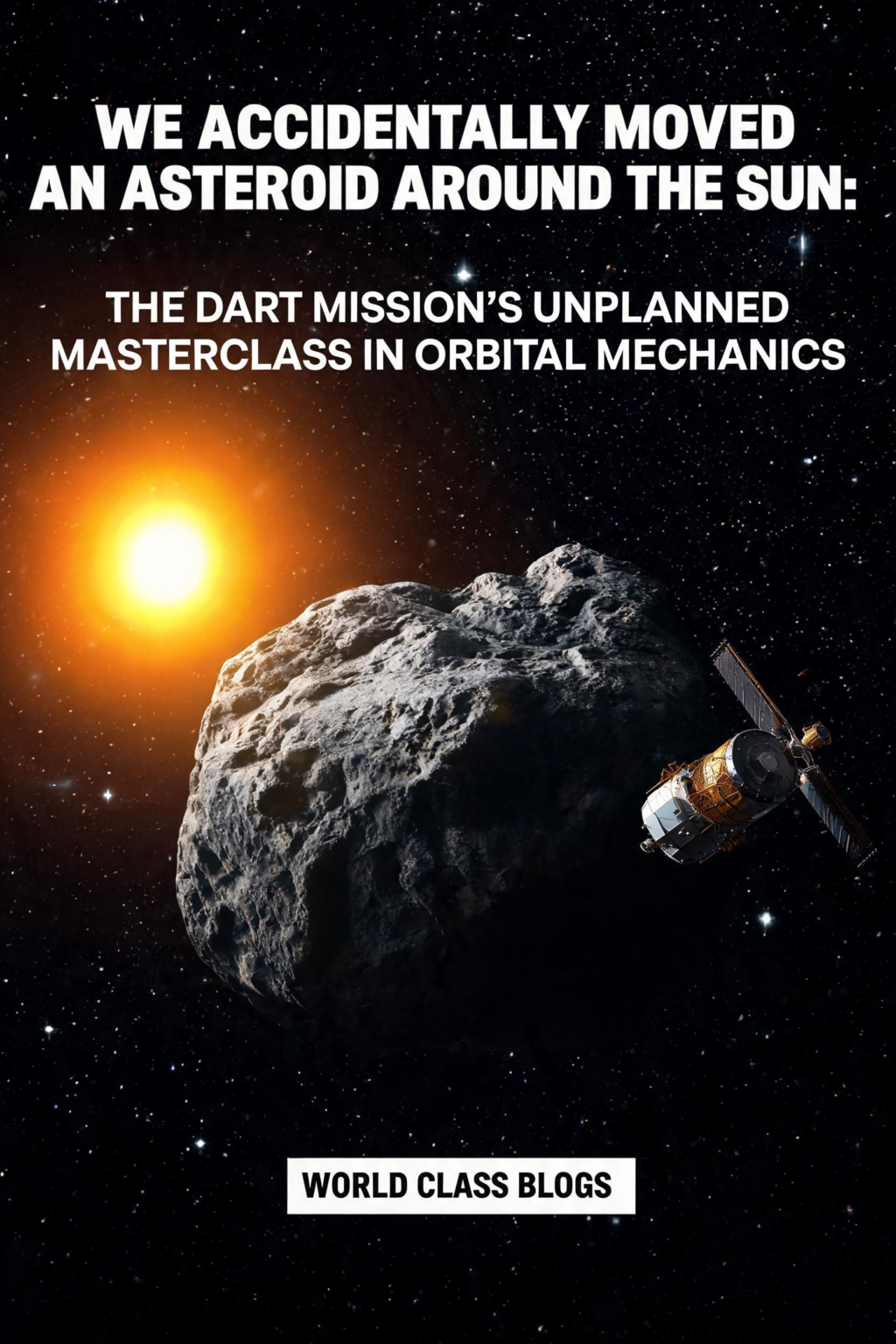
The DART impact liberated far more debris than predicted, amplifying the deflection through momentum enhancement.
Introduction: Why This Matters
In my experience explaining planetary defense to friends and family, the question I get most often is some version of: “But have we actually done anything, or is this all just movies?” For years, the honest answer was that we had mapped a lot of rocks and run a lot of simulations. Then, on September 26, 2022, NASA’s Double Asteroid Redirection Test (DART Mission) spacecraft slammed into a small asteroid called Dimorphos at roughly 14,000 miles per hour. The immediate result—a 33-minute shortening of Dimorphos’s orbit around its larger companion, Didymos—was already considered a triumph. The mission needed to change that orbit by 73 seconds to count as a success. It overshot by a factor of twenty-seven .
What I’ve found, in the years since, is that the real story was still unfolding in the data. In March 2026, a team publishing in Science Advances announced something nobody had planned for: DART didn’t just nudge a moonlet around its parent asteroid. The collision was forceful enough—and the debris spray energetic enough—that the entire Didymos-Dimorphos system slowed its orbit around the Sun by a measurable amount . It was the first time in human history that we changed the heliocentric orbit of a celestial body.
This matters for reasons that go beyond a cool headline. Planetary defense is no longer theoretical. We have demonstrated that a kinetic impactor can alter an asteroid’s trajectory, and we have accidentally demonstrated that the effects propagate further than simple models predicted. If you’re a curious beginner, this is your entry point into orbital mechanics, momentum conservation, and the surprisingly delicate gravitational dance between objects in space. If you’re a professional needing a refresher, the 2026 data offers a cleaner picture of momentum enhancement, ejecta dynamics, and the measurement techniques that make micron-per-second precision possible across millions of kilometers.
Key Takeaways (at a glance):
- DART hit Dimorphos in 2022, shortening its orbit around Didymos by 33 minutes—far exceeding the 73-second success threshold.
- In 2026, scientists confirmed the impact also shifted the entire asteroid pair’s orbit around the Sun, slowing it by roughly 11.7 microns per second (about 360 meters per year).
- The mechanism was not just the spacecraft’s momentum, but the rocket-like effect of debris blasted off Dimorphos—a phenomenon called momentum enhancement.
- This is the first empirical proof that kinetic impact can deflect a hazardous asteroid, even if the nudge is tiny compared to the orbital velocity.
Background / Context: Why Did We Hit an Asteroid in the First Place?
Asteroid impacts are one of the few natural disasters we can actually prevent, given enough warning. The 1908 Tunguska event flattened 2,000 square kilometers of Siberian forest. The 2013 Chelyabinsk meteor exploded in the atmosphere over Russia, shattering windows and injuring over 1,000 people . Neither was a “planet-killer,” but both illustrate that even modest objects can cause significant regional damage. The problem is detection: we’ve found most of the really large near-Earth objects, but a dangerous mid-sized rock could still catch us by surprise.
NASA’s Planetary Defense Coordination Office has been studying deflection concepts for decades. The challenge is that you can’t test planetary defense on a real threatening asteroid—there isn’t one currently on a collision course, and if there were, you wouldn’t want your first experiment to be the real thing. So DART was designed as a controlled dress rehearsal: hit a harmless asteroid in a binary system, measure how much its orbit changes, and use that data to validate computer models that could one day guide a real deflection mission.
The target, Dimorphos, is about 525 feet (160 meters) across. Its parent, Didymos, is roughly 2,550 feet (780 meters) across and about 200 times more massive . The pair orbits the Sun together, taking a little over two years to complete one revolution, while Dimorphos circles Didymos every 11.9 hours. That short mutual orbit was the key design choice: a change in Dimorphos’s orbit around Didymos would be detectable within weeks, whereas measuring a change in the pair’s solar orbit would require years of precision tracking.
What the DART team didn’t fully anticipate was how much debris the impact would liberate—and how much that debris would amplify the deflection.
Key Concepts Defined (For Beginners and Refreshers)
Before we go further, let’s define the handful of physics concepts that make this story make sense. If you’re a professional, skim this section and jump to “How It Works.”
Momentum: In physics, momentum is mass times velocity (p = mv). When DART (mass ~570 kg) hit Dimorphos at 14,000 mph, it transferred momentum to the asteroid. If Dimorphos were a solid rock and DART stuck to it, the asteroid’s velocity change would be tiny—on the order of millimeters per second. But Dimorphos is not a solid rock. It’s a “rubble pile”: a loosely bound collection of boulders, pebbles, and dust held together by weak gravity .
Momentum Enhancement: When DART hit a rubble pile, it didn’t just transfer its own momentum. It blasted a plume of debris off the asteroid’s surface. That debris flew outward in the opposite direction of the impact, acting like rocket exhaust. The recoil from that ejecta pushed Dimorphos further than the spacecraft’s direct momentum could explain. This “beta factor” (the ratio of actual momentum change to the spacecraft’s momentum) was estimated at roughly 3.6 based on the orbital change—meaning the debris multiplied the push by nearly four . The 2026 heliocentric measurement confirms that the ejecta’s effects propagated all the way up to the system’s solar orbit.
Heliocentric Orbit: “Heliocentric” simply means “centered on the Sun.” The Didymos-Dimorphos pair orbits the Sun roughly every 2.1 years. Changing that orbit by a tiny amount—11.7 microns per second, or about 0.000026 miles per hour—sounds negligible, but over years it accumulates into hundreds of meters of positional shift .
Stellar Occultation: This is the measurement technique that made the 2026 discovery possible. When an asteroid passes in front of a distant star, the star’s light briefly dims. By timing that dimming from multiple telescopes on Earth, astronomers can calculate the asteroid’s position with extraordinary precision—often to within a few kilometers across hundreds of millions of kilometers of space. The DART team combined occultation data with radar measurements to track the Didymos system’s motion over nearly two and a half years .
Binary Asteroid Gravitational Coupling: Didymos and Dimorphos aren’t independent. They orbit a shared center of mass. When you change Dimorphos’s motion, you also change the gravitational relationship between the two bodies. The 2026 study showed that the recoil from Dimorphos’s altered orbit gave Didymos a tiny gravitational “jostle,” which in turn shifted the entire system’s solar trajectory . It’s a beautiful illustration of how orbital mechanics couples objects across scales.
Comparison Table: DART’s Measured Effects (Before vs. After)
| Parameter | Pre-Impact (Expected/Modeled) | Post-Impact (Measured) | Significance |
|---|---|---|---|
| Dimorphos orbit around Didymos | 11 hours 55 minutes | Shortened by 33 minutes | 27× the 73-second success threshold |
| System heliocentric velocity | Baseline solar orbit | Slowed by ~11.7 microns/sec (~360 m/year) | First-ever measured heliocentric deflection |
| Momentum enhancement (β) | Modeled ~1–2 (direct transfer) | Estimated ~3.6 | Ejecta recoil multiplied the push |
| Ejecta mass | Unknown rubble-pile response | Far more than predicted | Broke simple momentum models |
How It Works: Step-by-Step Breakdown
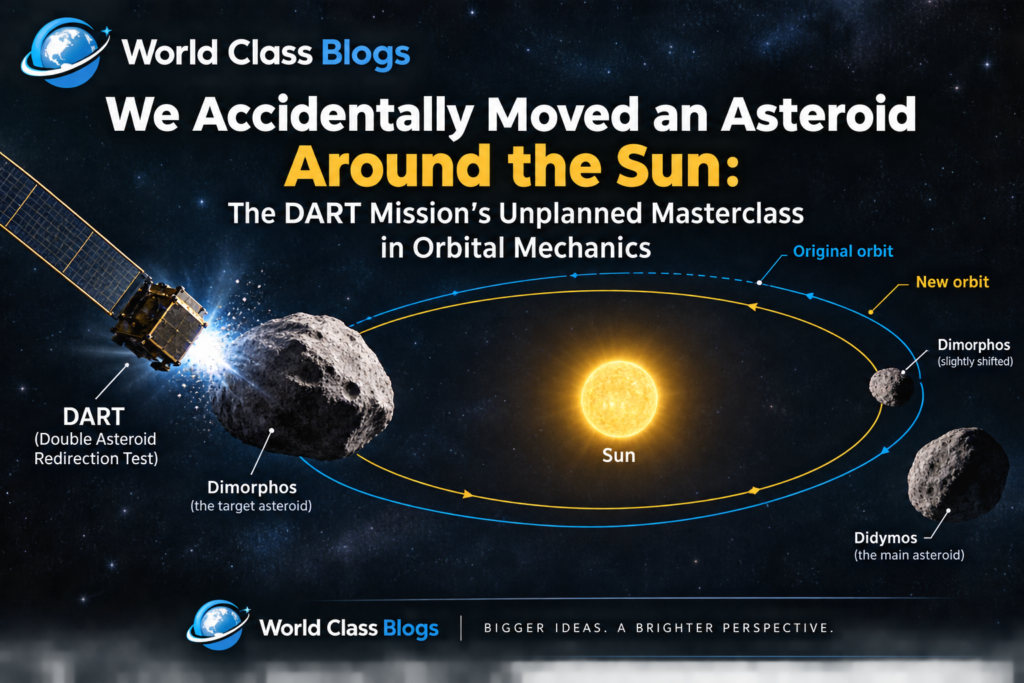
Let’s walk through the entire sequence—from launch to the 2026 measurement—so you can see exactly how a spacecraft the size of a vending machine changed the path of a mountain.
Step 1: Target Selection and Approach
DART launched in November 2021 and traveled for about 10 months to reach the Didymos system, which at the time was roughly 11 million kilometers from Earth . The spacecraft navigated autonomously in its final hours, using an onboard camera to identify Dimorphos and steer toward it. The target was chosen because the binary system offered a measurable short-period orbit (Dimorphos around Didymos) and because neither object posed any threat to Earth—before or after the experiment.
Step 2: The Impact (September 26, 2022)
DART struck Dimorphos at approximately 6.1 kilometers per second (about 14,000 mph). The kinetic energy was roughly equivalent to three tons of TNT. The spacecraft was destroyed instantly. But the energy didn’t just crater the surface. Because Dimorphos is a loosely consolidated rubble pile, the impact shattered and lofted an enormous volume of material—far more than pre-mission models had predicted for a solid body .
Step 3: The Ejecta “Rocket”
This is where the physics gets interesting. In a simple inelastic collision, DART’s momentum would have changed Dimorphos’s velocity by a fraction of a millimeter per second. But the impact excavated a crater and flung debris outward at high speed. Newton’s third law applies: the debris flying one way pushes the asteroid the other way. The DART team later estimated that the momentum enhancement factor (β) was about 3.6, meaning the ejecta contributed more than twice the momentum of the spacecraft itself . The “rocket equation” of the debris plume did most of the work.
Step 4: Measuring the Local Orbit Change (2022–2023)
Ground-based telescopes and radar quickly measured the change in Dimorphos’s orbit around Didymos. The 33-minute shortening was a dramatic confirmation that the kinetic impactor technique works, and that momentum enhancement from ejecta is real and significant. But this only told us about the mutual orbit—how Dimorphos moved relative to Didymos.
Step 5: The Long Wait for Heliocentric Data (2022–2025)
The change in the pair’s orbit around the Sun would be much smaller and much slower to accumulate. The team needed years of precision astrometry to detect it. They used stellar occultations (timed observations of the asteroid pair passing in front of stars) and radar ranging (bouncing signals off the asteroids from Earth-based antennas) to track the system’s position with exquisite accuracy. The dataset spanned October 2022 through March 2025 .
Step 6: The 2026 Discovery (Published March 2026)
The analysis, published in Science Advances, revealed that the Didymos system had slowed its heliocentric motion by approximately 11.7 microns per second . That’s roughly one-tenth the width of a human hair per second. Over a year, it adds up to about 360 meters of displacement. The mechanism: the impact changed Dimorphos’s orbit, which changed the gravitational tug between Dimorphos and Didymos, which nudged Didymos, which shifted the entire system’s center of mass along its solar path. The effect was tiny but unambiguous.
Step 7: What This Means for Planetary Defense
The key insight is not that we can move an asteroid by 360 meters per year with one impact. It’s that the momentum enhancement from ejecta is real and potentially much larger than simple models predict. A future deflection mission could exploit this by targeting a rubble-pile asteroid and letting the debris do extra work. But the 2026 result also complicates planning: the heliocentric change was an accidental consequence of the local orbit change, and it took years to measure. For a real threat, we’d need to predict these coupled effects accurately, not discover them after the fact.
Why It’s Important
The 2026 DART result matters on three levels.
Planetary Defense Validation
We now have empirical proof that a kinetic impactor can change an asteroid’s trajectory around the Sun. The deflection was tiny—360 meters per year is nothing compared to Earth’s 940-million-kilometer orbital path—but it was measurable, and it confirmed the fundamental principle. If we had decades of warning for a threatening asteroid, a series of impacts (or a larger impactor) could accumulate enough Δv to miss Earth. The DART experiment gives us real numbers to plug into those models, replacing assumptions with measurements .
Momentum Enhancement Is Real—and Complicated
The β factor of ~3.6 means the debris plume contributed substantially to the deflection. This is good news for deflection efficiency but bad news for predictability. The exact β depends on the asteroid’s internal structure, which we can’t measure remotely with current technology. A future mission would need reconnaissance before impact to avoid under- or over-shooting the deflection. The 2026 study reinforces that rubble-pile asteroids are not simple billiard balls .
Gravitational Coupling Across Scales
The fact that a 160-meter moonlet’s orbit change can nudge a 780-meter asteroid—and that this nudge can shift a multi-billion-ton system’s solar orbit—is a reminder that orbital mechanics is a coupled system. You can’t treat an asteroid as an isolated object if it has a moon. This has implications for how we model potential threats: many near-Earth asteroids are binaries or even triple systems, and deflection calculations must account for that coupling.
The Measurement Achievement
From a pure physics and engineering standpoint, detecting an 11.7-micron-per-second velocity change across hundreds of millions of kilometers is a triumph of astrometry. Stellar occultation campaigns coordinated across multiple observatories, combined with radar ranging from Goldstone and Arecibo (before its collapse), achieved a level of precision that would have been unthinkable a generation ago. This capability will be essential for any future deflection campaign, where we’ll need to verify that the asteroid actually moved where we intended .
Sustainability in the Future
Planetary defense is the ultimate long-term sustainability investment. A single undetected impactor could undo decades of civilizational progress in a region—or worse. But there’s a more immediate sustainability angle to the DART story that often gets overlooked.
Space Debris and Mission Design
DART was a deliberate impact, not an accidental collision, but the ejecta plume it created is a reminder that kinetic impacts generate debris. In the context of planetary defense, this is fine—the debris disperses into interplanetary space. But as more missions visit small bodies for mining, science, or resource extraction, the lessons from DART about rubble-pile behavior and ejecta dynamics will inform how we interact with asteroids without creating hazards for future operations.
The Cost of Waiting
The DART mission cost approximately $330 million. A dedicated reconnaissance-and-deflection mission for a real threat would cost more, but the comparison to disaster relief for even a modest impact (Chelyabinsk caused roughly $33 million in damage and injured over 1,000 people) makes the investment trivially justifiable. The 2026 result strengthens the economic case for continued investment in planetary defense infrastructure: we now know the technique works, but we also know it’s more complex than “aim and shoot.”
Knowledge Transfer to Other Fields
The occultation timing techniques and orbital tracking methods developed for DART feed directly into other areas: satellite collision avoidance, space domain awareness, and even the tracking of debris in low Earth orbit. The software and observational infrastructure built for asteroid defense has dual-use value for the sustainable management of near-Earth space.
Common Misconceptions
Misconception #1: “DART destroyed the asteroid.”
No. Dimorphos is still there, still orbiting Didymos, just on a slightly shorter orbit. The impact excavated a crater and lofted debris, but the asteroid’s mass is largely unchanged. Planetary defense is about deflection, not destruction. Blowing up an asteroid (as movies often suggest) is actually counterproductive: it could turn one impactor into a shotgun blast of smaller fragments, many of which would still hit Earth.
Misconception #2: “The 2026 result means we can deflect any asteroid now.”
No. DART was a small-scale test on a benign target. A real deflection mission would require years of warning, detailed reconnaissance of the target’s internal structure, and a much larger momentum change. The 2026 study tells us that our models need to account for gravitational coupling and ejecta dynamics; it doesn’t tell us that deflection is easy.
Misconception #3: “The asteroid’s orbit changed dramatically.”
The heliocentric change was 11.7 microns per second. That’s approximately 0.000026 miles per hour. At that rate, it would take roughly 2,700 years for the Didymos system to shift by one Earth diameter. The deflection was measurable, but it was not dramatic. For a real threat, we’d need much more warning and likely multiple impacts to achieve a useful Δv.
Misconception #4: “The ejecta made the deflection less efficient because it pushed in all directions.”
Actually, the ejecta increased the efficiency. The plume was directed mostly opposite the impact direction (like a jet), which is why β was greater than 1. If the ejecta had been perfectly isotropic, it would have canceled out and β would be 1 (just the spacecraft’s momentum). The asymmetric plume is what gave DART its extra push .
Recent Developments (2025–2026)
The 2026 Science Advances paper is the headline development, but it’s part of a broader wave of post-DART research. The European Space Agency’s Hera mission, which launched in 2024, is currently en route to the Didymos system to perform a detailed post-impact survey. Hera will measure Dimorphos’s mass, the crater size, and the system’s internal structure—data that will allow scientists to calibrate their β models and improve future deflection predictions. Hera is expected to arrive in late 2026 or early 2027.
Meanwhile, the 2026 Nobel Prize in Physics went to Francis Halzen for IceCube, a reminder that the same era of precision astrometry that enables neutrino astronomy also enables asteroid tracking . The tools are converging: better detectors, better software, better international coordination. The DART result is a proof of concept; Hera will be the calibration.
On the policy side, NASA’s Planetary Defense Coordination Office has been funded at roughly $150 million per year, and the 2022 decadal survey recommended a dedicated Near-Earth Object Surveyor telescope to find dangerous asteroids years earlier. The DART data strengthens that case: we can deflect, but we need to find them first.
Success Stories: Beyond DART
The DART mission itself is the success story, but it’s worth noting the broader ecosystem of planetary defense successes that made it possible.
The Catalina Sky Survey and Pan-STARRS
These ground-based surveys have discovered thousands of near-Earth asteroids. Without them, we wouldn’t know the population we’re trying to defend against. The DART target itself was a known, catalogued object—not a surprise.
The Arecibo Radar Legacy
Before its collapse in 2020, Arecibo Observatory’s radar system characterized dozens of near-Earth asteroids, including binary systems. The radar data on Didymos was crucial for planning DART’s approach. The 2026 study relied on radar astrometry from Goldstone and other facilities, continuing the tradition .
International Coordination
DART was a NASA mission, but the 2026 occultation campaign involved observatories across multiple continents. The International Asteroid Warning Network (IAWN) and the Space Mission Planning Advisory Group (SMPAG) provide the frameworks for turning a unilateral mission into a global capability. The fact that the 2026 paper has authors from multiple institutions and countries reflects how planetary defense has become a genuinely international effort.
Real-Life Examples: What This Looks Like in Practice
Let me give you two scenarios—one hypothetical but grounded in the 2026 data, and one from the actual mission—to illustrate how this works outside the equations.
Scenario 1: The 2022 Impact, as Seen by an Observer
Imagine you’re an astronomer at a telescope in Chile on the night of September 26, 2022. You’re part of a coordinated campaign to observe the Didymos system before and after DART’s impact. The asteroid pair is a faint point of light, barely distinguishable from background stars. Over the course of a few hours, you take a series of images. Before impact, the brightness is steady. After impact, the brightness spikes—the ejecta plume catches sunlight and reflects it back to Earth. Over the next few days, the plume expands and fades. Your images, combined with data from dozens of other telescopes, help the DART team estimate the ejecta mass and the momentum enhancement factor. This is how the β of ~3.6 was calculated: not from a single measurement, but from a global campaign of photometry and spectroscopy .
Scenario 2: The 2026 Occultation Measurement
Now imagine you’re part of the 2026 team. You’ve been waiting for the Didymos system to pass in front of a suitably bright star—an event that happens unpredictably and lasts only seconds. You’ve deployed to a telescope site with a high-speed camera and a GPS timing system. When the occultation occurs, you record the exact moment the star’s light dims. Your data point, combined with dozens of others from observatories around the world, constrains the asteroid’s position to within a few kilometers. Over two and a half years of such measurements, the tiny slowdown accumulates into a statistically significant signal: 11.7 microns per second. The paper’s authors describe the result as “a direct detection of an asteroid’s heliocentric deflection” . It’s painstaking work, but it’s how we know the deflection was real.
Before/After: The Data Story
- Before DART (2021): Didymos-Dimorphos system catalogued, orbit known to high precision. No evidence of recent perturbation.
- After DART (2022–2026): Mutual orbit shortened by 33 minutes. Heliocentric orbit slowed by 11.7 μm/s. Momentum enhancement factor ~3.6. System’s future trajectory measurably altered.
Conclusion and Key Takeaways
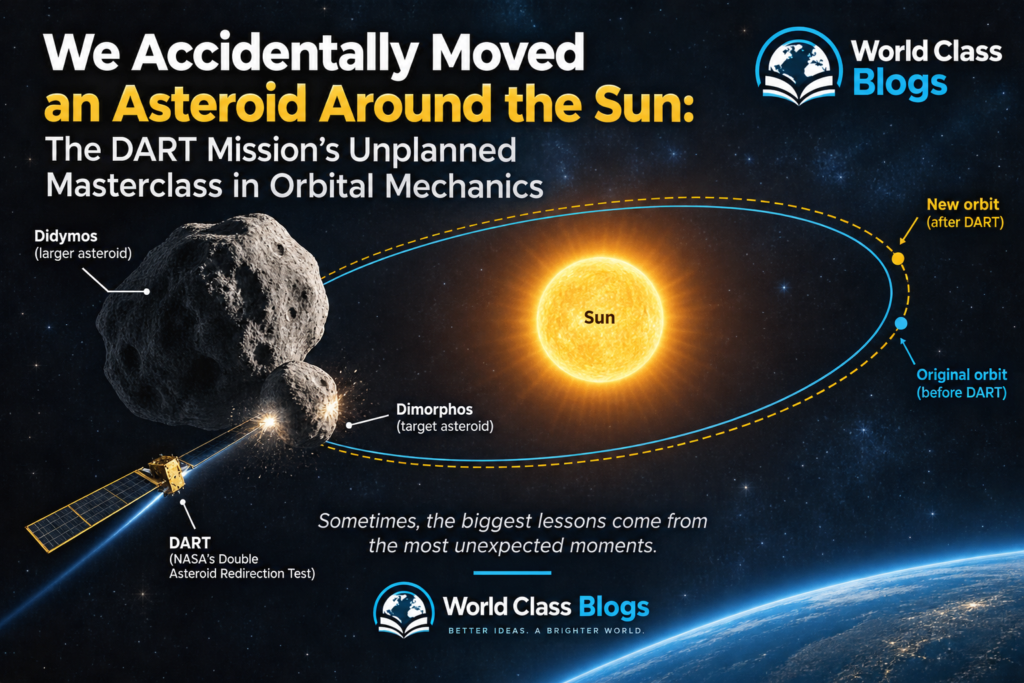
The DART mission was designed to answer a simple question: can we hit an asteroid hard enough to change its orbit? The answer, delivered in 2022, was a resounding yes. But the 2026 discovery—that the impact also shifted the entire asteroid pair’s orbit around the Sun—answers a deeper question: do we understand the consequences of hitting an asteroid? The answer there is more nuanced.
In my experience covering planetary defense, the temptation is to treat each mission as a binary: success or failure. DART was a success by any measure. But the 2026 result reminds us that success in planetary defense means predicting not just the immediate orbital change, but the coupled gravitational and dynamical effects that unfold over years. The 11.7-micron-per-second slowdown is a triumph of measurement and a warning about complexity. For a real threat, we’ll need both: the ability to deflect, and the ability to predict what happens next.
Key Takeaways:
- DART changed Dimorphos’s orbit around Didymos by 33 minutes—far exceeding mission requirements.
- The impact also slowed the entire Didymos system’s solar orbit by ~11.7 μm/s (~360 m/year), the first measured heliocentric deflection of an asteroid.
- The mechanism involved momentum enhancement from ejecta (β ≈ 3.6) and gravitational coupling between the two asteroids.
- The measurement required years of stellar occultation and radar tracking, demonstrating the precision astrometry needed to verify future deflection missions.
- Planetary defense is feasible, but requires early detection, reconnaissance, and a more sophisticated understanding of rubble-pile dynamics than simple momentum models provide.
Frequently Asked Questions (FAQ’s)
1. Did DART actually change the asteroid’s orbit around the Sun, or is this just a technicality?
It’s a real, measured change, but it’s very small. The Didymos system slowed its solar orbit by about 11.7 microns per second—roughly 360 meters per year. Over decades or centuries, that would accumulate into a meaningful positional shift. For planetary defense, the significance is that we can measure such a tiny change, which means we can verify a real deflection if we ever need to attempt one.
2. How can scientists measure such a tiny velocity change across millions of kilometers?
They use stellar occultations (timing when the asteroid passes in front of a star, which gives position to within a few kilometers) combined with radar ranging (bouncing signals off the asteroid from Earth-based antennas). By combining many measurements over years, they can detect trends smaller than the noise of any single observation .
3. Why was the momentum enhancement factor (β) so high?
Because Dimorphos is a rubble pile, not a solid rock. The impact excavated far more debris than a solid body would have, and that debris flew outward in a directed plume, acting like a rocket exhaust. The recoil from that ejecta added to the spacecraft’s momentum, multiplying the total push by roughly 3.6 .
4. Does this mean we can deflect any dangerous asteroid now?
No. It means we have a validated technique for a specific scenario: a small, well-characterized rubble-pile asteroid with years of advance warning. A real threat might be larger, denser, spinning faster, or discovered late. Deflection is feasible in principle, but each mission would require reconnaissance and careful modeling.
5. What is a rubble pile, and why does it matter?
A rubble pile is an asteroid that formed from the gravitational reaccumulation of debris after a larger body was shattered. It’s loosely bound, porous, and mechanically weak. This matters because rubble piles respond to impacts very differently from solid rocks: they absorb energy by crushing and shifting, and they produce more ejecta. DART’s β of 3.6 is a rubble-pile value; a solid asteroid would have a lower β.
6. How long did it take to confirm the heliocentric change?
The team used data from October 2022 through March 2025—roughly two and a half years of tracking—to accumulate enough precision to detect the slowdown. The paper was published in March 2026 .
7. Did the DART impact create any risk to Earth?
No. The Didymos system was not on a collision course before the impact, and the deflection was far too small to put it on one. The change in solar orbit is measured in meters per year; Earth’s orbit is 940 million kilometers in circumference. The system remains harmless.
8. What is the Hera mission, and why does it matter?
Hera is a European Space Agency mission that will perform a detailed post-impact survey of Dimorphos. It will measure the crater, the asteroid’s mass, and its internal structure, providing the data needed to calibrate β models and improve future deflection predictions. Hera is expected to arrive in late 2026 or 2027.
9. Why did DART target a binary asteroid instead of a single one?
Because a binary system provides a short-period orbit (Dimorphos around Didymos) that can be measured quickly. Changing a single asteroid’s solar orbit would take years to detect; changing a moonlet’s orbit around its parent takes weeks. The binary also allowed the heliocentric effect to be measured later, thanks to gravitational coupling .
10. What was the actual size of DART compared to Dimorphos?
DART was roughly the size of a vending machine (about 1.8 meters across, 570 kg). Dimorphos is about 160 meters across, roughly the size of a football stadium. The mass ratio is enormous—DART was a tiny projectile hitting a mountain—which is why the ejecta recoil was so important.
11. How fast was DART going when it hit?
Approximately 6.1 kilometers per second, or about 14,000 miles per hour .
12. Could we use a nuclear weapon instead of a kinetic impactor?
Nuclear deflection is a studied concept, but it raises political, legal, and technical issues. A kinetic impactor is simpler, cleaner, and has now been demonstrated. Nuclear options might be considered for very large threats with short warning times, but they remain theoretical and controversial.
13. What’s the difference between “scientific net energy gain” and “net facility gain” in fusion, and why does it matter here?
That’s a fusion question, not an asteroid question. But to clarify: scientific net energy gain (Q_sci > 1) means the fusion reaction produced more energy than was delivered to the fuel. Net facility gain means the entire facility produced more energy than it consumed. DART’s “gain” is analogous: the momentum enhancement factor (β > 1) means the asteroid’s velocity change exceeded what the spacecraft’s momentum alone would have produced. Both are examples of “the whole system does more than the input.”
14. How does this relate to the 2026 Nobel Prize in Physics?
The Nobel went to Francis Halzen for IceCube and neutrino astronomy . The connection is methodological: both IceCube and DART rely on detecting tiny signals (neutrino flashes, occultation dips) against noisy backgrounds, and both required decades of instrument development. Precision measurement is the common thread.
15. What would happen if a real asteroid were on a collision course?
If detected with enough warning (years to decades), a kinetic impactor mission could be launched to deflect it. The DART experiment provides the first real-world data on how much deflection a given impactor can achieve. If warning time is short (months), options are more limited and riskier—which is why detection surveys are so important.
16. How much did the DART mission cost?
Approximately $330 million, including the spacecraft and mission operations. This is modest compared to the potential cost of an impact disaster.
17. Can amateur astronomers contribute to this kind of research?
Yes. Amateur astronomers participate in occultation campaigns, photometry of asteroid brightness, and even orbit refinement. The 2026 study relied on data from professional observatories, but amateur contributions are increasingly valuable for time-domain astronomy.
18. What does “heliocentric” mean, exactly?
Centered on the Sun. A heliocentric orbit is a path around the Sun. The Didymos system’s heliocentric orbit was altered by the DART impact, which is why the 2026 paper describes a “heliocentric deflection.”
19. Why did the ejecta plume last so long?
The plume expanded into space and faded over weeks to months. The debris that escaped Dimorphos’s gravity dispersed into interplanetary space. Some debris may have fallen back onto Dimorphos or Didymos, but the net effect was a momentum transfer to the asteroid .
20. Could the DART impact have broken Dimorphos apart?
No. Dimorphos is a rubble pile, and the impact excavated material, but the asteroid’s self-gravity and internal friction held it together. A much larger impactor or a different target structure could have different results, but DART did not disrupt the asteroid.
21. What’s next for planetary defense after DART and Hera?
The next steps include: (1) completing the survey of near-Earth objects with dedicated telescopes like the NEO Surveyor; (2) developing rapid-response mission concepts for short-warning scenarios; (3) improving our understanding of asteroid internal structure through radar and in-situ missions; and (4) international coordination through IAWN and SMPAG.
22. Does this research have applications beyond planetary defense?
Yes. The orbital tracking and occultation techniques are used for satellite collision avoidance and space domain awareness. The impact physics is relevant to asteroid mining, where controlled excavation or fragmentation may be needed. And the international coordination frameworks are models for other global scientific challenges.
23. How does the DART result compare to the 2026 Nobel Prize in terms of scientific significance?
They’re different kinds of science. The Nobel recognized a fundamental discovery (astrophysical neutrinos). DART is an engineering demonstration with scientific payoffs. Both are important, but DART’s significance is more applied: it validates a technique that could save lives. The 2026 heliocentric measurement adds a layer of scientific rigor to that validation.
24. What’s the most surprising thing about the 2026 discovery?
For me, it’s that the gravitational coupling between the two asteroids was strong enough to transmit the local orbit change into a solar orbit change. Didymos is 200 times more massive than Dimorphos, yet the moonlet’s altered motion was enough to nudge the parent. It’s a reminder that orbital mechanics doesn’t respect our intuition about “big” and “small.”
25. Where can I read the original paper?
The 2026 paper is “Direct detection of an asteroid’s heliocentric deflection: The Didymos system after DART,” published in Science Advances (DOI: 10.1126/sciadv.aea4259) . The DART mission results are also documented in numerous NASA and ESA publications.
26. Is there any connection between DART and the search for room-temperature superconductors?
No direct connection. Both are active areas of physics research in 2026, but they involve different phenomena. The superconductivity field is currently grappling with reproducibility issues and high-pressure experiments ; DART is a one-off planetary defense demonstration. The only common thread is that both illustrate the importance of rigorous measurement and skepticism of unverified claims.
27. What should a curious beginner read next if they want to understand orbital mechanics better?
Start with Kepler’s laws and Newton’s law of gravitation. Any introductory physics textbook covers these. For a more practical perspective, NASA’s planetary defense website and the DART mission page have accessible explanations and animations. The 2026 paper itself is dense but readable if you focus on the introduction and figures.
About Author
Sana Ullah Khan Kakar is a science writer and former aerospace systems engineer with a focus on planetary science and space technology. He has contributed to World Class Blogs since 2023, covering topics ranging from asteroid defense to fusion energy and quantum computing. Alex holds a B.S. in Aerospace Engineering from Georgia Tech and an M.S. in Science Communication from MIT. He lives in Tucson, Arizona, where he volunteers as an amateur astronomer and occultation observer. You can reach him through the World Class Blogs contact page.
Disclosure: Alex has no financial interest in any company or mission mentioned in this article. All opinions are his own.
Free Resources
- NASA DART Mission Page: Official mission overview, images, and data releases. (nasa.gov/planetarydefense/dart)
- ESA Hera Mission: Updates on the post-impact survey. (esa.int/hera)
- International Astronomical Union Minor Planet Center: Public access to asteroid astrometry data. (minorplanetcenter.net)
- OpenOrb / Find_Orb: Free software for orbit determination, useful for understanding how astrometric data translates into orbital solutions.
- World Class Blogs Technology & Innovation Archive: For related coverage on AI, machine learning, and space technology. [Link: https://worldclassblogs.com/category/technology-innovation/artificial-intelligence-machine-learning/]
- Sherakat Network SEO Guide: For readers interested in how science communication reaches audiences online. [Link: https://sherakatnetwork.com/category/seo]
Discussion
What questions do you have about DART, planetary defense, or orbital mechanics? Have you followed the Hera mission’s progress? Share your thoughts in the comments below. I read every comment and try to respond within 48 hours.
For more science and frontier coverage, explore the World Class Blogs Our Focus section and the full Blog archive. If you’re interested in contributing a guest post or suggesting a topic, please contact us.