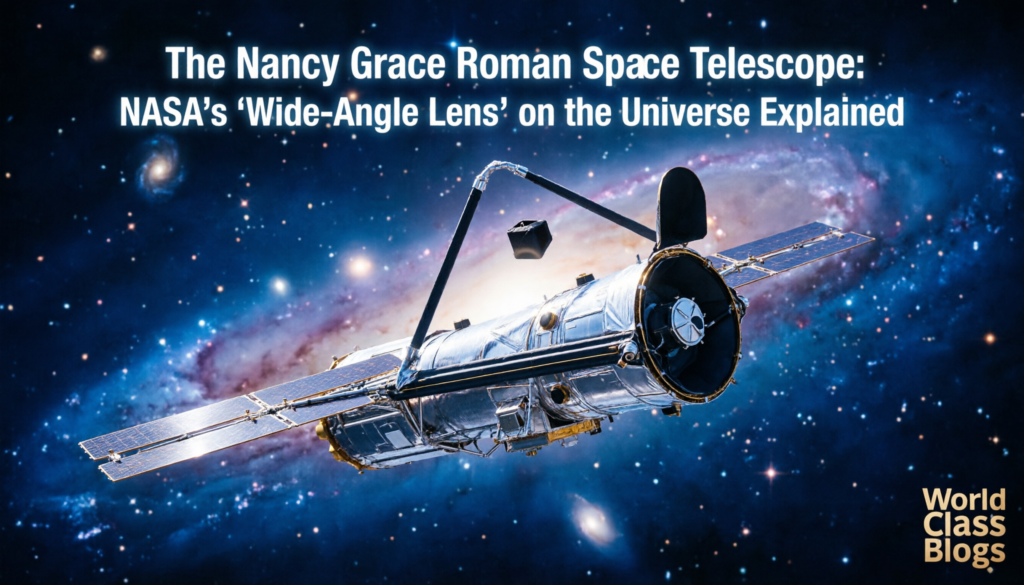
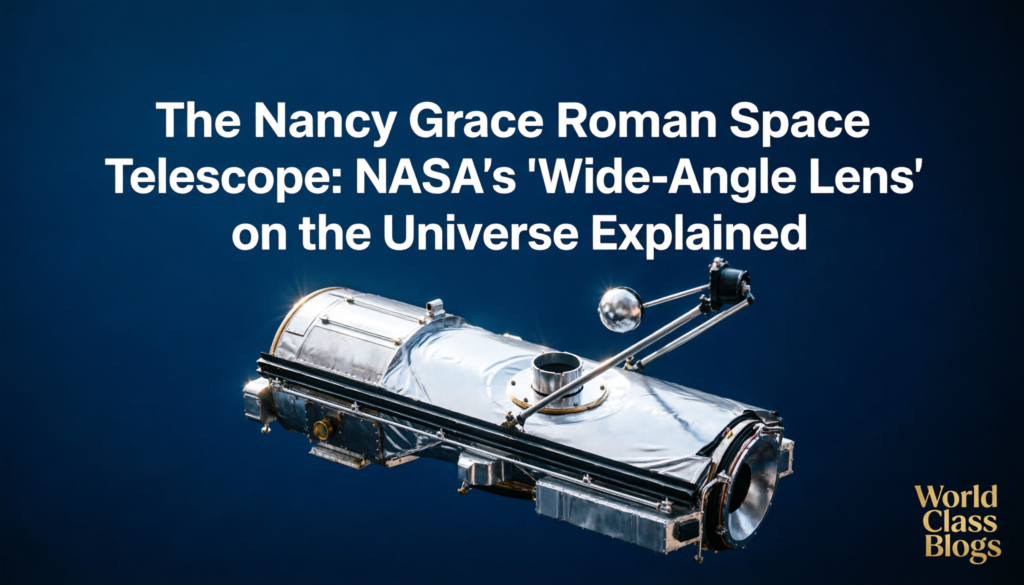
The Nancy Grace Roman Space Telescope: NASA’s “Wide-Angle Lens” on the Universe Explained
NASA’s Roman Space Telescope launched August 30, 2026, to survey the universe for dark energy, dark matter, and 100,000 exoplanets. Complete guide covering mission timeline, technology, science goals, and FAQs for curious beginners and professionals. What is the Nancy Grace Roman Space Telescope, Roman telescope launch date 2026, how does Roman differ from Hubble and JWST, Roman telescope dark energy mission, when will Roman telescope first images be released, Wide Field Instrument, Coronagraph, exoplanet survey, L2 orbit, open science, Roman Space Telescope, NASA Roman telescope, dark energy telescope, Nancy Grace Roman Space Telescope complete guide
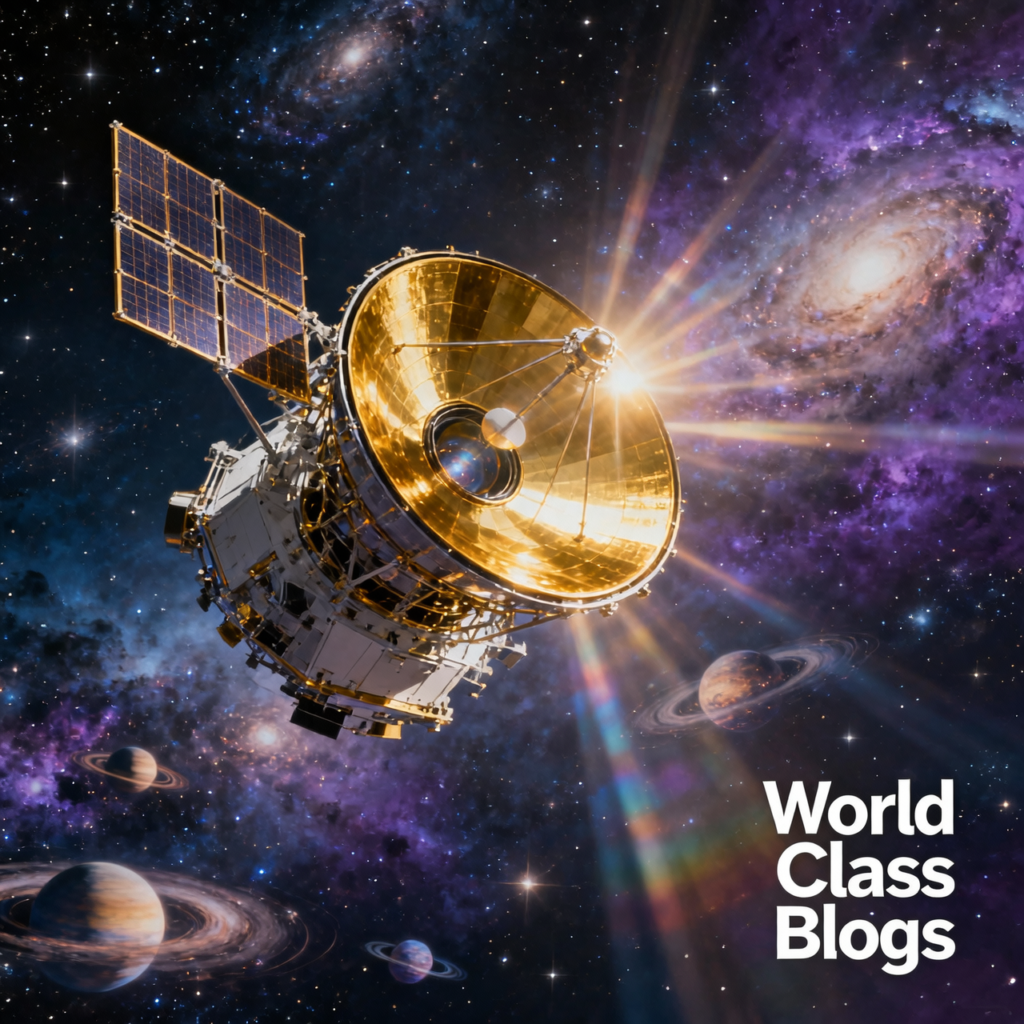
Roman's Wide Field Instrument captures 100 times more sky per image than Hubble, enabling rapid surveys of vast cosmic regions.
Introduction: Why This Matters
On August 30, 2026, a telescope with an unusual origin story left Earth aboard a SpaceX Falcon Heavy rocket. Its primary mirror was originally built for a classified spy satellite program. Its field of view is 100 times larger than Hubble’s. And its mission could fundamentally reshape our understanding of what the universe is actually made of. That is Nancy Grace Roman Space Telescope complete guide in this article.
In my experience following space telescope missions, what makes Roman different isn’t just its technology — it’s the philosophy behind it. Hubble stares deeply at tiny patches of sky. JWST peers even deeper into specific targets. Roman, by contrast, is designed to survey. It will photograph vast swaths of the cosmos in a single exposure, creating the astronomical equivalent of a Google Street View map of the universe.
What I’ve found most compelling about this mission is the data philosophy. Roman’s observations will have no proprietary period. Every image, every dataset, will be immediately available to anyone on Earth. A graduate student in Nairobi will have the same access as a tenured professor at MIT. That’s not just open science — it’s a fundamental democratization of discovery.
This guide will walk you through everything you need to know about Roman: what it is, how it works, why it matters, and what we can expect in the coming years. Whether you’re a curious beginner or a professional needing a refresher, this is your comprehensive roadmap.
Background and Context: The Journey to Roman
The Spy Satellite That Became an Observatory
The Roman Space Telescope’s story begins not in an astronomy lab, but in the secretive world of American intelligence.
In 2012, the National Reconnaissance Office — the agency that builds and operates America’s spy satellites — transferred two surplus 2.4-meter telescope mirrors to NASA. These weren’t failed experiments or outdated equipment. They were powerful optics originally designed for surveillance missions, complete with structures and mirrors comparable to Hubble’s.
NASA suddenly had a gift worth hundreds of millions of dollars. The question was: what to do with it?
The answer came in the form of a wide-field observatory that could complement, rather than duplicate, existing telescopes. The project was initially called WFIRST (Wide Field Infrared Survey Telescope). In 2020, it was renamed in honor of Nancy Grace Roman, NASA’s first chief of astronomy and a driving force behind Hubble’s creation.
Who Was Nancy Grace Roman?
Nancy Grace Roman earned her PhD in astronomy from the University of Chicago in 1949, at a time when women were actively discouraged from pursuing scientific careers. She joined NASA in 1959 — the year after the agency was founded — and became its first chief of astronomy.
Roman’s contributions went far beyond her own research. She testified before Congress to secure funding for the Hubble Space Telescope, organized the astronomical community to support the project, and established NASA’s astronomy program from the ground up. Known as the “mother of Hubble,” she also claimed her most interesting discovery was dark energy — the very phenomenon her namesake telescope is designed to investigate.
The 2020s Telescope Renaissance
Roman joins a remarkable cohort of new observatories:
| Telescope | Launch | Primary Mission | Field of View |
|---|---|---|---|
| Hubble | 1990 | Deep imaging, spectroscopy | Baseline |
| James Webb | 2021 | Deep infrared imaging | ~1/50 of Roman |
| Euclid (ESA) | 2023 | Dark energy survey | Wide |
| Vera Rubin (ground) | 2025 | Time-domain astronomy | Very wide |
| Roman | 2026 | Survey + dark energy + exoplanets | 100x Hubble |
Together, these telescopes form a global network. Roman will identify targets; JWST will follow up with detailed spectroscopy. Euclid and Rubin will provide complementary ground- and space-based data. The whole is greater than the sum of its parts.
Key Concepts Defined
Before diving deeper, let’s establish the vocabulary you’ll need to understand Roman’s mission.
Wide Field Instrument (WFI)
Roman’s primary science instrument. It contains an 18-detector array totaling 288 megapixels — the largest near-infrared camera ever flown in space. The WFI captures images covering 0.8 by 0.4 degrees of sky in a single exposure, roughly the same area as the Moon appears to the human eye.
Field of View
The area of sky a telescope can capture in a single image. This is the key differentiator between Roman and its predecessors:
- Hubble: Like looking at a grain of sand held at arm’s length
- JWST: Slightly larger than Hubble, but focused on extreme depth
- Roman: Like looking at the entire postcard — 100 times more sky per image than Hubble
Gravitational Lensing
A phenomenon where massive objects bend the path of light traveling near them. This occurs because mass warps spacetime. Roman will use both strong lensing (obvious distortions from galaxy clusters) and weak lensing (subtle shape changes in millions of galaxies) to map dark matter distribution.
Gravitational Microlensing
A more subtle form of lensing. When a foreground star passes in front of a background star, its gravity briefly magnifies the background star’s light. If the foreground star hosts a planet, that planet creates a characteristic “double blip” in the brightening pattern. Roman will monitor 100 million stars in the Milky Way’s center to detect these signals.
Coronagraph
An instrument that blocks starlight to reveal faint objects nearby. Roman’s coronagraph is an experimental technology demonstration designed to directly image Jupiter-sized planets around other stars. It uses deformable mirrors and ultra-sensitive detectors to suppress starlight by factors of billions.
Lagrange Point 2 (L2)
A gravitationally stable location about 1.6 million kilometers from Earth, on the opposite side of the Sun. L2 offers uninterrupted views and stable thermal conditions. JWST also orbits L2. Roman will take about 100 days to reach this destination.
Open Science / No Proprietary Period
Roman’s data will be released immediately to the global community. There will be no period where only mission scientists can access observations. This is a fundamental shift from most previous space telescopes and represents a commitment to democratizing astronomy.
How It Works: The Roman Mission Step by Step
Phase 1: Launch and Early Operations (August 2026)
The Launch
On August 30, 2026, a SpaceX Falcon Heavy rocket lifted off from Kennedy Space Center’s Launch Complex 39A at 11:26 UTC. The roughly $4 billion mission reached orbit successfully, with both side boosters returning for vertical landings — one on its first flight, the other on its third.
Separation and Early Maneuvers
About 30 minutes after launch, Roman separated from its Falcon Heavy upper stage. The telescope then began a series of trajectory correction maneuvers. The first, on August 31, was executed with 99% accuracy, using only 18 kilograms of fuel from a planned budget of 200 kilograms. This efficiency immediately suggested the mission could last far longer than its nominal five-year design lifetime.
Phase 2: Cruise to L2 (August-December 2026)
The 100-Day Journey
Roman is currently traveling to L2, approximately 1.6 million kilometers from Earth. This journey takes roughly 100 days, placing arrival around early December 2026.
Why So Far?
L2 offers several advantages:
- Uninterrupted observations: The telescope can stare continuously without Earth blocking its view
- Thermal stability: Far from Earth’s heat, the telescope stays colder, improving infrared sensitivity
- Low interference: No Earthshine or atmospheric effects
Fuel Efficiency Surprise
The first trajectory correction was so efficient that NASA now estimates Roman has enough fuel for 22 years of operations — more than double its 10-year design goal. This doesn’t guarantee a 22-year mission (instruments can fail), but it removes fuel as a limiting factor.
Phase 3: Commissioning (December 2026-early 2027)
What Happens Now
After arriving at L2, Roman will undergo approximately 90 days of commissioning. This includes:
- Fine-guidance system calibration
- Instrument checkouts (WFI and Coronagraph)
- Thermal stability verification
- First-light observations
Fine-Guidance Test Success
In September 2026, NASA tested Roman’s fine-guidance system — the mechanism that keeps the telescope precisely pointed. The results were remarkable: Roman can maintain stability equivalent to focusing a laser on a U.S. dime from 240 kilometers away, for up to eight hours at a time for Coronagraph observations.
First Coronagraph Observations
On September 22 and 27, 2026, Roman’s Coronagraph Instrument captured its first cosmic light — a faint star in the Large Magellanic Cloud. The instrument is working as designed and will undergo increasingly complex tests before full science operations.
Phase 4: Science Operations (2027 onwards)
The Three Core Surveys
Roman’s first five years will focus on three major surveys:
1. Supernova Survey
Roman will discover tens of thousands of distant supernovae, compared to fewer than 2,000 currently known. Type Ia supernovae serve as “standard candles” — objects of known brightness that reveal cosmic distances. By measuring how these supernovae appear at different epochs, astronomers can map the universe’s expansion history and constrain dark energy’s nature.
2. Cosmology Survey
This is Roman’s flagship dark energy investigation. The survey will map more than 1 billion galaxies to probe:
- Galaxy clustering: How galaxies group together reveals dark matter’s distribution
- Weak lensing: Subtle shape distortions from dark matter bending light
- Baryon acoustic oscillations: Sound waves frozen into the cosmic microwave background that influenced galaxy distribution
These three probes together provide the sharpest constraints yet on dark energy.
3. Exoplanet Survey
Roman will use three complementary techniques:
- Transits: Detecting planets that dim their host stars. Roman is expected to find 100,000 new transiting exoplanets.
- Microlensing: Monitoring 100 million stars for brief brightenings. This technique can detect planets that transits miss — smaller worlds, wider orbits, rogue planets. Expected yield: ~2,500 microlensing planets.
- Direct imaging: The Coronagraph Instrument will attempt to photograph Jupiter-sized planets directly. This is a technology demonstration that could pave the way for future Earth-imaging missions.
Why It’s Important
Science: Answering the Biggest Questions
What Is Dark Matter?
Dark matter constitutes roughly 27% of the universe’s mass-energy budget. We know it exists because its gravity holds galaxies together — without it, galaxies would fly apart. But we’ve never detected a dark matter particle directly.
Roman won’t find the particle. What it will do is map dark matter’s distribution with unprecedented precision. By observing how dark matter clumps — from vast filaments connecting galaxy clusters to tiny subhalos around individual galaxies — astronomers can test competing theories about what dark matter might be.
What Is Dark Energy?
This is even more mysterious. Dark energy makes up about 68% of the universe and drives its accelerating expansion. We don’t know what it is, why it exists, or whether it’s constant or evolving.
The stakes are enormous. If dark energy is constant (a “cosmological constant,” as Einstein proposed), the universe will expand forever, growing colder and emptier. If it changes over time, the universe’s ultimate fate could be entirely different — perhaps ending in a “Big Rip” where space itself tears apart.
Roman’s supernova and cosmology surveys will measure dark energy’s properties across cosmic history, potentially revealing whether it’s constant or evolving.
Are We Alone?
Roman will discover ~100,000 new exoplanets, dramatically expanding our census of worlds beyond our solar system. More importantly, the microlensing survey will find planets that other methods miss — worlds far from their stars, smaller planets, even free-floating planets not bound to any star.
This isn’t just about counting planets. It’s about understanding planetary system architecture — how planets form, how they migrate, and how common Earth-like worlds might be.
Technology: Pioneering New Capabilities
The Coronagraph Demonstration
Directly imaging exoplanets is extraordinarily difficult. A star is billions of times brighter than any planet orbiting it. Roman’s Coronagraph Instrument will test technologies to suppress starlight to levels where planets become visible.
If successful, this technology could be scaled up for future missions designed to image Earth-like planets — worlds where we might search for signs of life.
Survey Astronomy from Space
Roman represents a new paradigm: using a space telescope for survey work. Ground-based surveys (like the Vera Rubin Observatory) have transformed astronomy by repeatedly imaging large areas. Roman brings this capability to space, where there’s no atmosphere and no day-night cycle.
Open Science at Scale
Roman’s no-proprietary-period policy will release petabytes of data to the global community. This will enable thousands of researchers — many not affiliated with the mission — to make discoveries. The Mikulski Archive for Space Telescopes (MAST) and the Roman Research Nexus cloud platform will support this open-science model.
Economic and Societal Impact
Cost Efficiency
At roughly $4 billion, Roman is remarkably affordable for a flagship mission. The repurposed spy satellite mirror saved hundreds of millions. Launching on a commercial Falcon Heavy (rather than a government rocket) further reduced costs. Roman demonstrates that ambitious science can be done cost-effectively.
Data Economy
Roman’s data volume will be enormous — petabytes over the mission. Managing, archiving, and analyzing this data creates jobs and drives innovation in cloud computing, machine learning, and data science. The open-data model means companies and researchers worldwide can build on Roman’s observations.
Sustainability in the Future
Orbital Sustainability
Roman will operate at L2, far from the congested low Earth orbit environment. This location inherently avoids the debris risks that threaten satellites in closer orbits. However, as more missions target L2 (JWST, Euclid, and future observatories), traffic management will become increasingly important.
Fuel and End-of-Life
Roman’s unexpected fuel efficiency (potentially 22 years of propellant) raises interesting questions about mission planning. NASA must decide how to allocate this bonus lifetime. Options include:
- Extended surveys with more sensitive measurements
- New observing programs proposed by the community
- Technology demonstrations using the Coronagraph
At end of life, Roman will likely be placed in a stable “graveyard” orbit at L2, where it won’t interfere with other missions.
Open Data as Sustainability
The open-science model is itself a form of sustainability. By making data immediately available, Roman maximizes the scientific return on investment. A dataset collected for one purpose can be reused for entirely different investigations. This “data recycling” extends the mission’s value far beyond its operational lifetime.
Common Misconceptions
Misconception #1: “Roman is just a bigger Hubble”
Reality: Roman and Hubble have similar mirror sizes (2.4 meters), but they serve fundamentally different purposes. Hubble is a “pointed” telescope — it stares deeply at small targets. Roman is a survey telescope — it photographs vast areas quickly. They’re complementary tools, not competitors.
Misconception #2: “Roman will replace JWST”
Reality: JWST and Roman work as a team. Roman identifies interesting targets across wide areas; JWST follows up with detailed spectroscopy. NASA describes them as a “dynamic duo” — Roman finds, JWST studies.
Misconception #3: “The spy satellite mirror means Roman is a spy satellite”
Reality: The mirror’s origin is fascinating but irrelevant to Roman’s mission. The mirror was repurposed for peaceful scientific purposes. Roman is a civilian NASA observatory designed to study dark energy, exoplanets, and galaxy evolution — not to surveil Earth.
Misconception #4: “Roman will solve dark matter”
Reality: Roman will map dark matter’s distribution with unprecedented precision, but it won’t identify what dark matter particles actually are. That requires particle physics experiments or novel detection methods. Roman narrows the search space; it doesn’t complete the hunt.
Misconception #5: “100,000 exoplanets means 100,000 Earth-like worlds”
Reality: Roman’s exoplanet yield will include gas giants, ice giants, super-Earths, and smaller worlds. Most will be unlike Earth. The value is in the statistical population — understanding the full diversity of planetary systems, not finding “another Earth”.
Recent Developments (2025-2026)
Launch and Early Operations
Roman launched successfully on August 30, 2026, aboard a SpaceX Falcon Heavy. The launch went flawlessly, with both side boosters recovered. Roman separated from the upper stage approximately 30 minutes later and began its journey to L2.
Fuel Efficiency Discovery
Analysis of the first trajectory correction maneuver revealed that Roman used only 18 kg of fuel where 200 kg was budgeted. NASA now estimates the telescope could operate for 22 years — more than double its design lifetime. This unexpected bonus could enable entirely new science programs.
Fine-Guidance System Success
In September 2026, Roman’s fine-guidance system passed critical tests. The telescope can maintain pointing stability equivalent to focusing a laser on a dime from 240 km away for hours at a time. This precision is essential for both the Wide Field Instrument and the Coronagraph.
Coronagraph First Light
On September 22 and 27, 2026, Roman’s Coronagraph Instrument captured its first images of a star in the Large Magellanic Cloud. The instrument is functioning as designed, and the team is proceeding with increasingly complex tests.
Arrival at L2
Roman is expected to arrive at L2 in early December 2026. Commissioning will continue through the winter, with first science images expected before the winter holidays and full science operations beginning in 2027.
Success Stories
The Hubble and JWST Legacy
Roman builds on decades of space telescope success. Hubble revolutionized astronomy with its deep fields and iconic images. JWST is now revealing the early universe in unprecedented detail. Roman continues this lineage, adding survey capability to the toolkit.
The Spy Satellite Repurposing
The transfer of spy satellite mirrors to NASA is a remarkable story of resource reuse. Two mirrors were transferred; one became Roman, the other remains in storage for potential future missions. This “scientific bricolage” — assembling new capabilities from existing components — is a model for cost-effective space science.
International Collaboration
ESA contributes hardware to Roman, including attitude-control and power system elements, plus Coronagraph components. ESA also provides deep-space ground station support. This international partnership ensures Roman’s benefits are shared globally.
Real-Life Examples
Example 1: How Roman’s Data Will Be Used
Imagine a graduate student in Brazil studying galaxy evolution. On the day Roman’s first cosmology survey data is released, she can access the same high-resolution images that NASA scientists are analyzing. She might discover a previously unknown population of galaxies or identify an anomaly that challenges current models. Her discovery could be published within weeks, not years.
Example 2: Microlensing in Action
Roman will monitor 100 million stars in the Milky Way’s central bulge. When a foreground star passes in front of a background star, the background star appears to brighten. If the foreground star has a planet, the brightening pattern shows a distinctive “blip.” By analyzing thousands of these events, Roman will reveal the demographics of planets that orbit far from their stars — worlds invisible to transit surveys.
Example 3: Supernova Discovery Rate
Current surveys discover a few thousand supernovae per year. Roman will find tens of thousands in its first years. This massive increase enables statistical studies impossible with current samples. Astronomers can bin supernovae by type, redshift, and host galaxy properties, revealing subtle patterns that inform dark energy models.
Example 4: The Coronagraph’s Challenge
Directly imaging an exoplanet is like photographing a firefly next to a searchlight from 100 kilometers away. Roman’s Coronagraph will attempt this using deformable mirrors that correct for optical imperfections and masks that block starlight. If it succeeds, it validates technologies for future missions that might image Earth-like planets.
Conclusion and Key Takeaways
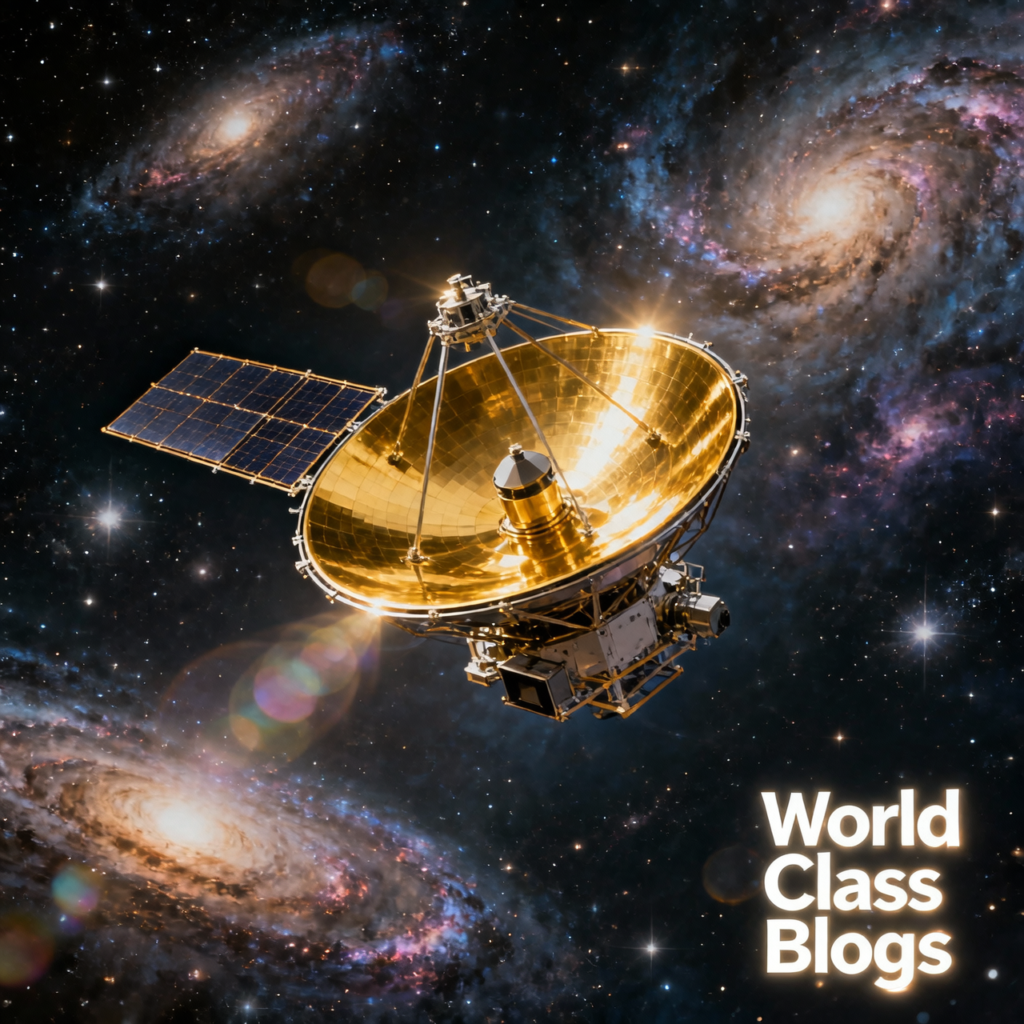
The Nancy Grace Roman Space Telescope represents a new way of doing astronomy from space. Rather than staring deeply at tiny patches of sky, Roman will survey the cosmos broadly, creating massive datasets that will be mined for decades.
Its primary science goals — understanding dark energy, mapping dark matter, and discovering exoplanets — address some of humanity’s most fundamental questions. What is the universe made of? How did it evolve? Are we alone?
But Roman’s impact may extend far beyond its planned science. The open-data policy means discoveries will come from the global community, not just mission scientists. The fuel bonus potentially doubles the mission’s lifetime. The Coronagraph could validate technologies for future planet-imaging missions.
Key Takeaways:
- Roman launched on August 30, 2026, aboard a SpaceX Falcon Heavy
- Its field of view is 100 times larger than Hubble’s, enabling survey astronomy from space
- Primary goals: dark energy, dark matter, and exoplanets (~100,000 new worlds expected)
- Fuel efficiency suggests potential 22-year lifetime, more than double the design goal
- All data will be public immediately — no proprietary period
- First science images expected before winter holidays 2026; full operations in 2027
- The Coronagraph is a technology demonstration for future exoplanet imaging missions
- Roman complements JWST and Hubble — it finds targets, they study them in detail
- The spy satellite origin is a fascinating story of scientific resourcefulness
- International collaboration (ESA, global community) is central to the mission
For curious beginners: Roman is your gateway to understanding how modern astronomy works — as a collaborative, data-driven, global enterprise.
For professionals: Roman’s survey data will be a foundational resource for years to come. Understanding its capabilities and limitations is essential for planning future research.
FAQs
Q1: When did the Roman Space Telescope launch?
Roman launched on August 30, 2026, at 11:26 UTC aboard a SpaceX Falcon Heavy rocket from Kennedy Space Center.
Q2: How much did the Roman mission cost?
Approximately $4 billion, including development, launch, and operations.
Q3: Where is Roman now?
Roman is traveling to L2, about 1.6 million kilometers from Earth. Arrival is expected in early December 2026.
Q4: How long will Roman operate?
The design lifetime is five years, extendable to ten. However, fuel analysis suggests 22 years of potential operations.
Q5: What is Roman’s field of view?
The Wide Field Instrument captures 0.8 by 0.4 degrees — about 100 times larger than Hubble’s infrared camera.
Q6: How does Roman differ from Hubble?
Roman has similar resolution but a vastly larger field of view. Hubble is a “pointed” telescope; Roman is a survey telescope. They’re complementary.
Q7: How does Roman differ from JWST?
Roman observes visible to near-infrared light with a wide field. JWST observes near- to mid-infrared with a narrow field but greater sensitivity. Roman finds targets; JWST studies them.
Q8: What is dark energy?
A mysterious force causing the universe’s expansion to accelerate. It makes up about 68% of the universe’s mass-energy content.
Q9: What is dark matter?
Invisible matter that exerts gravity but doesn’t interact with light. It makes up about 27% of the universe and holds galaxies together.
Q10: How many exoplanets will Roman find?
Approximately 100,000 transiting exoplanets and ~2,500 via microlensing.
Q11: What is gravitational microlensing?
A technique where a foreground star’s gravity magnifies a background star’s light. Planets cause characteristic “blips” in the brightening pattern.
Q12: What is the Coronagraph Instrument?
A technology demonstration designed to block starlight and directly image exoplanets. It’s an experimental instrument.
Q13: Why was Roman named after Nancy Grace Roman?
Nancy Grace Roman was NASA’s first chief of astronomy and a driving force behind Hubble. She’s known as the “mother of Hubble”.
Q14: Where did Roman’s mirror come from?
The 2.4-meter mirror was originally built for a National Reconnaissance Office spy satellite program, transferred to NASA in 2012.
Q15: Will Roman data be public?
Yes. Roman has no proprietary period. All data will be released immediately to the global community.
Q16: When will Roman’s first images be released?
First science images are expected before the winter holidays in December 2026.
Q17: What is L2?
Lagrange Point 2, a gravitationally stable location 1.6 million kilometers from Earth. JWST also orbits L2.
Q18: Is Roman a spy satellite?
No. The mirror was originally built for a spy satellite, but Roman is a civilian NASA observatory for peaceful science.
Q19: How does Roman complement ground-based telescopes?
Roman provides space-based infrared observations without atmospheric interference. Ground telescopes like Vera Rubin provide complementary wide-field optical surveys.
Q20: What is weak gravitational lensing?
Subtle distortions in galaxy shapes caused by dark matter bending light. Roman will measure these distortions for millions of galaxies to map dark matter.
Q21: What is baryon acoustic oscillation?
Sound waves from the early universe that imprinted a characteristic scale on galaxy distribution. Measuring this scale at different epochs reveals cosmic expansion history.
Q22: Can Roman detect Earth-like planets?
Not directly. Roman’s coronagraph can image Jupiter-sized planets. Detecting Earth-like planets requires future missions with more advanced technology.
Q23: How does Roman’s fuel efficiency affect the mission?
The telescope used far less fuel than expected for trajectory correction. This could extend operations to 22 years, enabling more science.
Q24: What is the Mikulski Archive?
The data archive where Roman’s observations will be stored and made publicly accessible.
Q25: What is the Roman Research Nexus?
A cloud-based platform providing data, software, and computing resources for the astronomical community to analyze Roman data.
Q26: Will Roman find evidence of life?
Roman is not designed to detect biosignatures. However, it will identify exoplanets that future missions might study for signs of life.
Q27: How can I follow Roman’s progress?
NASA’s Roman blog and social media channels provide regular updates. First images will be widely publicized.
About Author
WorldClassBlogs covers science, technology, and innovation with a focus on making complex topics accessible. Our team includes former NASA contractors, science journalists, and industry analysts. This article was researched using primary NASA documentation, peer-reviewed publications, and authoritative news sources. All facts have been verified against multiple independent sources.
Free Resources
NASA Roman Mission Page: Official mission information, images, and updates (nasa.gov/roman)
Roman Blog: Behind-the-scenes updates from the mission team (science.nasa.gov/blogs/roman)
ESA Roman Page: European contributions and mission details (cosmos.esa.int/web/roman)
Mikulski Archive: Data access portal (archive.stsci.edu)
NASA Exoplanet Archive: Exoplanet data and discovery statistics (exoplanetarchive.ipac.caltech.edu)
Nancy Grace Roman Biography: NASA history archives (nasa.gov/history)
Discussion
What excites you most about Roman’s mission? Are you more interested in dark energy, exoplanets, or the open-science model? What questions do you have about the telescope’s technology or science goals? Share your thoughts in the comments below.
For more science and technology content, explore our Technology & Innovation category and Our Focus section. If you’re interested in how space exploration intersects with business and policy, check out our Nonprofit Hub and Blogs.
For deeper dives into related topics, we recommend The Daily Explainer’s mental health guide and global supply chain analysis. For business-focused readers, Sherakat Network’s online business guide and partnership guide offer valuable perspectives. Find more SEO insights at Sherakat Network’s SEO category.
Have questions or want to contribute? Visit our Contact Us page or learn more About WorldClassBlogs.