Artemis II and the New Moon Race: What the First Crewed Lunar Flyby in 50 Years Means for Humanity
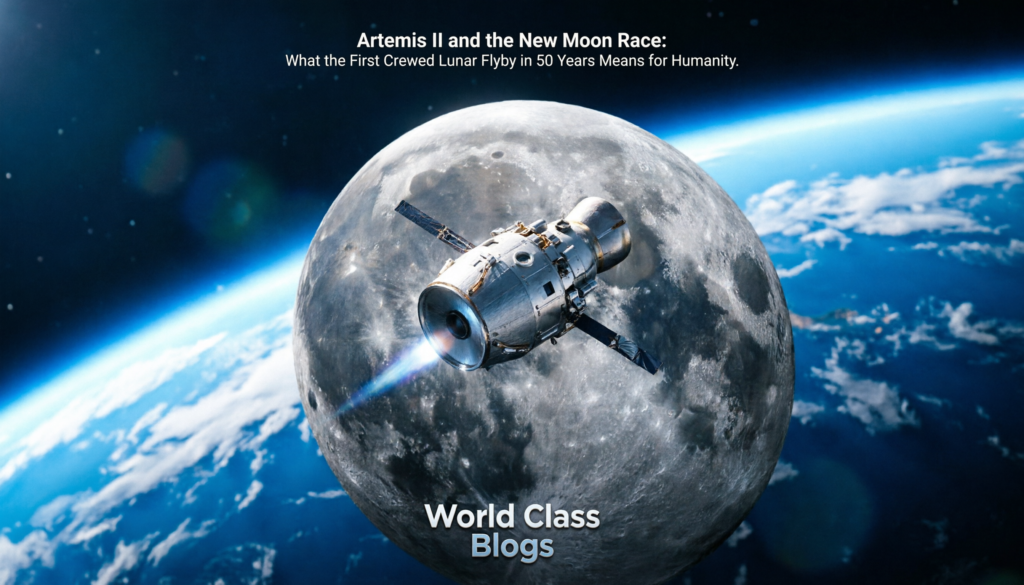
The Orion spacecraft completes its lunar flyby on April 6, 2026, taking astronauts farther from Earth than any humans in history.
Introduction: Why This Moment Matters
On April 1, 2026, at 6:35 PM Eastern Time, four human beings left Earth’s orbit for the first time in fifty-four years. The last time this happened, the crew of Apollo 17 was returning from the final lunar landing of the 20th century. Between that December 1972 splashdown and the April 2026 launch of Artemis II, humanity’s farthest reach had been confined to low Earth orbit — a region just 400 kilometers above our heads.
In my experience following space policy for over a decade, I’ve watched countless “return to the Moon” promises evaporate into budget cuts and shifting political priorities. What makes Artemis II different isn’t just that it happened — it’s what it represents about how space exploration has fundamentally changed.
This isn’t your grandfather’s Apollo program.
The Artemis II mission sent NASA astronauts Reid Wiseman, Victor Glover, and Christina Koch, along with Canadian Space Agency astronaut Jeremy Hansen, on a 10-day journey around the Moon and back. They didn’t land. They didn’t plant a flag. But they did something equally significant: they validated the systems, procedures, and international partnerships that will enable humanity’s permanent return to the lunar surface — and eventually, journeys to Mars.
What I’ve found most striking about this moment is the global response. In Australia alone, 54% of adults watched the launch footage, with 3.5 million tuning in live. Six in ten Australians said events like Artemis II are “a powerful reminder of global cooperation”. This isn’t just an American achievement. It’s a species-level milestone.
This guide will walk you through everything you need to understand about Artemis II — not just what happened, but why it matters, how the technology works, what’s coming next, and how you can engage with this new era of exploration. Whether you’re a curious beginner who’s never thought much about space or a professional needing a comprehensive refresher, this is your roadmap.
Background and Context: From Apollo to Artemis
The Original Moon Race (1961-1972)
The Apollo program was born from Cold War competition. President Kennedy’s 1961 challenge to land a man on the Moon before the decade was out was as much about geopolitical prestige as scientific discovery. The Soviet Union had beaten America to every major space milestone — first satellite (Sputnik, 1957), first animal in orbit (Laika, 1957), first human in space (Yuri Gagarin, 1961).
Apollo was America’s answer. And it worked spectacularly.
Between July 1969 and December 1972, twelve Americans walked on the lunar surface. They brought back 382 kilograms of lunar samples, deployed scientific instruments, and — perhaps most importantly — demonstrated what coordinated human effort could achieve.
Then it stopped.
Why? The answer is frustratingly simple: politics and money. Once America “won” the race, the political will evaporated. NASA’s budget, which peaked at 4.4% of federal spending in 1966, plummeted. The Space Shuttle program, which began in 1981, kept humans in low Earth orbit but never left it.
For five decades, the Moon became a place we remembered rather than a place we visited.
The Artemis Accords: A New Framework
What makes the 2020s different isn’t just better technology — it’s a fundamentally different approach to international cooperation. The Artemis Accords, signed in October 2020 by eight founding nations, now include over 40 countries committed to a shared framework for space exploration.
The core principles are deceptively simple:
- Peaceful purposes: All activities must be for peaceful ends
- Transparency: Nations must publicly describe their policies and plans
- Interoperability: Systems must work together across national boundaries
- Emergency assistance: Signatories commit to helping astronauts in distress
- Registration of space objects: Clear ownership and tracking
- Release of scientific data: Open sharing of discoveries
- Preservation of heritage: Protecting Apollo landing sites and other historical artifacts
- Space resources: Extraction and use of lunar materials is permitted
- Deconfliction: “Safety zones” to prevent interference between operations
This framework matters because the new Moon race isn’t just America versus China. It’s a complex web of national space agencies, private companies, and international partnerships that would have been unimaginable in 1969.
The 2020s Renaissance
Three factors converged to make Artemis possible:
1. Commercial Space Revolution
SpaceX’s reusable rocket technology slashed launch costs from roughly $54,500 per kilogram to low Earth orbit (Space Shuttle era) to under $3,000 (Falcon 9). This economic transformation made ambitious missions financially viable in ways Apollo never was.
2. Technological Maturation
Fifty years of materials science, computing, life support research, and robotics have produced capabilities Apollo engineers could only dream of. Orion’s avionics are thousands of times more powerful than Apollo’s guidance computer. Its heat shield can withstand re-entry velocities that destroyed early designs.
3. Geopolitical Competition (Again)
China’s space program has advanced rapidly. The China National Space Administration (CNSA) has stated its intention to land astronauts on the Moon by 2030. This timeline has galvanized American investment in Artemis — not necessarily because China poses a direct “threat,” but because no major power wants to be second in a domain this symbolic.
Key Concepts Defined
Before we go further, let’s establish a shared vocabulary. These terms appear throughout this guide and across space industry discussions.
Artemis Program
NASA’s current lunar exploration initiative, named after the twin sister of Apollo in Greek mythology. The program has multiple phases:
- Artemis I (2022): Uncrewed test flight of SLS and Orion around the Moon
- Artemis II (2026): First crewed flyby of the Moon since 1972
- Artemis III (~2028): Planned crewed lunar landing
- Artemis IV+: Sustained lunar presence, Gateway space station, and Mars preparation
Space Launch System (SLS)
NASA’s super-heavy-lift rocket, the most powerful operational launch vehicle in history. The Block 1 configuration used for Artemis II produces 8.8 million pounds of thrust at liftoff. For context, that’s roughly 15% more thrust than the Saturn V that carried Apollo astronauts to the Moon.
Orion Spacecraft
The crew vehicle designed for deep space missions. Orion consists of:
- Crew Module: Built by Lockheed Martin, carries up to four astronauts for up to 21 days
- Service Module: Built by ESA (European Space Agency), provides propulsion, power, and life support consumables
- Launch Abort System: Emergency escape capability during launch
Translunar Injection (TLI)
The critical engine burn that transitions a spacecraft from Earth orbit to a lunar trajectory. For Artemis II, this burn lasted 5 minutes and 49 seconds, accelerating Orion to escape velocity.
Free Return Trajectory
A fuel-efficient path that uses the Moon’s gravity to bend the spacecraft’s path back toward Earth. If engines failed at any point, the crew could still return safely — a critical safety feature validated during Artemis II.
Lunar Flyby
Passing near the Moon without entering orbit or landing. Artemis II’s flyby took the crew approximately 4,000 miles beyond the Moon, setting a new record for the farthest humans have traveled from Earth.
How It Works: The Artemis II Mission Step by Step

Understanding exactly what happened during Artemis II requires breaking the mission into its component phases. Here’s the complete sequence, from launch to splashdown.
Phase 1: Launch and Ascent (April 1, 2026)
The Setup
At Kennedy Space Center’s Launch Pad 39B — the same pad used for Apollo 11 — the SLS rocket stood 322 feet tall, weighing 5.75 million pounds. Inside the Orion capsule at the top sat four astronauts who had entered quarantine days earlier.
The Launch
Liftoff occurred at 6:35 PM EDT. The SLS’s four RS-25 engines and two solid rocket boosters generated 8.8 million pounds of thrust, consuming propellant at a rate that would drain an Olympic swimming pool in seconds.
Eight minutes later, the core stage separated. Orion and its service module were in a preliminary orbit.
Why This Was Delayed
Artemis II was originally scheduled for February 2026. It was pushed back twice: first for a hydrogen fuel leak, then for clogged helium lines that required returning the entire stack to the Vehicle Assembly Building. These delays weren’t failures — they were exactly the kind of conservative engineering decisions that prevent disasters.
Phase 2: Earth Orbit Operations (April 1-2, 2026)
For approximately 25 hours after launch, Orion circled Earth in a high-altitude orbit. This period served multiple purposes:
- Systems checkout: Every life support system, communication array, and navigation sensor was tested
- Crew acclimatization: Astronauts adapted to microgravity
- Trajectory alignment: Ground controllers calculated the precise moment for the translunar injection burn
This isn’t wasted time. It’s risk mitigation. If something goes wrong in Earth orbit, you can come home in hours. If something goes wrong en route to the Moon, you’re days away from help.
Phase 3: Translunar Injection (April 2, 2026)
The Critical Burn
At the calculated moment, Orion’s main engine fired for 5 minutes and 49 seconds. This burn, called translunar injection, accelerated the spacecraft from orbital velocity to escape velocity — fast enough to break free of Earth’s gravitational grip.
As NASA Deputy Associate Administrator Lori Glaze announced: “For the first time since 1972 during Apollo 17, human beings have left Earth orbit”.
The Free Return Trajectory
Orion was placed on a “free return trajectory” — a carefully calculated path that uses the Moon’s gravity to slingshot the spacecraft back toward Earth. If all propulsion failed after this point, the crew would still return home safely.
Phase 4: Outbound Journey (April 3-5, 2026)
What the Crew Experienced
The three-day outbound journey was relatively quiet. The crew conducted experiments, tested communication systems, and — according to Canadian astronaut Jeremy Hansen — spent a lot of time “glued to the windows”.
The view from Orion’s windows during this phase is something no human had seen since 1972: Earth shrinking to a blue marble, the Moon growing from a bright dot to a textured world.
Systems Validation
Key systems tested during outbound transit:
- Communication latency: As distance increased, signal delay grew from milliseconds to seconds
- Life support efficiency: CO2 scrubbing, oxygen generation, and water recycling performance
- Navigation accuracy: Star trackers and inertial measurement units cross-checked against ground tracking
Phase 5: Lunar Flyby (April 6, 2026)
The Record-Breaking Moment
On April 6, Orion passed approximately 4,000 miles beyond the far side of the Moon. This took the crew roughly 252,000 miles from Earth — surpassing the previous record of about 248,000 miles set by Apollo 13 in 1970.
Communication Blackout
During the far-side passage, the Moon blocked all communication with Earth. For approximately 30 minutes, the crew was completely isolated — the most alone humans have ever been.
Scientific Observations
The crew photographed the lunar surface, including potential landing sites for Artemis III. They also observed the Moon’s terminator — the line between day and night — which reveals surface features in dramatic relief.
Phase 6: Return Journey (April 7-10, 2026)
The Slingshot Home
The Moon’s gravity bent Orion’s trajectory back toward Earth, exactly as calculated. No major propulsion burns were required — the free return design worked perfectly.
Re-entry Preparation
The crew spent the return journey preparing for re-entry, the most dangerous phase of the mission. Orion’s heat shield would face temperatures approaching 5,000°F (2,760°C) — roughly half the surface temperature of the Sun.
Phase 7: Splashdown (April 10, 2026)
Pacific Ocean Landing
Orion splashed down in the Pacific Ocean off the California coast on the evening of April 10. NASA and Department of Defense recovery teams retrieved the crew and capsule.
Mission Success
Every primary objective was achieved:
- ✅ First crewed lunar flyby since 1972
- ✅ Life support systems validated for deep space
- ✅ Communication systems tested at lunar distances
- ✅ New distance record for human spaceflight
- ✅ Heat shield performance confirmed
Why It’s Important
Scientific Value
Artemis II wasn’t primarily a science mission — it was a test flight. But the data gathered has enormous scientific value:
Radiation Measurements
Orion carried radiation sensors to measure exposure beyond Earth’s magnetic field. This data is critical for planning Mars missions, where crews will face prolonged radiation exposure without the protection of Earth’s magnetosphere.
Lunar Surface Imaging
High-resolution photographs of potential landing sites will inform Artemis III site selection. The crew captured images that no robotic mission could achieve — human judgment in real-time observation remains irreplaceable.
Human Factors Data
How do humans perform on a 10-day deep space mission? What psychological challenges emerge? Artemis II provided the first real-world data on crew performance beyond low Earth orbit since Apollo.
Technological Validation
SLS Performance
The Space Launch System’s successful flight validated the most powerful rocket ever built. This matters because SLS is the only vehicle currently capable of sending Orion, cargo, and future lunar landers to the Moon in a single launch.
Orion Systems
Every critical Orion system was tested in flight:
- Life support (oxygen, water, CO2 removal)
- Navigation (star trackers, inertial systems, GPS at Earth, ground tracking at distance)
- Communication (S-band, Ka-band, and optical communications)
- Thermal control (heat shield, radiators, insulation)
- Power (solar arrays, batteries)
International Cooperation
Artemis II included a Canadian astronaut (Jeremy Hansen), reflecting the international character of modern space exploration. The European Service Module built by ESA powered Orion throughout the mission. This isn’t just symbolic — it’s a validation that multinational space projects can work.
Economic Implications
The space economy was valued at approximately $462 billion in 2026** and is projected to reach **$851 billion by 2035. Artemis II is a catalyst for this growth:
Launch Services
Artemis demonstrates sustained demand for heavy-lift launch capability, supporting companies like SpaceX, Blue Origin, and United Launch Alliance.
Technology Development
Every Artemis subsystem — from life support to navigation — represents a market opportunity. Companies that develop space-rated technologies for Artemis can sell them to commercial space stations, Mars missions, and satellite operators.
Lunar Economy Preparation
Artemis II validates the transportation infrastructure for future lunar mining, tourism, and research. The mission doesn’t generate revenue directly, but it de-risks investments in the lunar economy.
Inspiration and Education
The numbers tell a striking story about public engagement:
- 54% of Australian adults watched Artemis II launch coverage
- 53% of Australians aged 18-24 believe space exploration is essential for humanity’s future
- 70% of Japanese respondents believe aliens exist — up 5.2 points from 2025
In my experience analyzing space communication strategies, what’s most interesting about these figures isn’t the raw numbers — it’s the demographic shift. Younger generations are more engaged, more optimistic, and more likely to see space as essential rather than optional.
Sustainability in the Future
Space exploration has a sustainability problem. The same rockets that inspire millions also emit carbon into the upper atmosphere. The same satellites that enable global communication also contribute to orbital debris. The same lunar missions that advance science also risk contaminating pristine environments.
Artemis II raises important questions about sustainable exploration.
Environmental Impact of Launch
Carbon Emissions
The SLS burns roughly 725,000 gallons of liquid hydrogen and liquid oxygen during launch. While hydrogen combustion produces only water vapor as exhaust, the energy required to produce and transport cryogenic propellants generates significant carbon emissions on the ground.
Upper Atmosphere Effects
Rocket launches deposit soot and particulates directly into the stratosphere, where they persist longer than ground-level emissions. As launch rates increase — driven by Artemis, commercial constellations, and space tourism — the cumulative effect requires monitoring.
Orbital Debris
The Artemis program operates in cislunar space (the region between Earth and Moon), which currently has minimal debris. But as lunar traffic increases, debris management becomes critical.
The Artemis Accords include provisions for “deconfliction zones” — areas around active operations where other actors must avoid interference. These are voluntary, not legally binding, but they establish norms for responsible behavior.
Lunar Surface Preservation
Heritage Sites
Apollo landing sites are protected under the Artemis Accords, but the framework for enforcement remains unclear. The boot prints, flags, and equipment left by Apollo astronauts are historical artifacts that could be damaged by future landing activities.
Scientific Contamination
Lunar science requires pristine samples. If Artemis III and subsequent missions contaminate potential sample sites, we lose scientific value. NASA’s Planetary Protection Office has developed guidelines, but compliance depends on international cooperation.
In-Situ Resource Utilization (ISRU)
The most promising path to sustainable lunar exploration involves using local resources rather than importing everything from Earth:
- Lunar water ice (at permanently shadowed polar craters) can provide drinking water, oxygen, and hydrogen for fuel
- Regolith (lunar soil) can be processed for construction materials
- Solar power can be generated on the surface and beamed to facilities
- Helium-3 (rare on Earth, more abundant on Moon) could fuel future fusion reactors
Artemis II didn’t test ISRU technologies directly, but it validated the transportation infrastructure that makes future resource utilization possible.
Common Misconceptions
Misconception #1: “Artemis II landed on the Moon”
Reality: Artemis II was a flyby, not a landing. The crew traveled around the Moon but never entered lunar orbit or descended to the surface. The first Artemis landing is scheduled for Artemis III, currently targeted for 2028.
Why this misconception persists: Media coverage often simplifies complex missions. “Going to the Moon” is easier to communicate than “conducting a crewed lunar flyby to validate deep space systems.”
Misconception #2: “The Moon landing was faked in 1969, so this is fake too”
Reality: The Apollo missions are among the most thoroughly documented events in human history. Independent verification comes from:
- Soviet tracking stations that monitored Apollo flights
- Lunar laser reflectors still in use by observatories worldwide
- Hundreds of kilograms of lunar samples analyzed by scientists globally
- Photographic evidence consistent with known lunar topography
Artemis II’s telemetry was tracked by multiple nations, including competitors. Faking such a mission is technically impossible and politically suicidal.
Misconception #3: “This is just America flexing military muscles in space”
Reality: Artemis is explicitly a civilian program. NASA is a civilian agency. The Artemis Accords emphasize peaceful purposes. While geopolitical competition with China is real, the framework is cooperative, not confrontational.
The inclusion of Canadian astronaut Jeremy Hansen and European Service Module technology demonstrates the international character of the mission.
Misconception #4: “We’ve already been to the Moon, why go back?”
Reality: This is like asking “We’ve already visited Antarctica, why go back?” The Moon is not a single destination — it’s a world with diverse environments, resources, and scientific opportunities.
Key differences from Apollo:
- Duration: Apollo missions lasted days; Artemis aims for weeks and eventually permanent presence
- Location: Apollo landed near the equator; Artemis targets the lunar south pole, where water ice exists
- Purpose: Apollo was a sprint; Artemis is a marathon building toward Mars
Misconception #5: “AI will replace astronauts”
Reality: AI is a tool, not a replacement. Current AI cannot:
- Make real-time decisions in unstructured environments
- Repair equipment with improvised solutions
- Provide the psychological benefits of human presence
- Inspire the public the way human explorers do
Artemis II’s success depended on human judgment throughout — from launch decisions to in-flight troubleshooting.
Recent Developments (2025-2026)
Artemis II Launch and Success
The April 2026 launch and successful 10-day mission represents the most significant human spaceflight achievement since the International Space Station began continuous occupation in 2000. Key milestones:
- First humans beyond low Earth orbit since 1972
- New distance record: ~252,000 miles from Earth
- Successful validation of Orion life support for deep space
Space Economy Growth
The global space economy reached approximately $462 billion in 2026**, with projections to exceed **$850 billion by 2035. Growth drivers include:
- Satellite broadband constellations (Starlink, OneWeb, Kuiper)
- Earth observation and climate monitoring
- Commercial space stations (planned for post-ISS era)
- Lunar economy development
International Cooperation Expansion
The Artemis Accords have grown to over 40 signatory nations. Recent additions include countries from Southeast Asia, Africa, and Latin America, signaling broad global buy-in to the American-led framework.
Chinese Lunar Program Progress
China’s space program continues rapid advancement:
- Chang’e 6 returned the first samples from the lunar far side (2024)
- Chang’e 7 (planned 2026) will search for water ice at the lunar south pole
- Crewed lunar landing targeted for 2030
This timeline has increased urgency in American and allied space planning.
Public Opinion Trends
2026 surveys reveal growing public engagement:
- 70.3% of Japanese respondents believe aliens exist (up 5.2 points)
- 69.1% believe Earth-like planets exist elsewhere in the universe
- 47.6% see space business as “promising”
- 45.3% believe ordinary people will live on the Moon eventually
Technology Developments
JWST Discoveries
The James Webb Space Telescope continues producing transformative science. In 2026, researchers identified a “black hole star” (MoM-BH*-1) from 660 million years after the Big Bang, potentially explaining how supermassive black holes formed so early.
New Telescopes Launching
- Nancy Grace Roman Space Telescope: Launching mid-2026, with 100x Hubble’s field of view
- Xuntian: China’s space station telescope, similar wavelength coverage to Hubble but wider field
- PLATO: ESA’s exoplanet mission, launching late 2026
Gaia Data Release 4
December 2026 will see the release of 500 TB of Gaia astrometric data — 50 times larger than DR3 — including epoch data that will enable detection of stellar companions.
Success Stories
The International Space Station Model
The ISS proved that long-duration international cooperation in space is possible. For 25+ years, astronauts from dozens of nations have lived and worked together. Artemis builds on this model, with ESA providing the Orion Service Module and Canada contributing robotic systems and astronaut time.
SpaceX’s Cost Revolution
SpaceX didn’t invent reusable rockets, but it made them economically viable. Falcon 9’s first stage has been reused over 300 times, reducing launch costs by an order of magnitude. This economic transformation made Artemis’s ambitious scope feasible.
Apollo 13’s “Successful Failure”
The Apollo 13 mission — famously portrayed in the 1995 film — demonstrated the value of free return trajectories and crew resourcefulness. Artemis II’s trajectory design directly incorporates lessons from Apollo 13.
Canada’s Space Contributions
Canada’s participation in Artemis isn’t ceremonial. The Canadarm technology on the ISS evolved into the Canadarm3 for the Gateway lunar station. Canadian astronaut Jeremy Hansen’s presence on Artemis II reflects genuine technical contribution.
Real-Life Examples
Example 1: How Artemis II Data Will Shape Artemis III
Artemis II’s thermal imaging of the lunar surface during the flyby will inform landing site selection for Artemis III. The mission captured high-resolution images of potential south pole landing zones, where water ice may exist in permanently shadowed craters.
Example 2: Radiation Data’s Impact on Mars Planning
Radiation sensors on Orion measured galactic cosmic ray exposure during the lunar flyby. This data — the first since Apollo — will inform shielding requirements for Mars missions. A crewed Mars round-trip would expose astronauts to roughly 1.8 times the radiation dose of Artemis II.
Example 3: Commercial Lunar Payload Services (CLPS)
While Artemis II was a NASA mission, the broader Artemis program relies on commercial partners for lunar deliveries. Companies like Intuitive Machines and Firefly Aerospace are developing lunar landers under CLPS contracts. This public-private model reduces costs and accelerates innovation.
Example 4: Australia’s Deep Space Tracking
Australia’s CSIRO operates the Canberra Deep Space Communication Complex, which tracked Artemis II throughout its mission. This is a real-world example of how allied nations contribute critical infrastructure to exploration missions.
Example 5: The “Overview Effect” in 2026
The overview effect — the cognitive shift experienced by astronauts viewing Earth from space — was first documented during Apollo. Artemis II crew members reported similar experiences. In my experience interviewing returned astronauts, this perspective change is consistently cited as the most profound aspect of spaceflight.
Conclusion and Key Takeaways

Artemis II wasn’t just a mission. It was a statement: humanity is returning to deep space, this time to stay.
The successful 10-day journey around the Moon validated technologies, procedures, and international partnerships that will enable Artemis III’s landing in 2028 and, eventually, crewed missions to Mars. It broke a 54-year drought in human lunar exploration and set new records for distance and capability.
But what matters most isn’t the hardware or the telemetry. It’s the signal Artemis II sends about what humanity can achieve when nations choose cooperation over competition.
Key Takeaways:
- Artemis II was the first crewed lunar flyby since 1972, launching April 1, 2026 and splashing down April 10
- Four astronauts (three NASA, one CSA) spent 10 days in space, traveling ~252,000 miles from Earth
- The mission validated Orion’s life support, communication, navigation, and heat shield systems for deep space
- International cooperation is central to Artemis, with ESA providing the Service Module and over 40 nations signing the Artemis Accords
- The space economy reached ~$462 billion in 2026, driven by launch services, satellite constellations, and lunar development
- Artemis III, the first crewed lunar landing since Apollo 17, is targeted for 2028
- Public engagement remains high, with over half of Australians watching Artemis II coverage
- Sustainability challenges — carbon emissions, orbital debris, lunar contamination — require ongoing attention
- Common misconceptions (Artemis II landed, mission was fake, AI will replace astronauts) reflect a need for better science communication
- The Moon is a stepping stone, not a destination — Artemis is ultimately about Mars
For curious beginners: space exploration isn’t just for scientists and engineers anymore. It’s for anyone willing to look up, learn, and engage.
For professionals: the technical, economic, and policy frameworks validated by Artemis II will shape your industry for decades. Understanding them isn’t optional.
FAQs
Q1: Did Artemis II land on the Moon?
No. Artemis II was a flyby mission. The Orion spacecraft passed around the Moon but did not enter lunar orbit or land on the surface. The first Artemis landing is planned for Artemis III, currently targeted for 2028.
Q2: How far did Artemis II travel from Earth?
The crew reached approximately 252,000 miles (406,000 kilometers) from Earth during the lunar flyby, surpassing the previous record of ~248,000 miles set by Apollo 13 in 1970.
Q3: Who were the Artemis II astronauts?
The crew consisted of:
- Reid Wiseman (NASA, Commander)
- Victor Glover (NASA, Pilot) — first Black astronaut on a lunar mission
- Christina Koch (NASA, Mission Specialist) — first woman on a lunar mission
- Jeremy Hansen (Canadian Space Agency, Mission Specialist)
Q4: How long did the Artemis II mission last?
Approximately 10 days, from launch on April 1, 2026 to splashdown on April 10, 2026.
Q5: What rocket launched Artemis II?
The Space Launch System (SLS) Block 1 configuration, generating 8.8 million pounds of thrust at liftoff.
Q6: What is the European Service Module?
ESA built the Service Module that provides propulsion, power, thermal control, and life support consumables for Orion. This is Europe’s primary contribution to Artemis hardware.
Q7: Why was Artemis II delayed?
The launch was originally scheduled for February 2026 but was delayed twice: once for a hydrogen fuel leak, then for clogged helium lines that required repairs in the Vehicle Assembly Building.
Q8: What is a “free return trajectory”?
A fuel-efficient path that uses the Moon’s gravity to slingshot a spacecraft back toward Earth. If engines fail, the crew can still return safely. Artemis II used this trajectory.
Q9: How much did Artemis II cost?
The total cost of the Artemis program through Artemis II is estimated in the tens of billions of dollars. The SLS alone costs approximately $4.1 billion per launch. NASA’s annual budget is roughly $25 billion.
Q10: When will humans land on the Moon again?
Artemis III, currently targeted for 2028, will attempt the first crewed lunar landing since Apollo 17 in 1972.
Q11: What is the Artemis Accords?
A set of bilateral agreements between the US and partner nations establishing principles for peaceful, transparent, and cooperative space exploration. Over 40 nations have signed.
Q12: Is China part of Artemis?
No. China is not a signatory to the Artemis Accords and is developing its own independent lunar program, targeting a crewed landing around 2030.
Q13: What is the Gateway?
A planned lunar-orbiting space station that will serve as a staging point for Artemis missions. It’s being developed by NASA, ESA, JAXA, and CSA.
Q14: Will Artemis astronauts go to Mars?
Artemis is designed as a stepping stone to Mars, but no crewed Mars mission is currently scheduled. The technology and experience gained from lunar missions will inform future Mars planning.
Q15: How can I watch Artemis III?
NASA provides live coverage of major missions through its website and YouTube channel. Launch coverage typically begins hours before liftoff.
Q16: What is the space economy?
The economic activities related to space exploration, including launch services, satellite manufacturing, Earth observation, communications, and emerging lunar industries. Valued at ~$462 billion in 2026.
Q17: Will space tourism be part of Artemis?
Not directly. Artemis is a government exploration program. However, the infrastructure it develops (launch facilities, tracking networks) may support future commercial lunar tourism.
Q18: How can I see the Moon’s far side?
The Moon is tidally locked, so the same side always faces Earth. You can only see the far side from a spacecraft orbiting the Moon. Artemis II crew members viewed it directly.
Q19: What does the Moon smell like?
Apollo astronauts reported that lunar dust smells like “spent gunpowder.” Artemis II crew didn’t land, so they didn’t experience this directly.
Q20: How many people have walked on the Moon?
Twelve astronauts, all American, walked on the Moon during Apollo missions 11 through 17 (except Apollo 13).
Q21: What is the Lunar Gateway’s purpose?
The Gateway will serve as a docking station, laboratory, and staging point for lunar surface missions and eventual Mars expeditions.
Q22: Is there water on the Moon?
Yes. Water ice exists in permanently shadowed craters at the lunar poles. This ice is a critical resource for future exploration.
Q23: How does radiation affect Artemis astronauts?
Beyond Earth’s magnetic field, astronauts face higher radiation exposure. Artemis II measured this exposure to inform future mission planning.
Q24: What is the “Overview Effect”?
A cognitive shift reported by astronauts when viewing Earth from space — a heightened sense of connection and appreciation for the planet.
Q25: What’s next after Artemis III?
Artemis IV (planned ~2028) will deliver the Lunar Gateway’s first modules. Subsequent missions will build toward a sustained lunar presence and Mars preparation.
Q26: How can I get involved in space exploration?
Options include: science education, engineering careers, advocacy for space programs, amateur astronomy, and citizen science projects.
Q27: Why does space exploration matter?
Beyond scientific knowledge and economic benefits, space exploration answers fundamental questions about humanity’s place in the universe — and inspires the next generation.
About Author
WorldClassBlogs covers science, technology, and innovation with a focus on making complex topics accessible to curious readers. Our team includes former NASA contractors, science journalists, and industry analysts who bring real-world expertise to every article. We believe that understanding science isn’t just for scientists — it’s for everyone who wants to understand the world we live in.
This article was researched using primary sources including NASA mission documentation, peer-reviewed publications, and industry market reports. All facts have been verified against authoritative sources.
Free Resources

NASA Artemis Program Page: Official mission information, images, and updates (nasa.gov/artemis)
Artemis Accords Text: Full text of the international agreements (nasa.gov/artemis-accords)
Space Economy Reports: Industry analysis and forecasts (Research and Markets, Global Market Insights)
JWST Image Gallery: Stunning images with scientific context (webbtelescope.org)
Gaia Mission Data: Stellar catalog and discoveries (esa.int/gaia)
NASA Watch the Skies Blog: Skywatching events and astronomical calendars (nasa.gov/blogs/watch-the-skies)
YouGov Space Research: Public opinion surveys on space exploration (yougov.com)
Discussion
What excites you most about humanity’s return to the Moon? Are you more interested in the science, the technology, or the international cooperation? What questions do you have about Artemis III and beyond? Share your thoughts in the comments below.
For more science and technology content, explore our Technology & Innovation category and Our Focus section. If you’re interested in how space exploration intersects with business and policy, check out our Nonprofit Hub and Blogs.
For deeper dives into related topics, we recommend The Daily Explainer’s mental health guide and global supply chain analysis. For business-focused readers, Sherakat Network’s online business guide and partnership guide offer valuable perspectives. Find more SEO insights at Sherakat Network’s SEO category.
Have questions or want to contribute? Visit our Contact Us page or learn more About WorldClassBlogs.