
The AI Arms Race: How Artificial Intelligence is Reshaping Foreign Policy, Power, and Global Order
A deep dive into the U.S.-China AI race. Learn how AI is redefining military strategy, economic competition, and global alliances. Analysis of recent developments, key concepts, and future trends for professionals and beginners. artificial intelligence.
The step-by-step mechanism through which nations convert technological investment into foreign policy influence.
A Deep Dive into the 21st Century’s Defining Geopolitical Contest
By Sana Ullah Kakar / World Class Blogs Team, Foreign Policy Analyst
Published on December 25, 2025
Introduction – Why This Matters
We are in the midst of a silent, software-driven revolution that is redefining the very meaning of national power. Artificial Intelligence (AI) is no longer a speculative future technology; it is the active core of a geopolitical contest that will determine which nations lead, which follow, and which are left behind in the 21st century. For foreign policy practitioners and observers, understanding AI is no longer optional—it is essential.
In my experience, discussions about AI in policy circles often swing between two extremes: breathless hype about its world-altering potential or narrow technical debates detached from strategic reality. What I’ve found is that the most critical insights lie in the middle. AI is a tool, a resource, and a battlefield. It amplifies existing national strengths and exposes profound vulnerabilities, from economic competitiveness to military readiness. The decisions made by governments today on investment, regulation, and international cooperation will lock in advantages—or create dangerous dependencies—for decades to come.
This deep dive moves beyond the headlines to explore how AI is fundamentally reshaping foreign policy. We will examine how it has become the central arena of U.S.-China rivalry, how it is driving a historic realignment between states and tech corporations, and how it challenges the foundations of international law and security. Whether you are new to foreign policy or a seasoned professional, this guide will provide the framework you need to understand the most significant technological shift in statecraft since the advent of the nuclear age.
Image Suggestion: A split graphic showing symbolic representations of U.S. and Chinese tech landscapes (e.g., Silicon Valley skyline vs. Shenzhen tech park) with AI-related icons (neural networks, chips, robots) bridging the divide.
- Image Title: The AI Geopolitical Arena – U.S. and China’s Competitive Landscapes
- Image Alt Text: Comparative infographic illustrating the key elements of the U.S. and Chinese approaches to AI development and strategy.
- Image Caption: The core players and philosophies in the global race for AI dominance.
Background / Context
The integration of AI into national strategy did not happen overnight. Its journey from academic research to a geopolitical priority followed a path shaped by technological breakthroughs, economic transformation, and shifting strategic doctrines.
The modern AI revolution, powered by deep learning and vast datasets, began gaining mainstream attention in the early 2010s. Initially, its implications were seen primarily through an economic lens. Tech giants in the United States pioneered commercial applications, from search algorithms to targeted advertising, building immense market power. In parallel, China unveiled its “Next Generation Artificial Intelligence Development Plan” in 2017, declaring its aim to become the world’s primary AI innovation center by 2030. This was not just an industrial policy; it was a statement of geopolitical intent, explicitly linking AI development to national rejuvenation.
The strategic landscape crystallized around 2020. The U.S.-China tech decoupling accelerated, with restrictions on semiconductor exports and investment. The COVID-19 pandemic highlighted the strategic importance of resilient supply chains and digital infrastructure. Meanwhile, AI demonstrated tangible battlefield potential in regional conflicts, showcasing the use of autonomous drones and AI-enabled intelligence analysis.
By 2024-2025, the race entered a new, more urgent phase. The release of increasingly powerful foundation models by companies like OpenAI, Google, and China’s DeepSeek created a sense of continuous, rapid acceleration. For policymakers, the question evolved from “What can AI do?” to “How do we secure a decisive and permanent advantage?” The context is now defined by what some U.S. advisors term an “existential race” with China, where leadership in AI is equated with future economic supremacy and military security.
This backdrop sets the stage for a multifaceted competition that is simultaneously driving innovation and fostering a new era of strategic instability.
Key Concepts Defined
To navigate this complex field, let’s establish clear definitions for the most critical terms.
- Artificial Intelligence (AI): The broad field of computer science focused on creating systems capable of performing tasks that typically require human intelligence. This includes reasoning, learning, perception, and decision-making.
- Machine Learning (ML): A subset of AI where systems learn and improve from data without being explicitly programmed for every task. Most current AI advancements are driven by ML.
- Artificial General Intelligence (AGI): A theoretical form of AI that possesses the ability to understand, learn, and apply intelligence across a wide range of cognitive tasks at a level equal to or beyond a human. It is a stated long-term goal of many leading labs and a focal point of strategic concern.
- Frontier Models: The most advanced, capable, and often largest AI models at the cutting edge of what is technically possible. Development is concentrated in a handful of companies and nations.
- Civil-Military Fusion: A national strategy, prominently employed by China, that systematically breaks down barriers between the country’s commercial technology sector and its military-defense industrial base to accelerate technological innovation for national power.
- Geoeconomics: The use of economic instruments (investment, trade, sanctions) to achieve geopolitical objectives. AI is a primary geoeconomic tool, with control over semiconductors, data, and talent being key leverage points.
- Technological Sovereignty: The goal of a state to possess autonomous control over its critical technological infrastructure, supply chains, and data, reducing dependency on foreign entities. This drives policies from chip manufacturing to data localization laws.
- Mutual Assured AI Malfunction (MAIM): A nascent strategic concept, analogous to nuclear-era Mutually Assured Destruction (MAD). It posits that if AGI systems become powerful enough, states may be deterred from attacking a rival’s AI infrastructure for fear of triggering a catastrophic, uncontrollable response in their own.
How It Works (Step-by-Step Breakdown): The Mechanisms of AI Power Projection
Understanding how AI translates into geopolitical influence requires breaking down the process into actionable national strategies. Here is a step-by-step breakdown of how major powers are operationalizing AI for foreign policy goals.
Step 1: Foundation Building – Securing the Power Inputs
A nation’s AI potential rests on a “substrate” of four key resources:
- Talent: Attracting and educating top AI researchers, engineers, and ethicists. This involves immigration policies (like visa fast-tracks), world-class university programs, and incentives to prevent “brain drain.”
- Data: Access to vast, high-quality datasets for training models. Nations with large digital populations (like China, India, the U.S.) have a natural advantage, leading to policies on data sovereignty and cross-border data flows.
- Compute: The immense processing power required to train frontier models. This depends on access to the most advanced semiconductors. The U.S. export controls on chips and fabrication tools to China are a direct attempt to constrain this input.
- Capital: Massive, sustained investment. In 2024, U.S. private investment in AI hit $109.1 billion, dwarfing other nations and concentrated in a few tech giants. States must create environments—through R&D funding, venture capital, and public-private partnerships—to mobilize this capital.
Step 2: The Innovation Engine – From Lab to Ecosystem
With inputs secured, the focus shifts to organizing the innovation pipeline. Two dominant models have emerged:
- The U.S. “Private-Led, Government-Backed” Model: The engine is the private sector (e.g., Google, Microsoft, OpenAI), with the government playing a role in de-risking through defense contracts, research grants, and creating a favorable regulatory environment. The recent “Hamiltonian shift” under the Trump administration represents an unprecedented deepening of this collusion, with tech companies pledging allegiance to national reindustrialization goals in exchange for deregulation and lucrative contracts.
- The Chinese “State-Guided, Fusion-Driven” Model: Here, the state sets the direction through multi-year plans. The strategy of civil-military fusion mandates that private sector innovations be made accessible for military and security applications, creating a unified national technology push.
Step 3: Military-Strategic Integration – The Intelligentization of Warfare
AI is being woven into the fabric of national defense, a process often called the “intelligentization” of warfare. This occurs at three levels:
- Back-Office & Logistics: AI optimizes supply chains, predictive maintenance, recruitment, and administrative tasks, freeing resources and increasing efficiency.
- Intelligence, Surveillance, and Reconnaissance (ISR): AI algorithms process data from satellites, drones, and signals intelligence at unprecedented speed, identifying patterns and targets human analysts might miss.
- Autonomous & Decision-Support Systems: This is the most contentious frontier. It ranges from AI-piloted drone swarms to “hyperwar” concepts where AI command systems make tactical decisions at machine speed. The development of lethal autonomous weapons systems (LAWS) poses profound ethical and strategic stability questions.
Step 4: Geoeconomic Deployment – Shaping the Global Landscape
Finally, AI capabilities are projected outward to shape the international environment:
- Setting Standards: The nation whose AI models, ethics frameworks, and technical protocols become the global default wields immense “soft power.” There is an active contest between Western “ethical AI” principles and alternative models from China and others.
- Securing Allies and Dependencies: Partnerships are increasingly built around technology stacks. The U.S. conditions support on access to critical minerals; it seeks to create “coalitions of the wiring” based on shared tech infrastructure.
- Economic Statecraft: AI is a tool for economic coercion and protection. It powers advanced cyber operations, enables sophisticated sanctions evasion detection, and is central to industries of the future, from biotech to clean energy. Dominance here translates directly to broader economic influence.
Table: Comparing U.S. and Chinese AI Strategic Models
| Feature | United States Model | Chinese Model |
|---|---|---|
| Primary Driver | Private Sector & Venture Capital | State Planning & Industrial Policy |
| Government Role | Investor, Customer, Regulator (lately, partner-in-chief) | Director, Planner, Integrator (via civil-military fusion) |
| Key Advantage | Entrepreneurial culture, deep capital markets, historic tech leadership. | Scale of data, rapid implementation, aligned national focus. |
| Key Vulnerability | Potential for corporate interests to diverge from national security; social/political backlash to tech. | Potential for innovation stifling; dependency on foreign semiconductor inputs (mitigation in progress). |
| Foreign Policy Tool | Export controls, alliance-building based on shared tech standards, “tech diplomacy.” | Scale of data, rapid implementation, and aligned national focus. |
Source: Synthesis from , , and industry analysis.
Why It’s Important: The Stakes of the AI Race
The scramble for AI supremacy is not merely a technical competition; it is a contest that will shape the future of global wealth, security, and societal organization. The stakes can be categorized into three tiers.
1. Economic and Industrial Dominance
AI is a general-purpose technology like electricity or the internet. Its integration across sectors—finance, healthcare, manufacturing, logistics—will redefine productivity and create new industries. The World Economic Forum and other analysts suggest that the countries and companies that lead in AI will capture the lion’s share of this future economic value. The concentration is already stark: nearly 90% of notable AI models in 2024 came from industry, not academia. This risks creating a “winner-takes-most” dynamic, where a small number of firms and their host nations set the terms for the global digital economy. For developing nations, the risk is being permanently locked into the status of data providers and technology consumers, unable to climb the value chain.
2. Military-Security Superiority and Strategic Stability
AI’s military applications promise a revolution in military affairs potentially more significant than the advent of aircraft or nuclear weapons. Autonomous systems could lower the threshold for conflict by offering attribution-proof, deniable warfare. More profoundly, the integration of AI into nuclear command, control, and communications (NC3) systems introduces terrifying new risks of accidental escalation based on algorithmic misjudgment.
What I’ve found is that while much attention is paid to flashy autonomous weapons, the more immediate destabilizing effect may be in the gray zone. AI-powered disinformation campaigns, cyber-attacks on critical infrastructure, and the manipulation of financial markets are tools that can cripple an adversary without firing a shot. This erodes the traditional boundaries of conflict and challenges existing international law.
3. The Future of Governance and Societal Model
Finally, the AI race is a contest between competing governance and societal models. The United States and its allies promote a vision of “ethical AI” and “responsible innovation,” albeit while aggressively pursuing military applications. China offers a model of state-controlled AI, where technology serves social stability and party objectives. The export of AI surveillance technology is a direct projection of this model. Which framework gains global acceptance will influence everything from individual privacy rights to the nature of censorship and social control for billions of people. The outcome will determine whether the digital future is shaped by liberal democratic values, authoritarian efficiency, or a fractured patchwork of incompatible systems.
Sustainability in the Future
Can the current trajectory of the AI arms race be sustained? Several looming physical and political constraints suggest a reckoning is ahead.
- The Compute and Energy Crunch: Training frontier AI models requires staggering amounts of energy and specialized chips. The demand for compute is doubling every few months. This growth collides directly with climate goals and grid capacities. Massive data centers require reliable, dense power sources and vast amounts of water for cooling. A 2025 analysis from the Stimson Center raised serious doubts about the sustainability of the required computing infrastructure in terms of energy and water supply. The environmental footprint of AI may become a critical geopolitical choke point.
- The “Sprint” vs. “Marathon” Debate: Within U.S. strategy, a tension exists between a “sprint” to achieve AGI first (betting it will solve all other problems) and a “marathon” focused on the broad, horizontal adoption of existing AI across the economy and military. The sprint is incredibly resource-intensive and risks creating fragile, monolithic systems. The marathon may be more resilient but risks ceding a decisive first-mover advantage to a competitor. Neither path is guaranteed or without cost.
- Internal Political and Social Fractures: The concentration of AI power in a few corporate hands, coupled with its disruptive impact on labor markets and its potential for misuse in surveillance and disinformation, is fueling significant public anxiety and political backlash. In Western democracies, this could lead to restrictive regulations that hamper innovation. In all societies, ensuring public trust and managing the disruptive socio-economic transition will be a major challenge to sustaining a national AI advantage.
The sustainable path likely lies in a recalibration: balancing relentless R&D with efficiency gains, fostering broader-based innovation ecosystems, and developing international guardrails to manage the worst risks without stifling progress.
Common Misconceptions
Let’s clarify some widespread misunderstandings about AI and geopolitics.
- Misconception: The AI race is a pure “U.S. vs. China” duopoly.
Reality: While these two are the clear front-runners, the landscape is multipolar. The European Union is a regulatory superpower shaping global rules. Nations like the U.K., Canada, Israel, and South Korea are powerhouses in specific sub-fields (e.g., cybersecurity, chip design). Furthermore, regions like the Middle East (Saudi Arabia’s $100 billion Project Transcendence), India, and parts of Southeast Asia are making massive investments to ensure they are not mere spectators. The race includes a scramble for “swing states” in the global tech ecosystem. - Misconception: Whoever develops Artificial General Intelligence (AGI) first “wins” geopolitics forever.
Reality: This is a dangerous oversimplification. First, AGI remains a theoretical goal with no agreed-upon timeline. Second, even if achieved, its translation into stable, controllable, and broadly beneficial applications is non-trivial. Geopolitical power is multi-dimensional—encompassing economic resilience, diplomatic alliances, military reach, and cultural influence. A technological breakthrough alone does not guarantee supremacy; it must be effectively integrated into the full spectrum of statecraft. The focus on a single “magic bullet” distracts from the critical, ongoing competition over current-generation AI applications and infrastructure. - Misconception: More AI regulation automatically means falling behind.
Reality: Smart regulation can be a source of competitive advantage. The EU’s AI Act, for instance, aims to create a trusted market for AI products. By setting high standards for safety, transparency, and fundamental rights, it can build public confidence and shape global norms—potentially forcing foreign companies to comply if they want access to the large EU market. The key is regulating with precision to mitigate harms without smothering innovation. The complete absence of regulation, on the other hand, can lead to public backlash, ethical disasters, and a loss of societal trust that ultimately undermines a nation’s innovation ecosystem. - Misconception: Open-source AI models weaken a nation’s competitive position.
Reality: The strategic value of open-source is nuanced. Releasing model weights can indeed spur global innovation and build a broad developer community aligned with a particular tech stack (a strategy used by both American and Chinese firms). However, as noted in the Institut Montaigne analysis, the U.S. promotion of open-source models can also be a tool to disseminate American standards and ideological frameworks globally. The calculus involves balancing the diffusion of know-how with the maintenance of a lead in the most advanced, proprietary “frontier” models.
Recent Developments (2024-2025)
The past two years have seen pivotal shifts that define the current phase of the competition.
- The “Hamiltonian Shift” in the U.S.: The relationship between the U.S. government and Big Tech has transformed from one of uneasy coexistence to explicit partnership. In exchange for deregulation and support against foreign competitors, tech giants are integrating into government functions and supporting national reindustrialization. Symbolic milestones include the creation of “Detachment 201”—a tech executive reservist program—and Palantir’s $10 billion contract to restructure the Department of Defense’s digital processes with AI.
- China Closes the Quality Gap: While the U.S. still produces more top models (40 vs. China’s 15 in 2024), the performance difference on key benchmarks has shrunk from double digits to near parity. Advances by companies like DeepSeek created a “Sputnik moment” in Washington, intensifying the sense of a direct race. China continues to lead in total AI publications and patents.
- The Global Regulatory Surge: Policymakers are scrambling to catch up. In 2024, U.S. federal agencies introduced 59 AI-related regulations—more than double the 2023 figure. Legislative mentions of AI rose 21.3% across 75 countries, a ninefold increase since 2016. This reflects a global consensus on the need to govern AI, even as the content of those regulations varies widely.
- The Semiconductor Chokehold Intensifies: The U.S. has tightened and expanded export controls on advanced semiconductors and chip-making equipment to China. This has spurred a massive, state-backed drive in China to achieve semiconductor self-sufficiency, with a new $47.5 billion fund launched in 2024. The chip has become the quintessential symbol of the geoeconomic battle.
- Frontier Model Consolidation and Cost Collapse: The industry frontier is becoming both more competitive and more concentrated. Meanwhile, the cost of AI inference is plummeting—dropping over 280-fold for a GPT-3.5 level system between 2022 and 2024. This democratizes access to powerful tools but also lowers the barrier for malicious use.
Success Stories (if applicable)
While the “race” is ongoing, several national and regional strategies offer instructive models.
- The United Arab Emirates & Saudi Arabia: The Sovereign Wealth Play
Lacking a massive domestic tech industry, these Gulf nations are leveraging their financial sovereignty to buy a seat at the table. The UAE has established itself as a global AI hub through the Mohamed bin Zayed University of Artificial Intelligence and attracting international talent. Saudi Arabia’s $100 billion Project Transcendence is perhaps the most audacious bet, aiming to vault the kingdom into the top tier of AI nations. Their strategy shows how capital, coupled with a clear vision, can rapidly build capacity. - Taiwan: Mastering the Critical Choke Point
In a world dependent on advanced semiconductors, Taiwan Semiconductor Manufacturing Company (TSMC) is arguably the most strategically important company on Earth. Taiwan’s success in dominating this niche has given it outsized geopolitical leverage. The proposal by a U.S. Commerce Secretary to relocate 50% of chip production to the U.S. in exchange for lifting tariffs on Taiwan underscores this reality. It is a masterclass in turning technological excellence into indispensable strategic value. - Estonia: The “Digital Nation” Model
For smaller nations, competing on scale is impossible. Estonia’s success lies in becoming a first-mover in digital governance and cybersecurity. By digitizing 99% of its public services and pioneering e-residency, it has built a resilient, efficient state and exported its expertise globally. It demonstrates how agility and a focus on a specific, high-value niche (digital governance and cyber defense) can create significant influence.
Real-Life Examples
1. The Stalled UN Shipping Carbon Tax and AI’s Role: In late 2025, the UN International Maritime Organization (IMO) delayed a vote on a landmark global carbon tax for shipping. While overtly a climate story, it’s also a geoeconomic one. AI-powered analytics are crucial for monitoring and enforcing such a complex global mechanism. The stall reflects not just climate politics, but also disagreements over who controls the digital monitoring infrastructure and the data it generates—a classic AI governance issue playing out in a traditional international body.
2. The “Drone Wall” and European Security: Following Russian drone incursions into Poland and Romania in 2025, European leaders proposed a “drone wall”—a network of AI-powered detection and disablement systems along NATO’s eastern flank. This is a perfect microcosm of AI’s impact: a new technological threat (cheap, ubiquitous drones) demands a new AI-driven defense, reshaping border security concepts and alliance burden-sharing discussions.
3. AI in the War in Ukraine: This conflict has been a real-world laboratory. Ukraine’s use of AI for target recognition in drone footage, satellite imagery analysis, and to counter Russian disinformation has been extensive. It has showcased how commercially available AI tools can be weaponized by a determined, tech-savvy defense force, leveling the playing field against a larger adversary. This has been watched closely by militaries worldwide, validating the “intelligentization” thesis.
Conclusion and Key Takeaways
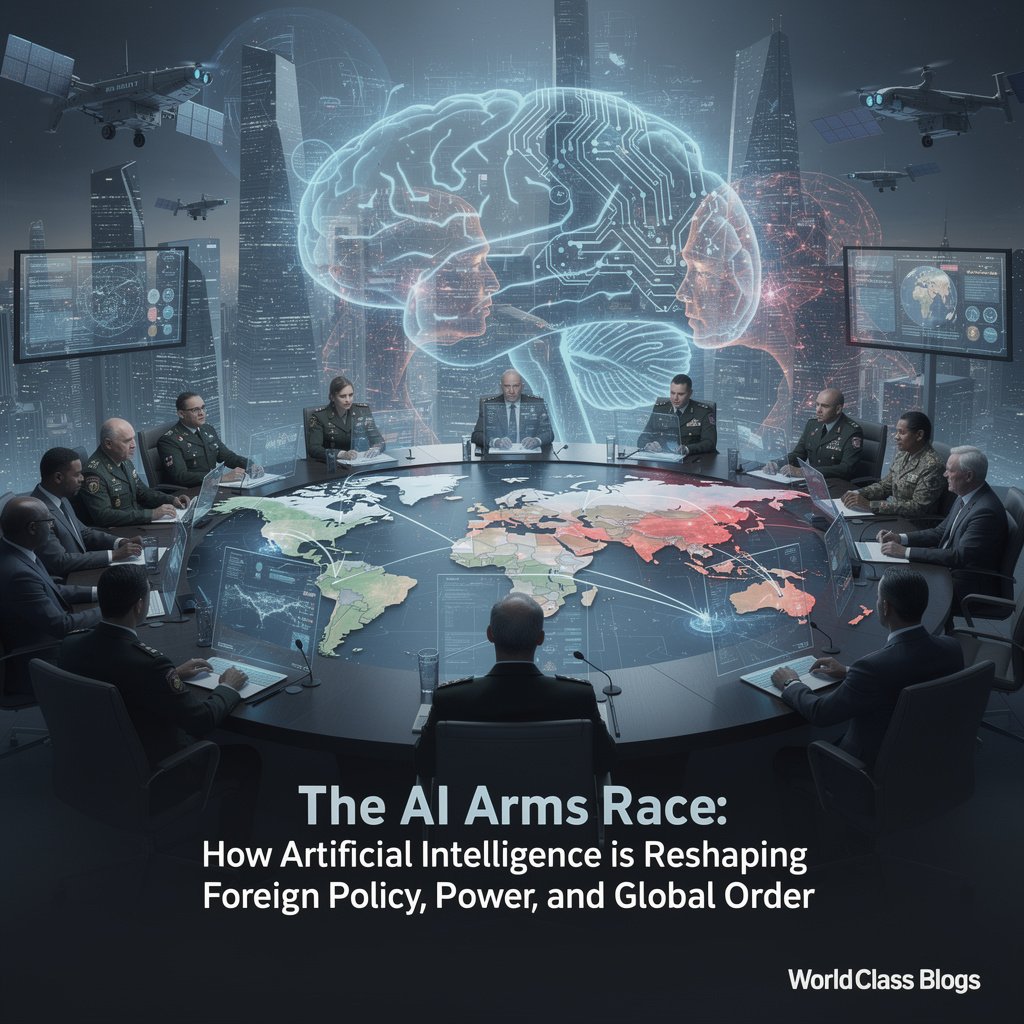
The integration of Artificial Intelligence into foreign policy is not a future scenario; it is the operating reality of the 2020s. The race for AI supremacy is restructuring alliances, redefining military power, and creating new forms of economic dependency and coercion.
Key Takeaways:
- AI is the New Geopolitical Currency: National power is increasingly measured in talent, data, compute, and algorithms. Control over the AI supply chain—from semiconductors to data lakes—is as strategically vital as control over oil or shipping lanes was in the past.
- The Public-Private Partnership is Redefined: The West, led by the U.S., is witnessing a “Hamiltonian” merger of state and tech capital. In China, the state directs through civil-military fusion. Both models seek to harness innovation for national power, blurring traditional lines.
- The Battle is Multi-Domain and Asymmetric: Competition spans economics (investment, standards), military (autonomous systems, cyber), and governance (digital authoritarianism vs. ethical AI). Gray zone conflict powered by AI—disinformation, cyber-attacks, economic manipulation—is the new normal.
- Sustainability is the Next Frontier: The breakneck pace of model scaling faces physical limits (energy, chips) and political limits (public trust, social disruption). The nations that develop efficient, trusted, and broadly beneficial AI systems will have a more durable advantage.
- No Nation is an Island: Even for leaders, alliances and partnerships based on shared technology standards and secure supply chains are critical. The future may see a world of competing “tech spheres of influence.”
The path forward demands not just technological prowess but strategic foresight, ethical guardrails, and international dialogue. For professionals and curious observers alike, developing AI literacy is now a core component of understanding global affairs. The nations that succeed will be those that can innovate rapidly while wisely governing the world-altering power they are creating.
FAQs (Frequency of Asked Questions)
1. Q: I’m new to this topic. Is the AI arms race really like the nuclear arms race?
A: There are parallels but important differences. Like the nuclear race, it’s a high-stakes competition between great powers seen as vital to national survival. However, AI is diffuse, commercial, and dual-use. It’s not a single weapon but a pervasive capability developed largely by private companies. The “deterrence” concept is also more complex and untested.
2. Q: What is the single most important advantage the U.S. has over China in AI?
A: Most analysts point to its ecosystem of innovation: world-class research universities, a deep pool of venture capital, a culture of entrepreneurial risk-taking, and the ability to attract top global talent. This has historically allowed it to lead in breakthrough, foundational innovations.
3. Q: What is China’s biggest advantage?
A: Scale and alignment. China’s vast population generates immense data, a key fuel for AI. Furthermore, its state-led model can direct enormous resources toward strategic goals without the same level of public debate or regulatory hurdles faced by Western companies, particularly in sensitive areas like surveillance.
4. Q: Could a “AI non-proliferation treaty” work, like the Nuclear Non-Proliferation Treaty (NPT)?
A: It’s extremely challenging. The dual-use, software-based nature of AI makes it nearly impossible to monitor and verify. The “know-how” is in papers and code, not easily observable facilities. Current efforts are focused on more pragmatic confidence-building measures, export controls on specific hardware (chips), and non-binding principles for responsible use, especially in military applications.
5. Q: How is AI changing espionage and intelligence?
A: Profoundly. AI automates the sifting of Open-Source Intelligence (OSINT)—social media, satellite imagery, financial records—finding needles in haystacks. It can also generate deepfake personas for disinformation or to recruit assets. Conversely, AI-powered cybersecurity tools are used to defend against such intrusions. The spy game has become a contest of algorithms.
6. Q: What is “compute” and why is it so geopolitical?
A: “Compute” refers to the raw processing power (measured in operations per second) needed to train large AI models. It requires the most advanced semiconductors (chips), which are designed in a few places (U.S., U.K., Taiwan) and manufactured in even fewer (Taiwan, South Korea). Controlling access to these chips, via tools like the U.S. Commerce Department’s Entity List, is a primary tool of AI statecraft.
7. Q: Are we headed for a world where AI starts a war by accident?
A: The risk is taken seriously. The concern is not about a “Skynet” scenario, but about escalation spirals. For example, if two AI-powered cyber defense systems interact unpredictably, or if an automated sensor system misinterprets data and recommends a kinetic response with little time for human oversight. Militaries are intensely studying this problem of “human-in-the-loop” command.
8. Q: How does climate change intersect with the AI race?
A: In two major ways. First, AI is a tool for climate science and green tech (optimizing grids, modeling climate impacts). Second, it is a massive consumer of energy and water. The sustainability of building ever-larger data centers is a major point of tension. A nation’s AI ambitions are now part of its energy security calculus.
9. Q: What is “algorithmic warfare”?
A: It’s a broad term for using AI to gain an advantage in information spaces. This includes:
* Computational Propaganda: Using bots and AI-generated content to manipulate public opinion.
* Social Network Analysis: Mapping and influencing communities online.
* “Fog of War” Generation: Using deepfakes to create confusion and distrust during a conflict. It’s a key aspect of modern hybrid warfare.
10. Q: Can a small country be a player in the AI race, or are they just spectators?
A: They can be niche players or “swing states.” They may not build frontier models, but they can excel in specific applications (e.g., Israel in cybersecurity AI, the Netherlands in agricultural AI). They can also leverage their position in supply chains (e.g., rare earth minerals) or their legal systems to shape global rules, as the EU does with regulation.
11. Q: What does “open-source” mean in AI, and is it a security risk?
A: It means releasing a model’s architecture and trained “weights” for anyone to use, modify, and distribute. It drives innovation and standardization, but also allows malicious actors (from rogue states to criminals) access to powerful tools. Governments are grappling with how to manage this trade-off between openness and security.
12. Q: How is AI affecting economic development in poorer countries?
A: There’s a major risk of an “AI divide.” Without investment in digital infrastructure, education, and local R&D, developing nations risk becoming mere data colonies and markets for foreign AI products. However, AI also offers “leapfrog” potential in areas like mobile banking, telemedicine, and precision agriculture if access and training are prioritized.
13. Q: What is the role of the United Nations in all this?
A: The UN is a forum for dialogue, but struggles with the pace of tech and geopolitical divides. Its main roles are:
* Setting Norms: Through agencies like the ITU and UNESCO.
* Facilitating Dialogue: Bringing parties together on issues like lethal autonomous weapons.
* Using AI for Its Missions: In peacekeeping, humanitarian aid, and development work. However, its ability to enforce binding rules is limited.
14. Q: What’s the difference between AI in consumer products and AI for national security?
A: Consumer AI (like a recommendation algorithm) prioritizes engagement, convenience, and profit. National security AI prioritizes reliability, security, explainability, and strategic effect. The underlying tech may be similar, but the requirements for testing, robustness against attack, and oversight are vastly more stringent for security applications.
15. Q: Are tech companies becoming more powerful than some governments?
A: In certain domains—data collection, cutting-edge R&D, global platform reach—the largest tech firms rival mid-sized states in resources and influence. The new “Hamiltonian” partnership is, in part, an attempt by the U.S. government to harness and direct that corporate power toward national goals, rather than be subject to it. It’s a renegotiation of power.
16. Q: What is “AI safety” and why do policymakers care?
A: AI safety research focuses on ensuring AI systems do what we intend, are robust against misuse or hacking, and can be controlled if they behave unexpectedly. For policymakers, it’s not science fiction; a flawed AI in a financial system, power grid, or military sensor could cause catastrophic real-world harm. Investing in safety is seen as a prerequisite for deploying powerful AI.
17. Q: How is the AI race impacting global trade?
A: It’s fueling protectionism and “friend-shoring.” Nations want to keep their AI intellectual property and talent at home while securing resilient supply chains for chips and critical minerals with allies. This is leading to techno-blocs and a fragmentation of the global internet and tech markets.
18. Q: What is “Explainable AI (XAI)” and why is it a foreign policy issue?
A: XAI aims to make AI decision-making processes understandable to humans. In military or diplomatic contexts, if an AI system recommends an action (e.g., a sanctions target), policymakers need to understand why to be accountable and avoid mistakes. A lack of explainability can erode trust among allies and make AI tools politically unusable in high-stakes situations.
19. Q: Can AI help with diplomacy and conflict resolution?
A: Potentially, yes. AI can be used for:
* Scenario Modeling: Simulating outcomes of different negotiation strategies.
* Language Translation: Breaking down barriers in real-time.
* Monitoring Agreements: Using satellite imagery and data analysis to verify ceasefire or environmental compliance. However, the human elements of trust, empathy, and creative compromise remain irreplaceable.
20. Q: What should I, as an informed citizen, watch for in the news to track this issue?
A: Watch for:
* Major AI Model Releases: Who is releasing what capability?
* Semiconductor Policy: New export controls or breakthroughs in manufacturing.
* Defense Contracts: Which company is winning big Pentagon deals for AI?
* International Summits: Like the G7 or UN meetings, where AI governance is discussed.
* Incidents: Cyber-attacks, deepfake scandals, or drone incidents with an AI component.
About the Author
Sana Ullah Kakar / World Class Blogs Team is a foreign policy analyst with a decade of experience at the intersection of technology and international relations. Previously, they worked with think tanks and advisory firms, focusing on geopolitical risk assessment in the tech sector. They hold a master’s degree in International Security and are a frequent commentator on the strategic implications of emerging technologies. Their writing aims to bridge the gap between technical innovation and strategic policy-making for a broad audience.
Connect with our team and explore more content on World Class Blogs:
- Our Focus: Discover our mission and editorial standards at Our focus.
- Technology & Innovation: Dive deeper into AI and machine learning at https://worldclassblogs.com/category/technology-innovation/artificial-intelligence-machine-learning/.
- All Blogs: Browse our full repository of analysis at https://worldclassblogs.com/category/blogs/.
Free Resources
To continue your learning, here are some high-quality, free resources:
- The AI Index Report (Stanford HAI): The most comprehensive annual report tracking AI development. The 2025 report is an indispensable data source.
- U.S. Government AI Resources:
- The National AI Initiative Office: https://www.ai.gov/
- The Office of the Director of National Intelligence’s AI-related publications.
- European Union AI Act Portal: Follow the implementation of the world’s first major comprehensive AI law.
- CSIS Technology Policy Program: The Center for Strategic and International Studies produces excellent, accessible reports on the geopolitics of tech.
- The UN’s “Our Common Agenda” Policy Brief on Global Digital Cooperation: A look at multilateral efforts to govern digital spaces.
- For a broader understanding of global systems, consider reading The Complete Guide to Global Supply Chain Management at The Daily Explainer to see how AI is revolutionizing logistics and trade.
- For insights on the strategic alliances shaping this field, the guide The Alchemy of Alliance at Shera Kat Network provides a valuable parallel perspective.
Discussion
The central dilemma for democratic societies: How do we compete effectively in a high-stakes technological race with an authoritarian rival without sacrificing the openness, ethical safeguards, and democratic oversight that define our societies?
Is the current fusion of state and corporate power in the U.S., the so-called “Hamiltonian shift,” a necessary adaptation for survival, or does it risk creating an unaccountable techno-nationalist complex? Can frameworks for “ethical AI” become a source of strength and soft power, or are they a competitive handicap in a raw struggle for dominance?
The answers to these questions will define not only who leads in AI but also what kind of world that leadership will create. We invite your thoughtful comments and perspectives below.
To be part of deeper conversations on shaping a better future, visit our Nonprofit Hub at https://worldclassblogs.com/category/nonprofit-hub/. To learn more about who we are, see https://worldclassblogs.com/about-worldclassblogs/. We welcome your feedback and inquiries at https://worldclassblogs.com/contact-us/.