The AI-Powered Marketer: Integrating Generative AI into Your SEO and Content Workflow
Stop fearing AI. Learn how to integrate generative AI into your SEO & content workflow. Step-by-step strategy, prompt engineering, tools, and ethics for marketers. Future-proof your skills. generative AI for marketing, SEO AI tools, prompt engineering, AI content creation, human-in-the-loop, marketing workflow automation, ChatGPT for marketers, AI in digital marketing, AI-powered SEO, content marketing AI, marketing AI ethics, AI hallucinations, Jasper AI, Claude AI, marketing efficiency, how to use AI for content marketing 2025, best AI tools for SEO, prompt engineering examples for marketers, how to integrate AI into marketing workflow, ethical guidelines for AI in marketing, does Google penalize AI content, AI for marketing personalization.

The symbiotic workflow: How human direction and AI execution interact at each stage of the marketing process.
Introduction – Why This Matters
A seismic shift is happening in digital marketing. The tools we use are no longer just dashboards and spreadsheets; they are becoming creative and analytical partners. Generative AI—technology that can create text, images, and ideas—is moving from a futuristic novelty to a core component of the modern marketer’s toolkit. But here’s the critical misunderstanding: AI is not here to replace marketers. It’s here to augment human creativity and strategy, freeing us from repetitive tasks and elevating our work.
For the curious beginner, this is an invitation to start on a level playing field with seasoned pros. For the professional needing a refresher, this is a strategic imperative to stay relevant and radically improve efficiency. In my experience, the marketers and SEOs who thrive will be those who learn to direct AI like a conductor leads an orchestra—harnessing its power while providing the essential human direction, nuance, and strategic oversight. This article is your guide to becoming that conductor.
Background / Context: From Science Fiction to Marketing Reality
The journey to AI in marketing began with predictive analytics and chatbots. However, the public release of large language models (LLMs) like OpenAI’s ChatGPT in late 2022 acted as a big bang, democratizing access to powerful generative tools. Suddenly, every marketer could experiment with AI for ideation, drafting, and analysis.
Initially, the reaction was polarized: excitement about unprecedented productivity clashed with fear of job displacement and concerns over generic, “soulless” output. The market quickly matured. We’ve moved past the phase of simple Q&A with a chatbot. Today, the conversation is about workflow integration—seamlessly weaving specialized AI tools into every stage of the marketing process, from research to creation to optimization. Platforms like Jasper, Copy.ai, and Frase evolved from simple text generators into full suites, while new entrants like Claude and perplexity.ai pushed the boundaries of research and reasoning. For a deeper look at the underlying technology, you can explore our archive on artificial intelligence and machine learning.
The context now is one of strategic augmentation. The goal isn’t to have AI write your entire blog post. It’s to use AI to research faster, overcome creative block, personalize at scale, and analyze data in plain language, allowing you to focus on high-level strategy, brand voice, and authentic connection.
Key Concepts Defined
- Generative AI: A type of artificial intelligence that can generate new content—including text, images, audio, and synthetic data—based on the patterns it has learned from existing data.
- Large Language Model (LLM): The engine behind most text-based generative AI (e.g., GPT-4, Claude 3). It’s a deep learning algorithm trained on vast amounts of text data to understand, summarize, translate, and generate human-like text.
- Prompt Engineering: The skill of crafting precise instructions and questions (prompts) to guide an AI tool to produce the most useful and accurate output. It’s less about coding and more about clear, strategic communication.
- AI Hallucination: A phenomenon where a confident AI generates factually incorrect, nonsensical, or fabricated information. A critical reason why human fact-checking and oversight are non-negotiable.
- Workflow Integration: The process of embedding AI tools into existing marketing and SEO processes (e.g., using an AI SEO tool within your content calendar platform) to create a seamless, efficient pipeline.
- Human-in-the-Loop (HITL): A model where AI handles repetitive, data-heavy tasks, but a human expert remains central to making final decisions, providing creative direction, and ensuring quality and ethics.
- AI-Powered SEO Tool: Specialized software that uses AI and machine learning to enhance traditional SEO tasks. Examples: AI for keyword clustering (MarketMuse), content gap analysis (Frase), or backlink prospecting (BuzzStream).
How It Works: The AI-Augmented Marketing Workflow (Step-by-Step)
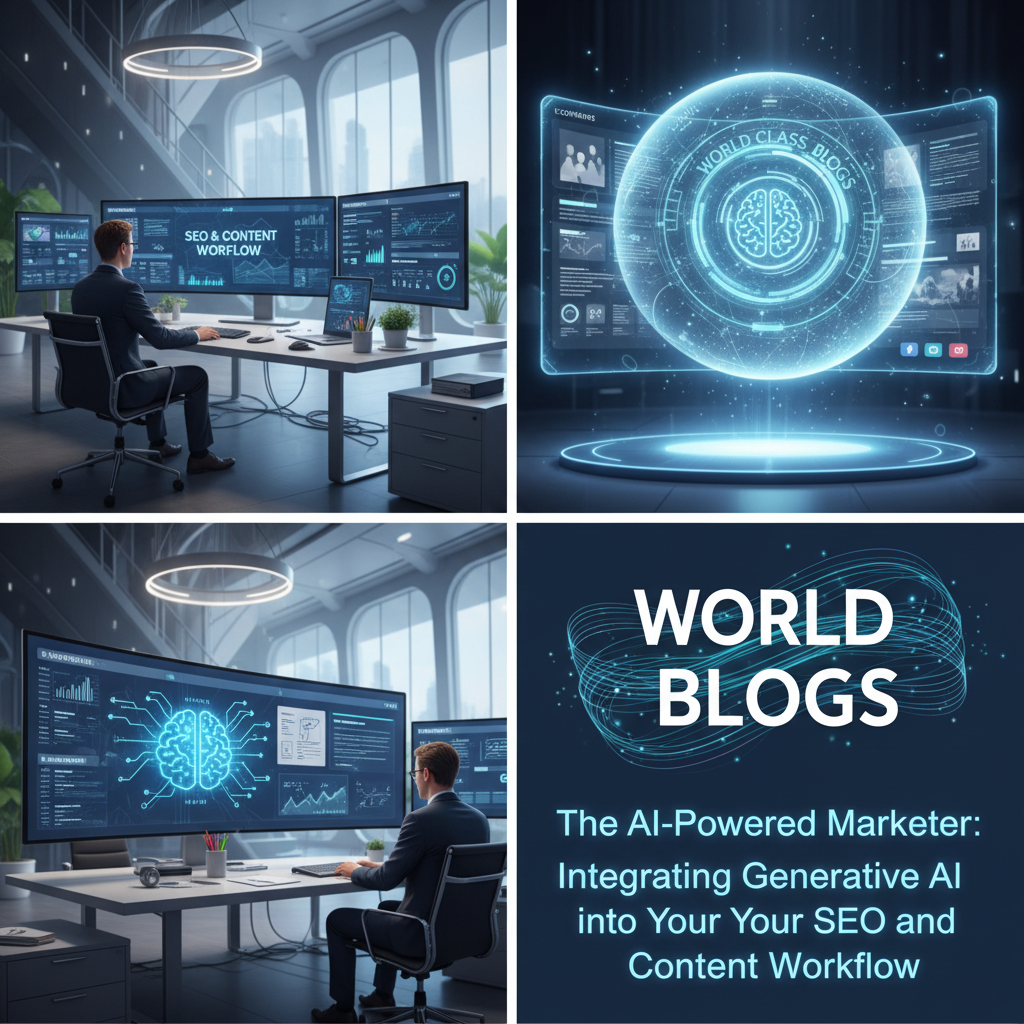
Integrating AI isn’t about one magical tool; it’s about enhancing each phase of your workflow. Here’s a step-by-step breakdown of a modern, AI-powered process.
Phase 1: Strategic Planning & Research
- Tool Example: perplexity.ai, ChatGPT with Browse plugin, SEO tools with AI insights (Ahrefs, SEMrush).
- The Human+AI Process:
- Market & Audience Insight: Instead of endless Google searches, you prompt an AI: “Act as a market researcher. Summarize the key pain points and content consumption habits of [Your Target Persona] in the [Your Industry] space in 2025. Cite recent sources.” The AI provides a synthesized summary, which you then verify and deepen.
- Keyword & Topic Ideation: Go beyond seed keywords. Ask your AI SEO tool or ChatGPT: “Cluster these 50 seed keywords around [Core Topic] into 5-7 thematic topic clusters for a pillar page strategy.” Or, “Generate 10 long-tail question keywords for the search intent ‘commercial investigation’ around [Product].”
- Competitor Content Gap Analysis: Use AI-powered tools to analyze the top 10 ranking pages for your target keyword. The tool can summarize common themes, identify missing subtopics, and suggest angles your content can cover more comprehensively.
Phase 2: Content Creation & Drafting
- Tool Example: Claude for long-form, Jasper for brand-voice consistency, ChatGPT for brainstorming.
- The Human+AI Process:
- Overcoming the Blank Page: Prompt: “Based on this outline [paste outline], write a compelling introduction paragraph that highlights the key problem for [audience] and promises a actionable solution.”
- Expanding and Drafting: Use AI to write first drafts of specific sections, especially those that are more explanatory or data-summarizing. Crucial Prompt Tip: “Write this section in a [professional/concise/conversational] tone, for an audience of [beginners/experts]. Include 3 key points with brief explanations.”
- Human Synthesis & Voice: This is where you take the wheel. Edit the AI draft aggressively. Inject personal anecdotes, brand-specific examples, and unique insights. Rearrange paragraphs for better flow. The AI provides the raw material; you sculpt it into a finished piece with soul and authority. As with any business endeavor, the foundation matters; for those building an online presence, a solid starting guide can be invaluable.
Phase 3: Optimization & Enhancement
- Tool Example: Frase, SurferSEO, Clearscope.
- The Human+AI Process:
- On-Page SEO Optimization: Plug your draft into an AI-powered SEO content editor. It will analyze top-ranking pages and give you specific, real-time suggestions: “Include the keyword ‘sustainable sourcing’ in an H2 heading,” or “Your content depth score is 70; add a section about common implementation challenges to reach 85.”
- Content Upcycling: Prompt AI to repurpose your core pillar article. “Turn the key points from this 2000-word blog post into a script for a 5-minute LinkedIn video,” or “Create a 10-tweet thread summarizing the main takeaways.”
- Personalization at Scale: Use AI to generate multiple email subject line variants, meta description options, or ad copy tailored to different segments of your audience, then A/B test the best.
Phase 4: Distribution & Engagement
- Tool Example: ChatGPT for social copy, Taplio for LinkedIn, Opus Clip for turning long videos into shorts.
- The Human+AI Process:
- Social Media Snippets: “Create 5 engaging social media posts (for LinkedIn, Twitter, and Facebook) to promote this article. Each post should have a different hook (statistic, question, story).”
- Community Engagement: Use AI to help draft thoughtful responses to comments or forum questions, ensuring you stay engaged without spending hours crafting each reply. (Always personalize the final response!).
Phase 5: Analysis & Iteration
- Tool Example: Google Gemini for Analytics insights, ChatGPT Advanced Data Analysis.
- The Human+AI Process:
- Plain Language Reporting: Upload a CSV of your Google Analytics data and ask: “Identify the top 3 content pieces driving marketing-qualified leads and hypothesize why they are performing well.”
- Generating Hypotheses: “Based on the Q4 performance data, suggest 3 testable hypotheses for improving click-through rate on our category pages.”
Key Takeaway Box: The AI-Human Partnership
AI is the ultimate intern: incredibly fast, knowledgeable, and never sleeps. But you are the director. Your role is to provide the creative brief (prompt), edit the work, ensure it aligns with brand strategy, and make the final ethical call. The magic happens in the edit, not the generation.
Why It’s Important: The Competitive Imperative
Ignoring AI in your digital marketing strategy is no longer an option for businesses that want to remain competitive. Its importance is multifaceted:
- Exponential Efficiency Gains: AI automates the most time-consuming parts of marketing—research, initial drafting, data crunching. What used to take a week can now take a day, allowing you to scale content output or reallocate time to deep strategy and creativity.
- Enhanced Quality and Depth: AI tools help you create more comprehensive, SEO-optimized, and data-informed content by ensuring you cover topics thoroughly and match search intent, directly boosting your search engine rankings.
- Democratization of Expertise: A solo entrepreneur or small team can now access capabilities that were once the domain of large agencies with big data teams, leveling the playing field.
- Personalization at Scale: AI makes it feasible to tailor messaging and content to different audience segments without manual, unscalable effort, improving engagement and conversion rates.
In my experience, the teams that adopt AI aren’t just working faster; they’re working smarter. They test more ideas, personalize more campaigns, and uncover insights hidden in their data, leading to better overall performance.
Sustainability in the Future
The future of AI in marketing is not just more powerful models, but more sophisticated and responsible integration.
- Vertical-Specific AI Tools: We’ll see a rise in AI tools built exclusively for niche marketing verticals (e.g., AI for real estate lead gen, AI for nonprofit donor communications), offering deeper, more relevant functionality. Our nonprofit hub will be tracking these developments closely.
- The Rise of Autonomous Agents: Beyond chatbots, we’ll see AI “agents” that can execute multi-step workflows with minimal supervision—e.g., an agent that researches a topic, outlines an article, drafts it, sources images, and suggests a publishing time, all based on a single high-level goal.
- Integrated Model Ecosystems: Marketing platforms (like HubSpot, Shopify) will deeply bake generative AI into every module, from CRM to email to ads, creating a unified, intelligent marketing brain for your business.
- Ethical and Authentic AI Use as a Brand Differentiator: As AI-generated content floods the web, brands that are transparent about their AI use and double down on unique human perspective, experience, and storytelling will stand out. Trust (E-E-A-T) will become even more critical.
- Regulation and Standardization: Expect clearer guidelines around AI disclosure, copyright of AI-generated works, and data privacy. Sustainable AI use will mean operating within these emerging ethical and legal frameworks.
Common Misconceptions
- Misconception 1: “AI will replace marketers and writers.”
- Reality: AI replaces tasks, not roles. It automates drafting and research, but strategy, brand voice, creative direction, emotional intelligence, and ethical judgment are profoundly human skills that AI cannot replicate. The marketer’s role elevates from creator to editor and strategist.
- Misconception 2: “AI-generated content is low quality and penalized by Google.”
- Reality: Google’s stance is that it rewards helpful content, regardless of how it’s created. The issue isn’t the tool but the output. Mass-produced, unedited, spammy AI content will fail. Well-directed, expert-edited, human-refined AI content that serves users can perform excellently. Google penalizes poor quality, not a specific tool.
- Misconception 3: “Using AI is cheating or unethical.”
- Reality: Using a calculator isn’t cheating at math; it’s using a tool for efficiency. The ethical line is crossed when you use AI to plagiarize, spread misinformation, or deceive your audience about the origin of the content. Transparency and maintaining editorial standards are key.
- Misconception 4: “You need to be a tech expert to use marketing AI.”
- Reality: Modern AI tools are designed with user-friendly interfaces. The core skill is prompt engineering—clear communication—which any competent marketer already possesses. The learning curve is about new workflows, not coding.
- Misconception 5: “AI ideas are generic and lack creativity.”
- Reality: AI is an exceptional brainstorming partner. When given a creative prompt (e.g., “Give me 10 metaphor-based headlines for a cybersecurity service”), it can produce a volume of ideas that would take a human hours, sparking new creative directions you might not have considered alone.
Recent Developments (2024-2025)
- Multimodal AI Becomes Standard: Models like GPT-4V and Gemini can now process and generate text, images, and audio within a single prompt. For marketers, this means generating a social media post with a matching image concept in one step.
- AI Search Changes the Game: Google’s Search Generative Experience (SGE) and AI-powered competitors like perplexity.ai are changing how users find information. Marketers must now optimize content not just for keywords, but to be featured as a cited source within these AI-generated answers.
- “Small Language Models” (SLMs): Companies like Microsoft are developing more efficient, specialized models that run locally on devices. This could lead to faster, cheaper, and more private AI marketing tools.
- AI Content Detection Falters: Tools designed to detect AI-written text have proven highly unreliable. The focus is shifting from detection to valuing quality and experience, reinforcing the need for strong human editing.
- Video Generation Takes Off: Tools like Runway ML, Pika, and OpenAI’s Sora are making high-quality AI video generation accessible. This will revolutionize content marketing for social media, ads, and explainer videos.
Success Stories & Real-Life Examples
Case Study: The E-commerce Brand Scaling Content
A direct-to-consumer home goods brand used AI to tackle a massive SEO project: creating detailed, helpful product category guides (e.g., “The Ultimate Guide to Choosing a Mattress”).
- Process: They used an AI research tool to analyze top-ranking guides and extract a master outline. Using this, they prompted an LLM to draft comprehensive sections on materials, firmness, sizing, etc. Their human editors then spent their time injecting unique customer testimonials, proprietary data from their reviews, and brand-specific design philosophy.
- Result: They reduced the time to produce a 3,000-word, SEO-rich guide from 40 hours to 12. This allowed them to launch 15 such guides in a quarter, covering their entire product range. Organic traffic to their category pages increased by 150% within 6 months, directly attributable to this content.
Real-Life Example: The Agency’s Personalization Engine
A digital marketing agency for B2B tech clients used AI to supercharge its LinkedIn lead generation.
- Process: For a target account list, they used AI to scrape and synthesize recent news, funding announcements, and executive interviews. They then prompted an AI to generate 3-5 personalized icebreaker comment ideas for each company’s recent LinkedIn posts, focusing on insightful commentary rather than sales pitches.
- Result: The account executives used these AI-generated talking points as a starter, adding their own voice. This led to a 300% increase in meaningful engagement (comments starting conversations) and a significant shortening of the sales cycle, as outreach was deeply relevant and timely.
Conclusion and Key Takeaways
The integration of generative AI into digital marketing is not a passing trend; it is a fundamental upgrade to our professional toolkit. Resistance is a path to obsolescence, while mastery is a path to unprecedented creativity and impact.
Final Takeaways:
- Adopt a “Human-in-the-Loop” Mindset: You are the strategist and editor. Use AI for heavy lifting, not for autonomous decision-making.
- Invest in Prompt Engineering Skills: The quality of your AI output is directly proportional to the quality of your input. Learn to write clear, contextual, and strategic prompts.
- Start with a Single Workflow: Don’t boil the ocean. Integrate AI into one repetitive task first (e.g., meta description writing, email subject line generation). Master it, then expand.
- Double Down on What Makes You Human: As AI handles more creation, your unique experience, stories, ethical judgment, and strategic vision become your most valuable assets. Forge strong partnerships, as outlined in guides on strategic alliances, to amplify this human advantage.
- Prioritize Editing and Fact-Checking: Never publish AI output verbatim. Assume there are “hallucinations.” Your final edit is what separates useful content from digital noise.
The future belongs to marketers who are not afraid of the tool, but who learn to wield it with wisdom and intention. For more insights into the evolving digital landscape, keep an eye on our primary focus areas.
FAQs
1. What is the best AI tool for marketers just starting out?
Begin with a versatile, low-cost LLM interface like ChatGPT Plus or Claude. They are excellent for learning prompt engineering across a wide range of tasks. Once you understand the basics, explore specialized tools for specific jobs (e.g., SurferSEO for content optimization).
2. How can I ensure my AI-assisted content still sounds like my brand?
Create a brand voice guide document. Feed this document to your AI tool and instruct it to “analyze this brand voice guide and apply its tone, style, and terminology to all subsequent responses.” Also, always do a final human read-aloud edit to catch any phrasing that sounds “off-brand.”
3. Does Google penalize websites for using AI-generated content?
Officially, Google’s helpful content system targets content created primarily for search engines, not people, regardless of how it’s made. Mass-produced, low-quality AI content will be caught. High-quality, human-edited, helpful content—whether AI-assisted or not—is what Google rewards. Focus on quality and EEAT.
4. What are the ethical lines I shouldn’t cross with AI in marketing?
- Deception: Passing off fully AI-generated content as purely human-written without disclosure (where expected).
- Plagiarism: Using AI to rephrase someone else’s copyrighted work without attribution.
- Misinformation: Publishing AI-generated statements without fact-checking, especially in sensitive domains like health or finance.
- Impersonation: Using AI to generate content in the style of a real person without their consent.
5. How do I write a good prompt for marketing content?
Use the C.R.E.A.T.E. framework:
- Context: Set the scene. (“You are an expert B2B content strategist…”)
- Role: Define the AI’s role. (“…writing for a CEO audience…”)
- Expectation: State the goal. (“…to draft a blog post introduction that highlights the strategic value of AI.”)
- Action: Give the specific task. (“Write a 150-word paragraph.”)
- Type: Specify format/tone. (“Use a professional but conversational tone.”)
- Examples: Provide a sample if possible. (“Similar to this style: [paste example].”)
6. Can I use AI for SEO keyword research?
Yes, exceptionally well. Use it to:
- Expand seed keyword lists. (“Generate 50 related keywords and questions for ‘cloud data security’.”)
- Group keywords by search intent. (“Categorize these keywords into informational, commercial, and transactional.”)
- Analyze competitor keyword gaps at a conceptual level.
7. How much does it cost to integrate AI into a marketing stack?
Costs vary widely. You can start with ChatGPT Plus for $20/month. Specialized SEO AI tools range from $50-$300/month. Enterprise-grade suites with deep workflow integration can cost thousands. Begin with one tool, prove ROI, and scale your budget accordingly.
8. What tasks should I never outsource to AI?
- Final strategic decisions.
- Client or customer relationship management.
- Crafting your core brand messaging and values.
- Providing sensitive personal advice (e.g., in health, finance, legal).
- Making ethical judgments on campaign imagery or messaging.
9. How can AI help with content localization and translation?
AI translation tools (like DeepL) are highly advanced. The best practice is to use AI for the first translation pass, then have a native-speaking human editor refine it for cultural nuance, idioms, and local brand voice. This combines speed with authenticity.
10. Will AI kill creativity in marketing?
On the contrary, it has the potential to unleash it. By removing the friction of the blank page and the grind of initial research, AI frees mental space for higher-order creative thinking—big-picture campaign ideas, innovative formats, and deeper storytelling. The tedious part is automated; the creative part is amplified.
11. How do I train my team on using AI tools effectively?
Don’t just give them logins. Run workshops focused on:
- Prompt Engineering Labs: Hands-on sessions crafting prompts for real tasks.
- Workflow Redesign: Mapping out old vs. new, AI-augmented processes for common projects.
- Ethics & Quality Guidelines: Establishing clear team standards for AI use and review.
12. Are there copyright risks with AI-generated images or text?
The legal landscape is evolving. Currently, in many jurisdictions, purely AI-generated works may not have clear copyright protection. There are also lawsuits regarding the training data of AI models. The safest approach for commercial work is to use AI-generated output as a component or inspiration within a larger, human-created work, or to use platforms that offer indemnity for commercial use.
13. Can AI write effective email marketing campaigns?
Yes, for many components. It can generate subject line variants, preview text, and draft body copy for different segments. However, the most effective emails are highly personal and relationship-driven. Use AI for the framework, but inject personal touches, specific client references, and true human empathy.
14. How do I measure the ROI of investing in AI marketing tools?
Track time savings and output quality. Metrics:
- Efficiency: Hours saved per content piece/campaign.
- Output: Increase in content volume without quality drop.
- Performance: Improvement in SEO rankings, engagement rates, or conversion rates on AI-assisted work vs. pre-AI benchmarks.
- Cost: Compare tool cost to value of time saved or incremental revenue.
15. What’s the next big thing in AI for marketing I should watch?
Autonomous AI Agents. These are AI systems that can be given a high-level goal (e.g., “Increase sign-ups for our webinar”) and will independently plan and execute a multi-step campaign across channels, reporting back on results. This moves from task automation to campaign automation.
16. How can a small business or solo entrepreneur compete with AI?
They can win with agility and authenticity. A small business owner can use the same powerful AI tools as a giant corporation. Their advantage is a deep, personal connection to their customer and community. Use AI to handle the “scale” tasks (content, ads) so you can spend more time on the “soul” tasks (customer service, community building).
17. Is my marketing data safe with AI tools?
You must read the privacy policies of each tool. Avoid pasting sensitive, non-public data (customer lists, internal financials, unreleased strategy) into public AI chat interfaces. Opt for enterprise-grade tools that offer data privacy guarantees and do not use your inputs for model training.
18. Can AI help with marketing strategy, not just execution?
Yes, as a brainstorming and analysis partner. You can prompt it to act as a strategy consultant: “Based on these SWOT analysis points [paste], generate 3 potential market penetration strategies for the coming year.” It won’t give you the perfect answer, but it will provide structured, thought-provoking options to refine.
19. How do I stay updated without being overwhelmed?
Follow 2-3 leading marketing technology newsletters (e.g., Marketing Brew, SEJ). Join one dedicated community (like a subreddit or Discord). Experiment with one new tool or technique per quarter. Depth in a few areas is better than shallow knowledge of all.
20. What’s the biggest risk of relying on AI?
Complacency and skill atrophy. The risk isn’t that AI makes a mistake; it’s that you stop double-checking its work, stop doing your own deep thinking, and lose the very expertise that makes you valuable. Always maintain a “trust but verify” stance and continually hone your core marketing skills.
About the Author
Sana Ullah Kakar is the Lead Digital Innovation Strategist at World Class Blogs. With a background spanning computational linguistics and a decade in content marketing, Alex specializes in translating emerging technologies into practical, ethical business applications. They have helped organizations from startups to Fortune 500 companies design human-centric AI marketing workflows. Connect with our team and learn more about our mission on our About Us page.
Free Resources
- The Marketer’s AI Prompt Library: A curated Google Doc of 50+ proven prompts for SEO, content, social media, and email marketing.
- AI Tool Stack Comparison Matrix (2025): A spreadsheet comparing features, pricing, and best use cases for 20+ popular marketing AI tools.
- “Human-in-the-Loop” Workflow Template: A Miro/FigJam board template to map your AI-augmented process for a key marketing project.
- AI Ethics Checklist for Marketers: A one-page guide to ensure responsible AI use in your campaigns.
(These resources are available to our readers. Please visit our contact page to request the access link.)
Discussion
We want to hear from you!
- What’s the first marketing task you successfully augmented or transformed with AI?
- What fears or hesitations do you still have about integrating these tools?
- Have you encountered a situation where AI hindered rather than helped? What did you learn?
- What unique human skill in marketing do you think will become most valuable in the AI age?
Share your experiences and questions below. Let’s build the future of marketing, together.