
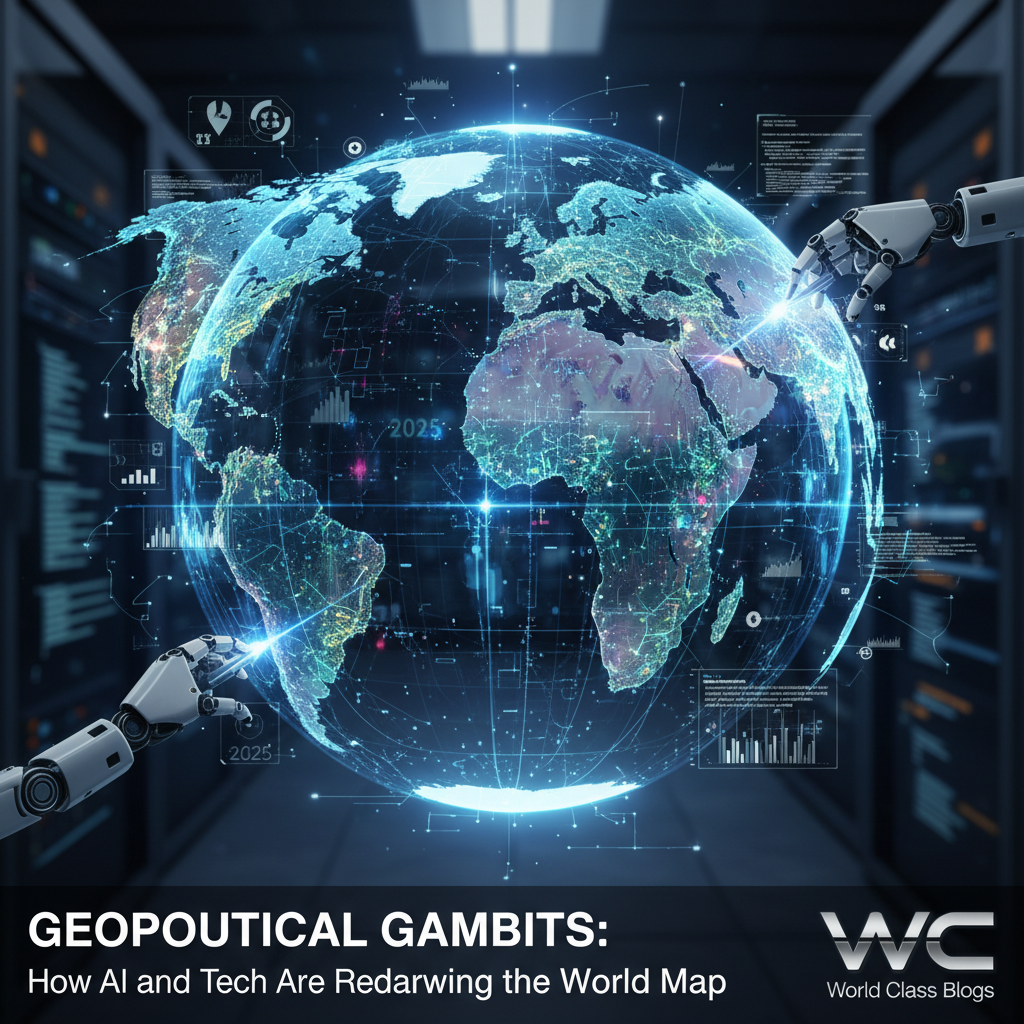
Geopolitical Gambits: How AI and Tech Are Redrawing the World Map in 2025
Discover how AI, cyber warfare, and tech competition between the US and China are reshaping global alliances, economies, and security in this comprehensive geopolitical analysis for 2025. Artificial Intelligence, Geopolitics, US-China Relations, Technology Competition, Cyber Warfare, Semiconductor, AI Governance, Digital Sovereignty, Quantum Computing, Tech Cold War, Supply Chain Security, National Security, Innovation Policy, Critical Minerals, Digital Infrastructure.

The global AI landscape in 2025: Investment patterns and regulatory approaches reveal competing technological blocs and spheres of influence
Introduction – Why Technology Has Become the New Geopolitical Battlefield
If you think geopolitical competition is still primarily about tanks, treaties, and territorial disputes, you’re looking at an outdated map. The most decisive battles of our era are being fought in server farms, semiconductor foundries, and algorithm laboratories. In my experience advising both government and private sector clients on emerging technology risks, I’ve witnessed a fundamental shift: artificial intelligence and associated technologies have moved from being economic enablers to becoming the primary instruments of geopolitical power projection in the 21st century.
The statistics tell a compelling story. Global investment in AI reached an estimated $1.3 trillion in 2025, with governments accounting for a growing percentage of that spending. Meanwhile, the geopolitical landscape has evolved into what analysts term a “technopolar” world—one where technological capabilities increasingly determine national power rankings. This isn’t just about which country can build the fastest computer; it’s about which nations can harness AI for economic dominance, military superiority, and ideological influence.
What does this mean for professionals and curious observers? Whether you’re involved in international business, policy making, investment decisions, or even academic research, understanding these technological undercurrents is no longer optional. A company’s supply chain, a country’s economic strategy, and even regional security alliances are being fundamentally reshaped by decisions made in Silicon Valley, Shenzhen, and Seoul. This article provides a comprehensive framework for understanding how AI and technology have become the new currency of global power, complete with actionable insights for navigating this transformed landscape.
For broader context on how technological shifts impact global systems, consider exploring our analysis of global supply chain management and its evolving challenges.
Background / Context: From Industrial to Intelligence Competition
To understand today’s technological geopolitics, we must recognize how we moved from an era of industrial competition to one of intelligence competition. The 20th century was defined by races for industrial supremacy—steel production, automobile manufacturing, and eventually computing hardware. The digital revolution of the 1990s and 2000s created the foundation, but it was viewed largely through an economic lens.
The turning point came in the mid-2010s, when several converging trends created today’s technological Cold War:
- China’s Technological Ascent: The publication of China’s “Made in China 2025” plan in 2015 marked a watershed moment. For the first time, a strategic competitor announced its intention not just to compete in, but to lead in foundational technologies including artificial intelligence, quantum computing, and biotechnology. This explicitly linked technological development with national rejuvenation.
- AI’s Dual-Use Breakthroughs: Between 2012 and 2018, advances in deep learning demonstrated that AI had not just commercial but profound military and security applications. From autonomous weapons to cyber warfare to mass surveillance, the same technologies powering recommendation algorithms could be repurposed for national security ends.
- The Semiconductor Supply Chain Crisis: The pandemic-era chip shortage exposed a critical vulnerability: approximately 92% of the world’s most advanced semiconductors (below 10 nanometers) were manufactured in a single jurisdiction—Taiwan. This transformed semiconductor manufacturing from an economic concern to an urgent national security priority for multiple nations.
- The Data Revolution: As data became “the new oil,” control over data flows, storage, and processing emerged as a new dimension of sovereignty. The European Union’s GDPR (2018), China’s Cybersecurity Law (2017), and various national data localization requirements created competing visions of digital governance.
What I’ve found in tracking these developments is that we’re witnessing what historian Melvin Kranzberg might have called a sixth “law of technology”: Technology is neither good nor bad, but it is never neutral in geopolitical terms. The same AI system that improves medical diagnosis in one country becomes a tool for social control in another. The same semiconductor that powers smartphones in peacetime guides precision missiles in conflict.
Key Concepts Defined
Navigating this complex landscape requires understanding its specialized vocabulary:
- Technological Sovereignty: The capacity of a state to exercise control over its digital infrastructure, data flows, and technological supply chains without excessive dependence on foreign entities. The EU’s push for “digital sovereignty” exemplifies this concept.
- Dual-Use Technologies: Technologies that have both civilian and military applications. AI, quantum sensing, biotechnology, and advanced materials increasingly fall into this category, blurring traditional boundaries between commercial and defense sectors.
- Compute Governance: Emerging regulatory frameworks focused on controlling access to the immense computing power required to train frontier AI models. The U.S. export controls on advanced AI chips to China represent an early form of compute governance.
- Algorithmic Warfare: The use of AI and autonomous systems in conflict, encompassing everything from drone swarms to AI-enhanced cyber attacks to algorithmic disinformation campaigns. The conflict in Ukraine has served as a testing ground for many such technologies.
- Splinternet: The fragmentation of the global internet into separate, incompatible spheres governed by different rules, standards, and ideologies. Often discussed in the context of a potential division between a U.S.-led internet and a China-led internet.
- Critical and Emerging Technologies (CETs): A government-designated list of technologies deemed essential to national security. The U.S., EU, Australia, and other allies have developed aligned but slightly different CET lists, typically including AI, quantum, biotechnology, and advanced semiconductors.
Key Takeaway: The vocabulary of tech geopolitics is evolving as rapidly as the technologies themselves. Understanding these terms is essential for parsing policy discussions and strategic documents from governments and international organizations.
How It Works: The Mechanisms of Tech Geopolitics (A Step-by-Step Breakdown)
Step 1: Technological Discovery and Research
The competition begins in laboratories and research institutions. Government funding plays a crucial role, with China announcing $50 billion in AI research funding through 2025 and the U.S. CHIPS and Science Act allocating $280 billion for semiconductor research and manufacturing. National strategies increasingly prioritize foundational research in quantum, AI, and biotechnology with explicit geopolitical objectives.
Step 2: Talent Acquisition and Retention
With an estimated global shortage of 1 million AI specialists, the competition for human capital is intense. Nations employ various strategies: streamlined immigration for specialists (U.S., Canada), large-scale domestic training programs (China’s plan for 500,000 AI undergraduates by 2025), and, concerningly, intellectual property theft and talent recruitment campaigns.
Step 3: Industrial Policy and Supply Chain Control
Governments intervene directly to shape technological ecosystems. This includes:
- Subsidies: The EU’s €43 billion Chips Act, U.S. CHIPS Act grants, and China’s extensive state-backed investment funds.
- Export Controls: Restrictions on selling advanced technology to strategic competitors. The U.S. has progressively tightened controls on AI chips, chipmaking equipment, and now quantum computing technologies to China.
- Investment Screening: Mechanisms like the U.S. Committee on Foreign Investment (CFIUS) that review foreign investments in sensitive technologies.
Step 4: Standard Setting and Governance Frameworks
Who sets the technical standards and ethical guidelines for emerging technologies gains immense influence. We see competing visions:
- U.S.-led approach: Emphasizes innovation with limited regulation, industry-led standards.
- EU approach: Risk-based regulation (AI Act), emphasis on privacy and fundamental rights.
- China-led approach: State-centric control, integration of technology with social governance objectives.
These competing models are being exported through trade agreements and digital economy partnerships.
Step 5: Military and Security Integration
Technologies are adapted for defense and intelligence purposes. The U.S. Department of Defense’s Joint Artificial Intelligence Center, China’s integration of civilian and military research (军民融合), and NATO’s embrace of emerging technologies exemplify this trend. The battlefield is becoming a laboratory for what I’ve termed “competitive technological adaptation.”
Step 6: Alliance Building and Technological Blocs
Countries are forming technology-specific alliances. The U.S.-EU Trade and Technology Council, the Chip 4 Alliance (U.S., Japan, Taiwan, South Korea), and AUKUS Pillar II (advanced technology sharing between US, UK, Australia) demonstrate how technological cooperation is becoming a cornerstone of geopolitical alliances.
Comparison Table: Major Power Approaches to Tech Geopolitics
| Dimension | United States | China | European Union |
|---|---|---|---|
| Primary Strategy | Innovation protection, alliance-based containment | Technological self-sufficiency, selective globalization | Regulatory power, digital sovereignty |
| AI Focus | Private sector-led, military applications | State-directed, social governance integration | Ethics-first, risk-based regulation |
| Semiconductor Goal | Secure advanced design, reshore manufacturing | Achieve parity in manufacturing, reduce import dependence | Double global market share to 20% by 2030 |
| Data Governance | Sectoral approach, limited federal privacy law | Cybersovereignty, data as state resource | Comprehensive rights-based (GDPR) |
| Alliance Strategy | Create tech-exclusive blocs with allies | Build alternative standards through Belt and Road | Bridge between US and China, assert regulatory influence |
Why It’s Important: The Stakes of Technological Competition
The outcome of this technological competition will determine more than economic rankings—it will shape the future of democracy, human rights, and global stability.
- Economic Dominance: AI and automation could contribute up to $15.7 trillion to the global economy by 2035, according to PwC estimates. The nations that lead in these technologies will capture disproportionate shares of this growth, reshaping global wealth distribution.
- Military Asymmetry: The integration of AI into military systems creates potentially decisive advantages. An AI-enabled military could process sensor data, coordinate forces, and make targeting decisions orders of magnitude faster than human-centric systems. This risks creating what some analysts call “flash wars”—conflicts that escalate too rapidly for human diplomacy to intervene.
- Societal Model Competition: At its deepest level, this is a competition between governance models. The U.S. model emphasizes innovation with relatively light regulation. The Chinese model features state direction and integration of technology with social control. The European model prioritizes human rights and privacy. Whose model proves most successful at harnessing technology while managing its risks will have global ideological consequences.
- Everyday Implications: For businesses, this means navigating conflicting regulations, securing fragile supply chains, and making strategic bets on which technological standards will prevail. For citizens, it means contending with different visions of digital privacy, surveillance, and the role of technology in daily life.
In my consulting work, I’ve seen companies blindsided by how quickly a technological advantage can become a geopolitical liability. A European manufacturer of surveillance cameras found itself caught between U.S. sanctions and Chinese market access requirements. A startup developing encryption technology faced impossible choices between different national security demands. The lesson is clear: in today’s world, technological strategy is inseparable from geopolitical strategy.
Sustainability in the Future: Can This Competition Be Managed?
The current trajectory of technological decoupling and zero-sum competition is economically wasteful and strategically dangerous. However, several factors could lead to more sustainable management of tech competition:
- Mutual Vulnerability: Just as nuclear weapons created a shared interest in avoiding apocalyptic conflict, certain technologies (like offensive cyber capabilities or autonomous weapons) may create mutual vulnerabilities that force cooperation. The 2025 U.S.-China talks on AI risk, while limited, represent a recognition of this dynamic.
- Global Challenges Requiring Cooperation: Climate change, pandemic preparedness, and nuclear proliferation cannot be solved by any single nation. These transnational problems may eventually force collaboration on the underlying technologies needed to address them, from climate modeling AI to biomedical research tools.
- The Rise of Third-Party Powers: Nations like India, the UAE, and Singapore are investing heavily in technology while attempting to maintain strategic autonomy. These “technological swing states” could potentially broker compromises or create alternative frameworks that bridge competitive divides.
- Corporate Resistance to Fragmentation: Global technology companies with operations in multiple jurisdictions have strong economic incentives to resist technological fragmentation. Their lobbying for interoperable standards and against extreme decoupling could moderate nationalist policies.
The most likely scenario for the coming decade is what I term “managed technological competition”—neither full cooperation nor complete decoupling, but a tense coexistence with guardrails to prevent catastrophic conflict. This would resemble the Cold War’s strategic stability concepts, but applied to digital rather than nuclear domains.
Common Misconceptions About Tech Geopolitics
- Misconception 1: “This is just about semiconductors.”
Reality: While semiconductors are the most visible battleground due to their enabling role, the competition spans at least a dozen critical technology stacks including AI algorithms, quantum computing hardware, biotechnology platforms, and clean energy technologies. The semiconductor focus exists because chips currently represent the most significant single point of Western leverage. - Misconception 2: “The U.S. is clearly winning/losing the AI race.”
Reality: The competition is multidimensional and different powers lead in different domains. The U.S. generally leads in foundation model development and venture capital investment. China leads in AI implementation (especially facial recognition and smart cities) and produces more AI research papers. The EU leads in AI regulation and ethics frameworks. Declaring a single “winner” oversimplifies a complex landscape. - Misconception 3: “Export controls will stop China’s technological development.”
Reality: While controls can slow progress and increase costs, history suggests they often spur indigenous innovation. China’s SMIC developed a 7nm chip despite restrictions, and the country is investing an estimated $150 billion in domestic semiconductor capacity through 2027. Controls are more about maintaining a lead than preventing development entirely. - Misconception 4: “This is just a U.S.-China issue.”
Reality: While the superpower competition dominates headlines, middle powers are making crucial decisions that will shape the outcome. South Korea and Taiwan’s semiconductor policies, the Netherlands’ decisions on chipmaking equipment exports, India’s digital public infrastructure model, and the EU’s regulatory approach all independently influence the global technological landscape.
Recent Developments (2024-2025): The Frontier Expands
The past year has seen several developments that have accelerated or altered the trajectory of tech geopolitics:
- Quantum Computing Escalation: In late 2024, the U.S. expanded export controls to include quantum computing components, while China announced it had developed a 1,000-qubit quantum computer (though Western experts questioned its practical utility). This marks the opening of a new front in the technology competition beyond semiconductors and AI.
- The AI Safety Summit Network: Following the initial UK summit in 2023, a series of regional AI safety summits in 2024-2025 have begun creating a patchwork of international dialogue mechanisms. While substantive agreements remain limited, these forums are establishing channels for crisis communication—a small but important step toward managing AI risks.
- Generative AI and Disinformation Elections: The global election supercycle of 2024 (involving over 50 countries) became a testing ground for AI-generated disinformation. Deepfake audio of political leaders, AI-generated imagery of fake events, and automated influence campaigns demonstrated how accessible AI tools have lowered barriers to sophisticated information operations.
- The “Chiplet” Innovation End-Run: As U.S. controls focus on monolithic advanced chips, Chinese firms are innovating with “chiplet” technology—connecting several less advanced chips to approximate advanced capabilities. This exemplifies the dynamic of “innovation under constraints” that may characterize the competition moving forward.
Success Stories and Real-Life Examples
Taiwan’s Semiconductor Pivot: Facing unprecedented geopolitical pressure, Taiwan’s semiconductor industry has executed a sophisticated diversification strategy. While maintaining cutting-edge manufacturing at home, TSMC has accelerated construction of plants in Japan, the United States, and Germany. This “geographical resilience through trusted diversification” model protects Taiwan’s economic crown jewels while reducing the catastrophic risk of concentration. For other technology-dependent economies, this offers a template for reducing single-point vulnerabilities.
Estonia’s Digital Sovereignty Model: A small nation facing large neighbors, Estonia has turned technological innovation into a security strategy. Their X-Road data exchange layer allows secure data sharing across government and private sectors while maintaining citizen control. Their data embassies—server farms in allied countries that host government data—ensure continuity even if territory is compromised. Estonia demonstrates how asymmetric technological strategy can enhance both prosperity and security for smaller states.
The U.S. National Semiconductor Technology Center: Launched in 2024 with $11 billion in CHIPS Act funding, the NSTC represents an innovative public-private partnership model. By creating a shared R&D facility where companies, universities, and government researchers collaborate on pre-competitive challenges, the U.S. aims to overcome fragmentation in the domestic semiconductor ecosystem. Early projects focus on packaging innovations and workforce development—addressing both technical and human capital challenges simultaneously.
What I’ve observed in these cases is that successful technological strategies combine technical excellence with geopolitical awareness. The most effective actors understand that their technological decisions have foreign policy implications, and they structure their innovation ecosystems accordingly.
Conclusion and Key Takeaways
The integration of technology and geopolitics represents one of the most significant transformations in international relations since the advent of nuclear weapons. As we have explored, artificial intelligence, semiconductors, quantum computing, and associated technologies have become central to economic competitiveness, military capability, and ideological influence.
Key Strategic Insights for Navigating Tech Geopolitics:
- Think in Ecosystems, Not Isolated Technologies: Success depends on nurturing complete innovation ecosystems—from fundamental research through talent development to manufacturing and deployment. Nations or companies that excel in one segment but depend on others for critical components remain vulnerable.
- The Talent War is Fundamental: All the investment in infrastructure matters little without the human capital to drive innovation. Strategies must address the full pipeline from STEM education to immigration policy to retention of top researchers.
- Dual-Use is the New Normal: Assume that any significant technological breakthrough will have both civilian and military applications. This necessitates earlier consideration of ethical implications and potential security concerns in the research and development process.
- Alliances Are Technological Architecture: The technology competition is increasingly alliance-based. The ability to build and maintain coalitions around technical standards, supply chains, and research collaboration may prove as important as domestic capabilities.
- Resilience Trumps Efficiency in Strategic Sectors: The pandemic and geopolitical shocks have demonstrated that hyper-efficient, geographically concentrated supply chains are vulnerable. For technologies critical to national security, redundant capacity and trusted partnerships now outweigh pure cost optimization.
For professionals across sectors, developing technological geopolitical literacy—the ability to understand how technical developments intersect with international relations—has become an essential competency. The decisions made in this domain will shape not just which countries lead economically, but what kind of world our children inherit.
To understand how these technological shifts impact specific sectors, explore our analysis of artificial intelligence in business transformation and the role of strategic partnerships in navigating complex ecosystems.
FAQs: Understanding Technology and Geopolitics
1. What exactly is meant by “technopolar world”?
A technopolar world describes an international system where technological capability and control over digital infrastructure have become primary determinants of national power and influence, rivaling or surpassing traditional measures like military size or resource wealth.
2. How does AI specifically contribute to geopolitical power?
AI contributes through: (1) Economic advantage via productivity gains and new industries, (2) Military advantage through autonomous systems and intelligence analysis, (3) Informational advantage via surveillance and influence capabilities, and (4) Soft power through technological demonstration effects.
3. Are we headed toward completely separate U.S. and Chinese tech ecosystems?
Not completely separate, but increasingly bifurcated in strategic sectors. In semiconductors, AI infrastructure, and telecommunications, we see divergence. In consumer applications and scientific research, some integration continues. The result is likely “partial decoupling” rather than complete separation.
4. What role are middle powers like India or Brazil playing?
Middle powers are practicing “technological non-alignment” or “multi-alignment”—partnering with different powers in different sectors. India, for example, partners with the U.S. on semiconductor manufacturing while using Russian military equipment and developing its own digital public infrastructure.
5. How does quantum computing fit into the competition?
Quantum computing represents a potential “Sputnik moment” in the making. While practical applications remain limited, the nation that achieves quantum advantage first could break current encryption standards, design new materials and drugs exponentially faster, and gain substantial intelligence advantages.
6. What’s the single most important technology to watch?
Semiconductor manufacturing equipment (especially EUV lithography machines) represents the ultimate bottleneck. The Dutch company ASML has a near-monopoly on the most advanced machines, giving the Netherlands and its allies disproportionate influence over the pace of advanced chip development worldwide.
7. How are businesses adapting their strategies?
Leading firms are: (1) Conducting detailed supply chain mapping to identify geopolitical vulnerabilities, (2) Developing “China+1” or “Taiwan+1” manufacturing strategies, (3) Increasing lobbying for predictable regulatory environments, and (4) Sometimes maintaining separate product lines or business units for different geopolitical markets.
8. What about cybersecurity in this context?
Cybersecurity has moved from protecting data to protecting critical infrastructure and intellectual property. State-sponsored cyber operations now regularly target research institutions, technology firms, and infrastructure providers as part of broader technology competition strategies.
9. Can international agreements help manage this competition?
Limited agreements are possible on specific issues like AI safety testing protocols or norms against certain uses of autonomous weapons. However, comprehensive technology treaties face significant obstacles due to verification challenges and the rapid pace of innovation.
10. What should investors be watching most closely?
Investors should monitor: (1) Government policy shifts (subsidies, export controls), (2) Breakthroughs in alternative technologies that could disrupt current leaders (e.g., photonic chips vs. silicon), (3) Talent migration patterns, and (4) The evolving positions of “swing” technology powers like South Korea and the Netherlands.
11. How is military strategy changing with these technologies?
The concept of “decision advantage” through AI is transforming military planning. Nations are developing “kill webs” (networked autonomous systems) rather than linear “kill chains,” emphasizing electromagnetic spectrum dominance, and preparing for conflicts that begin in cyberspace long before traditional hostilities.
12. What’s happening with rare earth elements and critical minerals?
While China dominates processing (controlling 85-90% of rare earth processing), new sources are being developed in Australia, the United States, and Africa. The competition has expanded to include minerals essential for batteries (lithium, cobalt) and permanent magnets (neodymium).
13. How is artificial intelligence affecting espionage and intelligence?
AI is revolutionizing intelligence through automated analysis of vast data sets (signals intelligence, satellite imagery), deepfake generation for influence operations, and enhanced cyber penetration capabilities. The intelligence advantage increasingly goes to those who can best integrate AI into their workflows.
14. Are universities becoming battlegrounds in this competition?
Absolutely. Research universities face tensions between open scientific exchange and national security concerns. Many are establishing clearer policies on foreign partnerships, export-controlled research, and protection of intellectual property while trying to maintain their global collaborative nature.
15. What’s the environmental impact of this technology race?
Significant and growing. Training large AI models consumes enormous energy, semiconductor manufacturing requires vast amounts of water and produces toxic waste, and mining for critical minerals causes environmental damage. Sustainable technology development is becoming both an ethical and strategic imperative.
16. How is space technology connected to this competition?
Space has become a dual-use domain where civilian satellites provide critical communications, navigation, and Earth observation that have military applications. Competition is intensifying in satellite internet constellations (Starlink vs. Chinese counterparts), space-based surveillance, and potential space resource extraction.
17. What role do technical standards play?
Who sets standards gains enormous influence over global markets. The battle over 5G standards between Huawei-backed proposals and Western alternatives demonstrated this clearly. Similar contests are emerging for AI ethics standards, IoT protocols, and next-generation wireless technologies.
18. How is biotechnology becoming geopolitical?
The COVID-19 pandemic highlighted the strategic importance of biomedical manufacturing and vaccine development. Gene editing, synthetic biology, and biomanufacturing are now viewed as critical technologies with both health security and potential dual-use (bioweapon) implications.
19. Can smaller countries compete at all?
Yes, through specialization and niche dominance. The Netherlands dominates chipmaking equipment, Israel excels in cybersecurity, Finland leads in 6G research, and Singapore punches above its weight in biotech. Smaller nations can thrive by excelling in specific technological niches rather than trying to compete across the board.
20. Where can I find reliable information on these developments?
Recommended sources include: the Center for Security and Emerging Technology (CSET), the International Institute for Strategic Studies (IISS) Technology and Security program, the Stanford Institute for Human-Centered Artificial Intelligence (HAI), and the European Union Agency for Cybersecurity (ENISA). For business implications, consult our resources on building successful business partnerships in technology sectors.
About the Author
This analysis was developed by the technology and geopolitics research team at World Class Blogs. Our analysts combine technical expertise with geopolitical insight to provide actionable intelligence on how technological shifts are reshaping global power dynamics. We maintain active collaborations with academic institutions, policy think tanks, and industry leaders across the technology spectrum. Learn more about our analytical approach and focus areas.
Free Resources for Further Learning
- CSET “Mapping the Frontiers of AI Governance” Report: Excellent overview of national AI strategies worldwide.
- SemiAnalysis Newsletter: Deep technical and strategic analysis of semiconductor industry developments.
- The National Security Commission on Artificial Intelligence Final Report (2021): Foundational document outlining U.S. strategic thinking on AI competition.
- EU “Foresight on Critical Technologies” Dashboard: Interactive tool tracking European capabilities and dependencies.
- Carnegie Endowment “AI Global Surveillance Index”: Documents the spread of AI surveillance technologies worldwide.
- MIT Technology Review “China and AI” Series: Balanced reporting on China’s technological development.
- Explore our related content on nonprofit strategies for technology ethics and our broader blog collection on global affairs.
Discussion
Join the Conversation on Technology and Global Power:
- For Technology Professionals: How are geopolitical considerations affecting your R&D priorities or product development roadmaps?
- For Policy Experts: What governance mechanisms show the most promise for managing technological competition without stifling innovation?
- For Business Leaders: What has been your most challenging experience navigating conflicting technology regulations across different markets?
- For All Readers: Which technological development discussed here do you believe will have the greatest impact on everyday life in the next five years?
Share your perspectives in the comments below or contact our editorial team directly with questions or suggestions for future analysis.