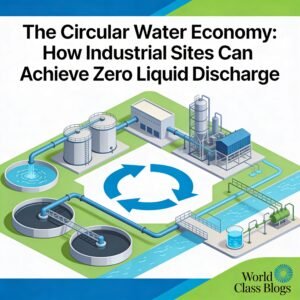
The Circular Economy: How Technology is Turning Waste into Wealth
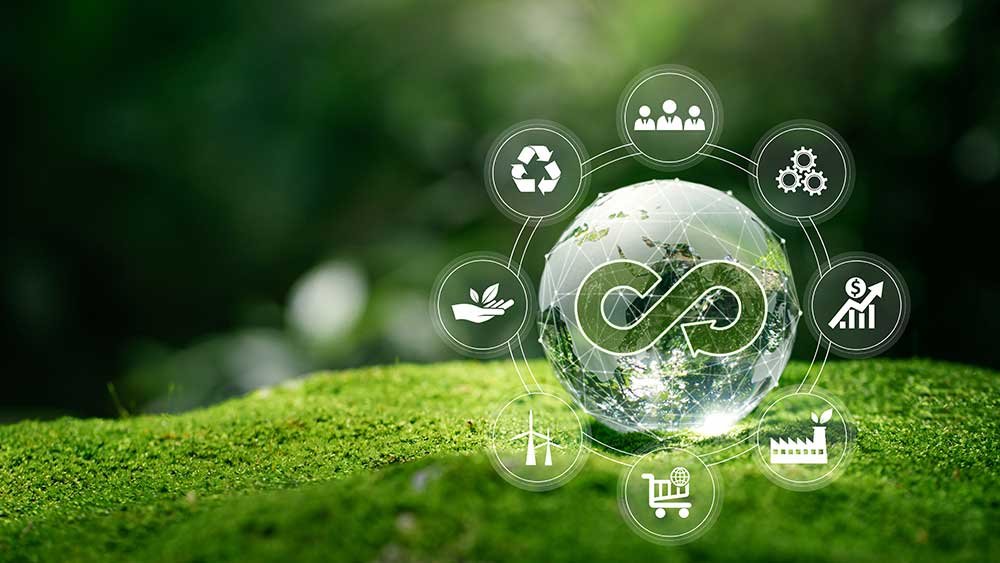
The fundamental shift from a wasteful linear model to a restorative circular system.
Introduction – Why This Matters
I was standing in a massive e-waste recycling facility in Belgium when it hit me: we’re solving the wrong problem. Workers were meticulously disassembling smartphones, their hands moving with practiced efficiency to recover tiny amounts of gold, cobalt, and rare earth metals. It was impressive, but also tragic. The real opportunity isn’t better recycling—it’s designing phones that never become “e-waste” in the first place. This realization captures the essence of the circular economy, and why it represents the most important economic transformation of our time.
For curious beginners, the circular economy might sound like fancy recycling. For professionals needing a refresher, it’s easy to get lost in abstract frameworks. What I’ve found through working with manufacturers, tech companies, and cities is this: The circular economy is about designing out waste and pollution, keeping products and materials in use, and regenerating natural systems. And technology is the engine making this possible at scale. In 2025, with raw material prices soaring and supply chain disruptions becoming the norm, linear “take-make-waste” models aren’t just unsustainable—they’re bad business. This article will show you exactly how digital technologies are turning waste into wealth, creating smarter systems, and building a regenerative future.
Background / Context: From Industrial Revolution to Regenerative Revolution
For 250 years, since the first Industrial Revolution, we’ve operated under a linear economic model: extract raw materials, manufacture products, use them briefly, and discard them as waste. This model delivered unprecedented prosperity but at a catastrophic cost: according to the Circularity Gap Report 2025, the global economy is only 7.2% circular—meaning over 90% of materials extracted are wasted, lost, or remain unavailable for future use.
The circular economy concept isn’t new—it draws from indigenous practices, industrial ecology, and cradle-to-cradle design. But what has changed dramatically is our technological capability to implement it. We’re now experiencing what some call the “Fourth Industrial Revolution” meeting the “Circular Revolution.” Digital technologies—AI, IoT, blockchain, and advanced materials science—provide the tools to track materials at the molecular level, connect waste streams to new uses, and design products for multiple lifecycles. This convergence creates what the Ellen MacArthur Foundation calls the “digital circular economy,” where technology accelerates the transition from linear to circular models.
Key Concepts Defined
- Circular Economy: An industrial system that is restorative or regenerative by intention and design, replacing the end-of-life concept with restoration, shifting towards renewable energy, eliminating toxic chemicals, and aiming for waste elimination.
- Linear Economy: The traditional model following a “take-make-dispose” pattern, where resources are extracted, turned into products, used, and then discarded as waste.
- Industrial Symbiosis: A system where waste or byproducts from one industry become raw materials for another. Think of it as industrial ecosystems where companies exchange materials, energy, water, and byproducts.
- Product-as-a-Service (PaaS): A business model where customers pay for the service a product provides rather than owning the physical product itself (e.g., lighting-as-a-service, laundry-as-a-service). This aligns incentives for durability and recoverability.
- Biological vs. Technical Cycles: In circular design, materials are separated into biological nutrients (that safely return to nature) and technical nutrients (finite materials that should be kept in circulation through reuse, repair, and recycling).
- Digital Product Passport (DPP): A digital record containing information about a product’s materials, components, origins, and repair/disassembly instructions, enabling better end-of-life management and circularity.
- Urban Mining: The process of recovering valuable materials from urban waste streams, particularly e-waste, construction debris, and end-of-life vehicles, treating cities as material banks.
How It Works: The Technology-Enabled Circular System
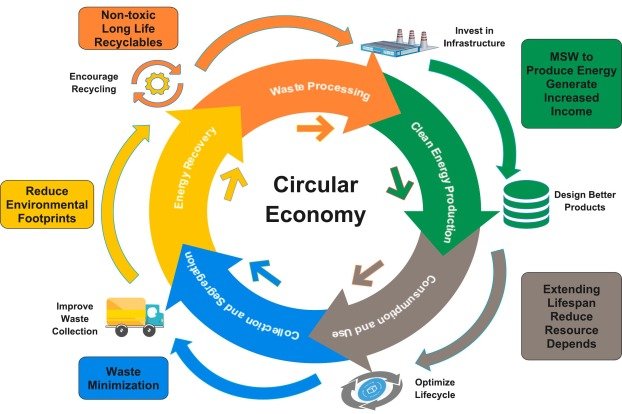
Let’s trace how technology enables circularity at each stage of the value chain, using a smartphone as our example.
Stage 1: Design & Materials Selection
Problem: Traditional design focuses on cost and features, not disassembly or material recovery.
Tech Solutions:
- Generative Design AI: Algorithms create optimal designs based on parameters like “easy to disassemble,” “minimum material use,” and “maximum durability.” Companies like Autodesk offer tools that generate designs humans wouldn’t conceive.
- Material Informatics Platforms: Databases like the Materials Project help designers select materials that are both high-performing and readily recyclable or biodegradable.
- Blockchain for Material Provenance: From mine to factory, blockchain tracks conflict-free minerals and ensures responsible sourcing, creating transparency impossible with paper trails.
Personal experience: I consulted with an electronics startup using AI to redesign a router casing. The algorithm reduced material use by 22% while making it possible to disassemble in under 60 seconds with basic tools—compared to 8 minutes of destructive prying for their old model.
Stage 2: Manufacturing & Production
Problem: Manufacturing waste and inefficient processes.
Tech Solutions:
- Industrial IoT & Smart Factories: Sensors monitor production lines in real-time, minimizing defects and material waste. Predictive maintenance prevents breakdowns that cause scrap.
- Additive Manufacturing (3D Printing): Produces parts with near-zero waste compared to subtractive machining. Allows on-demand production and distributed manufacturing closer to users.
- AI for Process Optimization: Algorithms optimize energy use, chemical inputs, and yield. Google’s DeepMind reduced energy for cooling its data centers by 40%—similar approaches work in manufacturing.
Stage 3: Use & Consumption
Problem: Products are discarded while still functional; ownership model encourages waste.
Tech Solutions:
- Product-as-a-Service Platforms: Companies like Philips offer “lighting-as-a-service” where they install, maintain, and upgrade LED systems. Customers pay for lumens, not lightbulbs. IoT sensors in products monitor performance and predict maintenance.
- Sharing Economy Platforms: While early sharing apps (like Uber) showed promise, the next generation focuses on durable goods. Platforms for sharing power tools, appliances, or even clothing (like Rent the Runway) increase utilization rates.
- Digital Twins: Virtual replicas of physical products that track usage patterns, enabling predictive maintenance and optimizing performance throughout the lifecycle.
Stage 4: Recovery & Regeneration
Problem: Products end up in landfills; materials are lost; recycling is inefficient.
Tech Solutions:
- Computer Vision & Robotics for Sorting: AMP Robotics uses AI-guided robots that identify and sort materials at superhuman speeds and accuracy. Their systems can distinguish between 50 types of plastics, something impossible for human sorters.
- Advanced Chemical Recycling: Unlike mechanical recycling (which downgrades plastic), chemical processes like depolymerization break plastics back into original monomers for infinite recycling. Companies like Loop Industries and Carbios are commercializing these technologies.
- Blockchain for Reverse Logistics: Creating transparent, efficient systems for taking back products. Consumers scan QR codes for instant return labels and incentives; companies track products through the recovery chain.
- Digital Product Passports: Mandated by the EU for batteries starting 2027, DPPs contain repair manuals, material composition, and recycling instructions accessible via QR code, drastically increasing recovery rates.
Circular Economy Technology Stack:
| Layer | Technologies | Function |
|---|---|---|
| Data Layer | IoT Sensors, Blockchain, RFID Tags | Collect & verify material/product data |
| Intelligence Layer | AI/ML, Digital Twins, Analytics Platforms | Analyze patterns, optimize flows, predict failures |
| Transaction Layer | Smart Contracts, PaaS Platforms, Marketplaces | Enable circular business models & material exchanges |
| Physical Layer | Robotics, Additive Manufacturing, Chemical Recycling | Execute circular processes in the physical world |
Why It’s Important: Beyond Sustainability to Resilience
The circular economy matters for reasons far beyond environmentalism:
- Economic Opportunity: The World Economic Forum estimates the circular economy represents a $4.5 trillion economic opportunity by 2030 through job creation, innovation, and reduced material costs. For businesses, it mitigates price volatility in virgin materials—a lesson many learned during recent supply chain crises detailed in resources on global supply chain management.
- Supply Chain Resilience: Linear supply chains are fragile. Circular systems create local material loops, reducing dependence on geopolitically sensitive raw materials. During the pandemic, companies with take-back programs for their products had more stable material supplies.
- Innovation Driver: Circularity forces radical innovation in materials, business models, and partnerships. Fairphone’s modular smartphones, where users replace individual components instead of the whole device, emerged from circular thinking.
- Carbon Reduction: According to the Ellen MacArthur Foundation, circular economy strategies could reduce global greenhouse gas emissions by 39% (22.8 billion tons CO2e) by 2050 in key sectors—without requiring miraculous new technology.
- Consumer Engagement: Modern consumers, especially younger generations, increasingly prefer brands with circular offerings. H&M’s garment collecting program and Patagonia’s Worn Wear repair service build loyalty while recovering materials.
- Regulatory Compliance: Governments worldwide are implementing Extended Producer Responsibility (EPR) laws, forcing companies to handle end-of-life products. Technology makes compliance efficient and even profitable.
Sustainability in the Future: The Fully Circular 2050
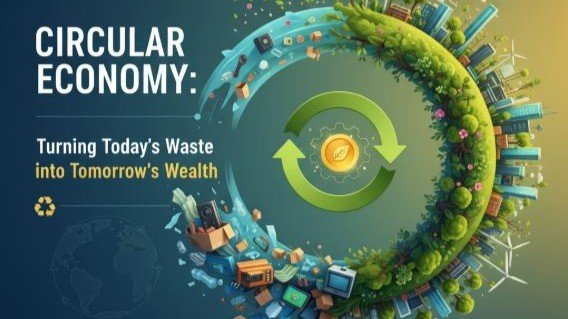
Looking toward 2050, the circular economy will evolve from discrete initiatives to the default operating system:
- The Internet of Materials: Individual products will have embedded sensors communicating their location, condition, and material composition, enabling autonomous routing to the highest-value recovery option.
- Biosphere-Compatible Materials: Advances in synthetic biology will create truly biodegradable polymers and materials that safely feed biological cycles. Mushroom-based packaging and algae-based textiles will replace plastics.
- Circularity as Standard in AI Training: Just as we’re seeing ethics embedded in AI development (explored in our AI and machine learning section), circular design parameters will become default in all product development AI.
- Distributed Micro-Factories: 3D printing hubs in neighborhoods will produce goods on-demand from local recycled materials, drastically reducing transport emissions and waste.
- Circular Business Model Dominance: Product-as-a-Service will become standard for everything from appliances to clothing. Your washing machine will be a subscription, endlessly upgraded and refurbished by the manufacturer.
Common Misconceptions
- Misconception: “Circular economy is just advanced recycling.” Reality: Recycling is the last resort in a circular system. The hierarchy is: 1) Maintain/Repair, 2) Reuse/Redistribute, 3) Refurbish/Remanufacture, 4) Repurpose, 5) Recycle materials, 6) Recover energy. Technology enables all these “R’s” before recycling.
- Misconception: “It’s only for environmentalists and costs more.” Reality: Leading companies adopt circular strategies for profit. Michelin’s tire-as-a-service program for fleets actually increases margins while reducing customer costs. It’s a competitive advantage.
- Misconception: “Technology will solve everything—we just need better gadgets.” Reality: Technology enables circularity but systemic change requires business model innovation, policy support, and consumer behavior shifts. It’s socio-technical.
- Misconception: “It means lower quality or going without.” Reality: Circular products are often higher quality because they’re designed to last. Patagonia’s repaired clothing often becomes more valued by owners. It’s about better utilization, not deprivation.
Recent Developments (2024-2025)
- AI-Powered Material Matching: Platforms like Circunity connect companies with waste streams to potential users using AI that understands material properties and compatibility. Think “Tinder for industrial waste.”
- EU Digital Product Passport Mandates: Starting with batteries in 2027 and expanding to electronics, textiles, and packaging, this creates a universal data infrastructure for circularity that will drive global adoption.
- Chemical Recycling at Scale: In 2024, Eastman Chemical opened the world’s largest molecular recycling facility in France, capable of processing 110,000 tons of hard-to-recycle plastic waste annually.
- Blockchain-Backed Circular Finance: New financial instruments like “circular bonds” and “material bank financing” use blockchain to verify circular performance, attracting ESG investment. The World Bank issued its first circular economy bond in 2024.
- Bioprinting for Replacement Parts: Researchers are now 3D printing replacement components from fungal mycelium or bacteria-produced cellulose, creating truly biodegradable repair parts.
Success Story: Interface’s Mission Zero and Beyond
Carpet manufacturer Interface provides perhaps the best long-term case study. In 1994, CEO Ray Anderson had an environmental epiphany and launched “Mission Zero”—to eliminate any negative impact by 2020. Through relentless innovation, they:
- Developed carpet tiles that could be individually replaced (reducing waste 90% compared to broadloom)
- Created the first commercially viable carpet from recycled fishing nets (Net-Works program)
- Pioneered carpet leasing with take-back guarantees
- Used lifecycle assessment software to optimize every material choice
By 2020, they achieved Mission Zero. More importantly, they proved circularity is profitable: they saved over $500 million in waste costs and created the most desirable brand in commercial carpeting. Now their “Climate Take Back” mission goes beyond zero to become carbon negative. Their story proves circularity isn’t a sustainability initiative—it’s an innovation and business strategy.
Real-Life Examples
- For Consumers:
- GRO Circular Grocery Platform: A service delivering groceries in reusable containers. Empty containers are picked up, professionally cleaned, and reused 100+ times. App tracks your environmental impact.
- Lizee Fashion Rental Platform: Partners with brands like Adidas to offer clothing rental. RFID tags track each garment through 20+ rental cycles before being recycled.
- For Businesses:
- Caterpillar Remanufacturing: Their Cat Reman program takes back end-of-life components, completely refurbishes them to original specifications, and sells at 40-70% of new price. This represents a $2 billion business segment.
- Schneider Electric’s Circular Framework: The energy management company has circularity hubs worldwide. Their Nantes factory uses 100% recycled plastic and produces zero waste to landfill. Products are designed for easy disassembly.
- For Cities:
- Amsterdam’s Circular 2025 Strategy: The city tracks material flows through a digital platform, has established “waste-to-resource” hubs where businesses exchange byproducts, and mandates circular principles in all public procurement.
- San Francisco’s Zero Waste Program: Though not fully circular, its mandatory composting and recycling ordinances have diverted 80% of waste from landfills, creating feedstock for local circular businesses.
Conclusion and Key Takeaways
The circular economy represents the most profound reimagining of commerce since the Industrial Revolution. It moves us from an economy of consumption to an economy of utilization, from ownership to access, from waste to resource. Technology isn’t merely supporting this transition—it’s the catalyst that makes it feasible, scalable, and profitable.
What excites me most isn’t the technology itself, but what it enables: businesses that thrive by preserving value rather than destroying it, products that get better with time, and a relationship with stuff that’s more thoughtful and less disposable. The companies mastering circularity today—like Interface, Philips, and Schneider Electric—aren’t just reducing their environmental impact; they’re building more resilient, innovative, and customer-centric businesses.
Key Takeaways Box:
- Circular is Systemic: It’s not about individual products but about redesigning entire systems—from business models to supply chains to consumer relationships.
- Technology is the Enabler: AI, IoT, blockchain, and advanced materials science provide the tools to track, optimize, and innovate circular systems at scale.
- Waste is a Design Flaw: In a circular economy, waste and pollution are designed out from the beginning, not managed at the end.
- Value Creation Shifts: Value comes from maintaining, sharing, and recovering assets rather than constantly producing new ones.
- Start Now: Every business can begin its circular journey—through product redesign, material choice, business model innovation, or recovery programs.
For more on how innovation intersects with societal goals, explore our broader Our Focus section.
Frequently Asked Questions (FAQs)
1. How is circular economy different from recycling?
Recycling is one component at the bottom of the circular hierarchy. Circular economy focuses first on keeping products in use longer (through repair, refurbishment, sharing), then on recovering materials. It’s a systemic approach that includes product design, business models, and material choices that make recycling easier and more valuable.
2. Can the circular economy work for all types of products?
Yes, but implementation varies. For durable goods (cars, machinery), the focus is on longevity, remanufacturing, and parts recovery. For consumables (food, packaging), the focus is on compostable materials and nutrient cycles. For complex products (electronics), it’s about modular design and material recovery.
3. What’s the biggest barrier to circular economy adoption?
Economic misalignment. In many cases, virgin materials are cheaper than recycled due to subsidies, externalized environmental costs, and established infrastructure. Policy changes (like virgin material taxes) and technology that lowers recovery costs are needed to correct this.
4. How do digital product passports actually work?
A Digital Product Passport (DPP) is typically a QR code or RFID tag on a product. When scanned, it accesses a secure database containing information like material composition, repair instructions, disassembly guidelines, and recycling options. This information stays with the product throughout its lifecycle.
5. Is the circular economy just for large corporations?
Not at all. Small businesses often innovate more quickly. Local repair shops, sharing platforms, upcycling artisans, and material startups are crucial to circular ecosystems. In fact, the flexibility of smaller operations can be an advantage, much like the agility needed in starting an online business.
6. What role do consumers play?
Crucial roles: choosing durable products, participating in sharing/rental schemes, properly maintaining items, using repair services, and returning products to take-back systems. Consumer demand drives corporate adoption.
7. How does blockchain help with circular economy?
Blockchain creates tamper-proof records of material provenance, product ownership history, and recycling transactions. This builds trust in recycled materials, enables automated payments in material exchanges, and verifies circular claims for ESG reporting.
8. Can circular economy principles apply to digital products?
Absolutely. For digital services, circular principles mean designing for longevity, minimizing data waste, using renewable energy for servers, and ensuring hardware infrastructure (servers, devices) follows circular principles. The focus shifts from reducing material waste to reducing energy and computational waste.
9. What are “material banks” in construction?
This concept treats buildings as material repositories. Instead of demolishing buildings, they’re carefully disassembled, and materials (steel beams, bricks, windows) are cataloged in a digital “bank” for reuse in new construction. This requires design for disassembly from the start.
10. How does circular economy address planned obsolescence?
It directly opposes it. Circular business models like Product-as-a-Service incentivize durability because the manufacturer retains ownership and bears maintenance costs. Digital product passports make repairability information available, empowering consumers and independent repair shops.
11. Is circular economy compatible with economic growth?
Yes, but it redefines growth. Instead of growth through increased resource consumption, circular growth comes from increased utilization of existing assets, value-added services, and innovation. It’s qualitative rather than quantitative growth.
12. What industries are leading in circular adoption?
Fashion/textiles (through rental, resale, and recycled materials), electronics (through modular design and e-waste recovery), automotive (through remanufacturing and material recovery), and packaging (through reusable systems and alternative materials).
13. How can I implement circular principles in my office?
Start with: 1) Switch to reusable dishware, 2) Implement a “circular procurement” policy favoring durable, repairable, or take-back products, 3) Set up proper recycling with clear bins, 4) Create a “free stuff” area for unused supplies, 5) Lease rather than buy equipment where possible.
14. What is “circular procurement”?
Purchasing policies that prioritize products and services that align with circular principles: durable, repairable, made from recycled content, offered as a service, or with take-back guarantees. Governments and large corporations are increasingly adopting these policies.
15. How does circular economy relate to climate change?
Deeply intertwined. According to the Ellen MacArthur Foundation, applying circular economy strategies in just five key areas (cement, aluminum, steel, plastics, and food) could eliminate almost half (45%) of global CO2 emissions from material production.
16. Are there certifications for circular products?
Yes, several are emerging: Cradle to Cradle Certified, UL Environmental’s Circular Factored, and the EU’s forthcoming circular product labeling scheme. These evaluate material health, recyclability, renewable energy use, and social fairness.
17. What happens to jobs in a circular economy?
Jobs shift from extraction and disposal to refurbishment, repair, remanufacturing, reverse logistics, and material innovation. Studies show net job creation, but retraining programs are essential for affected workers in linear industries.
18. How do we handle hazardous materials in circular systems?
Through “material filtering”: designing out toxic substances where possible, and where not possible, creating closed-loop systems that safely contain and recycle hazardous materials rather than dispersing them.
19. Can developing countries leapfrog to circular models?
Absolutely. Without entrenched linear infrastructure, many developing regions are innovating with circular solutions out of necessity. Repair cultures are strong, informal recycling networks are sophisticated, and new technologies can be adopted without legacy system constraints.
20. What’s the first step for a company wanting to go circular?
Conduct a materiality assessment: map your material flows, identify waste hotspots, and assess where circular interventions (design changes, new business models, recovery programs) could create the most value. Start with pilot projects rather than trying to transform everything at once.
21. How does mental wellbeing connect to circular living?
Research suggests that mindful consumption, repairing rather than replacing, and connection to local circular communities can reduce the anxiety of consumerism and create more meaningful relationships with possessions. This aligns with broader themes of psychological wellbeing.
22. What is “regenerative design” in this context?
Going beyond sustainability (doing less harm) to actually improve ecosystems. In circular economy, this means designing systems that regenerate natural capital—like agricultural practices that rebuild soil health or products that safely biodegrade into nutrients.
23. How do we handle data privacy with digital product passports?
DPPs typically contain product information, not personal user data. When personal data is involved (like in a take-back transaction), it should be handled according to GDPR and similar regulations, separate from the product data.
24. What is the role of policy and regulation?
Essential. Policies like Extended Producer Responsibility (EPR), landfill taxes, recycled content mandates, and eco-design requirements create the “rules of the game” that make circular business models competitive.
25. Where can I learn more about circular business models?
The Ellen MacArthur Foundation offers extensive free resources. Also explore case studies from the Circular Economy 100 network, and for implementation, the book “The Circular Economy Handbook” by Lacy et al. provides practical guidance.
About the Author
Sana Ullah Kakar is a circular economy strategist and systems thinker who has spent the past decade at the intersection of sustainability, technology, and business innovation. They began their career in industrial design, became frustrated with designing for planned obsolescence, and shifted focus to designing for circularity. They’ve advised Fortune 500 companies on circular transitions, helped startups develop circular business models, and worked with cities on circular economy roadmaps. At World Class Blogs, they’re passionate about demystifying the circular economy and showing how it represents not sacrifice but opportunity—for innovation, resilience, and profitability. They believe the most exciting developments happen at the intersection of disciplines, which is why they frequently contribute to discussions about nonprofit innovation and cross-sector collaboration. When not writing or consulting, they can be found repairing old electronics or participating in local tool libraries. Connect with our team through our contact page.
Free Resources
- Ellen MacArthur Foundation Toolkit: The definitive resource library with reports, case studies, and educational materials on all aspects of circular economy.
- Circularity Gap Report: Annual assessment of global circularity with country-specific data and recommendations.
- Material Economics: Research firm offering excellent free reports on the business case for circular economy in specific sectors.
- Platform for Accelerating the Circular Economy (PACE): World Economic Forum initiative with toolkits for policymakers and businesses.
- Related Reading: Explore how partnership models enable circular systems in our partner site’s guide to business partnership models.
- Stay Updated: For ongoing insights into how technology shapes our world, browse our technology blogs.
Discussion
What circular economy practice have you adopted personally or professionally? What’s the most surprising example of “waste into wealth” you’ve encountered? What barriers do you see to wider adoption of circular principles in your industry or community? Share your experiences and questions below—the circular economy thrives on shared knowledge and collective problem-solving.