Language Beyond Words: Building Cross-Cultural Connections Without Fluency
Don’t speak the language? No problem. Our 2026 guide shows you how to build deep cross-cultural connections using gestures, tone, visuals & a few key phrases. Master non-verbal travel. cross-cultural communication, travel without language, non-verbal communication, gesture travel, language barrier solutions, how to connect with locals, basic phrases for travel, communicative competence, travel confidence, cultural humility, translation app alternatives, 2026 travel tips, global communication, gesture communication travel, communicative competence, cultural humility, using translation apps wisely, overcoming language anxiety, travel confidence, local interaction tips, how to communicate in a foreign country without knowing the language, best gestures for travelers to use worldwide, connecting with locals when you don’t speak their language, basic words to learn before any trip, overcoming fear of language barriers while traveling, using pictures and visuals to communicate abroad, cultural dos and don’ts of body language, how to show respect without speaking, traveler’s guide to non-verbal communication 2026, tools for cross-cultural connection beyond translation apps

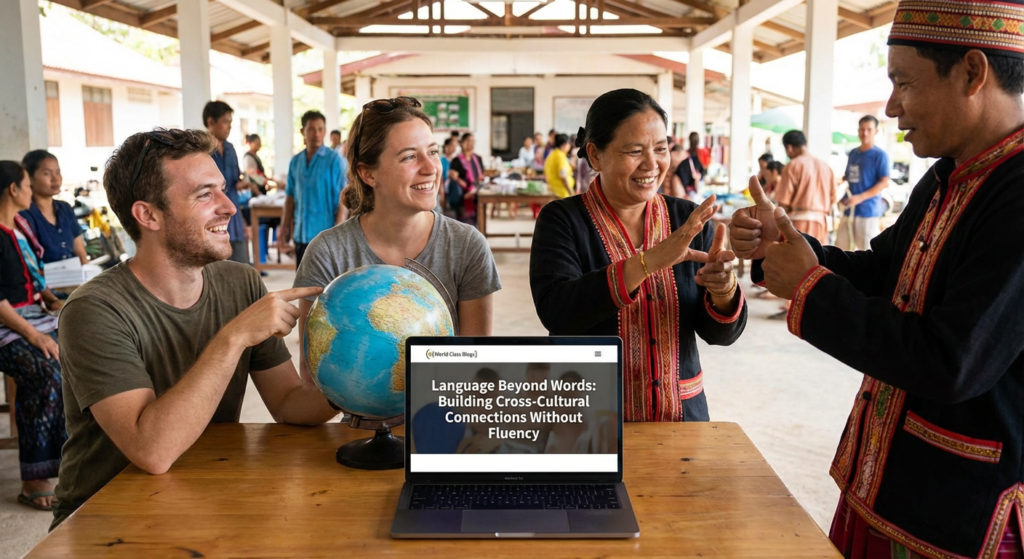
Shared focus and a smile create understanding that words alone cannot.
Introduction – Why This Matters: The Myth of Fluency
A single, pervasive myth holds countless travelers back from meaningful connection: the belief that you must be fluent in a language to truly connect with its people. This paralyzing standard leads to anxiety, silence, and missed opportunities. The liberating truth is that human connection thrives in the fertile ground beyond vocabulary lists and perfect grammar. Communication is a full-body, multi-sensory experience, and some of the most profound cross-cultural bonds are built not through flawless sentences, but through shared laughter, a gesture of help, or the mutual attempt to bridge a gap.
In my experience, linguistic vulnerability can be your greatest asset. I remember being utterly lost on a rural bus in Vietnam, unable to decipher the route or the conductor’s rapid-fire questions. My flustered attempt to point at a map, combined with an apologetic smile, didn’t solve the problem with words. Instead, it prompted an elderly woman to gently tap my shoulder, gesture for me to sit, and then, 30 minutes later, wordlessly shepherd me off at the correct stop with a firm nod. We exchanged no intelligible dialogue, but a profound understanding passed between us. This guide is for anyone who has ever felt shut out by a language barrier. It’s a toolkit for the curious beginner and a vital reminder for the seasoned professional: connection is a creative act, not a linguistic test. This philosophy of finding alternative pathways to understanding resonates with the innovative problem-solving approaches we often highlight in our technology and innovation category at World Class Blogs.
Background / Context: The Science of Connection
Human communication is only about 7% verbal (the words themselves). The remaining 93% is non-verbal: tone of voice (38%) and body language (55%), according to the classic (though debated) Mehrabian study. While the exact percentages are contested, the principle is foundational: we are wired to read faces, gestures, posture, and vocal inflection. Before Homo sapiens developed complex language, we relied on these cues for survival and social bonding.
In our hyper-verbal world, we’ve undervalued this innate skill set. Furthermore, the global rise of English as a lingua franca has created a paradoxical dynamic: while it facilitates basic transactions, it can also create a lazy, transactional form of tourism where deeper, localized understanding is bypassed. The modern mindful traveler recognizes that leaning on English as a crutch can be a barrier to the very authenticity they seek. The post-2020 era has seen a surge in apps and methodologies focused not on language acquisition, but on language connection—tools that facilitate non-verbal understanding and micro-communicative exchanges. A 2025 Berlitz Cultural Intelligence Report noted that travelers who focused on learning “connection phrases” (greetings, thank yous, apologies) and non-verbal etiquette reported 60% higher satisfaction in local interactions than those who relied solely on translation apps for complex communication.
Key Concepts Defined: The New Vocabulary
Communicative Competence: In linguistics, this is the ability to use language correctly and appropriately in social contexts. For travelers, we expand this to Cross-Cultural Communicative Competence—the ability to achieve mutual understanding using all available tools: basic words, gestures, tone, and cultural awareness.
Phonological Awareness: Sensitivity to the sounds and rhythms of a language. You don’t need to know what a word means to mimic its musicality—a skill that shows respect and often earns goodwill.
Proxemics: The study of personal space. The comfortable distance for conversation varies dramatically by culture (e.g., closer in Latin America, farther in Northern Europe). Misreading this can cause discomfort without a word being spoken.
Kinesics: The study of body language and gesture. This includes emblems (gestures with direct translations, like a thumbs-up), illustrators (gestures that accompany speech), and regulators (gestures that control conversation flow). Crucially, many gestures are culture-specific.
Paralanguage: The non-lexical components of speech: pitch, volume, speed, hesitation noises (“um,” “ah”), and tone. A friendly tone can make broken language charming; a loud, impatient tone can make perfect grammar offensive.
The Principle of Cooperative Intent: This is the master key. It’s the clear, demonstrable signal you send that says, “I am trying to meet you halfway. I am not expecting you to do all the work.” This intention is felt, not heard.
Key Takeaway: The Communication Toolkit – Beyond the Phrasebook
Tool What It Is How to Use It Example The Linguistic Toe-Dip 5-10 key phrases mastered for pronunciation. Greetings, thanks, apologies, “please,” “beautiful,” “delicious.” Saying “Xièxie nǐ” (谢谢您) with a slight bow in China. The Non-Verbal Symphony Body language, facial expressions, eye contact. Matching local posture (respectful), using open gestures, smiling appropriately. In Thailand, using a two-handed pass with a slight bow (wai) when giving/receiving. The Prop & Visual Aid Objects, maps, pictures, pointing, money. Bridging the vocabulary gap with universal or specific visuals. Pointing to a menu item, then showing a picture of an allergy on your phone. The Sound & Rhythm Mirror Mimicking the melody and pace of the local language. Listening carefully to greetings and repeating their musical pattern. Matching the rising intonation of a Filipino “Hello po!” The Cooperative Intent Signal Your overall demeanor of patience, humility, and humor. Showing you’re relaxed in the confusion, laughing at your own mistakes. A shrug, a smile, and a “I’m sorry, my [Language] is bad!” before attempting.
How It Works: A Step-by-Step Framework for Connection
Phase 1: The Pre-Travel Mindset & Micro-Learning (Weeks Before)
- Ditch Fluency, Embrace Function: Set a goal of learning 10 Connection Words/Phrases. Prioritize: Hello/Goodbye, Please, Thank you, Sorry/Excuse me, Yes/No, Delicious, Beautiful, Help, How much?, My name is…
- Learn the Music, Not Just the Lyrics: Use apps like Pimsleur or YouTube to hear natives speak these phrases. Record yourself and compare. Focus on the melody and rhythm.
- Research the Non-Verbal Landscape: What are key cultural gestures? (e.g., the “fig” hand gesture is offensive in Turkey, the “OK” sign is rude in Brazil). What is the etiquette for eye contact, touching, or personal space? This is as critical as learning verbs.
- Prepare Your Visual Kit: Save offline maps. Download a photo-based allergy card if needed. Have pictures of your hotel, key destinations, and common needs (bathroom, water, pharmacy) on your phone.
Phase 2: The On-the-Ground Connection Playbook (During Travel)
- Always Lead with Your Local Greeting: Your first uttered sound should be “Bonjour,” “Konnichiwa,” “Sawasdee krub/ka.” This immediately signals respect and cooperative intent.
- Master the “Triangle of Communication”: Combine a word + a gesture + a prop. Point to a pastry, say “Uno, per favore,” and show one finger with a smile. This triple reinforcement is incredibly effective.
- Become a Detective of Context: If you don’t understand words, read the situation. Is the vendor holding up fingers? They’re telling you the price. Is someone gesturing with a flat hand, palm down? They’re likely telling you to wait or slow down.
- Leverage “Iconic” & “Universal” Gestures: While many gestures are cultural, some are widely understood: miming drinking, eating, sleeping, taking a photo, or pointing to your wrist for time. Use these as a base.
- Embrace the Power of Silence & Smile: A shared moment of confusion, followed by a genuine laugh, can create more camaraderie than a stiff, transactional exchange in broken English. Your non-verbal demeanor is your constant broadcast.
Phase 3: Deepening the Exchange (When You Have More Time)
- Use the “Point & Learn” Method: In a market, point to items and ask for the word. Repeat it. This active learning is engaging and flattering to the local person.
- Invite Correction: After attempting a phrase, gesture and ask, “Correct?” Most people are delighted to help you say it better.
- Share Something from Your World: Show a photo of your hometown, your pet, or a local dish from home on your phone. This reciprocal sharing moves the interaction from service to human exchange.
Why It’s Important: The Alchemy of Effort
Making the effort to communicate beyond words is a profound act of respect that dismantles the “ugly tourist” stereotype. It demonstrates that you see the person you’re interacting with as a human being, not just a service provider or a cultural backdrop. This effort actively preserves linguistic diversity by showing value in local languages, even at a micro-level. On a personal level, it builds incredible confidence and resourcefulness, turning every small interaction into a rewarding puzzle. It fosters a sense of shared humanity that transcends political and cultural borders. This kind of bridge-building is essential not just in travel, but in all facets of a globalized society, much like the intricate, cooperative work required in effective global supply chain management, as detailed in the comprehensive guide on The Daily Explainer.
Sustainability in the Future: Technology as a Bridge, Not a Wall
The future of cross-cultural connection lies in technology that facilitates human interaction rather than replacing it.
- AR (Augmented Reality) Translation Glasses: While real-time subtitles for conversations may emerge, the sustainable use will be for decoding written text (menus, signs) while leaving face-to-face interaction to human cues and learned phrases.
- AI-Powered Cultural Context Coaches: Imagine an app that listens to a conversation (with permission) and discreetly vibrates to warn you of a tonal misstep or suggests a more culturally appropriate gesture in real-time.
- Haptic Feedback for Proxemics: Wearable devices could give a subtle vibration if you’re unconsciously standing too close or too far based on culturally programmed norms, helping you adjust non-verbally.
- Gamified Micro-Learning in VR: Pre-travel VR experiences that drop you into a simulated market or train station to practice non-verbal and basic verbal exchanges in a low-pressure, immersive environment.
The goal is to use tech to build competence and confidence, so you can eventually put the device away and connect person-to-person—a principle that aligns with using technology to enhance, not replace, human core competencies, a topic explored in our artificial intelligence and machine learning category.
Common Misconceptions
Misconception 1: “If I try to speak their language poorly, I’ll look stupid or offend them.”
Reality: The opposite is almost universally true. Attempting to speak the local language, however poorly, is seen as a sign of respect and effort. Locals will typically be patient, helpful, and appreciative. Perfection is not expected; intent is everything.
Misconception 2: “Translation apps make learning any phrases unnecessary.”
Reality: Apps are fantastic for complex, specific needs (e.g., medical issues). But relying on them for every interaction is socially isolating, slow, and can be perceived as rude. It creates a technological barrier between you and the other person. It’s a dictionary, not a social skill.
Misconception 3: “Body language is universal.”
Reality: This is a dangerous assumption. The thumbs-up, the “OK” sign, head nods, and even the beckoning gesture vary hugely in meaning. Research is essential to avoid accidental offense.
Misconception 4: “Speaking English louder and slower will help them understand.”
Reality: This is the hallmark of the inconsiderate traveler. It’s condescending and ineffective. If someone doesn’t understand your English, altering your volume and speed won’t magically grant them vocabulary. Switch to your toolkit of simple words, gestures, and visuals.
Recent Developments (2025-2026)
- The Rise of “Connection-First” Language Apps: Apps like “Globessa” are pivoting from grammar drills to teaching “connection blocks”—curated sets of 50 words and phrases tailored to specific interaction scenarios (market haggling, asking for directions, complimenting a home), with heavy emphasis on pronunciation and associated gestures.
- Non-Verbal Communication Workshops for Travelers: Offered by cultural centers and forward-thinking tour companies, these workshops teach participants to “read” a culture through body language, silence, and ritual, reducing anxiety about verbal gaps.
- Digital “Connection Passports”: Some boutique tour operators provide clients with a digital “passport” containing key phrases pronounced by locals, a gallery of essential gestures (dos and don’ts), and a simple pictorial menu decoder for their specific destination.
- Academic Focus on “Tourist-Local Interactive Pragmatics”: Linguistics research is now heavily focused on studying the micro-interactions between non-fluent tourists and locals to identify the most effective strategies for mutual understanding and satisfaction, moving beyond traditional language pedagogy.
Success Stories & Real-Life Examples
Success Story: The “No-English” Homestay Experiment in Japan
A program in the Japanese countryside offers travelers a “Sumimasen Experience” (named for the all-purpose word for excuse me/sorry/thank you). Travelers agree to a 3-day homestay where they and the host family will not use any English translation devices for basic communication. They are provided with a pictogram booklet and taught 10 essential Japanese phrases. The result, documented in a 2025 tourism study, was profound. Travelers reported hyper-awareness of non-verbal cues, developed creative communication methods, and formed deeply emotional bonds with hosts. The forced limitation became a gateway to a more intuitive, human connection, challenging the notion that deep understanding requires deep vocabulary. The success of this structured, experimental program mirrors the innovative mindset needed to build new ventures, akin to the approaches in the start online business 2026 guide on Sherakat Network.
Real-Life Example: The Silent Market Transaction
A traveler in a Marrakech souk wanted to buy spices but knew no Arabic or French. Instead of launching into English, she simply smiled at the vendor, pointed at the vibrant saffron, and made an inquisitive face. He smiled back, pinched a few strands, and mimed sprinkling them into a pot. She nodded enthusiastically. He showed five fingers. She showed three, then four. He clapped his hands and laughed, agreeing to four. The entire negotiation and transaction occurred with two words from her (“Shukran” – thank you) and one from him (“Afwan” – welcome). It was efficient, respectful, and mutually enjoyable—a perfect example of the “Triangle of Communication” in action.
Success Story: The Gesture-Based Community Project in Kenya
In a Maasai community partnering with a responsible tourism operator, visitors are taught a set of about 15 agreed-upon gestures and basic Maa words before engaging in a community day. These include signs for “water,” “child,” “work,” “sing,” “share,” and “beautiful.” This pre-established “lexicon” levels the playing field. Visitors can ask simple questions and give compliments without a translator constantly mediating, leading to more direct, personal interactions during activities like beadwork or herding. The program has increased community satisfaction with tourism, as interactions feel more genuine and less orchestrated. Building such a successful, respectful cross-cultural program requires careful partnership models, reflecting the principles found in the comprehensive guide to business partnership models on Sherakat Network.
Conclusion and Key Takeaways
Language is a river, but connection is the bridge. You do not need to swim the entire river to cross it. You can build a bridge with the materials you have: a handful of local words, an open posture, a respectful gesture, and, most importantly, a spirit of humble, cooperative intent.
Key Takeaways for Your Next Journey:
- Quality Over Quantity: Master 10 phrases with good pronunciation rather than knowing 100 words you can’t say clearly.
- Your Body is Your Best Tool: Cultivate an awareness of your own gestures and an observant eye for others’. When in doubt, mirror the local demeanor (formality, volume, personal space).
- Lead with Respect: A local greeting is your universal key. It immediately signals that you are a guest making an effort.
- Tech is an Aid, Not a Crutch: Use translation apps for decoding text and complex ideas, but have the courage to put your phone away for basic human interactions.
- Celebrate the Attempt: Embrace the awkward moments, the misunderstandings, and the laughter they produce. These are often the stories you’ll cherish most, and they are proof of a genuine, human attempt to connect.
For more explorations on building understanding across complex systems—be they cultural or technological—browse the diverse topics within our broader collection of blogs at World Class Blogs.
FAQs (Frequently Asked Questions)
Q1: I have social anxiety. Is this approach still feasible for me?
Absolutely. In some ways, it’s better. The pressure is off to have a flowing conversation. Your goal becomes smaller and more manageable: deliver your 1-2 phrases clearly and smile. The focus on non-verbal cues can actually feel less intimidating than verbal sparring.
Q2: How do I handle a situation where my gestures are being misunderstood?
Stay calm. If you see confusion or a negative reaction, stop. Default to a universal “I’m sorry” gesture (hand on heart, apologetic look) and switch to a different method—use your phone to show a picture, or point to an object. The key is to de-escalate with humility.
Q3: What if someone is impatient with my attempts?
This happens rarely, but if it does, don’t take it personally. They may be stressed or in a hurry. Politely switch to a translation app to expedite the transaction, or simply thank them and move on. Don’t let one negative experience deter you.
Q4: Are children easier to connect with non-verbally?
Often, yes. Children are less self-conscious and highly adept at play-based, non-verbal communication. A game of peek-a-boo, sharing a sticker, or a simple high-five can create an instant, joyful connection that transcends language completely.
Q5: How do I learn about taboo gestures for a specific country?
A simple web search for “[Country] offensive gestures” is a great start. Reputable travel guidebooks (like Lonely Planet) always have a cultural etiquette section. You can also ask in country-specific travel forums on Reddit or Facebook.
Q6: Is it appropriate to use humor when I make a language mistake?
Yes, if it’s self-deprecating. Laughing at yourself for a funny error shows you don’t take yourself too seriously and eases tension. Just ensure the humor is directed at your own mistake, not at their language or culture.
Q7: What’s the best way to remember and practice my 10 key phrases?
Use spaced repetition apps like Anki. Record them on your phone and listen while commuting. Most importantly, use them immediately and repeatedly upon arrival, even if you’re just saying “thank you” to the hotel cleaner. Active use cements memory.
Q8: How do I communicate dietary restrictions without a common language?
This is critical. Use a professionally translated card (from a source like Equal Eats or SelectWisely) that explains your restriction in the local language. Combine this with the “point and deny” gesture (wave hand over dish, point to card, look apologetic).
Q9: Can this approach work in very formal cultures (e.g., Japan, South Korea)?
It works exceptionally well, but the type of non-verbal communication shifts. In formal cultures, subtlety is key. Less exuberant gesturing, more attention to bows, the respectful exchange of items with two hands, and a softer, more polite tone. Your cooperative intent is shown through extreme politeness.
Q10: Where can I learn more about the psychology of non-verbal communication?
For a deeper dive into how communication and understanding underpin our mental and social wellbeing, resources like the complete guide to psychological wellbeing on The Daily Explainer offer valuable insights that complement these practical travel skills.
About the Author
Sana Ullah Kakar is a linguist and intercultural communications facilitator who believes the most broken language, spoken with a sincere heart, is more powerful than perfect silence. With fieldwork experience documenting endangered languages and designing cross-cultural training programs for NGOs and businesses, they are fascinated by the creative ways humans build understanding. They have navigated hospitals in rural Bolivia using charades, bargained in Mongolian markets with number gestures, and shared stories with Indonesian fishermen through drawn pictures. Their work is dedicated to proving that connection is always possible. They contribute to the insightful discussions within the blogs at World Class Blogs and welcome dialogue via the contact page at World Class Blogs.
Free Resources
- The “Connection Toolkit” Cheat Sheet: A downloadable, printable PDF for your destination with your 10 key phrases (with pronunciation guide), a diagram of key local gestures (DOs and DON’Ts), and simple pictograms for common needs.
- “The Music of Language” Audio Guide: Short audio files for major language families (Romance, Slavic, tonal languages etc.) teaching you to hear and mimic the distinctive rhythm and melody, not just the words.
- Gesture Library Video Series: A curated playlist of short, original Loom videos demonstrating common universal gestures and explaining a few critical culture-specific ones to avoid.
- For those looking to apply these principles of clear, intentional communication and building bridges in a professional context, such as forming a strategic business partnership, the foundational strategies are explored in the alchemy of alliance guide on Sherakat Network. Similarly, the innovative mindset behind creating new connection tools shares DNA with entrepreneurial ventures, as discussed in the guide to starting an online business.
Discussion
Let’s build bridges together:
- What’s your most memorable “successful failure” in communication—a time you connected deeply despite a language barrier?
- What non-verbal cue or gesture from another culture has fascinated or confused you?
- What’s your single most trusted “tool” in your cross-communication kit when words fail?
Your stories and strategies are the best resource for fellow travelers. Please share them below.