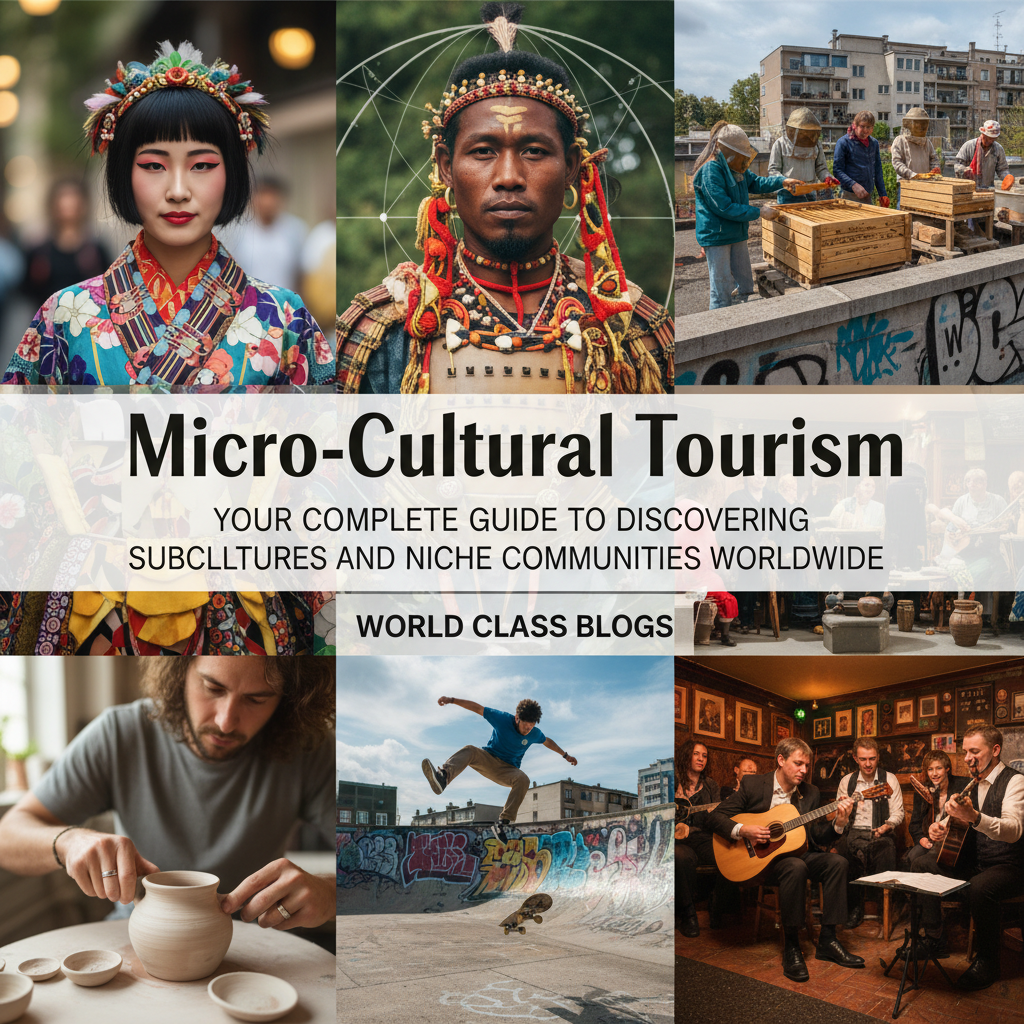
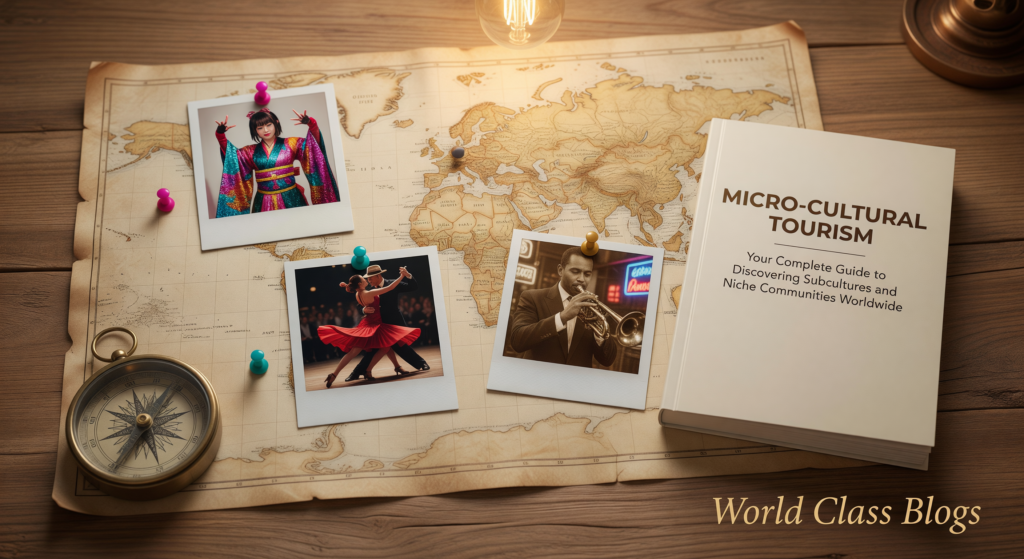
Micro-Cultural Tourism: Your Complete Guide to Discovering Subcultures and Niche Communities Worldwide

A systematic guide to respectful and successful engagement from start to finish.
Table of Contents
Introduction – Why This Matters
The classic travel itinerary—landmark, museum, restaurant, repeat—is undergoing a quiet revolution. While millions still flock to the Eiffel Tower or the Colosseum, a growing movement of curious travelers is seeking something different: an authentic connection with the living, breathing subcultures that give a place its true heartbeat. This is micro-cultural tourism.
In my experience, the most profound travel memories don’t come from perfect photos at famous sites, but from the unexpected moments of shared humanity within a niche community. I recall sitting in a tiny, smoke-filled Budapest rom (traditional folk) music club, far from the tourist drag of the Jewish Quarter, watching elderly locals and young artists alike sway to rhythms untouched by time. That was travel. That was understanding.
This guide is for the traveler who feels that the surface has been thoroughly skimmed and who now wants to dive deeper. Whether you’re a curious beginner wondering how to start or a professional travel enthusiast needing a refreshed approach, understanding micro-cultural tourism is your key to transformative journeys. For those interested in broader societal impacts of such deep engagement, you might find valuable insights in our resource hub at https://worldclassblogs.com/category/our-focus/.
Background / Context
Tourism has evolved through distinct phases. From the aristocratic Grand Tours of the 18th century to the packaged mass tourism of the late 20th century, the desire to “see the world” has been constant, but the “how” has changed dramatically. The early 2000s saw the rise of experiential and sustainable travel, focusing on “living like a local.” Micro-cultural tourism is the next logical, more focused iteration.
It’s driven by several converging trends:
- Digital Connectivity: Online platforms allow us to discover hyper-niche interests globally before we ever book a flight.
- The Search for Authenticity: In an increasingly homogenized world, travelers crave unique, uncommercialized experiences.
- The Specialist Hobbyist: Whether it’s vinyl collecting, urban gardening, or skateboarding, people want to connect with their global “tribe.”
- Post-Pandemic Shifts: The 2020s catalyzed a desire for more meaningful, less crowded, and personally resonant travel.
According to a 2025 report by the Adventure Travel Trade Association, “special interest and micro-niche travel” now represents an estimated 22% of the international leisure travel market, growing at nearly three times the rate of general tourism. This isn’t a fringe trend; it’s the new frontier of exploration.
Key Concepts Defined
Micro-Cultural Tourism: Travel planned with the primary intent of engaging with a specific, often non-mainstream, cultural subset of a destination. It prioritizes depth over breadth, seeking to understand the values, practices, art, and social dynamics of a particular group.
Subculture: A cultural group within a larger culture, often having beliefs, interests, or practices at variance with those of the mainstream. (e.g., the jazz scene in New Orleans, the “cosplay” community in Tokyo’s Harajuku, the tango milongas of Buenos Aires).
Niche Community: A group united by a specific shared interest, activity, or skill, which may or may not be at odds with mainstream culture. (e.g., specialty coffee aficionados in Melbourne, rock climbing communities in Chiang Mai, independent bookstore collectives in Reykjavik).
Cultural Broker: A local individual or organization (not a standard tour guide) that facilitates respectful and informed entry into a micro-culture. They are often community insiders.
Extractive vs. Contributive Engagement: A key framework. Extractive engagement is taking (photos, stories, experiences) without giving back. Contributive engagement involves a reciprocal exchange—spending money locally, sharing skills, or participating in a way that supports the community’s continuity.
Key Takeaway Box:
Micro-Cultural Tourism vs. Traditional Cultural Tourism
Aspect Traditional Cultural Tourism Micro-Cultural Tourism Focus Broad, national/regional culture Deep, specific subculture or community Interaction Often observational (museums, shows) Participatory and immersive Access Public, commercial venues Private spaces, community events Goal To see and learn about a culture To connect and engage with a culture Planning Guidebooks, major review sites Forums, social media groups, niche blogs
How It Works (Step-by-Step Breakdown)
Phase 1: The Pre-Travel Deep Dive (Months/Weeks Before)
- Identify Your Micro-Culture: Start with your own passions. Are you a ceramicist? Seek out pottery villages in Japan (like Bizen) or studio collectives in Oaxaca. A vintage motorcycle enthusiast? Research bike subcultures in Hanoi or Berlin.
- Research with Nuance: Go beyond Google. Use Reddit (specific subreddits), Facebook Groups, Discord servers, and niche forums. Search in the local language using translation tools (e.g., “climbing gym Beirut” becomes “نادي تسلق بيروت”).
- Find Your Cultural Broker: Look for small, specialized operators, artist collectives, community centers, or local academics. A resource like https://worldclassblogs.com/category/blogs/ can sometimes feature profiles of such facilitators. Reach out with respect, explaining your genuine interest, not just a demand for a service.
- Learn the Basic Codes: Understand essential etiquette. Is it appropriate to take photos? Should you bring a small gift? What is the dress code? Learn 5-10 key phrases in the local language related to the activity.
Phase 2: On-the-Ground Engagement (During Travel)
- Start on the Periphery: Attend a public event or workshop first. Don’t force an immediate deep connection. Observe and listen.
- Practice Humble Curiosity: Your role is that of a respectful guest and student. Ask open-ended questions: “How did you learn this craft?” “What does this tradition mean to your community?”
- Follow the Community’s Lead: Let interactions unfold organically. An invitation to a home or a private studio is a privilege, not an expectation.
- Document Ethically: Always ask for permission before photographing people or sacred spaces. Consider sketching or writing instead.
Phase 3: Post-Travel Integration (After Returning)
- Maintain Connections Judiciously: A thoughtful thank-you message is good. Spamming your new contacts is not. Follow their work online.
- Give Back: Promote their work (with permission), write a genuine review for a small business, or make a donation to a related community project.
- Reflect and Share: Process your experience. What did you learn? How has your perspective changed? Share stories in a way that honors the community and inspires others to engage respectfully.
Why It’s Important
Micro-cultural tourism matters because it creates a more sustainable, equitable, and meaningful travel ecosystem.
- For the Traveler: It combats “destination fatigue” and leads to profound personal growth, fostering empathy and global citizenship.
- For the Host Community: It distributes economic benefits beyond tourist hubs to smaller artisans, specialists, and neighborhoods. It validates and helps preserve cultural practices that might be fading.
- For Cross-Cultural Understanding: It moves beyond stereotypes, revealing the incredible diversity within societies. It builds person-to-person bridges in a fragmented world. This aligns with the deeper missions often explored in resources like https://worldclassblogs.com/category/nonprofit-hub/.
As noted by Dr. Anya Petrova, a cultural anthropologist at the Global Travel Institute, in a 2026 paper: “Micro-cultural engagement is a potent antidote to the ‘Placelessness’ of globalization. It allows for the celebration of distinct identity while creating new, hybrid forms of global community.”
Sustainability in the Future
The future of micro-cultural tourism hinges on ethical sustainability. The risk is that a beloved subculture becomes a “product,” leading to gentrification, performance, and ultimately, destruction of the very authenticity travelers seek.
Future-Proof Practices:
- Carrying Capacity: Communities must establish their own limits on visitor numbers and engagement.
- Direct Economic Channels: Platforms that allow travelers to pay community members directly, bypassing large corporate intermediaries, will be crucial.
- Codes of Conduct: Travelers and brokers must co-create and adhere to clear, community-endorsed guidelines.
- Digital Stewardship: Using VR and AR for “pre-visit” education or “low-impact virtual visits” could reduce physical pressure on sensitive communities.
The principles of careful engagement here mirror the strategic care needed in building any lasting venture, a topic explored in guides like https://sherakatnetwork.com/the-alchemy-of-alliance-a-comprehensive-guide-to-building-a-successful-business-partnership/.
Common Misconceptions
Misconception 1: “It’s just hipster tourism.”
Reality: While often associated with urban creatives, micro-cultural tourism spans all interests and ages—from retirees engaging with traditional fishing communities in Kerala to families learning about sustainable farming with Amish communities in Pennsylvania.
Misconception 2: “You need to be an expert.”
Reality: You need curiosity and respect, not expertise. A beginner’s mind is often an asset. Your genuine interest as a novice is more welcome than a know-it-all attitude.
Misconception 3: “It’s inherently ethical because it’s small-scale.”
Reality: Scale doesn’t guarantee ethics. A single disrespectful traveler can cause harm. The intent and behavior define the ethics. Similarly, large-scale operations can be designed ethically with proper protocols.
Misconception 4: “It’s cheap because you’re avoiding tourist traps.”
Reality: Often, it’s more expensive. Properly compensating a master artisan for a private workshop, or a cultural broker for their deep network and translation, costs money. You’re paying for specialized access and knowledge, which has high value.
Recent Developments (2025-2026)
- Platform Specialization: The rise of platforms like “Village Roots” and “Atlas Obscura Marketplace” that specifically connect travelers with micro-cultural experiences vetted for authenticity and community benefit.
- “Skill-Swap” Travel: Formalized networks where travelers (e.g., web designers, carpenters) exchange professional skills for cultural immersion and lodging.
- Post-Industrial Micro-Cultures: Growing interest in the subcultures of former industrial cities—from the electronic music scene in Detroit’s abandoned factories to the artist collectives in Germany’s Ruhr Valley.
- Regenerative Travel Certifications: New certifications, like the “Regenerative Travel Seal,” now include specific criteria for micro-cultural engagement, assessing impact on social capital, not just environment.
Success Stories & Real-Life Examples
Success Story 1: The Jazz Kissa of Tokyo
Japan’s jazz kissa (jazz cafes) are a fading subculture—dedicated spaces where audiophiles listen to high-fidelity vinyl recordings in silent reverence. In my experience, visiting “Jazz Cafe Intro” in Shinjuku was a lesson in deep listening. Through a local music blogger (my cultural broker), I learned the etiquette: no talking when the music plays, handle the owner’s precious records with care. Travelers’ respectful interest, channeled through dedicated blogs and small-group tours, has helped sustain a handful of these cafes, providing vital income and validating this unique cultural practice for a new generation.
Success Story 2: The Female Surfing Co-ops of Morocco
In Taghazout, Morocco, traditional Berber culture and a global surf scene collide. Recently, female-run cooperatives like “Surf Berbere” have created a powerful micro-culture. They provide surf instruction and cultural guiding for women travelers, while simultaneously creating economic independence and challenging local gender norms. Travelers participate in surf lessons, couscous-making workshops, and henna ceremonies, creating a contributive model that supports female empowerment directly. The financial management of such a successful cooperative is complex; understanding different partnership models, as outlined in resources like https://sherakatnetwork.com/business-partnership-business-partnership-models-types-of-business-partnerships-strategic-alliance-models-joint-venture-partnership-equity-partnership-revenue-sharing-model-distribution-pa/, can be insightful.
Real-Life Example: The Laptop Nomad & The Writers’ Salon
A digital nomad in Lisbon, tired of co-working spaces, sought out the city’s literary scene. Through a local independent bookstore’s newsletter, she discovered a monthly “Writers’ Salon” held in a private apartment. After attending as a quiet observer for two months, she shared her skills by helping the group set up a simple website to archive their work. This skill-swap led to genuine friendships and an understanding of Lisbon’s contemporary intellectual life invisible to the average tourist.
Conclusion and Key Takeaways
Micro-cultural tourism is not a checklist; it’s a mindset. It’s a commitment to traveling with your eyes wide open and your assumptions checked at the door. It recognizes that culture isn’t a monument frozen in time, but a living, breathing, and often wonderfully quirky entity expressed through people and their passions.
The rewards are immense: stories you can’t buy, connections that span the globe, and a sense of having touched the true fabric of a place. It requires more effort than booking a bus tour, but the depth of experience is its own compensation. As you plan your next journey, look past the skyline and ask: “Who makes this place tick? What do they love? And how can I learn from them?”
Final Takeaways:
- Start with your passion and research deeply in niche online spaces.
- Prioritize finding a respectful cultural broker, not just a guide.
- Observe first, participate second, and always ask permission.
- Focus on contributive, not extractive, engagement.
- Embrace the role of the humble, perpetual student.
For more guides on transforming your approach to complex topics, explore our compendium at https://worldclassblogs.com/category/technology-innovation/artificial-intelligence-machine-learning/.
FAQs (Frequently Asked Questions)
1. Q: I’m not part of any specific “subculture” at home. Can I still do this?
A: Absolutely. Your “niche” can simply be a curiosity—like “traditional bread-making” or “independent cinema.” Use that as your entry point.
2. Q: How do I know if a community actually wants visitors?
A: Look for active invitations. Is there a public workshop, a community event calendar, or a locally-run tour? If access feels secretive or exploitative, it probably is.
3. Q: Is micro-cultural tourism safe?
A: As with all travel, situational awareness is key. Using a reputable cultural broker for initial introductions significantly mitigates risk. Always inform someone of your whereabouts.
4. Q: How much should I budget for these experiences?
A: Budget more than for standard tours. A 3-hour private workshop with a master craftsperson may cost $150-$300. The value is in the access and knowledge transfer.
5. Q: What’s the best way to find a genuine cultural broker?
A: Search for academics (university .edu emails) studying the topic, local NGOs supporting the arts or culture, or highly reviewed specialty operators on platforms like Atlas Obscura. Check their “About” page—do they highlight specific community partnerships?
6. Q: I’m an introvert. Is this still for me?
A: Yes. Micro-cultural tourism can be perfect for introverts, as it often involves smaller groups or one-on-one interactions focused on a shared interest, which can be less draining than large, chaotic tours.
7. Q: How can I ensure my photography is ethical?
A: Always ask. “Is it okay if I take a photo?” for people. For spaces, a general ask to the host. Offer to send copies back. Sometimes, putting the camera away altogether leads to a richer experience.
8. Q: Can families with children engage in this type of travel?
A: 100%. Seek out family-run workshops, children’s art classes in other countries, or nature-based subcultures like bird-watching groups. It can be incredibly educational for kids.
9. Q: What’s the biggest mistake first-timers make?
A: Assuming their presence is a favor. The second is talking too much and not listening enough. Approach with humility.
10. Q: How does this relate to “voluntourism”?
A: It shares the desire for deep engagement but is distinct. Voluntourism focuses on “helping,” often with problematic power dynamics. Micro-cultural tourism focuses on “learning and exchanging,” with the community in the lead as experts.
11. Q: Do I need to speak the local language?
A: Fluency is not required, but effort is essential. Learning basic greetings and phrases related to your niche (e.g., “beautiful pottery,” “thank you for teaching me”) shows deep respect and breaks the ice.
12. Q: What if I accidentally offend someone?
A: Apologize sincerely and simply. “I’m very sorry, I am still learning your customs. Thank you for correcting me.” Most people appreciate genuine effort and are forgiving of honest mistakes.
13. Q: Are there destinations particularly suited for this?
A: All destinations have microcultures. However, cities with strong local artistic scenes (e.g., Mexico City, Berlin, Seoul) or regions with distinct traditional crafts (e.g., Guatemala, Indonesia, Ghana) offer very visible entry points.
14. Q: How do I avoid contributing to gentrification?
A: Spend money at long-standing local businesses (not new boutiques catering to outsiders), stay in locally-owned guesthouses, and be mindful if your presence seems to be pricing locals out of their own spaces.
15. Q: Can I do this as a solo traveler?
A: Solo travel is often ideal for this, as you’re more approachable and flexible. Many group micro-cultural experiences are small and welcoming to individuals.
16. Q: What should I bring as a thank-you gift?
A: Avoid generic souvenirs. Something meaningful from your hometown (a local food specialty, a book of photographs, quality tools related to the shared craft) is better. Often, the best gift is a heartfelt thank-you note or a genuine online review.
17. Q: How is this different from “going off the beaten path”?
A: “Off the beaten path” is geographic—going to a less-visited town. Micro-cultural tourism is thematic—it can happen in the heart of a major city. It’s about who you connect with, not just where you go.
18. Q: What resources are best for research?
A: Move beyond TripAdvisor. Use: Instagram hashtags in the local language, niche subreddits, academic journals via Google Scholar, podcasts featuring local creators, and websites of local cultural centers.
19. Q: Is it okay to participate in religious or spiritual subcultures?
A: This requires extreme sensitivity. Only participate in events explicitly open to the public or where you have a personal invitation from a trusted member. Your role is a silent observer unless instructed otherwise.
20. Q: How can I assess the ethical credentials of a tour operator?
A: Ask direct questions: “What percentage of the fee goes directly to the community/artisan?” “How long have you worked with this group?” “Can you share a testimonial from a community leader?” Transparency is key.
21. Q: I have limited time. Can I do a micro-cultural experience in just a day?
A: Yes. A well-organized half-day workshop or a curated visit to a community market with a broker can be a powerful introduction. Depth isn’t always about the length of time, but the quality of engagement.
22. Q: What about documentation for visas? Do I need a special visa?
A: No special visa is required, as your stated purpose is still tourism. However, if you are engaging in a formal skill-swap or unpaid work, check local regulations, as this can blur into “work” status.
23. Q: How do I handle payment in cash-only, informal settings?
A: Always carry local currency in small denominations. Agree on a price beforehand to avoid awkwardness. Pay directly to the person providing the service.
24. Q: Where can I learn more about the philosophy behind this kind of travel?
A: For a deeper dive into the mindset of meaningful, impactful engagement in various fields, resources like https://thedailyexplainer.com/mental-health-the-complete-guide-to-psychological-wellbeing-in-the-modern-world/ can offer complementary perspectives on intentional living.
About the Author
[Author Name] is a cultural documentarian and travel ethnographer with over 15 years of experience seeking out the world’s hidden subcultures. From living with nomadic herders in Mongolia to documenting the underground jazz scenes of Eastern Europe, their work focuses on the intersection of travel, storytelling, and community sustainability. They believe the future of travel lies in connection, not just consumption. Their writing has appeared in National Geographic Traveler, Afar, and The Guardian. They are a contributor to https://worldclassblogs.com/about-worldclassblogs/. You can contact them or propose a topic via https://worldclassblogs.com/contact-us/.
Free Resources

- Micro-Cultural Tourism Starter Kit: A downloadable PDF with a pre-travel research checklist, sample phrases in 10 languages for niche engagement, and a list of ethical questioning prompts. (Link to a sign-up form on your site).
- Global Community Board: A curated, moderated list of reputable cultural brokers and community-led experiences by region (updated quarterly).
- Recommended Reading & Media List: A living document of books, documentaries, podcasts, and blogs that exemplify deep cultural exploration.
- **For further exploration of complex, interconnected global systems, which impact all communities, consider reading https://thedailyexplainer.com/global-supply-chain-management-the-complete-guide-to-optimizing-worldwide-business-operations/. For practical steps on building your own platform to share such stories, https://sherakatnetwork.com/start-online-business-2026-complete-guide/ is an excellent resource.
Discussion
We want to hear from you!
- What micro-culture or niche community are you curious about exploring?
- Have you had an experience traveling that connected you deeply with a local subculture? Share your story (and tips!) below.
- What concerns or questions do you still have about planning your first micro-cultural journey?
Let’s build a community of thoughtful, curious travelers together. Your insights make this guide richer for everyone.