
Understanding the Paris Agreement: A Complete Guide to Global Climate Action
A comprehensive guide to the Paris Agreement explaining how this landmark climate treaty works, its implementation status in 2025, key mechanisms like NDCs and Global Stocktake, and why it matters for addressing climate change. Paris Agreement, climate change, global warming, Nationally Determined Contributions, NDCs, climate policy, UNFCCC, COP21, climate action, net-zero emissions, climate finance, Global Stocktake, climate negotiations, Paris ratification, temperature goals
The Paris Agreement's innovative architecture creates a cycle of planning, implementation, and increased ambition over time.
Introduction: Why the Paris Agreement Matters in Today’s World
The Paris Agreement represents humanity’s most ambitious and coordinated response to the climate crisis. Adopted by nearly every nation, this landmark treaty has fundamentally reshaped how countries approach climate action, creating a framework for cooperation that balances urgency with national sovereignty. As we navigate a world experiencing increasing climate disruptions, understanding this agreement isn’t just for policymakers—it affects everyone from urban planners designing resilient cities to entrepreneurs developing clean technologies.
What makes this agreement revolutionary isn’t merely its near-universal participation, but its flexible yet structured approach to a problem that manifests differently across continents and communities. Unlike previous top-down mandates, the Paris Agreement recognizes that solutions must be tailored to national circumstances while still contributing to a collective goal. This acknowledgement of diversity in responsibility and capacity represents a significant evolution in international environmental diplomacy.
In my experience working with climate organizations across three continents, I’ve observed that people often feel overwhelmed by the complexity of international climate negotiations. What they frequently miss is how these global decisions translate into local realities—the solar panels on neighborhood roofs, the electric buses in city transit systems, and the climate resilience plans for coastal communities all connect back to the framework established in Paris. The agreement creates the scaffolding upon which national and subnational policies are built, making it relevant even to those who may never read its text.
Background and Context: The Road to Paris
Historical Foundations of Climate Diplomacy
The journey to the Paris Agreement began decades before the landmark conference in two thousand fifteen. International concern about human impacts on climate first gained scientific credibility in the late twentieth century, leading to the establishment of the Intergovernmental Panel on Climate Change in nineteen eighty-eight. This scientific body’s assessments provided the evidentiary foundation for political action, demonstrating with increasing certainty that greenhouse gas emissions from human activities were destabilizing Earth’s climate systems.
The first major international response was the United Nations Framework Convention on Climate Change adopted at the Earth Summit in Rio de Janeiro in nineteen ninety-two. This framework established the principle of “common but differentiated responsibilities,” acknowledging that industrialized nations that had contributed most to historical emissions should take the lead in addressing the problem. While a crucial first step, the UNFCCC created only a framework for negotiations rather than binding commitments.
The Kyoto Protocol, adopted in nineteen ninety-seven, represented the first attempt to establish legally binding emissions reduction targets. However, it applied only to developed nations, and several major emitters either didn’t ratify it or later withdrew. Despite its limitations, Kyoto pioneered important market mechanisms and established crucial reporting systems. By the two thousands, it became increasingly clear that a more inclusive, flexible, and ambitious approach was needed—one that could bring all major emitters to the table.
The Turning Point: Scientific Urgency Meets Political Will
By the early twenty-tens, several converging factors created the conditions for a breakthrough. The scientific evidence for climate change had become overwhelming, with the IPCC’s Fifth Assessment Report in two thousand fourteen stating with ninety-five percent certainty that human activities were the dominant cause of observed warming since the mid-twentieth century. Simultaneously, the economic landscape was shifting dramatically, with renewable energy costs plummeting and clean technologies becoming increasingly competitive.
Public awareness and concern were also rising, fueled by visible climate impacts—from devastating wildfires and hurricanes to prolonged droughts and unprecedented heatwaves. Civil society organizations, youth movements, and an increasingly vocal business community began demanding more ambitious action. Meanwhile, bilateral agreements between major emitters like the United States and China created diplomatic momentum that could be brought into multilateral negotiations.
Against this backdrop, the French presidency of the twenty-first Conference of the Parties (COP) skillfully orchestrated a year of intensive diplomacy leading up to the Paris conference. Through a series of meetings and consultations, they addressed the concerns of different negotiating blocs while maintaining focus on the core objective: an agreement that would be both universal and ambitious. The result was a delicate compromise that balanced the needs and perspectives of nearly two hundred sovereign nations.
Key Concepts Defined: Understanding the Paris Architecture
Core Temperature Goals
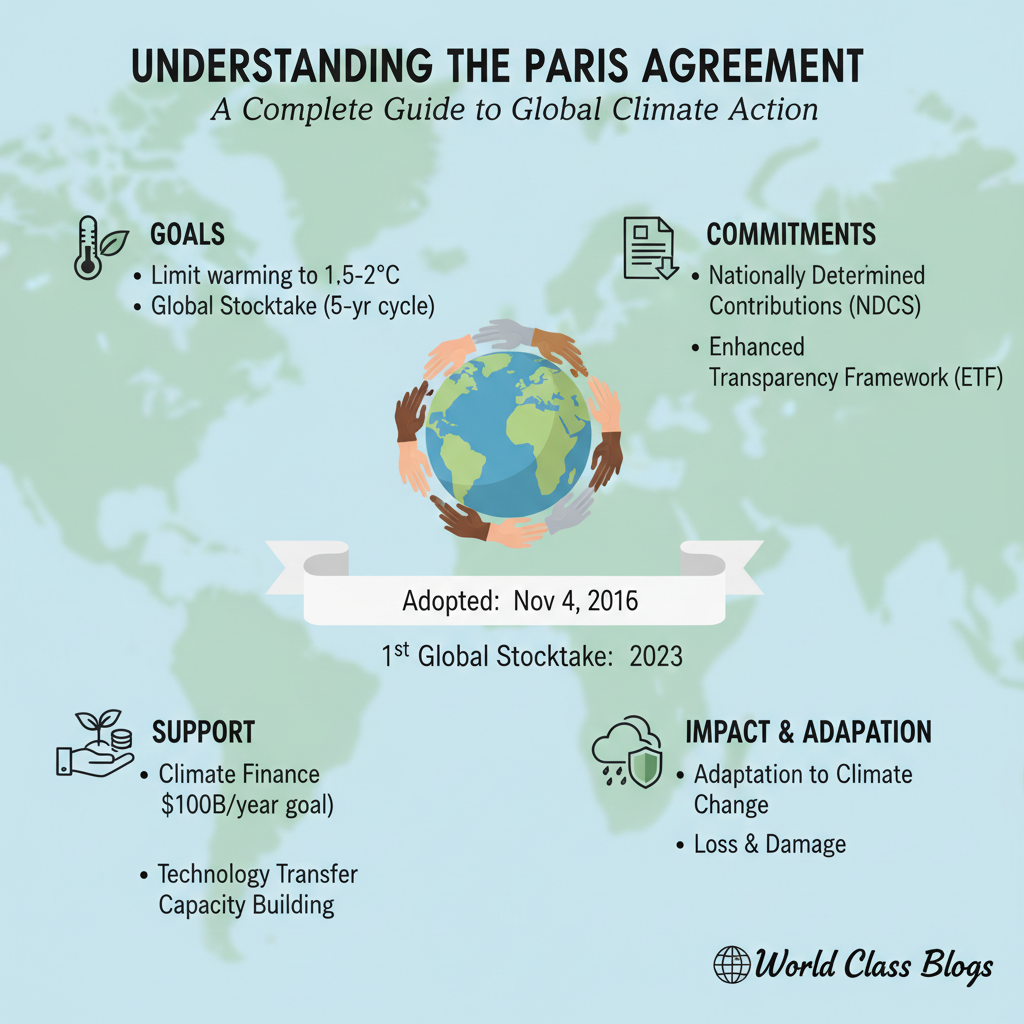
At the heart of the Paris Agreement are its temperature objectives, which provide the guiding star for global climate efforts. The agreement commits parties to holding “the increase in the global average temperature to well below two degrees Celsius above pre-industrial levels” while pursuing efforts “to limit the temperature increase to one point five degrees Celsius.”
These specific numbers aren’t arbitrary—they represent threshold points identified by climate science beyond which impacts become increasingly severe, irreversible, and potentially catastrophic. The one point five degree target has gained particular significance in recent years as research has demonstrated substantially different outcomes between one point five and two degrees of warming. At two degrees, virtually all coral reefs would die, Arctic sea ice would disappear entirely most summers, and hundreds of millions more people would face climate-related risks and poverty.
The Nationally Determined Contributions (NDCs) System
Perhaps the most innovative feature of the Paris Agreement is its system of Nationally Determined Contributions. Unlike the Kyoto Protocol’s top-down imposition of targets, the Paris Agreement allows each country to determine its own climate actions based on national circumstances, capabilities, and development priorities. This “bottom-up” approach was crucial to securing universal participation, particularly from developing nations concerned about preserving their right to development.
Each NDC outlines what a country will do to reduce national emissions and adapt to climate impacts, along with details about how it will implement and finance these actions. The agreement requires countries to submit new or updated NDCs every five years, with each successive commitment expected to represent a progression beyond previous efforts—a principle known as the ratchet mechanism. This structure creates a continuous cycle of assessment and ambition-raising, theoretically driving increasingly stringent actions over time.
Global Stocktake: The Agreement’s Accountability Mechanism
To ensure that individual national actions collectively achieve the agreement’s temperature goals, the Paris Agreement established a Global Stocktake process. Occurring every five years, this comprehensive assessment evaluates collective progress toward achieving the agreement’s purpose and guiding its implementation. The first Global Stocktake concluded in two thousand twenty-three, providing a sobering assessment that current efforts remain insufficient but also offering a roadmap for enhanced action.
The Stocktake examines not only mitigation (emissions reductions) but also adaptation, finance, technology transfer, and capacity-building—recognizing that the climate challenge requires a comprehensive response. Its outcomes should inform the preparation of subsequent NDCs, creating a feedback loop between global assessment and national planning. This mechanism represents the agreement’s built-in learning and improvement cycle, acknowledging that our collective response must evolve as science advances and circumstances change.
How the Paris Agreement Works: A Step-by-Step Breakdown
Step 1: National Climate Planning and NDC Development
The implementation cycle begins at the national level, where governments develop their climate action plans through domestic political and technical processes. These processes ideally involve extensive stakeholder consultation with businesses, civil society organizations, local governments, indigenous groups, and scientific institutions. This inclusive approach helps ensure that NDCs are both ambitious and implementable, grounded in national realities while contributing to global objectives.
Countries conduct technical analyses to identify mitigation opportunities across different sectors—energy, transportation, industry, agriculture, and land use. They also assess climate vulnerabilities and adaptation needs, considering how different population groups and economic sectors will be affected. Based on these analyses, governments determine what targets and actions they can commit to, considering factors like economic development stages, technological capacities, and available financial resources.
Step 2: International Submission and Registry
Once developed, countries formally submit their NDCs to the UNFCCC Secretariat, which maintains a public registry of all contributions. This transparency allows for international scrutiny and comparison, creating a form of “peer pressure” among nations. While the agreement doesn’t include punitive measures for non-compliance, this transparency mechanism creates reputational incentives for countries to fulfill their commitments and progressively enhance their ambitions.
The registry also facilitates technical assessment and support. The UNFCCC’s technical expert teams review NDCs for clarity, transparency, and understanding, providing feedback to help countries improve their reporting. Developing countries can access support for NDC implementation through various channels established under the agreement, including technology transfer mechanisms and capacity-building initiatives.
Step 3: Domestic Implementation and Policy Alignment
After international submission, the real work begins: translating NDC commitments into concrete policies, regulations, investments, and actions. This involves aligning domestic policies across multiple sectors with climate objectives—revising energy policies to accelerate renewable deployment, transforming transportation systems, updating building codes, reforming agricultural practices, and protecting natural carbon sinks like forests and wetlands.
Successful implementation typically requires establishing inter-ministerial coordination mechanisms since climate action cuts across traditional government silos. Finance ministries must align budgetary decisions with climate priorities; energy ministries must transition systems; agriculture ministries must promote sustainable practices; and planning ministries must integrate climate resilience into infrastructure development. Many countries establish specialized climate change directorates or councils to oversee this cross-cutting implementation.
Step 4: Monitoring, Reporting, and Verification
To ensure accountability and track progress, the Paris Agreement establishes an enhanced transparency framework requiring all parties to regularly report on their emissions and implementation efforts. Developed countries must provide information on financial, technology transfer, and capacity-building support provided to developing countries, while all parties must report on their adaptation actions and support needed or received.
These reports undergo technical expert review, with developed countries facing more stringent assessment processes. The transparency framework represents a significant evolution from previous systems, creating more standardized reporting requirements while still recognizing different national capacities. Developing countries receive support to build their institutional and technical capabilities for measurement, reporting, and verification.
Step 5: Global Stocktake and Ambition Cycle
Every five years, the individual national reports feed into the Global Stocktake, which assesses collective progress toward achieving the agreement’s long-term goals. This comprehensive assessment examines mitigation, adaptation, and means of implementation (finance, technology transfer, capacity-building), identifying gaps between current efforts and what’s needed to achieve the temperature goals.
The outcomes of the Global Stocktake should inform the preparation of the next round of NDCs, which are expected to represent a progression in ambition. This creates a continuous cycle of planning, implementation, reporting, assessment, and enhanced planning—a ratchet mechanism designed to progressively increase global ambition over time. The first full cycle concluded with new NDCs due in two thousand twenty-five, with expectations for significantly enhanced commitments.
Step 6: Financial Flows and Support Mechanisms
Implementation depends heavily on financial mobilization, particularly for developing countries. The Paris Agreement reaffirms the obligation of developed countries to provide financial resources to assist developing countries with mitigation and adaptation, building on their existing commitments under the UNFCCC. While the agreement doesn’t specify exact amounts, it references the existing goal of mobilizing one hundred billion dollars annually by two thousand twenty from various sources.
Beyond public finance, the agreement explicitly aims to “make finance flows consistent with a pathway toward low greenhouse gas emissions and climate-resilient development.” This broader objective recognizes that transforming the entire global economy requires redirecting trillions of dollars in both public and private investment toward climate-aligned activities. Various mechanisms established under the agreement facilitate technology transfer, capacity-building, and south-south cooperation to support implementation.
Why the Paris Agreement Is Important: Beyond Climate Science
Creating a Universal Framework for Action
The Paris Agreement’s primary importance lies in its near-universal participation, creating a framework that includes all major emitters for the first time. Previous climate agreements either excluded developing countries from binding commitments or were rejected by major developed emitters. By securing agreement from the United States, China, India, the European Union, and virtually every other nation, the Paris Agreement established a truly global response to a global problem.
This universality matters because climate change is a collective action challenge of unprecedented scale—no single country can solve it alone, and efforts by some can be undermined by inaction of others. The agreement creates a cooperative framework that reduces concerns about “free riding” and competitive disadvantages, allowing countries to act with greater confidence that their efforts will be matched by others. This psychological and political aspect, while difficult to quantify, may be among the agreement’s most significant contributions.
Driving Economic Transformation
Beyond environmental protection, the Paris Agreement serves as a powerful catalyst for economic transformation toward cleaner, more resilient, and ultimately more sustainable development models. By sending clear long-term signals about the direction of global policy, it helps guide investment decisions, research priorities, and business strategies. Companies now operate within a policy environment that increasingly values low-carbon products and services, creating competitive advantages for climate-aligned businesses.
This signal has already influenced trillions of dollars in investment decisions. Renewable energy has become the cheapest source of new electricity generation in most markets, with global investment consistently outpacing fossil fuel investment in recent years. Electric vehicle sales are growing exponentially as major automakers phase out internal combustion engines. Financial institutions are increasingly assessing and disclosing climate risks in their portfolios. While not solely attributable to the Paris Agreement, these trends have accelerated within its framework.
Enhancing International Cooperation and Diplomacy
The Paris Agreement has also transformed climate diplomacy, creating new forums for cooperation beyond traditional negotiating blocs. The agreement recognizes the important role of non-state actors—cities, regions, businesses, investors, civil society organizations—in driving climate action. Through initiatives like the Global Climate Action Portal, these actors can register their commitments, creating a parallel track of implementation that complements national efforts.
This inclusive approach has fostered innovative forms of cooperation, such as sector-specific alliances (like the Global Methane Pledge), regional partnerships (like the Africa Renewable Energy Initiative), and public-private collaborations (like the Mission Innovation initiative on clean energy research). The agreement’s framework has enabled more targeted, practical cooperation alongside the broader multilateral negotiations, creating multiple pathways for progress.
Protecting Vulnerable Communities and Ecosystems
The Paris Agreement places unprecedented emphasis on adaptation and resilience, recognizing that some climate impacts are now unavoidable and must be addressed alongside emissions reduction. It establishes a global goal on adaptation of “enhancing adaptive capacity, strengthening resilience and reducing vulnerability to climate change.” This represents a significant evolution from previous agreements that focused primarily on mitigation.
For vulnerable developing countries, particularly small island developing states and least developed countries, this recognition is crucial. The agreement created the Paris Committee on Capacity-building to address gaps and needs in developing countries and established a process for recognizing the efforts of developing country parties to adapt to climate change. While adaptation finance remains insufficient, the agreement’s framework has elevated adaptation’s political prominence and created mechanisms to address implementation challenges.
Sustainability in the Future: The Paris Agreement’s Long-Term Vision

The Net-Zero Transformation
The Paris Agreement’s ultimate success will be measured by whether the world achieves net-zero greenhouse gas emissions in the second half of this century. This long-term goal represents a complete transformation of our energy, transportation, industrial, agricultural, and land-use systems. Unlike incremental reductions, net-zero requires fundamentally rethinking how we produce and consume, with any remaining emissions balanced by removal from the atmosphere through natural or technological means.
Achieving this transformation requires unprecedented innovation not only in technology but also in governance, finance, business models, and social norms. The Paris Agreement establishes a framework to guide this transition, but its implementation depends on countless decisions made by governments, businesses, investors, and consumers worldwide. The agreement’s five-year cycles provide opportunities to regularly reassess pathways and accelerate action as technologies evolve and costs decline.
Just Transition and Equity Considerations
A sustainable future cannot be achieved without addressing equity and justice considerations. The Paris Agreement explicitly references the concept of a “just transition of the workforce” and creation of decent work, recognizing that moving away from fossil fuels will have significant impacts on communities and workers dependent on carbon-intensive industries. How these transitions are managed will determine social acceptance and political sustainability of climate policies.
The agreement also recognizes different national circumstances and capabilities, allowing for differentiated timelines and pathways toward net-zero. Developed countries are expected to reach net-zero earlier than developing countries, reflecting their greater historical responsibility and current capacities. This differentiation is crucial for maintaining the agreement’s legitimacy and universal participation, though it also creates challenges in ensuring collective sufficiency of action.
Integration with Sustainable Development Goals
The Paris Agreement explicitly links climate action with the broader 2030 Agenda for Sustainable Development, recognizing that climate change impacts the achievement of sustainable development and that climate actions can generate significant co-benefits for other development objectives. This integration recognizes that climate policies are more sustainable and politically viable when they also address immediate development priorities like poverty reduction, job creation, public health, and energy access.
This integrated approach is particularly important for developing countries, which face the dual challenge of pursuing economic development while transitioning to low-carbon, climate-resilient pathways. The concept of “climate-compatible development” acknowledges that development choices made today will lock in emissions and vulnerability patterns for decades, making it essential to “get development right the first time” rather than pursuing carbon-intensive development followed by costly retrofitting.
Common Misconceptions About the Paris Agreement

“The Agreement Is Legally Binding”
One of the most common misconceptions is that the entire Paris Agreement is legally binding. In reality, the agreement employs a hybrid approach: the procedural obligations (like submitting NDCs and reporting on progress) are legally binding under international law, but the substantive content of the NDCs (the actual emissions reduction targets) is not. This carefully crafted structure was necessary to secure participation from countries like the United States, which would have faced ratification challenges with fully binding targets.
This doesn’t mean countries can ignore their commitments without consequences. The agreement establishes an implementation and compliance committee that is “facilitative in nature and function in a manner that is transparent, non-adversarial and non-punitive.” While it cannot impose sanctions, it can apply political pressure through public scrutiny. Additionally, the transparency framework requires regular reporting and review, creating reputational incentives for compliance.
“The Agreement Solves Climate Change”
Another misconception is that the Paris Agreement alone will solve climate change. In reality, the agreement creates a framework for action, but its success depends entirely on how governments, businesses, and civil society implement it. The initial NDCs submitted after Paris were collectively insufficient to meet the temperature goals, representing what was politically feasible rather than what was scientifically necessary. The agreement’s effectiveness hinges on the ratchet mechanism progressively closing this ambition gap.
Climate change is a wicked problem requiring sustained effort across decades. The Paris Agreement provides the international architecture for this effort, but it cannot guarantee success. Its value lies in creating the conditions for increasingly ambitious action over time, but actual emissions reductions depend on countless decisions made outside UN negotiating rooms. Viewing the agreement as the complete solution risks complacency; viewing it as insufficient risks cynicism that undermines its potential.
“It Treats All Countries the Same”
Contrary to some criticisms, the Paris Agreement does not treat all countries identically. It incorporates the principle of “common but differentiated responsibilities and respective capabilities” from the UNFCCC, recognizing that developed countries should take the lead in emissions reductions and financial support. The agreement allows for “differentiation” in multiple elements, including the timing and stringency of NDCs, reporting requirements, and access to support.
However, this differentiation is more nuanced than in previous agreements. Rather than creating binary categories (developed vs. developing), the Paris Agreement allows for self-differentiation through the NDCs, with each country determining its own contributions based on national circumstances. This approach has been praised for its flexibility but criticized for lacking clear criteria, potentially allowing countries to under-ambition based on self-assessment.
“Climate Finance Is Charity”
A persistent misconception, particularly in developed countries, is that climate finance represents charity or aid. In reality, it constitutes compensation for the use of a shared global commons (the atmosphere’s capacity to absorb greenhouse gases) and addresses harms caused by emissions for which developed countries bear historical responsibility. The one hundred billion dollar goal represents a minimum rather than a ceiling, and even this amount pales compared to the trillions needed for global transition.
Climate finance also represents an investment in global stability and security, as unmitigated climate change would create systemic risks to the global economy and potentially trigger conflict and mass migration. From this perspective, climate finance serves the enlightened self-interest of developed countries by preventing much costlier future damages. The Paris Agreement frames finance as an “enabler” of action rather than a transfer, emphasizing its role in facilitating mutually beneficial transitions.
Recent Developments: The Agreement in a Changing World
Post-Pandemic Recovery and Climate Alignment
The COVID-19 pandemic created both challenges and opportunities for the Paris Agreement. Initial concerns that economic recovery packages would prioritize short-term job creation over climate objectives have been partially alleviated by the significant green components in many countries’ recovery spending. The International Energy Agency estimates that governments worldwide have committed unprecedented amounts to clean energy measures as part of economic recovery, potentially accelerating the energy transition.
However, recovery spending has been unevenly distributed, with developed countries investing substantially more in green recovery than developing countries facing greater fiscal constraints. This disparity risks widening existing gaps in climate resilience and clean energy access. The pandemic has also delayed some climate diplomacy processes, though virtual negotiations have maintained momentum on technical issues. How countries rebuild their economies will significantly influence whether the world gets on track to meet Paris goals.
Geopolitical Shifts and Major Emitters
Recent years have seen significant geopolitical developments affecting implementation of the Paris Agreement. The United States’ withdrawal under one administration and subsequent re-entry under another highlighted both the agreement’s vulnerability to national politics and its resilience as other countries maintained their commitments despite this uncertainty. Other major emitters like China, India, and the European Union have generally maintained or enhanced their climate commitments amid these shifts.
Bilateral and minilateral initiatives have proliferated alongside the multilateral process, with major emitters forming new partnerships outside the UNFCCC. While some worry these could undermine the inclusive multilateral process, they may also accelerate action among key countries. The agreement’s flexible architecture appears capable of accommodating these various forms of cooperation, though ensuring they contribute to rather than distract from collective goals remains a challenge.
Scientific Advances and Increasing Urgency
Since Paris was adopted, climate science has advanced significantly, with the IPCC’s Special Report on Global Warming of One Point Five Degrees Celsius (two thousand eighteen) and Sixth Assessment Report (two thousand twenty-one through two thousand twenty-three) providing increasingly precise understanding of impacts and pathways. These reports have strengthened the scientific case for rapid, transformative action while clarifying the substantial differences between one point five and two degrees of warming.
This scientific advancement has influenced political discourse, with more countries now referencing the one point five degree limit as their guiding objective. However, the gap between this scientific imperative and current policies has also become more apparent, creating tension between what science demands and what politics currently delivers. This tension manifests in increasingly vocal demands from civil society, youth movements, and vulnerable countries for enhanced ambition.
Evolving Climate Litigation and Accountability
A significant development since Paris has been the expansion of climate litigation, with courts increasingly being used to enforce or enhance climate commitments. Cases have been brought against governments for inadequate climate policies and against corporations for misleading claims or insufficient action. Some rulings have referenced the Paris Agreement as part of the legal context, creating potential linkages between international commitments and domestic legal accountability.
This litigation trend complements the Paris Agreement’s transparency and review mechanisms by creating additional accountability pathways. While the agreement itself lacks strong enforcement mechanisms, domestic courts can potentially enforce national laws implementing Paris commitments. This judicialization of climate policy represents an evolving dimension of implementation that could significantly influence how countries approach their NDCs and climate planning.
Success Stories: Where the Paris Framework Is Working
Renewable Energy Transformations
Some of the most visible Paris Agreement success stories come from the rapid deployment of renewable energy worldwide. Countries that have integrated ambitious renewable targets into their NDCs have often seen faster than expected growth, driven by plummeting costs and supportive policies. For example, several countries have achieved or exceeded their renewable energy targets years ahead of schedule, demonstrating how policy signals can accelerate market transitions.
These successes aren’t limited to developed countries. Many developing nations are leapfrogging fossil fuel infrastructure entirely, moving directly to decentralized renewable systems. Solar home systems and mini-grids are bringing electricity to remote communities for the first time, demonstrating how climate action can simultaneously advance energy access and development. The Paris Agreement’s recognition of sustainable development synergies has helped legitimize these leapfrogging pathways.
Corporate Climate Action and Disclosure
Beyond governments, the Paris Agreement has catalyzed unprecedented corporate climate action. Thousands of companies have committed to science-based targets aligned with Paris temperature goals, and major investors are increasingly assessing portfolio alignment with climate objectives. Initiatives like the Task Force on Climate-related Financial Disclosures have created frameworks for companies to report climate risks and opportunities, with many jurisdictions moving toward mandatory disclosure.
This private sector mobilization creates a virtuous cycle with policy action: corporate commitments increase demand for supportive policies, while policy signals give companies confidence to invest in low-carbon transitions. While concerns about “greenwashing” persist, the overall direction represents significant progress from pre-Paris corporate engagement with climate issues. The agreement’s recognition of non-state actor contributions has helped legitimize and coordinate these efforts.
Subnational Government Leadership
Cities, states, and regions have emerged as crucial implementers of Paris Agreement objectives, often acting more ambitiously than their national governments. Through networks like the Global Covenant of Mayors and Under2 Coalition, subnational governments share best practices, set collective targets, and advocate for enhanced national ambition. Many have committed to net-zero emissions earlier than their national counterparts, creating pockets of accelerated action.
This distributed leadership is particularly important in large federal countries where national policy may be constrained. Subnational actions can demonstrate feasibility, build political support for broader action, and create markets for clean technologies. The Paris Agreement’s inclusive approach, which recognizes these actors alongside national governments, has helped elevate their role in global climate governance.
Financial Sector Alignment
Perhaps one of the most significant yet least visible success stories involves the financial sector’s gradual alignment with Paris objectives. Central banks and financial regulators are increasingly examining climate-related financial risks, with many conducting stress tests and requiring disclosure. The Network for Greening the Financial System, established after Paris, now includes most major central banks working to integrate climate considerations into their operations.
This financial alignment is crucial because capital allocation decisions will determine the pace and direction of the low-carbon transition. While fossil fuel financing continues, the trend toward incorporating climate risk into investment decisions represents a fundamental shift that could accelerate the reallocation of capital. The Paris Agreement’s goal of making finance flows consistent with climate objectives has provided a normative framework guiding these developments.
Real-Life Examples: Paris Agreement Implementation in Action
European Union’s Green Deal and Climate Law
The European Union has positioned itself as a leader in implementing Paris Agreement objectives through its comprehensive European Green Deal and European Climate Law. The Climate Law makes the EU’s commitment to climate neutrality by two thousand fifty legally binding and establishes an interim target of reducing net greenhouse gas emissions by at least fifty-five percent by two thousand thirty compared to nineteen ninety levels.
What makes the EU’s approach noteworthy is its comprehensive policy framework covering everything from energy system transformation to circular economy principles, biodiversity protection, and sustainable agriculture. The Just Transition Mechanism addresses social dimensions, ensuring regions dependent on fossil fuels receive support for economic diversification. While implementation challenges remain, the EU’s integrated approach demonstrates how Paris objectives can be translated into detailed policy frameworks.
Chile’s Integration of Climate and Development
As a developing country vulnerable to climate impacts, Chile has pursued an innovative approach integrating climate action with development priorities. Its updated NDC includes not only mitigation targets but also explicit adaptation commitments and social protection measures. Chile was the first country in the Americas to introduce a carbon tax and has committed to phasing out coal-fired power plants through negotiated agreements with utility companies.
Chile’s experience highlights how developing countries can design NDCs that address multiple objectives simultaneously: reducing emissions, building resilience, advancing social equity, and pursuing economic development. Its emphasis on participatory processes in NDC development and implementation has helped build broader ownership across society. While facing significant implementation challenges, Chile’s approach offers lessons for other middle-income countries.
Kenya’s Renewable Energy Leadership
Kenya exemplifies how developing countries can leverage renewable energy resources for both climate and development benefits. With over ninety percent of its electricity already coming from renewable sources (primarily geothermal, hydro, and wind), Kenya has exceeded its renewable energy commitments while expanding energy access. Its updated NDC includes conditional targets that could make it carbon-neutral by two thousand fifty if sufficient international support is received.
Kenya’s success stems from consistent long-term policy dating back decades, with supportive regulatory frameworks attracting private investment in renewables. The country has also pioneered innovative financing mechanisms, including green bonds for climate projects. As a developing country with significant clean energy resources, Kenya demonstrates how Paris implementation can align with national economic interests rather than being seen as a constraint on development.
California’s Subnational Climate Policy Innovation
As the world’s fifth-largest economy, California demonstrates how subnational governments can drive climate action even when national policy is insufficient. Through a comprehensive suite of policies including emissions trading, renewable portfolio standards, zero-emission vehicle mandates, and building efficiency codes, California has decoupled economic growth from emissions while maintaining one of the lowest per capita emissions rates among developed economies.
California’s approach emphasizes policy innovation and learning, with mechanisms for regular review and strengthening of measures. Its international partnerships with other states, regions, and countries help diffuse policy innovations globally. While facing challenges related to wildfires and equity, California’s experience shows how determined subnational action can achieve substantial emissions reductions while growing the economy.
Conclusion and Key Takeaways

The Paris Agreement represents a historic breakthrough in global climate cooperation, establishing a durable framework for collective action that balances universality with flexibility. Its significance extends beyond environmental protection to encompass economic transformation, social justice, and international relations. As we approach the agreement’s first major ambition cycle with new NDCs due, understanding its mechanisms and potential has never been more important.
Several key insights emerge from examining the agreement’s first decade:
First, the Paris architecture has proven resilient amidst political shifts, maintaining engagement from nearly all countries despite changing national administrations and geopolitical tensions. This resilience stems from its flexible, bottom-up design that allows countries to determine their own pathways while contributing to collective goals. The agreement has created a stable reference point for climate action even as political winds shift.
Second, implementation has revealed both the potential and limitations of the current approach. While renewable energy deployment has exceeded expectations in many regions, overall emissions continue to rise, and the gap between current commitments and necessary reductions remains large. The agreement’s mechanisms—particularly the five-year ambition cycle and Global Stocktake—are now being tested to determine whether they can close this gap sufficiently fast.
Third, the agreement has successfully expanded participation in climate governance beyond national governments to include cities, businesses, investors, and civil society. This multi-level governance approach creates more entry points for action and innovation, though it also creates coordination challenges. The agreement’s recognition of non-state actors has legitimized and amplified their contributions.
Fourth, equity considerations remain central to both the agreement’s legitimacy and its effectiveness. The differentiated approach recognizing varying national circumstances and capabilities continues to evolve, with debates about how to operationalize equity in an increasingly complex world. How these equity dimensions are addressed will significantly influence whether the agreement maintains universal participation and sufficient collective ambition.
Finally, the Paris Agreement should be understood not as a finished solution but as a dynamic framework for continuous improvement. Its value lies not in solving climate change instantly but in establishing processes through which solutions can emerge, scale, and accelerate over time. Its success ultimately depends not on the text agreed in Paris but on how countries, companies, and communities implement it in the coming decades.
As individuals concerned about climate change, we can engage with the Paris framework by supporting ambitious climate policies at all levels of government, aligning our professional activities and investments with climate objectives, and participating in civic discussions about implementation pathways. The agreement belongs not just to diplomats but to all who will live with its consequences and contribute to its implementation.
Frequently Asked Questions
What exactly is the Paris Agreement?
The Paris Agreement is an international treaty on climate change adopted in two thousand fifteen that aims to limit global warming to well below two degrees Celsius, preferably to one point five degrees Celsius, compared to pre-industrial levels. It works through nationally determined contributions that each country prepares and updates every five years, with a global stocktake process to assess collective progress.
How many countries have joined the Paris Agreement?
As of two thousand twenty-five, the agreement has been ratified by one hundred and ninety-five parties (one hundred and ninety-four countries plus the European Union), representing near-universal participation. This includes all major emitters and virtually every nation on Earth, making it one of the most widely supported international agreements in history.
Is the Paris Agreement legally binding?
The agreement employs a mixed approach: the procedural obligations (submitting NDCs, reporting progress) are legally binding under international law, but the substantive content of NDCs (the actual emissions reduction targets) is not legally binding. This structure was carefully designed to secure broad participation while still creating accountability through transparency and review mechanisms.
What are Nationally Determined Contributions?
Nationally Determined Contributions are climate action plans that each country prepares outlining its commitments to reduce greenhouse gas emissions and adapt to climate impacts. These are determined nationally based on each country’s circumstances and capabilities, submitted to the UNFCCC, and updated every five years with increasing ambition.
How does the Paris Agreement address fairness between developed and developing countries?
The agreement incorporates the principle of “common but differentiated responsibilities and respective capabilities,” recognizing that developed countries should take the lead in emissions reductions and provide financial support to developing countries. It allows for differentiation in timing and stringency of commitments, with developed countries expected to achieve net-zero earlier and provide climate finance.
What is the Global Stocktake?
The Global Stocktake is a comprehensive assessment of collective progress toward achieving the Paris Agreement’s goals, conducted every five years. It evaluates mitigation, adaptation, and implementation support (finance, technology transfer, capacity-building), identifying gaps and informing the preparation of more ambitious NDCs. The first stocktake concluded in two thousand twenty-three.
How does the Paris Agreement handle climate finance?
The agreement reaffirms developed countries’ obligation to provide financial resources to help developing countries with mitigation and adaptation. While not specifying exact amounts, it references the existing goal of mobilizing one hundred billion dollars annually by two thousand twenty. It also aims to make all finance flows consistent with climate objectives, recognizing the need to redirect trillions in both public and private investment.
Can countries withdraw from the Paris Agreement?
Yes, the agreement includes provisions for withdrawal. The process takes at least four years from when the agreement enters into force for a country: three years before a withdrawal request can be submitted, plus a one-year waiting period before withdrawal takes effect. One country began this process under one administration but rejoined under a subsequent administration.
What happens if countries don’t meet their Paris Agreement commitments?
The agreement establishes a compliance mechanism that is “facilitative in nature” rather than punitive. Countries face no formal sanctions for missing targets but must explain shortcomings in their transparency reports and face international scrutiny. This peer pressure and reputational risk create incentives for compliance, supplemented by potential domestic political consequences.
How does the Paris Agreement address adaptation to climate impacts?
The agreement establishes a global goal on adaptation of enhancing adaptive capacity, strengthening resilience, and reducing vulnerability. It recognizes adaptation as equally important as mitigation for many countries, particularly vulnerable developing nations. It created the Paris Committee on Capacity-building and a process for recognizing adaptation efforts.
What role do businesses and cities play in the Paris Agreement?
While the agreement itself is between national governments, it explicitly recognizes the importance of engagement by all levels of government and all segments of society. Many businesses, cities, states, and regions have made commitments aligned with Paris objectives, often through initiatives like the Global Climate Action Portal. Their actions complement national policies and demonstrate feasibility.
How does the Paris Agreement relate to the United Nations Sustainable Development Goals?
The agreement explicitly links climate action with sustainable development, recognizing that climate change threatens development gains and that climate action can generate co-benefits for other development objectives. This integrated approach ensures climate policies support rather than hinder progress on poverty reduction, health, education, and other priorities.
What are the main criticisms of the Paris Agreement?
Criticisms include: insufficient initial commitments to meet temperature goals; lack of enforcement mechanisms; reliance on voluntary national actions; inadequate climate finance; and continuation of fossil fuel production by many signatories. Supporters argue the agreement’s strength lies in its universality and ratchet mechanism for increasing ambition over time.
How has the Paris Agreement changed since it was adopted?
The agreement itself hasn’t been amended, but its implementation has evolved through decisions at annual UN climate conferences (COPs). These have developed rules for transparency, markets, and other elements. Additionally, many countries have enhanced their NDCs, and new initiatives have emerged within the Paris framework, such as sectoral pledges on methane, forests, and transportation.
What is the “ratchet mechanism” in the Paris Agreement?
The ratchet mechanism refers to the requirement that countries submit new or updated NDCs every five years, with each successive commitment expected to represent a progression beyond the previous one. This creates a cycle of regular ambition-raising, theoretically driving increasingly stringent action over time as technologies advance and costs decline.
How does the Paris Agreement handle loss and damage from climate change?
The agreement recognizes the importance of averting, minimizing, and addressing loss and damage associated with climate impacts, but it explicitly states this does not involve liability or compensation. Subsequent negotiations established the Santiago Network for technical assistance and, more recently, funding arrangements for loss and damage, though details remain under discussion.
What are the temperature goals of the Paris Agreement?
The agreement aims to hold “the increase in the global average temperature to well below two degrees Celsius above pre-industrial levels” while pursuing efforts “to limit the temperature increase to one point five degrees Celsius.” Scientific evidence indicates substantially worse impacts at two degrees compared to one point five, making the more ambitious target increasingly emphasized.
How transparent is the Paris Agreement process?
The agreement establishes an enhanced transparency framework requiring all parties to regularly report on emissions and implementation efforts. These reports undergo technical expert review, with information made publicly available. This transparency enables assessment of individual and collective progress while building trust among parties.
What happens after two thousand thirty under the Paris Agreement?
The agreement doesn’t have an end date but establishes a long-term framework for increasing ambition over time. The two thousand thirty targets in current NDCs represent milestones toward the long-term temperature goals. Beyond two thousand thirty, countries are expected to continue enhancing ambition through subsequent NDC cycles, moving toward net-zero emissions in the second half of the century.
How can individuals contribute to the Paris Agreement goals?
Individuals can support Paris implementation by: advocating for strong climate policies at all government levels; reducing personal emissions through transportation, energy, and consumption choices; aligning careers and investments with climate objectives; participating in community climate initiatives; and staying informed about climate issues and solutions. Collective individual actions create political space for more ambitious policies.
What is the relationship between the Paris Agreement and previous climate agreements?
The Paris Agreement builds upon the United Nations Framework Convention on Climate Change (UNFCCC) adopted in nineteen ninety-two and supersedes the Kyoto Protocol adopted in nineteen ninety-seven. It incorporates principles from these earlier agreements while establishing a more flexible, inclusive, and durable architecture for international cooperation.
How does the Paris Agreement address deforestation and forests?
The agreement recognizes the importance of conserving and enhancing sinks and reservoirs of greenhouse gases, including forests. Many countries include forest-related actions in their NDCs, and subsequent initiatives like the Glasgow Leaders’ Declaration on Forests have reinforced forest conservation within the Paris framework. Financial mechanisms like REDD+ continue under the Paris Agreement.
What are “Article Six” markets under the Paris Agreement?
Article Six establishes mechanisms for international cooperation through market and non-market approaches. These allow countries to transfer emission reductions between them to meet NDCs, potentially lowering costs. Rules for these mechanisms were finalized at COP26 in Glasgow after years of negotiation, though implementation remains in early stages.
How does the Paris Agreement address technology development and transfer?
The agreement establishes a technology framework to guide the work of the Technology Mechanism, which includes the Technology Executive Committee and Climate Technology Centre and Network. These bodies work to facilitate development and transfer of climate technologies, particularly to developing countries, with periodic assessments of technology needs and support.
What are the main challenges facing Paris Agreement implementation?
Key challenges include: insufficient ambition in current NDCs to meet temperature goals; inadequate climate finance, particularly for adaptation; difficulties in measuring, reporting, and verifying emissions and actions; ensuring just transitions for affected workers and communities; addressing loss and damage from unavoidable impacts; and maintaining political momentum amidst other global crises.
About the Author
This guide was developed by climate policy experts with decades of combined experience in international climate negotiations, national policy development, and implementation analysis. Our team has participated in UN climate conferences since the Kyoto Protocol negotiations, advised governments on NDC development, and worked with businesses on climate alignment strategies.
We believe that clear, accessible information about climate policy empowers more effective participation from all sectors of society. The Paris Agreement represents humanity’s best collective effort to address climate change, but its success depends on informed engagement far beyond diplomatic circles. We’re committed to bridging the gap between technical negotiations and public understanding.
Our work builds on collaborations with research institutions, civil society organizations, and policy practitioners worldwide. We maintain a strict commitment to scientific accuracy and policy relevance, ensuring our analysis reflects both what climate science demands and what political processes can deliver.
For more information about climate policy and sustainable development, explore related content on our platform covering topics from artificial intelligence applications in climate solutions to nonprofit initiatives driving climate action.
About the Author
This guide was developed by climate policy experts with decades of combined experience in international climate negotiations, national policy development, and implementation analysis. Our team has participated in UN climate conferences since the Kyoto Protocol negotiations, advised governments on NDC development, and worked with businesses on climate alignment strategies.
We believe that clear, accessible information about climate policy empowers more effective participation from all sectors of society. The Paris Agreement represents humanity’s best collective effort to address climate change, but its success depends on informed engagement far beyond diplomatic circles. We’re committed to bridging the gap between technical negotiations and public understanding.
Our work builds on collaborations with research institutions, civil society organizations, and policy practitioners worldwide. We maintain a strict commitment to scientific accuracy and policy relevance, ensuring our analysis reflects both what climate science demands and what political processes can deliver.
For more information about climate policy and sustainable development, explore related content on our platform covering topics from artificial intelligence applications in climate solutions to nonprofit initiatives driving climate action.
Free Resources for Further Learning
- UNFCCC Paris Agreement Portal: Official documents, NDC registry, and implementation information directly from the United Nations climate secretariat.
- World Resources Institute Climate Watch Platform: Interactive data visualization tools for exploring NDCs, emissions pathways, and climate policies across countries.
- Climate Action Tracker: Independent scientific analysis tracking government climate action against Paris Agreement temperature goals.
- IPCC Reports: The latest climate science assessments from the Intergovernmental Panel on Climate Change, including special reports on specific topics.
- NDC Partnership Knowledge Portal: Resources and tools to support NDC implementation, particularly for developing countries.
- Global Climate Action Portal: Registry of commitments and actions by cities, regions, businesses, and other non-state actors aligned with Paris goals.
- Climate Policy Initiative Finance Mapping: Analysis of climate finance flows and needs for implementing Paris Agreement objectives.
For those interested in broader implications of global cooperation, consider exploring this complete guide to optimizing worldwide business operations, which examines how global systems adapt to changing conditions, including climate impacts.
Discussion
The Paris Agreement represents a work in progress rather than a finished solution, and its evolution will depend on continued engagement from all stakeholders. Several critical discussions will shape its effectiveness in the coming years:
First, how should ambition cycles be strengthened to close the gap between current commitments and necessary emissions reductions? The five-year rhythm provides regular opportunities for enhancement, but political processes don’t always align with scientific urgency. Some advocate for additional sectoral agreements or “coalitions of the willing” moving faster, while others emphasize maintaining inclusive multilateral processes.
Second, how can climate finance be scaled sufficiently and distributed equitably? Current flows fall short of needs, particularly for adaptation in vulnerable developing countries. Discussions continue about new collective quantified goals beyond the one hundred billion dollar target, innovative financing instruments, and debt relief for climate-vulnerable nations.
Third, how should the agreement address fossil fuel production more directly? Current NDCs focus primarily on reducing demand for fossil fuels rather than limiting their supply. Some advocate for incorporating production-side measures, potentially through agreements to phase out fossil fuel subsidies or limit new extraction projects.
Fourth, how can accountability mechanisms be strengthened while maintaining broad participation? The current facilitative approach relies heavily on transparency and peer pressure. Some argue for stronger consequences for non-implementation, while others caution that punitive measures could reduce participation or encourage creative accounting.
Finally, how should the agreement evolve to address increasing climate impacts already occurring? As adaptation needs grow and loss and damage become more visible, questions about responsibility, support, and implementation become more urgent. The recent establishment of loss and damage funding arrangements represents progress, but operational details remain unresolved.
These discussions occur not only in formal negotiations but in academic circles, civil society forums, business networks, and community gatherings worldwide. Your perspective matters in shaping how humanity addresses its greatest collective challenge occur not only in formal negotiations but in academic circles, civil society forums, business networks, and community gatherings worldwide. Your perspective matters in shaping how humanity addresses its greatest collective challenge.