
The Spatial Computing Revolution: How the Metaverse and AR are Reshaping Reality
Explore Spatial Computing, the tech merging physical and digital worlds. Learn about the Metaverse, AR, VR, their real-world uses, and how they will reshape our future.
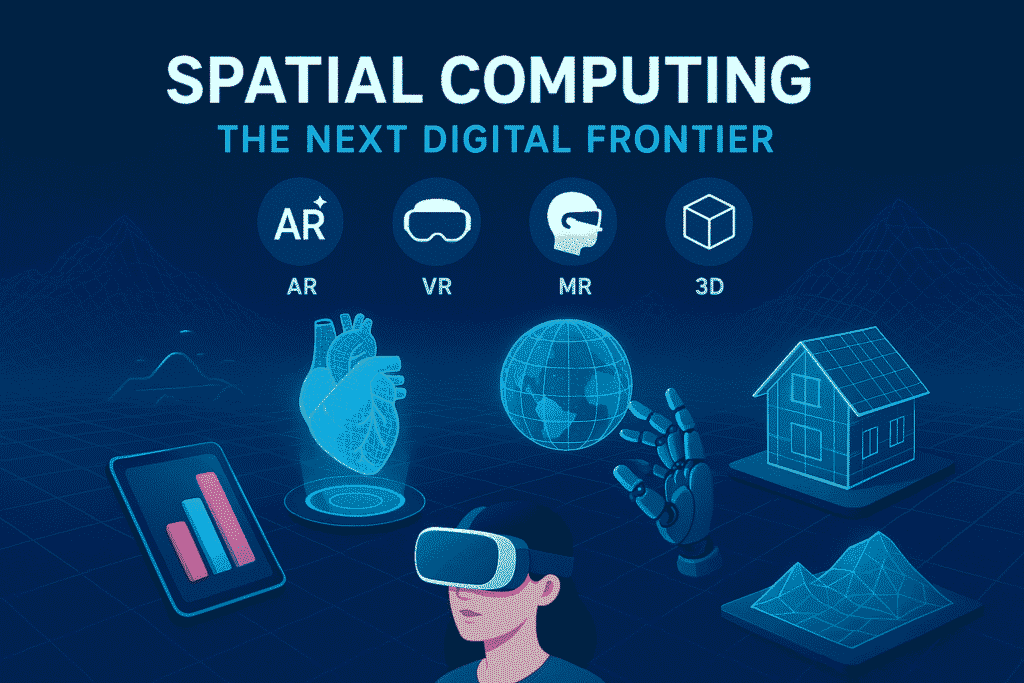
Spatial Computing in action: Augmented Reality glasses overlay critical digital information onto the physical world, enhancing human capability.
Introduction: Why the Spatial Web Matters
For decades, our interaction with the digital world has been confined to the 2D rectangle of a screen. We peer through this “window” to access information, connect with others, and conduct business. But a fundamental shift is underway, moving us from looking at the internet to being inside it. This is the promise of Spatial Computing—a technological paradigm that seamlessly blends the physical and digital worlds.
This matters because it represents the next major computing platform, following the mainframe, PC, and smartphone. It will redefine everything from how we work and learn to how we socialize and shop. Understanding Spatial Computing is no longer a niche interest for gamers and tech enthusiasts; it is crucial for business leaders, educators, and anyone who wants to comprehend the future trajectory of human-computer interaction. This article will serve as your comprehensive guide to this revolution, demystifying the concepts, exploring the mechanics, and forecasting its profound impact on our lives.
Background/Context: From Screens to Spaces
The journey to Spatial Computing has been a gradual evolution:
- The Command Line (1960s-80s): Pure text-based interaction.
- The Graphical User Interface – GUI (1980s-2000s): The “desktop” metaphor with windows, icons, and menus.
- The Mobile & Touch Revolution (2000s-2020s): Computing became personal, portable, and gesture-based.
- The Dawn of Spatial Computing (2020s+): We are now transitioning to an interface where digital content is mapped to our physical environment and interacted with in 3D space. The seeds were planted with the rise of VR headsets for gaming, AR filters on social media, and early industrial applications of digital twins.
This evolution is driven by advancements in processing power (GPUs), computer vision, AI, and connectivity (5G/6G), finally making it possible to render and anchor complex digital objects in real-time within our physical reality.
Key Concepts Defined
- Spatial Computing: A broad term for human-computer interaction where the machine retains and manipulates references to real-world objects and spaces. Essentially, it’s computing that understands the 3D space around you.
- Metaverse: A persistent, shared, and convergent virtual space that is a composite of the physical and digital realities. It’s often seen as the eventual manifestation of the spatial web—a 3D internet you can step into.
- Augmented Reality (AR): Overlays digital information onto the user’s view of the real world, enhancing it. (e.g., Pokémon Go, IKEA Place app).
- Virtual Reality (VR): Immerses the user in a fully digital, computer-generated environment, completely blocking out the physical world. (e.g., Meta Quest, HTC Vive).
- Mixed Reality (MR): A blend of AR and VR where physical and digital objects co-exist and interact in real-time. (e.g., Microsoft HoloLens).
- Digital Twin: A virtual, real-time replica of a physical object, process, or system. It’s used for simulation, analysis, and control.
- Web 3.0: The envisioned next generation of the internet, which is decentralized, user-owned, and often integrates with blockchain and spatial computing concepts.
How Spatial Computing Works: A Step-by-Step Technical Breakdown
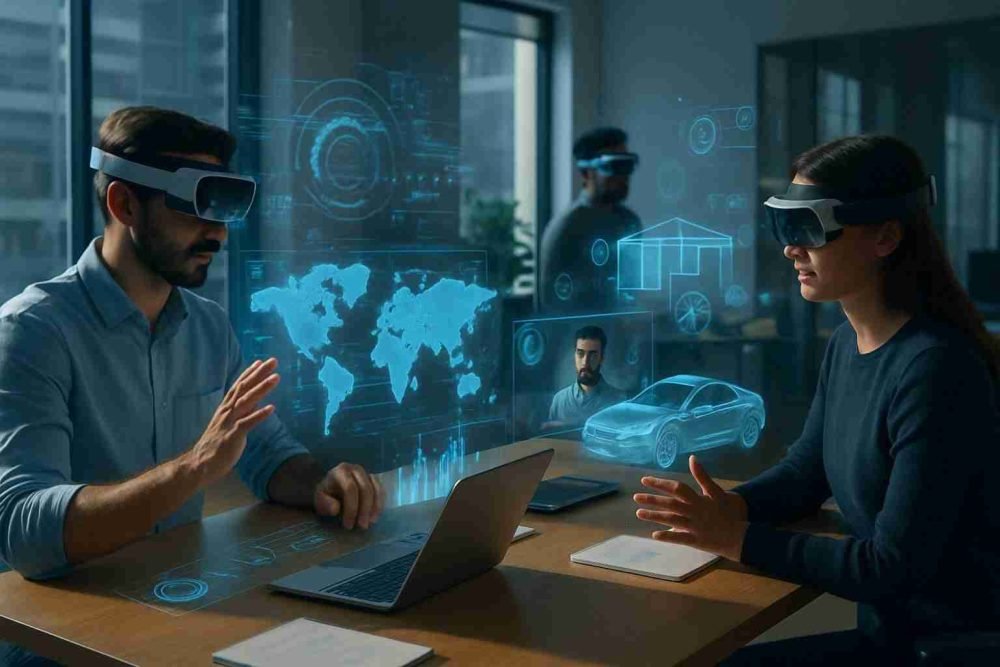
The magic of Spatial Computing happens through a complex, real-time orchestration of hardware and software.
Step 1: Spatial Mapping
The device (headset, glasses, or smartphone) uses a combination of cameras, LiDAR (Light Detection and Ranging), and depth sensors to scan the surrounding environment. It creates a precise 3D mesh or “point cloud” of the room, understanding the geometry, surfaces, and objects.
Step 2: World Locking & Tracking
Simultaneously, the device performs simultaneous localization and mapping (SLAM). It tracks its own position and orientation (6 degrees of freedom: X, Y, Z, pitch, roll, yaw) within the newly mapped space. This ensures that a digital object placed on a physical table will stay on that table even as you walk around it.
Step 3: Object Recognition & Semantic Understanding
AI and computer vision algorithms analyze the spatial map to identify and classify objects. It doesn’t just see a flat surface; it recognizes it as a “floor,” a vertical plane as a “wall,” and a smaller object as a “chair.” This allows for intelligent interaction (e.g., a virtual ball can bounce off the real floor).
Step 4: Rendering & Display
The system renders the digital content (3D models, user interfaces, avatars) from the correct perspective for the user’s viewpoint. For optical see-through AR (like glasses), this is projected onto lenses. For video see-through AR or VR, it’s composited onto a camera feed or displayed in a fully virtual environment.
Step 5: Interaction
Users interact with the digital content through various means:
- Hand Tracking: Using cameras to track finger and hand movements for natural gestures (pinching, grabbing).
- Voice Commands: Using natural language to control the environment.
- Controllers: Traditional handheld devices for precise input, common in VR.
- Eye Tracking: The system knows where you are looking, enabling gaze-based selection and more realistic social interactions with avatars.
Why It’s Important: The Transformative Impact
Spatial Computing is poised to revolutionize nearly every industry:
- Work & Collaboration: Imagine virtual meetings where you and your colleagues, as lifelike avatars, collaborate on a 3D model of a new product as if you were in the same room, regardless of your physical location. This can drastically reduce the need for business travel, optimizing Global Supply Chain Management for corporate operations.
- Education & Training: Medical students can practice complex surgeries on digital twin patients. Mechanics can learn to repair engines with step-by-step AR instructions overlaid onto the actual machinery.
- Retail & E-commerce: You can “try on” clothes virtually using your avatar or see how a new sofa would look in your actual living room at full scale, reducing returns and increasing consumer confidence.
- Industrial Design & Manufacturing: Engineers can design and iterate on products in a virtual 3D space long before committing to physical prototypes, saving millions. Factory managers can monitor a digital twin of their entire production line to identify bottlenecks in real-time.
- Healthcare: Surgeons can use AR to visualize a patient’s anatomy during an operation, overlaying CT scans directly onto the surgical site.
Common Misconceptions
- Myth: The Metaverse is just for gaming.
Reality: While gaming is a major driver, the most significant long-term applications are in enterprise, education, and social connection. It’s the future of remote work and the digital public square. - Myth: AR and VR will make us antisocial and disconnected from reality.
Reality: When designed responsibly, these technologies can enhance connection. They can bring families and friends together in shared virtual spaces when physical distance separates them, potentially supporting Psychological Wellbeing by combating isolation. - Myth: This technology is decades away from being practical.
Reality: It’s already here in industrial and enterprise settings. The consumer-facing technology is rapidly maturing, with major product releases from Apple, Meta, and others bringing it into the mainstream. - Myth: You need a bulky, expensive headset to experience it.
Reality: While high-end headsets offer the best experience, many AR applications run on the smartphone in your pocket. The hardware is becoming progressively smaller, lighter, and more affordable.
Recent Developments
- Apple Vision Pro: Apple’s entry into the spatial computing arena with a high-end “mixed reality” headset has legitimized the entire category, focusing on a “spatial computing” paradigm rather than just VR or AR.
- AI Acceleration: Generative AI is now being used to create 3D assets and environments for the metaverse instantly from text prompts, solving a major content creation bottleneck.
- Open Standards: The formation of the Metaverse Standards Forum, including companies like Meta, Microsoft, and Sony, aims to create interoperability so that your avatar and digital assets can move between different virtual platforms.
- Haptic Feedback Gloves: Companies are developing gloves that provide realistic touch sensations in virtual worlds, adding a critical layer of immersion.
Success Story: NVIDIA’s Omniverse
NVIDIA, a leader in graphics processing, has created the Omniverse—a platform for connecting 3D worlds into a shared virtual universe. It is essentially an operating system for building and operating metaverse applications.
- How it’s used: BMW used the Omniverse to build a full-factory digital twin of one of its plants. They simulated and optimized the entire production line in the virtual world before implementing changes in the physical factory, resulting in a 30% increase in production planning efficiency.
- The Lesson: This demonstrates that one of the most immediate and valuable applications of the metaverse is not for consumers, but for businesses using digital twins to solve complex, real-world engineering and logistics problems.
Real-Life Example: IKEA Place App
The IKEA Place app is a perfect example of accessible, consumer-facing AR. Users can select furniture from IKEA’s catalog and place true-to-scale 3D models in their own homes using their smartphone camera. This solves a real customer pain point—”Will this sofa fit and look good in my space?”—and has been shown to significantly increase customer confidence and conversion rates.
Sustainability of the Trend and Its Future
The Spatial Computing trend is sustainable for several reasons:
- Economic Driver: It is creating entirely new markets—from hardware and software to content creation and virtual real estate—driving massive investment and innovation.
- Solving Real Problems: It offers tangible solutions to global challenges like remote work efficiency, training scalability, and reducing physical waste through digital prototyping.
- Technological Convergence: It’s not a standalone technology but a convergence of AI, 5G/6G, blockchain, and advanced graphics, all of which are themselves rapidly advancing fields.
The Future (5-10 years out): We will move from headsets to sleek, everyday AR glasses that look like regular eyewear. The line between physical and digital will blur to the point of being indistinguishable. The “phygital” experience will be the default for shopping, navigation, and information retrieval. Your digital identity and assets, potentially managed through Web 3.0 principles, will be as important as your physical ones.
Conclusion & Key Takeaways
The Spatial Computing revolution is not a speculative fantasy; it is the next logical step in the evolution of the internet. It promises to make our interaction with technology more intuitive, immersive, and powerfully integrated into our daily lives.
Key Takeaways:
- It’s About Context: Spatial Computing understands the context of your environment, making digital information more relevant and accessible.
- Enterprise Leads, Consumer Follows: The most mature and valuable applications today are in business and industry, but consumer adoption is accelerating rapidly.
- Hardware is the Gateway: The evolution of comfortable, affordable, and powerful hardware (like AR glasses) is the key to mass adoption.
- Interoperability is the Challenge: The true potential of the metaverse will only be unlocked when we can move seamlessly between different virtual worlds with our identities and possessions intact.
- The Human is the Center: Despite the advanced technology, the goal remains to augment human capability, not replace it.
To stay at the forefront of such transformative trends, continuous learning is key. Explore more insights on our Technology & Innovation page and the wider Blogs section.
Frequently Asked Questions (FAQs)
1. What is the simplest way to experience Spatial Computing today?
Use the AR features on your smartphone. Apps like IKEA Place, Pokémon Go, or even social media filters (Snapchat, Instagram) are basic but widespread forms of AR.
2. Will Spatial Computing and the metaverse replace the current internet?
It will not replace it but rather evolve it. The 2D web will still exist for many tasks, but 3D, spatial experiences will become a dominant and parallel layer of the internet.
3. What is the role of blockchain and NFTs in the metaverse?
They can provide the infrastructure for true digital ownership. An NFT could represent a unique piece of virtual land, a avatar’s clothing, or a digital artwork that you truly own and can take across different metaverse platforms.
4. Are there any health concerns with using AR/VR headsets?
Some users experience eye strain, motion sickness (“cybersickness”), or disorientation, especially in VR. These are areas of active research and hardware improvement. Taking regular breaks is recommended.
5. How will this affect my personal privacy?
It raises significant privacy questions. These devices require extensive data about your environment and your behavior. Robust data privacy regulations and transparent company policies will be critical.
6. What’s the difference between the Metaverse and Web 3.0?
They are related but distinct. Web 3.0 is about who owns and controls the internet (decentralization, user ownership). The Metaverse is about the user experience of the internet (3D, immersive, spatial). They often converge in vision.
7. Can I make money in the metaverse?
Yes, through various means: creating and selling digital assets (clothes, art, experiences), trading virtual real estate, hosting paid events, or working as a metaverse developer or designer.
8. What skills will be in demand in a spatial computing world?
3D modeling and animation, game development (Unity, Unreal Engine), UX/UI design for 3D spaces, VR/AR software development, and digital ethics and governance.
9. How will this technology impact people with disabilities?
It has enormous potential for good. AR can provide real-time captions for the hearing impaired, VR can offer immersive experiences for those with mobility issues, and haptic tech can create new forms of communication.
10. Is any of this related to brain-computer interfaces?
In the long-term future, yes. The ultimate spatial interface may be direct neural input, bypassing screens and glasses altogether. Companies like Neuralink are exploring this, but it’s likely decades away from mainstream use.
11. What is the biggest barrier to mass adoption?
Currently, it’s the hardware. Headsets need to become cheaper, lighter, longer-lasting, and more socially acceptable to wear in public. The user experience also needs to be seamless.
12. How does this relate to AI?
AI is the brain behind spatial computing. It powers the computer vision for understanding the world, the natural language processing for voice commands, and the generative algorithms for creating content.
13. Will we have multiple metaverses or one unified one?
In the near future, we will have multiple, walled-garden metaverses (like different social networks today). The long-term goal for many is interoperability, creating a more unified “metaverse.”
14. Can I use this for personal finance visualization?
Absolutely. Imagine looking at your investment portfolio as an interactive 3D graph in your living room, or having an AR assistant help you visualize your budget and savings goals, making Personal Finance more intuitive.
15. What industries will be most disrupted?
Real estate, retail, education, entertainment, and remote work are at the forefront of this disruption.
16. How can a small business start preparing for this shift?
Start by experimenting with simple AR for marketing (e.g., a filter for your product). Think about how a 3D, interactive version of your product or service could provide more value to customers.
17. Is the technology ready for enterprise use?
Yes, absolutely. Companies like Microsoft (Hololens) and Magic Leap are already successfully deploying AR for training, remote assistance, and design in manufacturing, healthcare, and defense.
18. What is “phygital”?
A term blending “physical” and “digital,” referring to an experience that seamlessly integrates both realms, like using your phone to unlock a hidden AR experience at a museum exhibit.
19. How will social interactions change?
We will communicate through avatars with realistic body language and eye contact, making remote interaction feel more present and nuanced. This could redefine online community building, a topic we explore in our Nonprofit Hub.
20. Are there any environmental impacts?
Running powerful data centers for rendering complex virtual worlds consumes significant energy. The industry will need to prioritize renewable energy to ensure sustainable growth.
21. What was Google Glass, and how is it different from today’s AR glasses?
Google Glass was an early, limited precursor. It primarily displayed 2D notifications in a small field of view. Today’s AR glasses aim for a wide field of view with persistent, interactive 3D content locked into your environment.
22. Can I create my own virtual space?
Yes, with user-friendly creation tools becoming more accessible, individuals will be able to design and host their own virtual worlds for socializing, working, or showcasing creativity.
23. How does this impact global supply chains?
Digital twins allow for the simulation and optimization of entire supply chains, from warehouse logistics to global shipping routes, identifying inefficiencies and building resilience against disruptions.
24. Where can I learn more about the ethics of this technology?
Our About World Class Blogs page outlines our commitment to exploring the societal impact of technology. We recommend following academic research and think tanks focused on digital ethics.
25. I have a great idea for a spatial computing application. What should I do?
The ecosystem is still young! Start by learning the basic development tools. The world needs creative minds to shape this new frontier. For more inspiration on building future-focused projects, see our Our Focus page. If you have specific questions, feel free to Contact Us.