
Deterrence Theory in the 21st Century: Nuclear Weapons, Cybersecurity, and Space
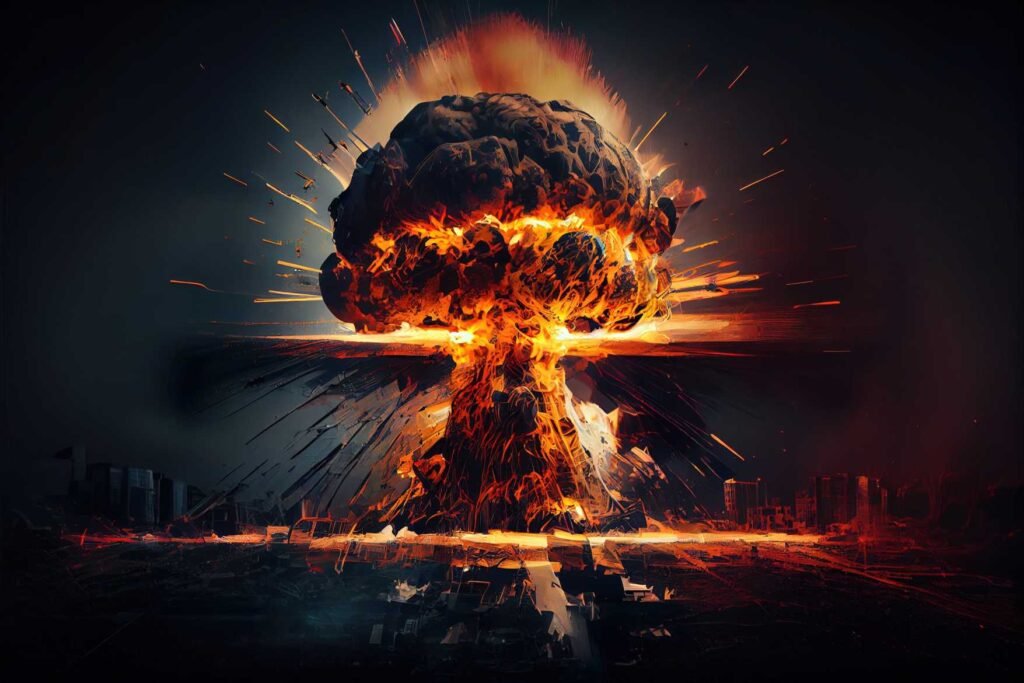
Modern deterrence must manage the risk of escalation across interconnected domains, where a conflict that starts in cyberspace could, through miscalculation, climb to catastrophic levels.
Deterrence Theory in the 21st Century: A Guide to Preventing War in a Multi-Domain, Multi-Nuclear World
Introduction – Why This Matters
Imagine a city. Its defense is a single, towering, impenetrable wall. For 50 years, the wall has held. But now, attackers have learned to tunnel underneath, fly drones over the top, and hack the gate’s locking mechanism. The wall remains formidable, but is it still enough? This is the dilemma facing deterrence theory—the foundational concept of the nuclear age—as it enters the 21st century. Born from the terrifying logic of Mutual Assured Destruction (MAD) during the Cold War, deterrence aimed to prevent war by making its cost unacceptably high. Today, the chessboard is exponentially more complex. The monolithic Soviet threat has fragmented into a landscape with multiple nuclear powers (Russia, China, North Korea), while non-nuclear threats like crippling cyber-attacks, swarming drones, and anti-satellite weapons challenge the very premises of traditional deterrence.
In my experience analyzing strategic stability, the most perilous assumption is that Cold War-era deterrence logic automatically applies to new technologies and new adversaries. What I’ve found is that we are navigating a period of “conceptual lag,” where our strategic doctrines have not yet caught up to the capabilities in play. For the curious beginner, understanding modern deterrence is key to grasping why nations act so cautiously yet provocatively. For the security professional, it’s an urgent intellectual overhaul. This guide will deconstruct deterrence, exploring how its timeless principles are being tested and transformed in the digital age, from the nuclear triad to the silicon chip. For a deeper dive into the technological drivers of this change, explore our section on Artificial Intelligence and Machine Learning.
Background / Context
Classical deterrence theory crystallized in the 1950s and 60s. Thinkers like Bernard Brodie, Thomas Schelling, and Herman Kahn developed their core tenets in the shadow of the hydrogen bomb. The bipolar U.S.-Soviet standoff created a (relatively) simple, if horrifying, paradigm:
- Rational Actors: Both sides were assumed to be rational, survival-seeking states.
- Second-Strike Capability: The goal was to ensure you could survive a first strike and retain the ability to retaliate with devastating force (the “secure second strike”). This led to the nuclear triad (bombers, ICBMs, submarines).
- Credibility: Your threat to retaliate had to be believable. This led to elaborate signaling, public declarations of policy, and costly investments in forces.
- Communication & Crisis Stability: The need to avoid accidental war led to the Moscow-Washington hotline and arms control treaties (SALT, START) to create predictability and reduce first-strike incentives.
The post-Cold War “unipolar moment” saw deterrence fade from central focus. The 2000s and 2010s were dominated by counter-insurgency and counter-terrorism, where deterrence against non-state actors proved largely ineffective (you can’t deter a suicide bomber with the threat of nuclear retaliation).
The return of great power competition and the proliferation of disruptive technologies has forced a dramatic reassessment. Russia and China have modernized their nuclear arsenals and developed sophisticated “non-nuclear strategic” capabilities. North Korea has become a de facto nuclear state. The battlefield has expanded to include cyberspace, where attacks can be anonymous and disproportionate, and space, where critical military and civilian infrastructure is vulnerable. The foundational question is: How do you deter an attack that doesn’t involve crossing a border with tanks, but instead involves turning off a city’s power grid from a keyboard halfway around the world?
Key Concepts Defined
- Deterrence by Punishment vs. Deterrence by Denial:
- Punishment: Threatening to inflict unacceptable costs in retaliation for an action. This is the classic nuclear model (“If you attack me, I will destroy your cities”).
- Denial: Threatening to make an adversary’s action fail or be futile (“If you try to seize this territory, my defenses will defeat your forces”). This is often associated with conventional and cyber defense.
- Strategic Stability: A condition where no state has an incentive to initiate a conflict, especially a nuclear conflict, because it fears a devastating response. Crisis stability is a subset, referring to stability during a tense confrontation where neither side feels pressured to strike first.
- First-Strike vs. Second-Strike Capability:
- First-Strike: The ability to destroy an adversary’s nuclear forces so completely that they cannot mount an effective retaliatory strike.
- Second-Strike: The assured ability to retaliate after absorbing a first strike. This is the bedrock of mutual deterrence.
- Escalation Dominance: The ability to control the rungs of the “escalation ladder”—to respond to an adversary’s action at a level of your choosing, forcing them to either back down or escalate to a level where you have the advantage.
- Cross-Domain Deterrence: The use of capabilities in one domain (e.g., cyber) to deter aggression in another (e.g., conventional). For example, threatening a cyber response to a conventional attack, or a conventional response to a severe cyber-attack.
- The Stability-Instability Paradox: The theory that mutual nuclear deterrence at the strategic level can make lower levels of conflict (conventional warfare, proxy wars, cyber conflict) more likely, as each side believes the other will not escalate to nuclear war over a limited provocation. This is seen vividly in Ukraine and Taiwan.
- Tailored Deterrence: The concept that deterrence threats must be customized to specific adversaries, accounting for their unique values, decision-making processes, and risk tolerance. Deterring North Korea is not the same as deterring China.
How It Works (Step-by-Step Breakdown): The Modern Deterrence Calculus
Deterrence is a psychological battle fought in the mind of an adversary. Let’s trace the calculus for a 21st-century aggressor, “State A,” considering a hybrid attack on “State B,” a NATO member.
Step 1: State A’s Objective & Desired Threshold
- Objective: Cripple State B’s military logistics by disrupting its power grid and communications for 72 hours, delaying a NATO exercise.
- Desired Threshold: Remain below the level of an “armed attack” to avoid triggering NATO’s Article 5. Use sophisticated cyber tools and cover tracks through a proxy hacking group.
Step 2: Assessing State B’s & NATO’s Deterrence Posture
State A’s leaders must evaluate:
- Attribution: Can State B/NATO quickly and credibly attribute the attack to us? (They have improved cyber forensics.)
- Response Doctrine: What has State B/NATO said they will do in response to a major cyber-attack? (NATO has declared cyberspace a domain of operations and that a severe cyber-attack could trigger Article 5.)
- Capabilities for Punishment: What retaliatory options do they have?
- Cyber: Potential for a disruptive counter-cyber strike against our infrastructure.
- Conventional: Could they impose sanctions, expel diplomats, or even launch a precision conventional strike on the server farm used in the attack?
- Nuclear: Is this remotely conceivable? (Extremely unlikely for a non-kinetic cyber-attack.)
- Capabilities for Denial: How resilient is State B’s grid? (They have invested in segmentation and backups; the attack may cause only limited, short-term disruption.)
- Credibility & Political Will: Does State B’s government have the domestic support for a strong response? Is NATO united, or are some members hesitant? (Recent statements show strong unity.)
Step 3: The Complex Cost-Benefit Analysis
State A must weigh:
- Benefit: Minor, temporary tactical delay of an exercise.
- Potential Costs:
- Attribution and Shaming: Public exposure, loss of diplomatic standing.
- Economic Retaliation: New, targeted sanctions on our tech sector.
- Military Retaliation: A tit-for-tat cyber-attack on our financial system, or a demonstration of force on our border.
- Alliance Strengthening: The attack could actually strengthen NATO cohesion and lead to increased defense spending and cyber cooperation, the opposite of our goal.
- Escalation Risk: While we think we’re below Article 5, could a miscalculation or a cascading effect of the cyber-attack (e.g., causing civilian deaths at a hospital) trigger an unpredictable, escalatory response?
Step 4: The Decision
In the Cold War, this was often a binary nuclear calculation. Now, it’s a multi-variable assessment of模糊性, risk, and proportionality. State A may conclude that the likelihood of a costly, attributable response is too high for the meager benefit, and deterrence holds. Or, they may calculate that NATO’s response will be weak and disjointed, and proceed, believing they have found a gap in the deterrence architecture.
This process highlights the new complexities: attribution challenges, the blurry line between war and peace, and the difficulty of crafting proportional, credible responses to non-kinetic attacks.
Why It’s Important: Preventing the Unthinkable in an Unstable World
Effective deterrence is not an academic exercise; it is the thin line preventing great power war and nuclear catastrophe in an increasingly volatile strategic environment.
- Managing Nuclear Risk in a Multipolar World: The Cold War was a two-player game. Now, there are at least nine nuclear-armed states, with different doctrines, command-and-control systems, and levels of crisis stability. A crisis between India and Pakistan could escalate without the stabilizing overlay of U.S.-Soviet control. Deterrence must now account for multilateral complexity.
- Preventing “Cyber Pearl Harbor” or “Below-Threshold” Conquest: If adversaries believe they can achieve major strategic gains through cyber or hybrid means without triggering a full-scale war, they will be incentivized to try. Robust cross-domain deterrence is essential to defend national sovereignty in the digital age.
- Securing the Global Commons: Space and cyberspace are vital for civilian and military life (GPS, communications, banking). Deterring attacks on satellites and networks is critical for global stability and economic function. An attack on a satellite could be an act of war, but the norms and responses are still undefined.
- Upholding Alliance Credibility: The credibility of extended deterrence—the U.S. nuclear umbrella over allies like Japan, South Korea, and NATO members—is the cornerstone of non-proliferation. If allies doubt that umbrella, they may seek their own nuclear weapons, triggering dangerous regional arms races. This principle of credible commitment is vital in any strategic context, much like in building successful business alliances.
- Informing Arms Control and Risk Reduction: Understanding modern deterrence dynamics is essential for negotiating new arms control agreements (or salvaging old ones like New START) and establishing “rules of the road” for behavior in space and cyberspace to reduce the risk of miscalculation.
Sustainability in the Future: The Search for Stable Deterrence
The future of deterrence hinges on adapting its principles to new realities without triggering an arms race or catastrophic miscalculation.
- Integrating New Domains into Strategic Thinking: Deterrence can no longer be siloed into “nuclear” and “conventional.” Integrated deterrence—seamlessly combining capabilities across all domains (nuclear, conventional, cyber, space, information) to convey a unified, credible threat—is the new paradigm being adopted by the U.S. and its allies.
- The Role of Defensive Denial: Investing in resilience and defense becomes a key component of deterrence. If an adversary knows your power grid can quickly recover from a cyber-attack or that your satellites are hardened and redundant, the incentive to attack diminishes. Deterrence by denial through resilience is becoming as important as deterrence by punishment.
- The AI and Hypersonic Challenge: Two technologies are particularly destabilizing.
- Hypersonic Glide Vehicles (HGVs) can evade traditional missile defenses and compress decision-making time for leaders, threatening crisis stability.
- Artificial Intelligence in command and control could speed up warfare beyond human comprehension or introduce new risks of accidental escalation if algorithms misperceive signals.
- Rebuilding Dialogue and Norms: The deterioration of U.S.-Russia and U.S.-China strategic dialogue is dangerous. Even in competition, channels are needed to communicate red lines, clarify intentions, and manage incidents. Establishing norms against attacking critical infrastructure, nuclear command-and-control systems, and civilian satellites is a pressing, if difficult, task.
Common Misconceptions
- Misconception 1: “Deterrence is all about having the biggest weapons.”
- Reality: It’s about credibility and communication. A smaller, survivable force with a clear, believable commitment to use it under specific conditions can be more deterrent than a larger, ambiguous one. It’s a psychological contest of will.
- Misconception 2: “Cyber deterrence doesn’t work because you can’t see it coming.”
- Reality: While attribution is hard, it is not impossible. Public attribution combined with imposition of costs (sanctions, indictments, retaliatory cyber operations) can deter. The key is to establish a track record of responding consistently to malign activity, raising the expected cost for the adversary.
- Misconception 3: “Mutual Assured Destruction (MAD) is an outdated, Cold War concept.”
- Reality: The underlying logic of MAD—that a secure second-strike capability prevents nuclear war—remains the grim foundation of strategic stability between the U.S. and Russia. It is not outdated; it is the inescapable reality of large, survivable nuclear arsenals. The challenge is applying deterrence logic beyond this nuclear bedrock.
- Misconception 4: “Deterrence guarantees peace.”
- Reality: Deterrence manages the risk of major war; it does not eliminate conflict. It can create a “stable” environment for lower-level competition and coercion (the stability-instability paradox). Deterrence can fail due to miscalculation, miscommunication, or irrational actors.
Recent Developments (2024-2025)
- The Demise of New START & The New Nuclear Era: With the last remaining U.S.-Russia nuclear arms control treaty (New START) effectively dormant since 2023, the world has entered an era of unconstrained nuclear competition for the first time since the 1970s. Both nations are deploying new, more advanced nuclear delivery systems (Russia’s Satan II ICBM, U.S.’s B-21 Raider bomber), and China is rapidly expanding its nuclear arsenal, aiming for parity.
- Russia’s “Escalate to De-escalate” Doctrine & Tactical Nukes: Russia has heavily invested in non-strategic (tactical) nuclear weapons and exercises their use. Their doctrine suggests they might use a limited nuclear strike on a battlefield to “de-escalate” a conflict they are losing conventionally, gambling that the West would not risk full nuclear war in response. This lowers the nuclear threshold and complicates deterrence.
- China’s “No First Use” (NFU) & Strategic Ambiguity: China maintains a declaratory policy of NFU but is modernizing its forces in ways that some analysts believe could support a first-strike capability (e.g., missile silos, hypersonics). The opacity surrounding its nuclear doctrine and expansion creates uncertainty, which can be destabilizing.
- The Militarization of Space: Multiple nations (U.S., Russia, China, India) have tested anti-satellite (ASAT) weapons. The U.S. Space Force and China’s PLA Strategic Support Force are organizing for potential conflict in space. Deterrence in space is nascent, focusing on resilience (proliferated satellite constellations) and the threat of cross-domain retaliation.
- The Cyber “Below the Threshold” Constant: 2024 saw continued aggressive cyber activity from state actors (Russian attacks on European water utilities, Chinese espionage against U.S. critical infrastructure). The line between espionage and pre-positioning for attack is blurred, creating a persistent “deterrence by persistent engagement” dynamic, where defenders actively contest adversary actions in cyberspace daily.
Success Stories (If Applicable)
- The Historical Success of Nuclear Deterrence: Despite close calls, nuclear weapons have not been used in conflict since 1945. This is the central, tragic success of nuclear deterrence. It created a powerful taboo and instilled a profound caution in leaders during crises (e.g., the Cuban Missile Crisis).
- U.S. Extended Deterrence in East Asia: For decades, the unambiguous U.S. security guarantee, backed by forward-deployed forces and the nuclear umbrella, has successfully deterred major conventional aggression against allies like Japan and South Korea. It has also been the key pillar preventing these capable allies from pursuing their own nuclear weapons programs, a cornerstone of the global non-proliferation regime.
Real-Life Examples
- Case Study: The 2022 Invasion of Ukraine & NATO’s Deterrence Failure/Success
- The Failure of General Deterrence: NATO’s pre-2022 deterrent posture failed to prevent Russia’s large-scale conventional invasion. Russia calculated that the West’s response would be limited to sanctions and light weapons, and that NATO would not directly intervene for a non-member. This was a catastrophic miscalculation of Western resolve, but it occurred outside NATO’s Article 5 guarantee.
- The Success of Immediate and Extended Deterrence: Since the invasion, NATO’s deterrence has been successful in its core mission: preventing the war from spilling into NATO territory. The enhanced forward presence, rapid reinforcement plans, and clear messaging have deterred Russian attacks on Poland, the Baltics, or Romania. It also demonstrates extended deterrence for a partner, as massive aid has enabled Ukraine to deny Russia its objectives.
- The Lesson: Deterrence is not a one-size-fits-all shield. It must be tailored, credible, and clearly communicated. General warnings may not suffice; specific capabilities and deployments in the right places are required.
- Case Study: The Stuxnet Cyber-Attack (2010)
- The Action: A sophisticated U.S.-Israeli cyber weapon (Stuxnet) physically destroyed Iranian nuclear centrifuges.
- The Deterrence Dynamic: This was deterrence by denial through offensive action. The goal was to deny Iran a nuclear weapons capability. It was also a demonstration of capability and resolve.
- The Unintended Consequence: It failed as a long-term deterrent. Iran cleaned its networks, arrested insiders, and accelerated its program. Moreover, it demonstrated the potential of cyber as a weapon, likely encouraging other nations to invest heavily in offensive cyber capabilities, potentially making the world less stable. It showed that cyber attacks can have limited, temporary deterrent effect and can spur arms-race dynamics.
Conclusion and Key Takeaways
Deterrence in the 21st century is no longer a monolithic theory but a complex, multi-domain practice under immense strain. The old verities of nuclear stability are being undermined by new weapons and new actors, while the frontiers of conflict in cyberspace and space lack established rules and reliable deterrent frameworks.
Key Takeaways:
- Deterrence is a Psychological, Not Just a Military, Contest. Success depends on convincingly communicating capability and resolve to a specific adversary’s decision-makers.
- The Domains of Deterrence Have Multiplied. Effective strategy must integrate nuclear, conventional, cyber, space, and informational tools into a coherent “integrated deterrence” posture.
- Attribution and Proportionality are the New Frontiers. The biggest challenges for deterring non-kinetic attacks are being able to quickly and credibly attribute them and then designing proportional, credible responses that deter without causing unwanted escalation.
- Resilience is a Form of Deterrence. Making critical infrastructure, military systems, and societies harder to disrupt (deterrence by denial) is as important as threatening retaliation (deterrence by punishment).
- Dialogue is a Deterrence Requirement. In a complex multi-actor environment, maintaining strategic dialogues—even with adversaries—to reduce misperception, clarify red lines, and manage crises is not appeasement; it is a vital component of preventing catastrophic miscalculation.
The task ahead is to rebuild a measure of strategic stability in a more crowded, technologically chaotic, and politically divided world. This will require intellectual innovation, diplomatic effort, and sustained investment to ensure that deterrence continues to prevent the war nobody can win.
FAQs (Frequently Asked Questions)
Q1: Can you deter a non-state actor like a terrorist group?
A: Traditional punishment-based deterrence is largely ineffective against non-state actors who lack a return address (territory, infrastructure) to hold at risk and whose members may welcome martyrdom. The primary tools become deterrence by denial (hardening targets, good intelligence) and dismantlement (capturing or killing leaders, disrupting financing).
Q2: What is “escalation control” and how does it differ from deterrence?
A: Deterrence is about preventing conflict from starting. Escalation control is about managing and limiting conflict once it has begun, to prevent it from spiraling to catastrophic levels (e.g., to nuclear war). They are two sides of the same coin.
Q3: How does missile defense affect deterrence?
A: It’s highly controversial. Proponents argue it strengthens deterrence by denial, protecting against limited strikes (e.g., from North Korea). Critics argue that large-scale defenses could undermine mutual deterrence by giving one side a potential first-strike advantage: if you think you can shoot down most of your enemy’s retaliatory missiles, you might be more tempted to strike first. This can trigger an arms race.
Q4: What is “nuclear ambiguity” (e.g., Israel’s policy)?
A: A deliberate policy of neither confirming nor denying possession of nuclear weapons. It is intended to create doubt in an adversary’s mind, forcing them to assume the worst and thus deterring attack. It is a form of deterrence that relies on uncertainty rather than explicit threat.
Q5: How does economic interdependence act as a deterrent?
A: It can create a powerful disincentive for conflict through the threat of mutual economic ruin. However, it is not foolproof. If an actor values a political/security objective (like territorial conquest) more than economic welfare, or if they believe they can weather the economic pain better than their adversary, interdependence may fail to deter.
Q6: What are “tripwire” forces?
A: Small military units deployed in a vulnerable location (e.g., NATO battlegroups in the Baltics). Their purpose is not to defeat an invasion alone but to guarantee that an attack will immediately involve and cause casualties among troops from multiple alliance members, thereby triggering a massive collective response. They make deterrence automatic and credible.
Q7: What is “launch on warning” (LOW)?
A: A nuclear command doctrine where a nation, upon receiving warning of an incoming enemy nuclear attack (from satellites and radars), launches its own retaliatory strike before the enemy warheads detonate. It is adopted to protect retaliatory forces from being destroyed in their silos. It is highly dangerous, as it relies on perfect warning and decision-making under extreme time pressure.
Q8: How do you deter attacks on undersea cables and pipelines?
A: A major 21st-century challenge. Deterrence combines: 1) Surveillance and Attribution: Increased naval and underwater drone patrols. 2) Resilience: Redundant cable routes. 3) Declaratory Policy: Publicly stating that such attacks on critical infrastructure will be met with a serious response. 4) Collective Action: NATO has established a Critical Undersea Infrastructure Protection cell.
Q9: What is the role of “strategic culture” in deterrence?
A: Crucial. An adversary’s history, values, and political system shape its risk tolerance and what it considers “unacceptable costs.” Western analysts often project their own rationality onto others. Understanding an adversary’s strategic culture—whether it views war as a continuation of politics or an existential struggle, for example—is essential for credible, tailored deterrence.
Q10: Can space be “sanctuary”?
A: The hope in the early space age was that space would remain a peaceful domain. That is now dead. With multiple ASAT tests, space is militarized. The goal of deterrence is not to make it a sanctuary but to prevent conflict from starting or escalating there, given our deep dependence on space systems.
Q11: What is “left-of-launch” deterrence?
A: A cyber/electronic warfare approach to missile deterrence. Instead of trying to shoot down a missile after it’s launched (“right-of-launch”), you use cyber attacks or jamming to disrupt its production, supply chain, or command system before it can be launched. It’s a form of preemptive denial.
Q12: How does domestic politics affect deterrence credibility?
A: Profoundly. An adversary will assess the strength of a leader’s domestic support. If a president or prime minister appears politically weak or constrained by public opinion from following through on threats, deterrence credibility plummets. Autocratic leaders often perceive democratic publics as weak and unwilling to sustain costs, which can lead to dangerous miscalculation.
Q13: What is the “security dilemma”?
A: A situation where actions taken by one state to increase its own security (e.g., building up military forces, deploying missile defenses) are perceived as threatening by another state, which then responds by building up its own forces, leading to an arms race and decreased security for all. It is a major obstacle to stable deterrence.
Q14: How is AI changing deterrence calculations?
A: AI could enable faster, more effective decision-support and target identification. However, it risks algorithmic escalation: if two sides’ AI systems interact in a crisis at machine speed, they could escalate based on misperceived patterns without human intervention. Ensuring human control and building “guardrails” into military AI is a critical deterrence stability issue.
Q15: What are “counterforce” and “countervalue” targeting?
A: Counterforce targets are an enemy’s military capabilities (missile silos, command bunkers, military bases). Countervalue targets are cities and industrial centers. Counterforce strategies are often seen as more “war-fighting” and potentially destabilizing, as they threaten an adversary’s ability to retaliate, creating first-strike pressure. Countervalue is the pure punishment model of MAD.
Q16: How does the private sector fit into cyber deterrence?
A: As owners and operators of most critical infrastructure, private companies are on the front lines. Public-private partnership is essential. The government can provide threat intelligence and a framework for retaliation, while companies must implement robust defenses (deterrence by denial). Their resilience is a national security asset.
Q17: What is “deterrence by delegation”?
A: When a major power extends its deterrent threat to protect an ally (e.g., the U.S. nuclear umbrella over Japan). It involves convincing an adversary that an attack on the ally will be treated as an attack on the major power itself. This is the cornerstone of alliance systems like NATO.
Q18: Can you have deterrence without conflict?
A: Yes, that is the ideal state. Deterrence is successful when conflict does not occur because the potential aggressor was dissuaded. We only see deterrence failures. Its successes are invisible—the wars that never happened.
Q19: What is the role of wargaming in deterrence?
A: Essential. Wargaming allows planners to test deterrence scenarios, explore an adversary’s potential decision paths, and identify vulnerabilities in their own posture. It helps refine strategies and communication plans before a real crisis.
Q20: How does climate change impact deterrence?
A: As a threat multiplier, it can increase competition for resources and trigger instability and migration, creating new flashpoints for conflict. It can also threaten military infrastructure (bases, ports), affecting force posture. Deterrence strategies must account for these indirect, systemic risks. For more, see our guide on climate security.
Q21: Is “Brinkmanship” a deterrence strategy?
A: It is a high-risk tactic that involves deliberately pushing a crisis to the edge of war to force an adversary to back down. It relies on appearing more risk-acceptant and committed than your opponent (e.g., the Cuban Missile Crisis). It can strengthen deterrence credibility if successful but carries an extreme risk of catastrophic failure.
Q22: What is the “nuclear football”?
A: The briefcase carried by a U.S. military aide that contains the codes and communication equipment allowing the President to authorize a nuclear strike. It is a physical symbol of the authority and immense responsibility inherent in nuclear deterrence.
Q23: How do you deter the use of chemical or biological weapons?
A: Through a clear declaratory policy of massive and disproportionate response. Following the 2013 chemical attacks in Syria, a “red line” was crossed but the response was initially weak, potentially undermining deterrence. The 2017/2018 strikes reinforced it. The threat is typically conventional or nuclear retaliation, as these weapons are considered weapons of mass destruction.
Q24: What is the future of arms control in deterrence?
A: In deep crisis. With the demise of the INF Treaty and New START, there are no active agreements limiting U.S. and Russian nuclear forces. The future may see less comprehensive treaties and more focused, risk-reduction measures: agreements on notification of missile launches, re-establishing communication links, and norms of behavior in new domains like cyber and space.
Q25: Where can I learn more about credible, modern deterrence strategies?
A: Follow the work of think tanks like the Carnegie Endowment’s Nuclear Policy Program, the Center for Strategic and International Studies (CSIS), and the Royal United Services Institute (RUSI). Official documents like the U.S. Nuclear Posture Review and National Defense Strategy outline current thinking.
About Author
Sana Ullah Kakar is a strategic analyst specializing in deterrence theory, nuclear policy, and the impact of emerging technologies on international security. Having contributed to wargaming exercises and policy dialogues, they focus on translating complex strategic concepts into clear frameworks for understanding contemporary threats. They believe that in an age of complexity, the fundamentals of deterrence are more important than ever to prevent catastrophe. This rigorous examination is part of World Class Blogs’ dedication to providing expert-level analysis on critical global affairs. Explore our broader mission on our Our Focus page.
Free Resources

- The Nuclear Threat Initiative (NTI) Website: Excellent resources on nuclear security and deterrence.
- “The Strategy of Conflict” by Thomas Schelling: The classic, foundational text on deterrence theory.
- CSIS “Integrated Deterrence” Project: Contemporary analysis on the new U.S. approach.
- “The Wizards of Armageddon” by Fred Kaplan: A fascinating history of the thinkers who built nuclear strategy.
- Stanford’s “Center for International Security and Cooperation (CISAC)”: Leading academic research on deterrence and disarmament.
- For insights on the strategic planning and risk assessment necessary in any complex field, consider resources like this guide on starting an online business in 2026.
Discussion
The ethics of existential risk: Is the possession of nuclear weapons, and the doctrine of threatening mass civilian annihilation to deter war, morally justifiable? Can a stable, peaceful world order ever be built on such a horrific threat? Or is nuclear deterrence an unfortunate but necessary evil in an anarchic international system? We welcome your philosophical and practical perspectives. Join deeper conversations on our platform in the blogs section. To engage directly, contact us.